Revenue has quadrupled, with a loss of 2 billion yuan, Zhipu AI has not yet proven itself.
Zhipu is one of the most high-profile large model companies on the Hong Kong Stock Exchange in 2026. After its share price dropped by 60% from the trillion-yuan peak, it released its first semi-annual report after listing. Its revenue skyrocketed nearly 4 times, while losses continued to widen.
According to the financial report, in the first half of 2026, Zhipu recorded a revenue of 950 million yuan, representing a year-on-year increase of 399.7%.
While revenue is growing rapidly, Zhipu is still not close to profitability. Its net loss decreased from 2.36 billion yuan to 2.07 billion yuan; after excluding items such as equity incentives and book value changes of financial instruments, the adjusted net loss expanded from 1.75 billion yuan to 1.96 billion yuan; operating loss also expanded to 2.15 billion yuan.
A more notable change lies in the revenue structure. Zhipu, which used to generate revenue mainly from localized projects, has become a company that charges primarily based on model call volume this year. Its open platform and API revenue reached 830 million yuan, a year-on-year increase of more than 27 times, accounting for 86.5% of total revenue. The API revenue for just half a year has exceeded Zhipu's total annual revenue in 2025. The gross margin of API rose from -0.4% in the same period last year to 24.6%.
At the performance meeting after the financial report was released, the management disclosed that by the end of August, the ARR of Zhipu's MaaS platform had reached 1.6 billion US dollars, a 60% increase from the 1 billion US dollars in early July. Its calculation method multiplies the revenue of August by 12.
Back-calculated based on this caliber, Zhipu's single-month revenue in August is about 130 million US dollars, equivalent to about 900 million yuan, which is close to the total revenue of the first half of this year. It proves that Zhipu's API business is still accelerating recently, but whether this growth rate can be maintained needs follow-up verification.
The market pays attention to this set of annualized revenue data because Zhipu's high valuation needs to be supported by rapid commercialization growth. When it listed in January this year, Zhipu's issue price was HK$116.2. By June 22, its share price once rose to HK$2980 during intraday trading, with a market cap exceeding HK$1 trillion. In the following two months, the share price fell by about 60% from the peak. On August 31, Zhipu closed at HK$1195, which is still more than ten times the issue price, with a market cap of HK$556.4 billion.
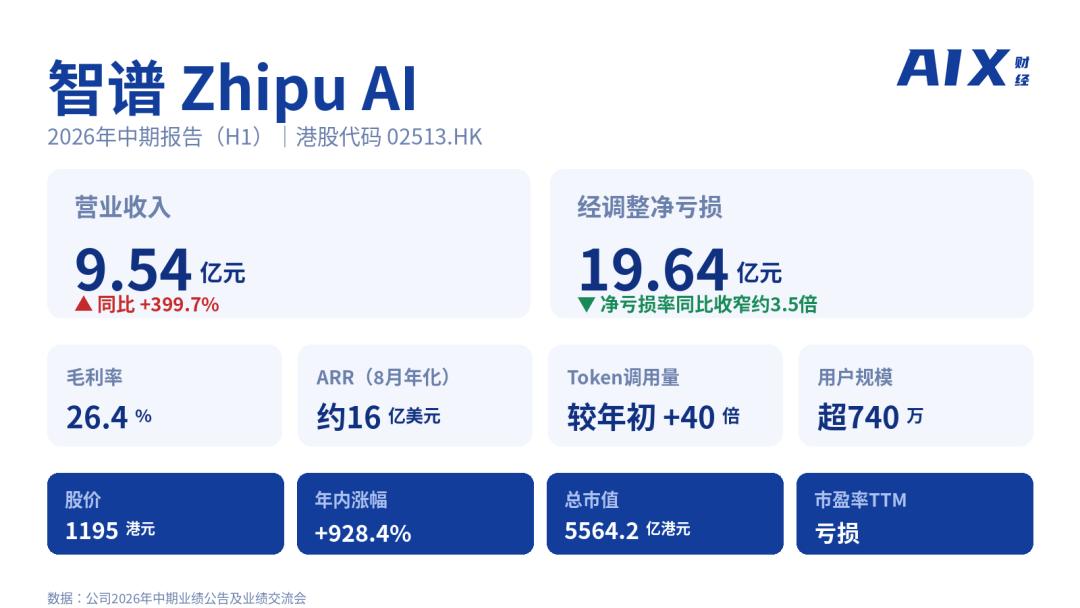
The market values not only Zhipu's model capabilities, but also whether the call volume in scenarios such as Coding can be converted into large-scale revenue to cover computing power and R&D investment.
This semi-annual report shows that model calls have been able to generate large-scale revenue, and API has begun to contribute gross profit; but the continued expansion of adjusted loss and operating loss indicates that the scale effect at the corporate level has not yet appeared. Two points need to be focused on next: Can API revenue growth continue? How far is Zhipu from profitability?
01. Coding Made API the Core Business
In the first half of this year, Zhipu's localized deployment business is shrinking, and almost all new revenue comes from APIs.
Localized deployment accounted for 84.8% of Zhipu's revenue in the same period last year, while its revenue in the first half of this year dropped to 130 million yuan, down 20.5% year-on-year, and its proportion fell to 13.5%.
In the same period, the new revenue of the API business is about 800 million yuan, exceeding the company's overall revenue increment of about 760 million yuan. The reduced revenue from businesses such as localized deployment is also covered by the growth of API.
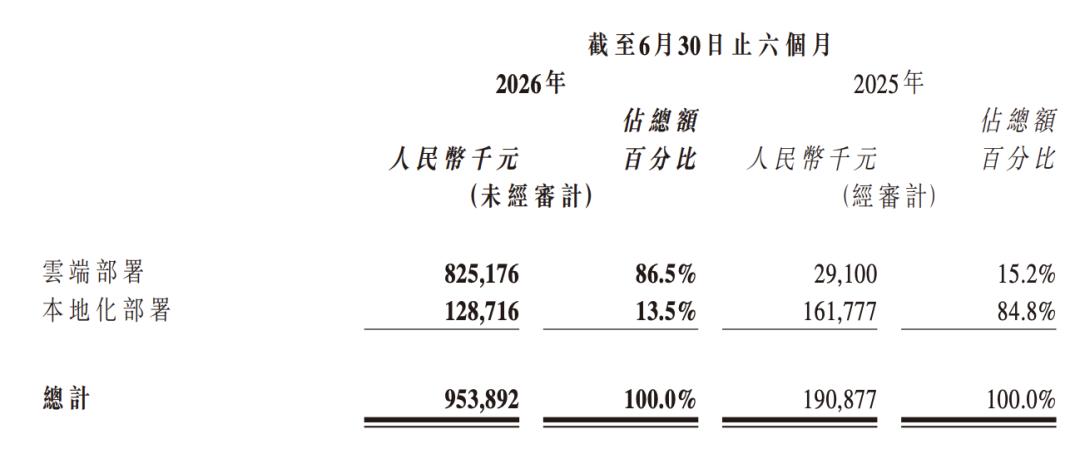
Zhipu's revenue structure, Source / Zhipu 2026 Semi-Annual Report
APIs and localized projects adopt different delivery methods.
The financial report divides the company's business into open platform and API, enterprise-level agents, enterprise-level general large models, and technical services. According to the actual delivery method, they can be summarized into two categories: one is to provide models on the cloud, where developers and enterprises access Zhipu's platform and pay according to call volume or packages. The other is to deploy models and agents to customers' own servers or private clouds, and Zhipu charges for software authorization and project delivery.
In the past, Zhipu mainly focused on localized projects. This type of business requires repeated deployment and delivery for different customers, and the revenue scale is limited by the number of customers and delivery capabilities. APIs allow a large number of enterprises and developers to call the same set of models and pay according to the call volume.
Zhipu is in the middle of the large model industry chain. Upstream are chips, cloud services and data centers. Zhipu purchases computing power to complete model training and inference; downstream are developers, enterprise customers and various AI applications. For a model company with huge upfront investment, the more customers and tasks there are, the more R&D and computing power investment can be spread over more calls.
APIs are easier to scale up, but this still cannot explain why revenue has accelerated in recent months. In the semi-annual report and the conference call, the management repeatedly mentioned one scenario: Coding.
Chatbots usually only need to answer a few questions. Programming tools face longer tasks: the model needs to read code, find problems, modify files, call tools, and then continue to adjust according to the running results. One task may go through multiple rounds of calls, consuming far more Tokens than ordinary Q&A.
Coding turns large models from low-frequency Q&A tools into production tools that continuously call models. Tang Jie, chief scientist of Zhipu, attributed the commercial value of models to two factors at the conference call: how difficult the tasks the model can complete, and how many tasks actually occur. Coding meets both conditions at the same time: the task value is higher, and the execution process will also generate a large number of calls.
The improvement of model capabilities further boosts the call volume. Zhipu launched GLM-5.2 in mid-June, focusing on improving Coding and long-range task capabilities. The financial report also attributes the growth of API revenue to the improved ability of the model to handle high-value tasks and the increase in the average daily Token call volume of users.
By the end of August, the Token call volume of Zhipu's MaaS platform increased by more than 40 times compared with the beginning of the year, and the average daily call volume of the top ten users calculated by revenue increased by 98 times. The former indicates that the call scale of the platform is expanding, while the latter indicates that the usage depth of head customers has increased.
In the same period, the average selling price of Zhipu's API increased by about 101% compared with the beginning of the year, and the subscription price of Coding Plan was also raised.
The increase in average selling price here does not mean that the public quotation has doubled. Model tiers, task types, customer structure and price adjustments may all change the average selling price. What can be confirmed is that Zhipu's call volume and average selling price have increased at the same time, and this round of growth did not rely on price cuts to increase usage.
The existing data already shows that Coding demand is rising, but whether it can be maintained for a long time depends on customer retention and revenue concentration.
MiniMax's revenue structure is also tilting towards the model platform. In the first half of this year, its revenue from platforms and enterprise services (accounting for 63.4%) exceeded that of consumer products (accounting for 36.6%). Whether they were previously more focused on enterprise services or consumer applications, independent large model companies have begun to take model calls as the focus of revenue growth.
For Zhipu, model calls have begun to bring revenue. The next thing to watch is how much computing power cost it takes to complete one task, and how much gross profit can be retained in the end.
02. Are Models Sold More, Is Zhipu More Profitable?
According to Zhipu's current API gross margin, for every 1 yuan of call revenue obtained, about 0.25 yuan can be retained after deducting direct costs such as computing power and services.
This 0.25 yuan has not yet deducted model R&D, sales and management expenses. Zhipu has crossed the threshold of positive API gross margin, but the 24.6% gross margin is still not enough to cover the R&D and operating expenses of the entire company.
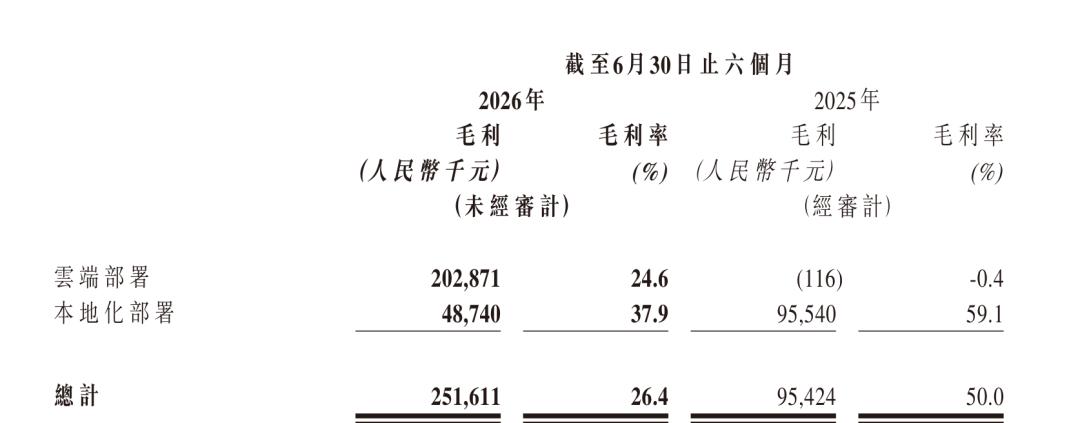
Zhipu's business gross margin, Source / Zhipu 2026 Semi-Annual Report
The financial report attributes the positive API gross margin to the expansion of call scale, pricing adjustment and the decline of inference cost.
The cost side mainly depends on inference efficiency. Zhipu disclosed that the inference cost per unit Token decreased by 80% compared with the beginning of the year; for every 1 yuan of computing power invested, including training and inference, the corresponding open platform and API revenue increased by about 14 times year-on-year. The company also stated that it has achieved low-cost inference on the scale of 100,000-level domestic chips.
The future trend of API gross margin depends on which type of models the new calls come from. GLM-5.3-Flash launched in August is priced at about one-tenth of GLM-5.3, which is mainly for high-frequency, cost-sensitive calls. Low-cost models can expand the Token scale, and will also change the revenue structure of APIs. To make these new calls contribute more gross profit, cost reduction needs to keep up with changes in prices and product structure.
The decline in inference cost per unit Token does not mean that the total computing power expenditure is reduced. As the call volume expands, the company still needs to purchase more computing services. In the first half of this year, Zhipu's sales cost increased to about 700 million yuan, a year-on-year increase of 635.7%, and the main increment came from computing services.
Zhipu's current changes can be summarized as: the cost of processing each unit of Token has decreased significantly, while the total cost generated by all calls is still increasing rapidly.
Although the API gross margin has turned positive, Zhipu's comprehensive gross margin has dropped from 50% to 26.4%, mainly due to changes in the revenue structure.
Localized projects, which used to account for the majority of revenue, include more software authorization revenue with relatively high gross margins. This year, APIs with lower gross margins have become the main business; the gross margin of localized deployment has also dropped from 59.1% to 37.9%, both dragging down the comprehensive gross margin.
Zhipu's net loss in the first half of the year decreased by about 290 million yuan year-on-year, which is not entirely due to its main business. In the same period, the book loss generated by financial instruments decreased from 430 million yuan to 22.09 million yuan, a reduction of about 410 million yuan. After excluding factors such as equity incentives and book value changes of financial instruments, Zhipu's adjusted net loss still expanded to 1.96 billion yuan, and operating loss is also increasing.
One important reason for the expansion of adjusted loss is the continued growth of R&D expenditure. In the first half of this year, Zhipu's R&D expenditure reached 2.13 billion yuan, which is 2.2 times the revenue of the same period and more than 8 times the total gross profit.
In terms of increment, Zhipu's new gross profit is about 160 million yuan, while R&D expenditure increased by about 540 million yuan. The newly added gross profit is less than 30% of the newly added R&D investment.
In the first half of last year, every 1 yuan of revenue corresponded to about 9.2 yuan of adjusted loss; this figure dropped to about 2.1 yuan in the first half of this year. Converted to every 1 yuan of revenue, the loss burden has decreased significantly. In terms of absolute amount, the adjusted loss still increased by about 210 million yuan.
Compared with peers, Zhipu and MiniMax both recorded adjusted net losses of about 290 million US dollars in the first half of the year. With similar adjusted losses, Zhipu has higher revenue and comprehensive gross margin. Zhipu's revenue in the same period was about 140 million US dollars, while MiniMax's was 120 million US dollars; Zhipu's comprehensive gross margin was 26.4%, and MiniMax's was 17.9%.
However, MiniMax has consumer products, and more than 60% of its revenue comes from markets outside mainland China; Zhipu's revenue is highly concentrated in APIs. This comparison can only illustrate the input-output situation of the two companies in the first half of the year, and cannot represent which of all their businesses is more competitive.
At the end of June, Zhipu held cash of 3.99 billion yuan. At the same time, of the approximately HK$4.9 billion net raised funds obtained from the company's listing, HK$4.59 billion had been used for the intended purpose by the end of June, accounting for more than 93%. This part of the funds includes expenditures on investment projects such as R&D and commercialization.
In July, Zhipu completed another placement with a total placement amount of about HK$31.41 billion. This sum of money has greatly supplemented the company's capital reserve; in the long run, Zhipu still needs to prove that the gross profit generated by APIs can gradually cover R&D and computing power investment.
03. Conclusion
In the past two years, the large model industry competed on model capabilities, ranking on leaderboards and parameter scale. Now that API revenue has started to grow, model companies still have to answer a more realistic question: Can model capabilities really become a sustainable profitable business?
In this round of Zhipu's API growth, Coding is the first scenario that stands out. Next, whether professional tasks such as cybersecurity and data analysis can follow up will determine whether this round of growth is an outbreak in a few scenarios, or can be extended to more industries.
Several indicators in the next financial report are worth paying attention to: whether the API gross margin can continue to increase, and whether the adjusted loss can start to narrow. For Zhipu, whether selling more models can make the company truly lose less money is the sign of the emergence of scale effect.
* The cover image is from Zhipu's WeChat official account.
This article is from the WeChat official account "AIX Finance", author: Jin Yufan, editor: Wei Jia, published with authorization from 36Kr.