Victoria's Secret, which is experiencing explosive sales boom once again, is abandoning its true self.
Victoria's Secret, which was once widely believed to be completely out of the game, is staging a remarkable comeback.
The moment Victoria's Secret is mentioned, men will raise the corners of their mouths while women will feel awkward, and people even need to summon up the courage to step into its stores. It has long been a byword for "body anxiety generator".
Modern women will no longer yield to any external pressure: if a brand makes them uncomfortable, they just stop buying its products. Since women are the ones paying the bills, the brand should know exactly who it needs to cater to.
But data is more honest than any public statement.
During the 618 shopping festival in 2026, the top spot of GMV in the underwear category on Tmall did not go to Ubras which made its name with "one-size-fits-all" products, nor to Bananain whose annual GMV was close to 7 billion yuan. It went to a brand that was considered totally obsolete only a few years ago — Victoria's Secret.
In fiscal year 2026, Victoria's Secret China recorded a revenue of 2.799 billion Hong Kong dollars (about 2.4 billion yuan), representing a 42.4% year-on-year growth, and its net profit reached 525 million Hong Kong dollars, up 513% year on year. Back in fiscal year 2020, the brand still posted a loss of 669 million Hong Kong dollars.
It only took the brand six years to turn from a total loss of more than 600 million yuan to a net profit of 500 million yuan.
The brand is also recovering globally. In the first quarter of fiscal year 2026, Victoria's Secret's net sales rose 15% year on year to 1.56 billion US dollars, with a net profit of 48 million US dollars, compared with a loss of 4 million US dollars in the same period of last year. After the financial report was released, its stock price surged by more than 47% in a single trading day.
How did this "once-fading giant" that had been written off for years manage to stage a comeback?
Victoria's Secret's comeback relies on three key moves
Victoria's Secret finally understands that only by listening to the market can it survive and thrive.
Thus, it started to completely revamp itself.
The first key move is to slash prices.
This international premium brand that used to be out of reach for most consumers has finally become accessible. Previously, the price of its core products was between 600 and 800 yuan, meaning one piece of its underwear cost as much as a double meal in an upscale restaurant. At that time, the price of one one-size-fits-all underwear from Ubras or Bananain was only a little over 100 yuan. With the price gap being 3 to 5 times, consumers voted with their feet.
Coupled with the world-famous Victoria's Secret Fashion Show, the angel wings and supermodel figures on the T stage pushed the brand's premium image to the extreme. In public perception, Victoria's Secret was an unattractive entry-level luxury brand.
Everything changed in January 2022. Victoria's Secret sold 49% stake of its China business to Regina Miracle, a Hong Kong-based underwear manufacturer, for 45 million US dollars. As one of the world's largest high-end underwear manufacturers, Regina Miracle has long been an OEM for Nike and Lululemon, and has deep expertise in fabric and production technology. Victoria's Secret holds 51% stake in the joint venture, but the local team is given full control over product development and supply chain operations.
In plain terms, the business is handed over to people who know the Chinese market better.
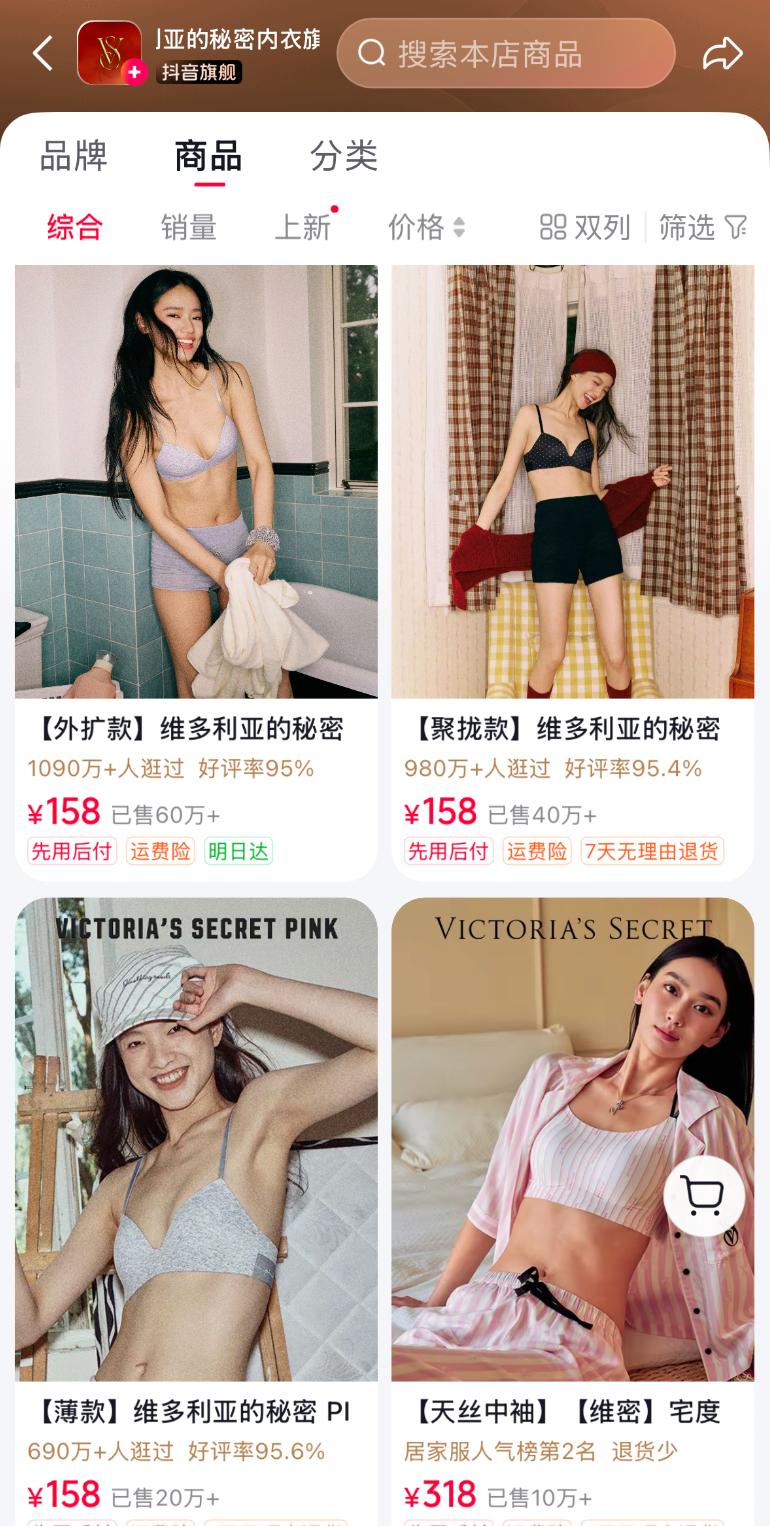
The first thing Regina Miracle did after taking over was to cut prices. It retained high-priced product lines for offline stores, and developed affordable product lines specifically for online channels. With additional discounts and livestream red envelopes, the actual price of one bra can be as low as just over 100 yuan. According to the check on Tmall flagship store by AI Blue Media, the PINK series camisole bra is priced at 158 yuan, and the "anti-gravity" series same as Yang Mi's pick can be obtained for just over 100 yuan in livestream rooms.
"It's unbelievable that I can buy a Victoria's Secret product for only over 100 yuan, which was totally unthinkable before," said Xiaotong, a consumer who stayed up late to watch livestream shows, to AI Blue Media.
At the same price of just over 100 yuan, consumers will naturally choose a world-famous big brand instead of a rising local domestic brand. The brand value is intangible most of the time, but once the price is adjusted to the same level as local brands, it becomes the sharpest competitive edge.
The effect is immediate. The anti-gravity bra same as Yang Mi's pick shows "over 100,000 units sold" on Tmall. During the 618 shopping festival in 2026, one tencel soft pajama sold in Li Jiaqi's livestream room recorded 120,000 units sold within 4 and a half minutes, and was sold out immediately.
Victoria's Secret proved one thing: consumers do not reject big brands, they just think the previous price of big brands was unreasonably high.
The second key move is to tear off the "sexy" label and redefine products.
What did Victoria's Secret's underwear look like in the past? Fancy lace, thick sponge cups, hard underwires and Western-style cuts. Wearing those products felt like taking part in an underwear beauty pageant, not living a daily life.
Worse still, the "sexy" concept of early Victoria's Secret was obviously designed to cater to men. The wings, high heels and charming looks on the T stage were essentially a carefully arranged visual feast, which was completely out of line with the daily commuting and home life demands of Asian women.
Many consumers put the products away after wearing them once because they felt extremely uncomfortable. A large number of consumers even felt embarrassed to wear those products out, considering they belonged to the "intimate novelty" category, totally different from daily underwear.
Now Victoria's Secret has completely changed.
The most intuitive change is the "softness" of products. The old-style bras were like armors: hard underwires pressed against the chest, thick sponge made users sweat, and straps left red marks on the skin. All its core product lines now adopt a user-friendly design: the "anti-gravity" series uses soft jelly strips to replace underwires, which offers support without squeezing the body; the "jelly strip" series even cancels the hook design, so users can put it on and go out directly.
In short, the brand's concept has shifted from "wearing for others" to "wearing for your own comfort". The products are comfortable while still keeping the beauty, and the nice figure line is retained, but no longer at the cost of comfort.
The shift of the brand's attitude is also remarkable.
In October 2025, the Victoria's Secret Fashion Show, which had been suspended for years, returned in New York, but the models on the T stage were totally different. Jasmine Tookes, who was 9 months pregnant, opened the show, and plus-size models, transgender models walked the stage alongside slim supermodels. In the early years, Victoria's Secret became famous for its "angel wings" and "perfect figure" standards, but was later criticized for "creating body anxiety", making consumers who did not have a supermodel figure feel unqualified to wear Victoria's Secret.
Now, Victoria's Secret no longer claims that "only one type of figure is beautiful", but advocates that "all types of figures can be beautiful".
The brand also renewed its spokesperson lineup, shifting from T-stage supermodels like He Sui and Ming Xi, to popular celebrities like Zhou Dongyu, Yang Mi, Eileen Gu and Yang Zhenzhen, and then to post-00s artist Shan Yichun.
Selecting Zhou Dongyu as the spokesperson is a landmark event. With a typical flat-chested figure, she would never be considered by Victoria's Secret ten years ago, but now she is the brand's official spokesperson. This move clearly conveys a message to all consumers: you do not need to have a supermodel figure to wear Victoria's Secret.
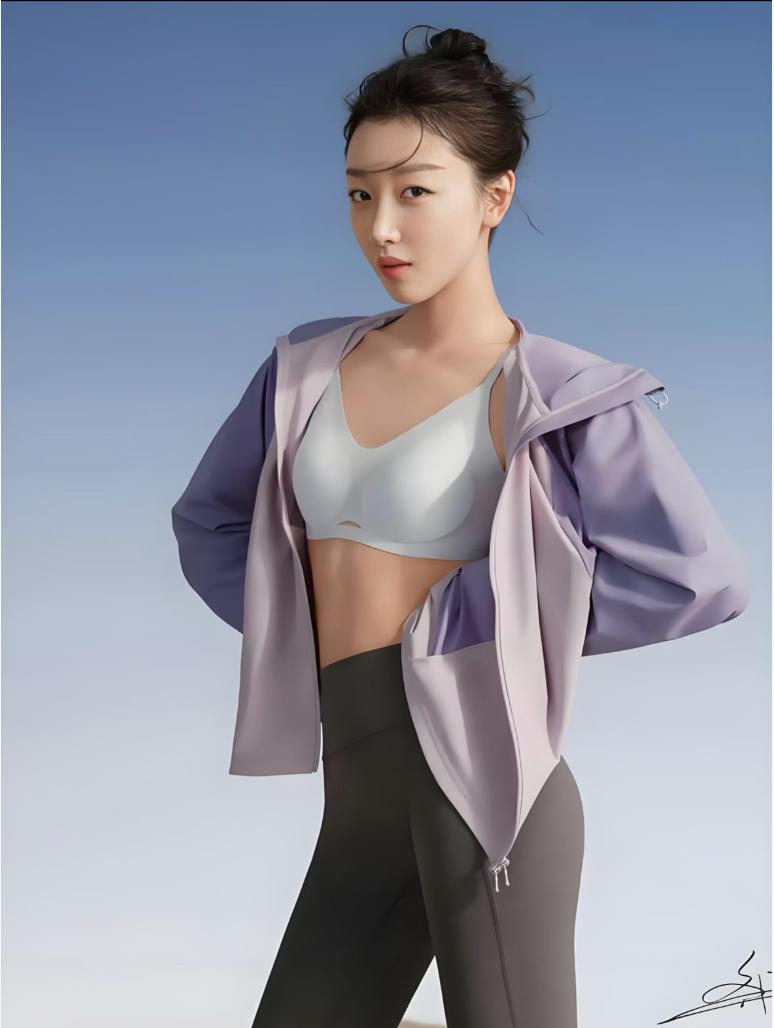
The definition of "sexy" has been reshaped: being intellectual, powerful, confident and relaxed are all different forms of sexy.
The third key move is to close large physical stores, and develop smaller and more refined outlets.
The brand no longer pursues large store area, but focuses on improving sales per square meter. It took Victoria's Secret three years to complete the transformation from "large and all-inclusive" to "small and refined", with the store area reduced from 1500 square meters to 300-400 square meters. At present, it has 58 offline stores, and the number will rise to around 70 by the end of the year.
From a total loss of over 600 million yuan to a net profit of over 500 million yuan, Victoria's Secret proved a simple truth in six years: no matter how big a brand is, it cannot go against the market.
Price reduction is a double-edged sword, and Victoria's Secret is hurting itself
There is no doubt that price reduction is the top contributor to Victoria's Secret China's turnaround.
But price reduction is sweet in the short term, but toxic in the long run.
Consumers rush to buy Victoria's Secret products priced at just over 100 yuan. 120,000 pieces of pajamas were sold in Li Jiaqi's livestream room within 4 and a half minutes, and the sales volume of Yang Mi's anti-gravity product exceeded 100,000 units. These figures look extremely impressive, so impressive that people ignore a key question: when Victoria's Secret positions itself as "Ubras with a logo", what essential difference does it have from Ubras?
It is easy to cut down the price, but extremely difficult to raise it back. Brand premium takes decades to build, but can be destroyed by several rounds of promotional campaigns. Once consumers get used to the "100-yuan Victoria's Secret" price level, they will ask you: why should I pay 600 yuan for one of your products?
Worse still, when the price goes down, the product quality also declines.
One white-collar consumer told AI Blue Media: "The box was broken when the product was delivered, and the fabric pilled after only one wash. I never expected a big brand could have such poor quality."
According to the check on Victoria's Secret's official flagship store by AI Blue Media, the number of complaints is rising obviously. Complaints about bras with plastic odor, silk pajamas that fade after two washes, and "second-hand bras" with serious deformation received after exchange are emerging. The amount of each complaint is not high, only 100 yuan or 300 yuan, but they cause huge damage to the brand's reputation.
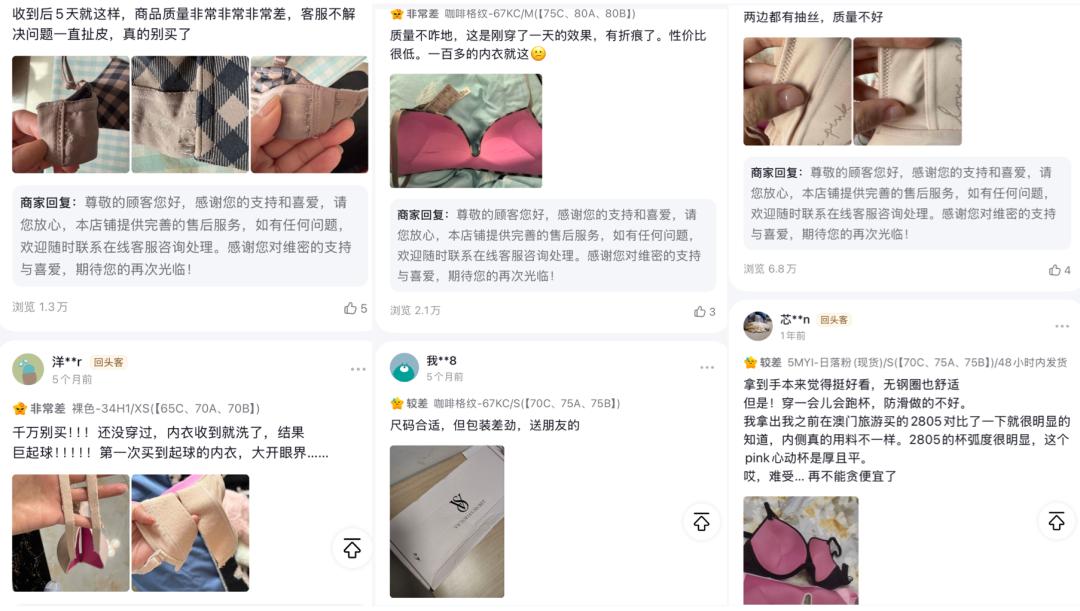
Victoria's Secret products used to be expensive, but consumers believed the high price was justified by delicate lace and perfect tailoring. Now the price is cut down, if the quality also drops, the most valuable asset of Victoria's Secret will disappear completely.
Consumers are not stupid. They feel they get a bargain when they buy a Victoria's Secret product at over 100 yuan for the first time, but find the product deforms and pilled after three wears. The next time they see the brand name Victoria's Secret, what comes to their mind is no longer "sexy", but "just so so".
Once the brand tonality slides from entry-level luxury to mass market, it is almost impossible to move back to the high-end track. H&M once launched premium product lines, and UNIQLO also rolled out designer collaborations, but no mass market brand has ever successfully returned to the luxury tier by launching several high-priced products. The path is one-way: once you go down, you can never go back up.
Cheng Weixiong, independent analyst of fashion industry and founder of Shanghai Liangqi Brand Management Co., Ltd., told AI Blue Media: "Victoria's Secret is following the 'selling brand label' model of Nanjing E-commerce, which brings short-term popularity but lacks long-term brand value building. Without clear brand tonality, continuously overdrafting brand value is a slow suicide that erodes brand reputation."
Besides, Victoria's Secret faces a deeper hidden risk: over-reliance on Regina Miracle.
Regina Miracle started as an OEM, and its strength lies in low-cost large-scale production, not maintaining the quality standard of a luxury brand. During the joint venture deal in 2022, Victoria's Secret gave full control of product and supply chain to Regina Miracle, with the clear goal of reducing cost, improving efficiency and getting close to the mass market. The goal is achieved, but the side effects are emerging now.
According to the financial report of Regina Miracle for the first half of fiscal year 2026, the revenue of traditional intimate underwear shrank by 6.6%, and the revenue of consumer electronics accessories dropped by half. Without the investment income from Victoria's Secret China, the 114.3% net profit growth would never be achieved. Regina Miracle has pinned its profit growth on Victoria's Secret China, while the growth of Victoria's Secret China highly relies on price reduction to boost sales volume.
This is a mutually binding structure: the more you cut price, the more you need to boost sales volume, the more you rely on the supply chain efficiency of Regina Miracle; but the extreme pursuit of supply chain efficiency usually means compromise on quality standards.
One party is the brand owner that needs to maintain brand tonality, the other party is the OEM and joint operation party that needs to ensure profit. When their interests align, everything goes smoothly, but what happens when their interests diverge? The "defective products bought at over 100 yuan" on complaint platforms are exactly the manifestation of this conflict among consumers.
Victoria's Secret spent six years proving that "you can survive if you follow the market demand", but it now faces a more difficult question: when the market has got used to the idea that your products are only worth 100 yuan, how can you ever move back to the high-end market?