Cracks have emerged in Wall Street's "AI eats software" thesis.
Over the past year, most US-listed software stocks have been weighed down by widespread concerns about the AI substitution effect.
The mainstream market logic back then was: as employees use AI tools to significantly boost their output, enterprises will inevitably downsize their workforce, and further reduce the purchase of software subscription accounts (i.e., "seats"). At the same time, the rise of "Vibe coding" has greatly lowered the cost and threshold for developing customized software.
These widespread expectations on Wall Street once jointly formed the pessimistic narrative that "AI is eating traditional software", and even the claim that "SaaS (Software as a Service) is dead" was rampant...
However, this bearish argument on the software industry has recently shown cracks quietly, leading many investors to start wondering: whether the most brutal sell-off phase has come to an end.
Last week, after Salesforce, the weathervane of the software industry, released an extremely strong earnings report, the year-to-date return of iShares S&P North American Tech-Software ETF (IGV) has rebounded from negative to positive.
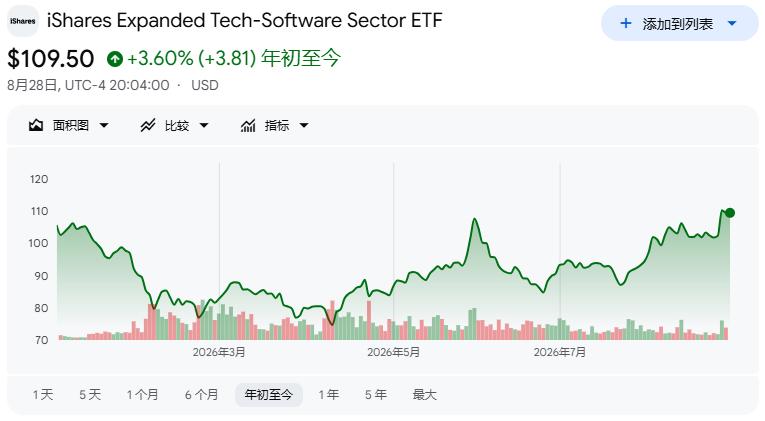
The earnings report shows that Salesforce's Q2 revenue and earnings both beat Wall Street expectations, and its full-year guidance was also raised simultaneously. The particularly eye-catching part in the report is that the company's current remaining performance obligation (cRPO) surged 14% year-on-year; the net new annual order value even hit a new high in four years. Boosted by this strong performance, Salesforce's share price skyrocketed 22.6% in a single trading day last Thursday.
"Everyone originally thought our subscriptions would decrease. But the opposite is true, sales, services and Slack business of Agentforce all achieved year-on-year growth," Marc Benioff, CEO of Salesforce, said bluntly on the earnings call.
Michael Monaghan, Partner and Portfolio Manager at Founder ETFs, pointed out optimistically that Salesforce's latest report card has positively answered the "life-or-death question" hanging over the company — this not only means that Salesforce has not lost users, but on the contrary, as customers are eager to access the most cutting-edge technologies, it has driven the trend of upgrading to premium packages.
"We are not surprised by this at all," Monaghan said in an interview. Even during the trough in March this year when software stocks were hit hard, he firmly believed that the sector would usher in a strong AI-driven recovery in the following months.
"It was clear as early as March that these companies would deliver very strong performance in the second half of the year. Salesforce's latest earnings report may be the first strong verification of this," Monaghan said. "The claim that AI can eliminate packaged software just through Vibe coding... simply does not hold water."
Multiple Bright Spots
In addition to Salesforce, Workday's share price also rose sharply by 5.8% last Friday, after the company announced that its latest quarterly subscription revenue exceeded market expectations. The company's management also disclosed that Workday's annual recurring revenue from autonomous AI products has approached 600 million US dollars, further increasing from 500 million US dollars in the previous quarter.
Other software stocks, such as CrowdStrike Holdings and ServiceNow, also rose sharply over the past week. As AI cybersecurity threats drive demand for its Falcon platform, CrowdStrike delivered the "best quarterly performance in history". ServiceNow, similar to Salesforce, is increasingly regarded as an authoritative repository of customer data, which is difficult for artificial intelligence to replicate.
Nicholas Frasse, Product Manager of VanEck Thematic ETF, said that although some companies may be replaced by cutting-edge labs, "I don't think all SaaS companies should be lumped together. Deeply rooted enterprises like Salesforce have very unique proprietary datasets, which make them more competitive in this new era and may also become the biggest beneficiaries of this technology."
It is worth noting that US-listed software stocks have experienced a rather fierce rebound in the past few months. Although many market participants said that these gains largely stemmed from the drastic sell-off of chip stocks, prompting investors to switch to the software sector, some experts believe that this round of rebound may have stronger sustainability.
"Investors and the market have begun to pick up signals from the noise," Frasse said. "Everyone has begun to make more precise choices based on the specific business model of each company, instead of blindly trading the entire sector indiscriminately as in the past."
Jordan Klein, tactical strategist at Mizuho, is relatively rational at present. He said in last Friday's research report that the core controversy and suspense in the market now lies in: how long this "carnival of pouring into software stocks" can last before institutional positions are fully allocated or buying momentum is exhausted.
Klein believes that this latest surge in software stocks is more driven by institutional investors' "position game" rather than some subversive new change in fundamentals. Many hedge funds and long-only growth fund managers previously allocated a far lower proportion of their portfolios to software stocks than the sector's weight in the overall market — this is not only due to concerns about AI threats, but also because they regarded software stocks as a "cash withdrawal" target to cash out and increase their positions in hot tracks such as semiconductors and AI hardware.
But based on the widespread underweight of software stocks across the market, Klein expects this round of rebound in the software sector to last until September or even October.
He is optimistic that Salesforce's share price will continue to rise before the Dreamforce conference next month, but he also made it clear that he will not "chase the rally" of this stock at the current high level, but prefers to deploy other high-quality targets such as ServiceNow and Microsoft.
This article is from WeChat Official Account "Kechuang Daily", author: Xiaoxiang, published by 36Kr with authorization.