The fierce rivalry between China Overseas and Poly will make for a thrilling show this year.
A major event took place shortly before off work last Friday.
On August 28, multiple government authorities including the Ministry of Housing and Urban-Rural Development, the People's Bank of China, the State Administration of Financial Regulation, and the China Securities Regulatory Commission rolled out policies simultaneously, bringing the 30-year-old commercial housing pre-sale system to major reforms. To put it plainly, the policies require the vigorous and orderly advancement of existing-home sales, with a series of supporting policies for the financial and capital markets. All these measures point to the core of the new development model for the real estate sector: the commercial housing sales system.
Western Securities described this as "supply-side structural system restructuring" rather than "short-term strong demand-side stimulus"; while Guotai Haitong stated that the industry's competition focus will completely shift from "scrambling for scale and speed" to "striving for better products, quality and delivery performance".
None of these descriptions are straightforward enough. In the final analysis, it all boils down to capital strength. In the future, only developers that can afford to build completed properties with real money will be qualified to participate in the market.
What does this imply? The report released by CRIC on August 31 once again provided further annotation.
Among the top 20 real estate developers by equity sales from January to August, 17 are central SOEs and local state-owned enterprises. This is hardly surprising, as state-owned enterprises still form the absolute mainstay of the market. All the top 5 players are central SOEs, with year-on-year growth rate exceeding 10%, while the market share of developers of other ownership types keeps being squeezed.
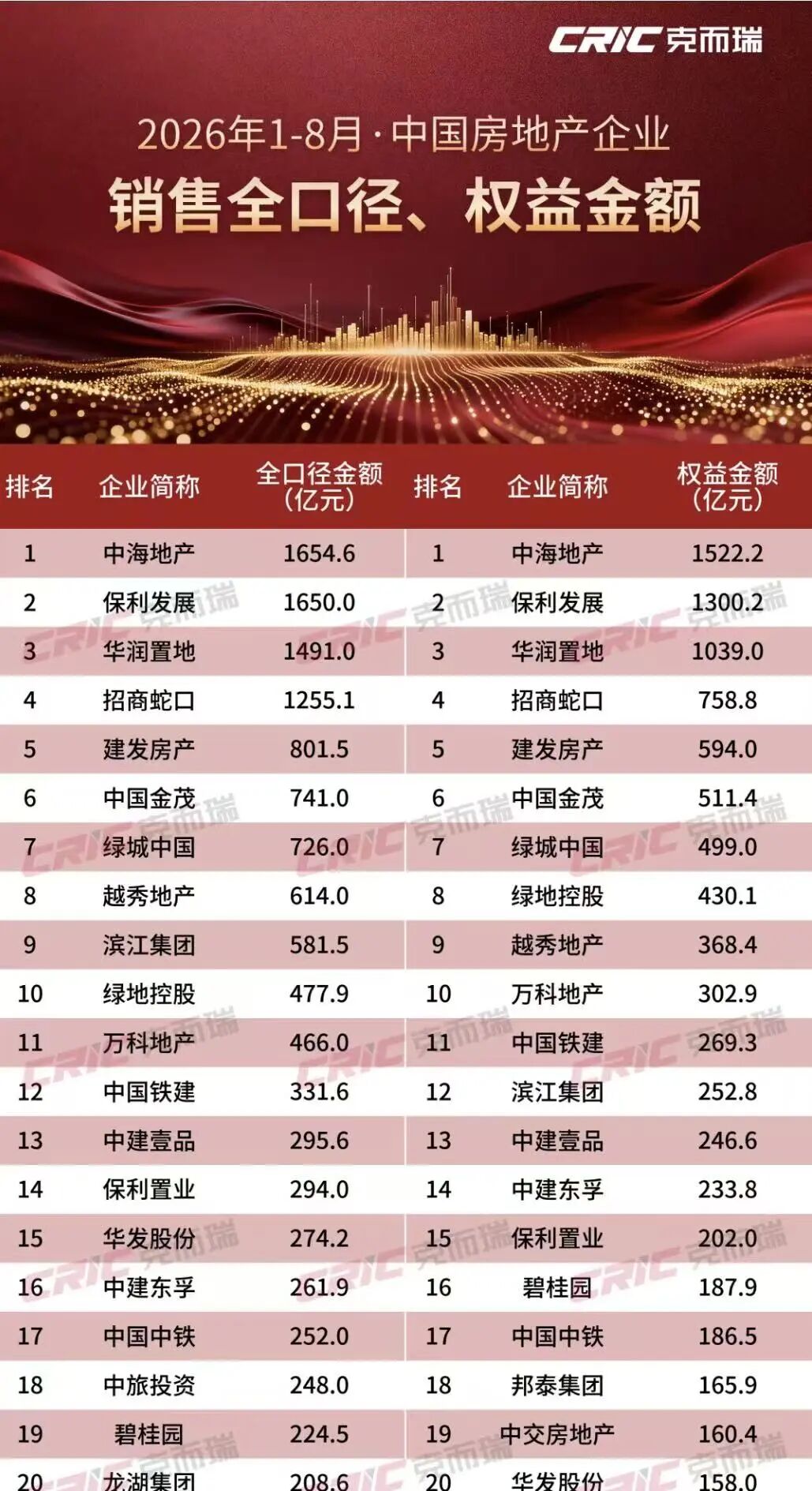
Who will dominate the future property market? The answer is self-evident. The new 828 real estate policy just reiterated this point: the market will be dominated by state-owned enterprises, especially central SOEs.
From the perspective of onlookers, the most exciting drama among central SOEs this year is the head-to-head competition between China Overseas Land & Investment (COLI) and Poly Real Estate.
Let's start with a "historic moment".
In the first half of this year, Poly Real Estate recorded a full-caliber sales (contracted amount) of 135.1 billion yuan, while COLI hit 134.35 billion yuan, meaning Poly edged out COLI by less than 800 million yuan. From January to July, Poly's full-caliber sales reached 150 billion yuan, compared with COLI's 149.46 billion yuan, narrowing the gap to only 540 million yuan.
Then from January to August, COLI overtook Poly, recording 165.46 billion yuan against Poly's 165 billion yuan, leading by 460 million yuan. In terms of equity sales amount, COLI leads Poly by 22.2 billion yuan. If my memory serves me correctly, this is the first time in many years that COLI has achieved a substantial overtake of Poly in full-caliber sales revenue.
It would be totally unfair to say that Poly has not been working hard. In the first half of this year, sales in core cities contributed 95% of Poly's total revenue, with first-tier and second-tier cities accounting for 86% of its total, bringing in 111 billion yuan of recovered funds.
But COLI performed even more impressively. In the first half of the year, it generated 78.99 billion yuan of sales in the five first-tier cities of Beijing, Shanghai, Guangzhou, Shenzhen and Hong Kong, accounting for 68.6% of the group's total sales revenue, far exceeding the proportion of Poly's sales in first-tier cities.
What will the annual ranking look like? Let's take a look at the available housing supply in the second half of the year.
Yan Jianguo, Chairman of the COLI Board of Directors, stated at the mid-term performance meeting on August 26 that in the second half of the year, multiple large-scale projects will be launched in the five first-tier cities, especially Shanghai, Beijing and Hong Kong. The Anlan Shanghai project alone has a total property value of over 52 billion yuan. According to institutional estimates, COLI will launch properties worth around 100 billion yuan in Shanghai alone in the second half of this year.
By the way, Yan Jianguo will turn 60 years old in September this year. Some industry insiders joked that he wants to make a final push to take the first place before retirement. This statement does make some sense.
Therefore, the competition is not limited to the first three quarters. Some institutions estimate that at the current growth rate, COLI is very likely to overtake Poly in full-caliber annual sales for the whole year of 2026.
What Yan Jianguo is aiming for is not just the 2026 ranking, which is mainly reflected in COLI's aggressive land acquisition moves.
In the first half of the year, the company added 9 new land parcels with an equity land price of 7.66 billion yuan, which was quite restrained. But after July, it went full steam ahead. In Beijing, it successively acquired three core land parcels in Jiuxianqiao, Guangqu Road and Liuniangfu within 15 days, spending over 15.5 billion yuan. It also acquired 9 new land parcels in cities including Shenzhen, Hong Kong, Taiyuan and Ningbo, with an equity land price of 25.68 billion yuan.
On August 31, at the first Shanghai land auction after the 828 new policy, COLI won the "mega" land parcel in Zhenru, Putuo District at the reserve price of 15.019 billion yuan. This is the land parcel with the highest starting total price in Shanghai this year, covering an area of nearly 12 hectares, with a plot ratio-regulated construction area of nearly 400,000 square meters, and a planned 220-meter landmark tower to be built on it.
Please note that COLI was the only bidder for this land parcel. While other developers were still waiting for detailed rules, calculating costs and observing the market trend, hesitating whether to make a move, COLI directly put down 15 billion yuan.
As of the release date of its interim report, COLI's total equity land price of new land acquisitions this year has reached 33.34 billion yuan, with Hong Kong, Beijing, Shanghai, Guangzhou and Shenzhen accounting for 79% of the total. Adding the 15 billion yuan for the Shanghai land parcel, the total amount reaches 48.3 billion yuan. Yan Jianguo said COLI's full-year target for new land acquisitions this year is 80 billion to 100 billion yuan. This means that the company has only completed about half of its annual plan, and it is very likely to make large-scale land acquisitions in the fourth quarter.
There is no doubt that capital strength lies behind all these moves. As of mid-2026, COLI's cash on hand stood at 121.1 billion yuan, with a net debt ratio of 27.2% and an average financing cost of only 2.76%.
Of course, Poly has not been idle either. It added 21 new projects in the first half of this year, with a total land acquisition amount of 38.4 billion yuan, and its investment intensity in the five cities of Beijing, Shanghai, Guangzhou, Shenzhen and Hangzhou accounted for 81% of the total.
If we have to differentiate the strategies of these two central SOEs, Poly adopts a "wide coverage" approach, fully expanding its presence in first-tier and strong second-tier cities; while COLI takes a "deep penetration" strategy, with its proportion of business in the five first-tier cities far exceeding that of Poly.
Although the current real estate developer rankings are not as widely followed as before, when we narrow the scope down to central SOEs, the "battle" between COLI and Poly is still quite worth watching.
Although COLI's financing cost is relatively lower, Poly still has a chance to win. Poly's national layout is more balanced, giving it stronger ability to resist regional risks. However, the subtle point is that after the 828 new policy, the importance of first-tier cities has become even more prominent. The developer with more property value reserves will be more qualified to fight a protracted war. From this perspective, COLI has taken the first-mover advantage on the main battlefield of first-tier cities for the time being.
But it is certain that no matter who finally "wins" the top spot in the ranking, the gap between the two will be very small. Perhaps the two companies themselves do not care much about who ranks first, it is just the onlookers that are more enthusiastic about the competition.
This article is from the WeChat Official Account "Youke Real Estate", written by Youke, and authorized for release by 36Kr.