The peak season highlights Meituan's solid fundamental capabilities, and it will still take some time to realize full recovery.
On the evening of August 28, Meituan released its performance report for the second quarter of 2026.
During the reporting period, Meituan recorded total operating revenue of 104.643 billion yuan, representing a year-on-year increase of 14.4%. Among this figure, revenue from its core local commerce segment, which primarily covers food delivery & instant on-demand shopping and in-store & travel services, rose 10.1% year on year; revenue from new businesses including Xiaoxiang Supermarket and overseas operations increased 25% year on year.
What has drawn the most market attention is that Meituan successfully turned its operating profit positive in the second quarter, and its instant retail business has returned to healthy growth.
According to Meituan's disclosure, the turnaround of operating profit from loss is mainly attributed to the positive UE of the food delivery business, that is, the positive unit economic profit per order. This figure excites some investors, while others begin to make linear extrapolation based on it, believing that Meituan's profit recovery will continue to accelerate in the future.
Admittedly, taking the lead in achieving profitability after the food delivery war is a direct manifestation of Meituan's refined operation capability and business moat. However, it should also be recognized that the recovery after the food delivery war cannot be accomplished overnight. The rapid improvement of Meituan's profitability in this quarter benefits not only from its own operational advantages, but also from the boost of "favorable timing".
01
Peak Season of UE Amplifies Meituan's Core Competence
Even in the stage with good operation performance, food delivery is only a low-margin business with a profit margin of about 3% calculated on the GTV basis.
At the macro level, the profit of food delivery depends on the balance between the platform's monetization revenue and distribution cost, operating expenses and subsidy expenses; at the micro level, for each individual order, the profit is the result of continuous optimization of multiple indicators such as order amount, distribution efficiency, user insight and precise subsidy.
A tiny change in each indicator, multiplied by the huge order volume, may lead to a qualitative change in the total profit. This is exactly the core reason why Meituan can deepen and refine its layout in the food delivery sector and build its business moat.
Objectively speaking, if consumers have strong willingness to consume, which can bring sufficient high-value orders, and external conditions such as weather are favorable for riders to deliver goods, the platform can not only increase the revenue per order, but also reduce relevant subsidy expenses.
The second quarter usually has the conditions to form such an operating environment, so it has become the peak season for the UE of the food delivery business.
The second quarter is at the turn of spring and summer, with generally friendly weather conditions. On the one hand, consumers' demand for food delivery usually starts to pick up from Q2, and high-unit-price dine-in orders increase accordingly; on the other hand, the suitable temperature and climate also help to improve the distribution efficiency of riders, so the platform can correspondingly reduce subsidies for bad weather and high temperature.
These changes seem small, but they act on a single order at the same time. For the food delivery business with a profit margin of only a few percentage points, a little more revenue on the income side and a little less cost on the cost side will add up to a significant improvement in UE.
However, the peak season will not create advantages out of thin air, it will only amplify the existing capabilities. Meituan has deeper accumulation in high-unit-price meal orders, core user stickiness, merchant supply density and rider scheduling. Therefore, after entering the peak season, Meituan's original advantages are further amplified, enabling it to take the lead in achieving positive UE.
From the results, after the subsidy intensity falls from the peak, Meituan still maintains its leading position in order volume and transaction value. The market share of food delivery orders is about 5:4:1, Meituan's transaction value share remains above 60%, and it takes the lead in achieving positive UE.
The difference between order volume share and transaction value share also reflects the difference in order quality. Meituan's order volume share accounts for about half, but its transaction value share exceeds 60%, which indirectly reflects that the proportion of its high-unit-price orders is relatively higher, and this is also an important reason why UE recovers faster after the subsidy is reduced.
This shows that high-intensity competition has not changed the basic pattern of the industry, and also shows that what the peak season really amplifies is the platform's original order quality, user structure and operational efficiency.
02
The Recovery of Food Delivery UE Is Not Linear
The inflection point in the second quarter does not mean that the same profit model can be continuously applied in the third quarter.
As mentioned above, slight changes in various sub-indicators of UE, amplified by the huge order scale, may have a significant impact on the overall profit .
Entering the third quarter, the food delivery business will face a new operating environment.
On the one hand, the summer vacation is not only the peak season for instant delivery demand, but also the peak period for the platform's marketing investment. While orders are growing, the platform still needs to increase investment to compete for users and stabilize market share. On the other hand, special weathers such as high temperature and rainstorm will increase the difficulty of fulfillment. To ensure stable delivery during the peak period, the platform needs to increase subsidies for riders, and the unit distribution cost is expected to be higher than that in the second quarter.
The order structure will also change accordingly. The increase in the proportion of low-unit-price orders such as tea and drinks during the summer vacation may put pressure on unit revenue and UE. In addition, Meituan's "new occupational injury" insurance for riders has covered the whole country since July, with the premium fully borne by the platform, which will further push up the distribution cost.
Therefore, it is inevitable that the food delivery UE will fluctuate in the third quarter, and it is unrealistic for the performance to continue to maintain the level of the second quarter. However, Meituan revealed at the performance presentation that the food delivery UE in the third quarter is expected to still improve significantly year on year and remain positive, but it will decrease compared with the second quarter due to seasonal factors.
This means that although the second quarter has released the signal of profit recovery, the recovery will not continue to rise along a straight line.
The situation of "year-on-year improvement and month-on-month decline" in the third quarter is not contradictory. The former shows that the most intense loss stage after the food delivery war has passed, and Meituan's profitability is recovering; the latter shows that food delivery is still a business with obvious seasonality and high sensitivity to order structure and fulfillment cost, and we cannot infer the whole year's performance only based on the data of a single quarter.
03
The Industry Subsidy Level Remains High, and Full Recovery Still Takes Time
On the whole, the most important significance of Meituan's performance in the second quarter lies not in how much profit it achieved in a single quarter, but in verifying its ability to recover rapidly after the food delivery competition cools down.
The positive UE of food delivery and the rapid recovery of core local commerce show that high-intensity subsidies have not shaken Meituan's user base, supply density and fulfillment efficiency. When the competition intensity decreases and the industry returns to the competition of efficiency, Meituan's accumulated operational advantages are highlighted.
The performance of new businesses also provides certain support for the overall performance. In the second quarter, the revenue of this segment increased by 25% year on year, and the operating loss continued to narrow to 1.7 billion yuan; among them, Xiaoxiang Supermarket continued to expand its urban coverage and increase the proportion of private labels. Compared with the revenue growth itself, its long-term value lies in undertaking Meituan's high-frequency users and instant fulfillment capabilities, extending consumption scenarios from catering to household demands such as fresh food and daily necessities, while feeding back the opening frequency of Meituan App and increasing the opportunities for cross-business consumption.
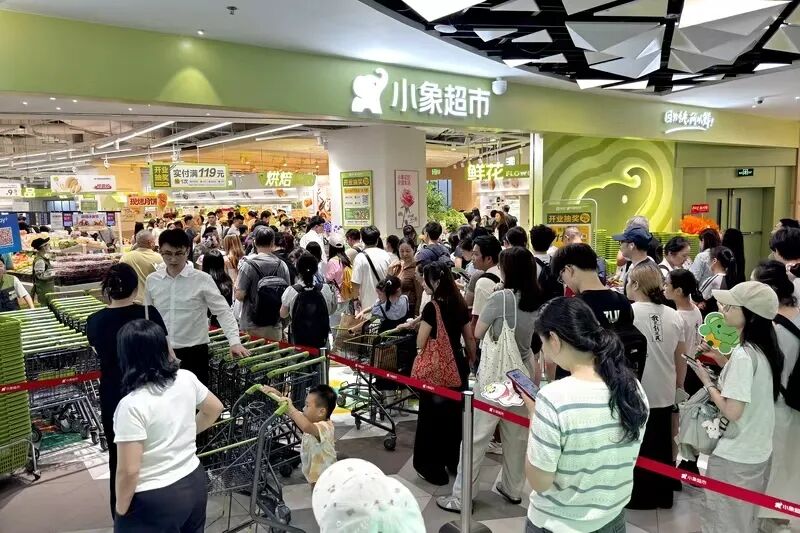
However, new businesses are not the core variable that determines the current profit trend of Meituan. At this stage, what the market needs to pay more attention to is still whether the food delivery UE can remain positive, and whether the performance of core local commerce can continue to recover as competition cools down.
At the same time, the overall subsidy level of the food delivery industry is still significantly higher than that in 2024, which shows that although competition has tended to be rational, there is still a long way to go before it fully returns to the state before the price war.
Industry participants need to change the inertial thinking of relying on subsidies to drive order growth, and gradually realize that real demand, high-quality supply, stable fulfillment and reasonable prices are the foundation of long-term development.
The real normalization not only means that the platform UE turns positive, but also requires subsidies to gradually decline, the operation status of merchants to improve, the rider security mechanism to be perfected, and real consumer demand to settle again. This process cannot be separated from regulatory guidance, and also requires the joint promotion of platforms, merchants and consumers.
Therefore, what the second quarter proves is that Meituan has the ability to take the lead in recovery, rather than that the food delivery industry has completed the recovery. Meituan has already seen the inflection point, but the industry still needs time to reach the real normal state.