After autonomous driving is written into the law, do vehicle owners still have to pay the traffic fines?
"If an accident occurs while using intelligent driving, who is responsible? We finally get the answer now. Autonomous driving has been written into the law for the first time: for accidents involving L3 and above autonomous vehicles, the automaker shall bear the responsibility, while for L2 level systems, the driver is still held accountable. The 'zero takeover' advertising claims will be taken as court evidence in the future." Just as this netizen's comment points out, the law has finally set a clear benchmark for the division of responsibilities after accidents involving intelligent driving systems.
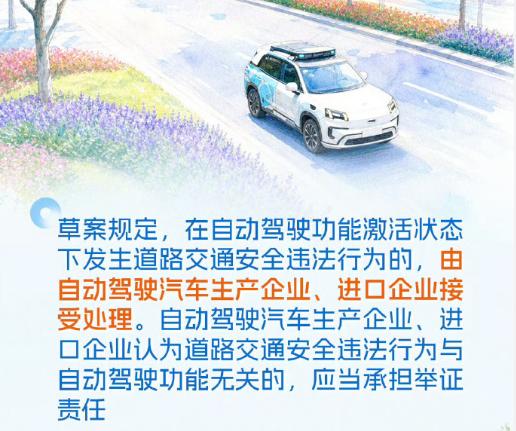
On August 25, the revised draft of the Road Traffic Safety Law was submitted to the 24th meeting of the Standing Committee of the 14th National People's Congress for initial deliberation, adding a special chapter of "Special Provisions on Autonomous Driving Vehicles" for the first time. The most notable provision states that if an autonomous driving vehicle commits a road traffic safety violation while its autonomous driving function is activated, the violation shall be handled by the manufacturing enterprise or import enterprise of the autonomous driving vehicle.
As soon as the draft was released, public opinion erupted immediately. Some people applauded it, saying "Finally, I don't have to be the one to take undeserved blame"; others expressed concern that the gray area of "the system exiting one second before the accident" has not been fully closed. In any case, a clear signal has been sent: "Intelligent driving" is no longer a space outside legal regulation, and the red line of responsibility has been drawn for the first time.
Manufacturer's responsibility guarantee may only be a limited experience
For autonomous driving, the old legal system born in 2004, whose rules are built on the premise of "human driving", has finally ushered in systematic revisions.
For a long time, the autonomous driving sector has been in a state of "technology leading, rules lagging behind", and local authorities have to implement "patchwork governance" in the form of local regulations, temporary license plates, and testing exemptions. However, local pilot programs can never replace superior laws, and the identification of rights and responsibilities on ordinary public roads has long been pending resolution.
In this revised draft, "the activated state of autonomous driving function" is taken as the core watershed for responsibility division, which means that the transfer of rights and responsibilities from "human" to "system" has obtained legal basis at the national level for the first time.
Source: Xinhua News Agency
From the perspective of specific provisions, the draft has completed three fundamental tasks.
First, complete the definition of terms in the form of national law. The draft defines autonomous driving vehicles as "vehicles that can continuously and automatically complete all dynamic driving tasks on behalf of the driver within their designed operating conditions"; while the assisted driving function is only defined as "a function that assists the driver to complete part of the dynamic driving tasks under designed operating conditions".
The essential difference between the two is that the former is dominated by the system in vehicle control, while the latter still takes the driver as the core, with the system only playing an auxiliary role.
Second, establish the imputation logic of "responsibility transfer upon function activation". The draft clarifies that when an autonomous driving vehicle is in the activated state of its autonomous driving function and commits a traffic violation, the corresponding administrative responsibility shall be borne by the vehicle's manufacturing enterprise or import enterprise; if the function is not activated, or the vehicle is only equipped with an assisted driving function, the case shall still be handled in accordance with the rules for ordinary motor vehicles, and the driver shall be the subject of responsibility.
In other words, in L2 and lower level assisted driving scenarios, the responsibility always lies with the driver; for L3 and higher level autonomous driving, during the period when the function is activated, the administrative responsibility for traffic violations shall be transferred to the automaker (the industry generally equates autonomous driving with L3 and above).
Third, introduce the inversion of burden of proof mechanism. The draft stipulates that if an enterprise claims that a traffic violation is not related to its autonomous driving function, it must provide evidence to prove the claim by itself.
This rule changes the traditional distribution method of "he who asserts must prove", no longer requiring consumers to prove that the system is in an activated state, but shifting the burden of proof to automakers who master vehicle operation data and technical details, significantly reducing the burden of proof on consumers in the process of safeguarding their rights.
However, the mixed public opinion from the outside world does not come out of nowhere. The expression of "activated state" in the draft is exactly the core of all future technical games and legal confrontations.
When an L3 vehicle is cruising on the highway at a speed of 120 km/h, the system suddenly detects an obstacle ahead but fails to brake in time, and the driver fails to take over within 0.5 seconds... For the responsibility of this accident, should it be counted as "system failure" or "delayed human intervention"?
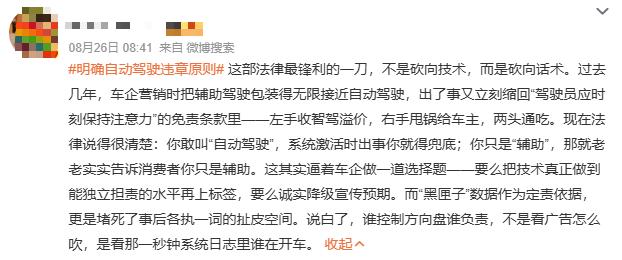
Everyone in the industry knows clearly that marketing terms such as "L2.9" and "L2.99" essentially blur the boundary between "human driving" and "intelligent driving", leading many consumers to mistakenly believe that what they bought is "autonomous driving".
What really makes the "exit in the last second" a gray area is the responsibility game under L3 scenarios. Under the framework of the current draft, automakers can argue that: "At the time of the accident, the system had exited 0.5 seconds in advance, and it was in the manual takeover phase." While the car owner would retort: "There was no warning before the system exited, and I had no time to react at all." This gray area of "passing the buck in the last second" has not been given a clear technical judgment standard in the draft, which is a gap that future judicial interpretations and industry standards must fill.
Source: Weibo
"If automakers, in order to evade responsibility, pop up a notification 'Intelligent driving has exited, please take over immediately' one second before an accident, while the average human reaction time from perception to completion of emergency operation is about 1.2 to 2 seconds, is that enough for the driver to take emergency avoidance measures?" This is the scenario that really makes consumers feel anxious — the risk is formed during the system operation phase, but when the collision occurs, the vehicle is already in manual driving mode.
What is more thought-provoking is the potential destructive power of the draft on "zero takeover" advertisements. In the past, automakers promoted "zero takeover over XX kilometers" to prove how capable their own systems are. But now, this advertising slogan has a new legal interpretation, which means that the automaker is promising consumers that in specific scenarios, the system can completely replace human beings without human intervention.
Theoretically, once an accident occurs, if the driver can prove that he was driving under the "zero takeover" scenario described in the advertisement (such as highway NOA), then the automaker's advertisement becomes a contractual clause of "product performance commitment". If the automaker tries to evade responsibility on the grounds that "the driver failed to fulfill the obligation of observation", it will fall into a passive position in terms of burden of proof, and the advertising slogan has become the most intuitive product commitment letter.
Most people are still driving under the "old rules"
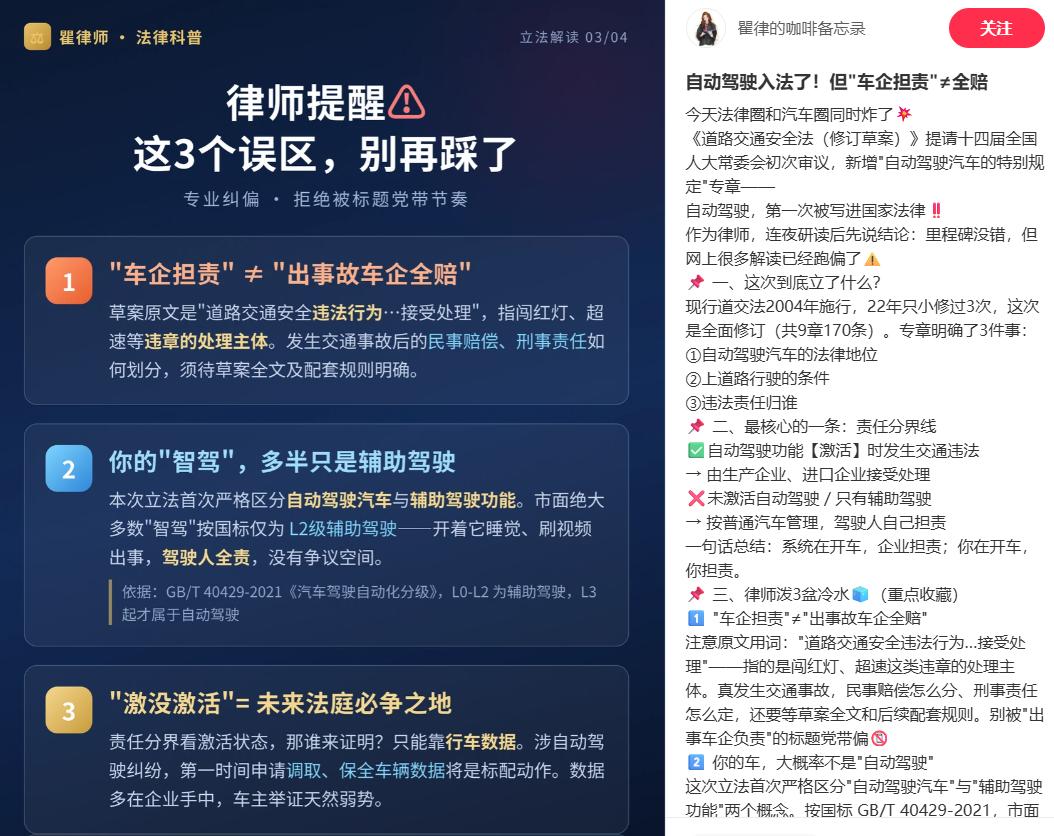
At present, the biggest misinterpretation of the incorporation of intelligent driving into law by the public is to take "automaker taking responsibility" as "someone will cover my losses if I have an accident while using intelligent driving".
According to the responsibility division of the draft, the logic is actually the opposite: it is not "you use intelligent driving, and the automaker will take all the responsibilities for you", but "the automaker will only pay the traffic fines for you within a very narrow compliance window, and all risks outside the window are still borne by you; and precisely because the automaker has to bear this part of the responsibility, it will tighten the window and manage you more strictly".
But most consumers do not need to consider these for the time being, because the mainstream intelligent driving systems on the market today are still at the L2 level.
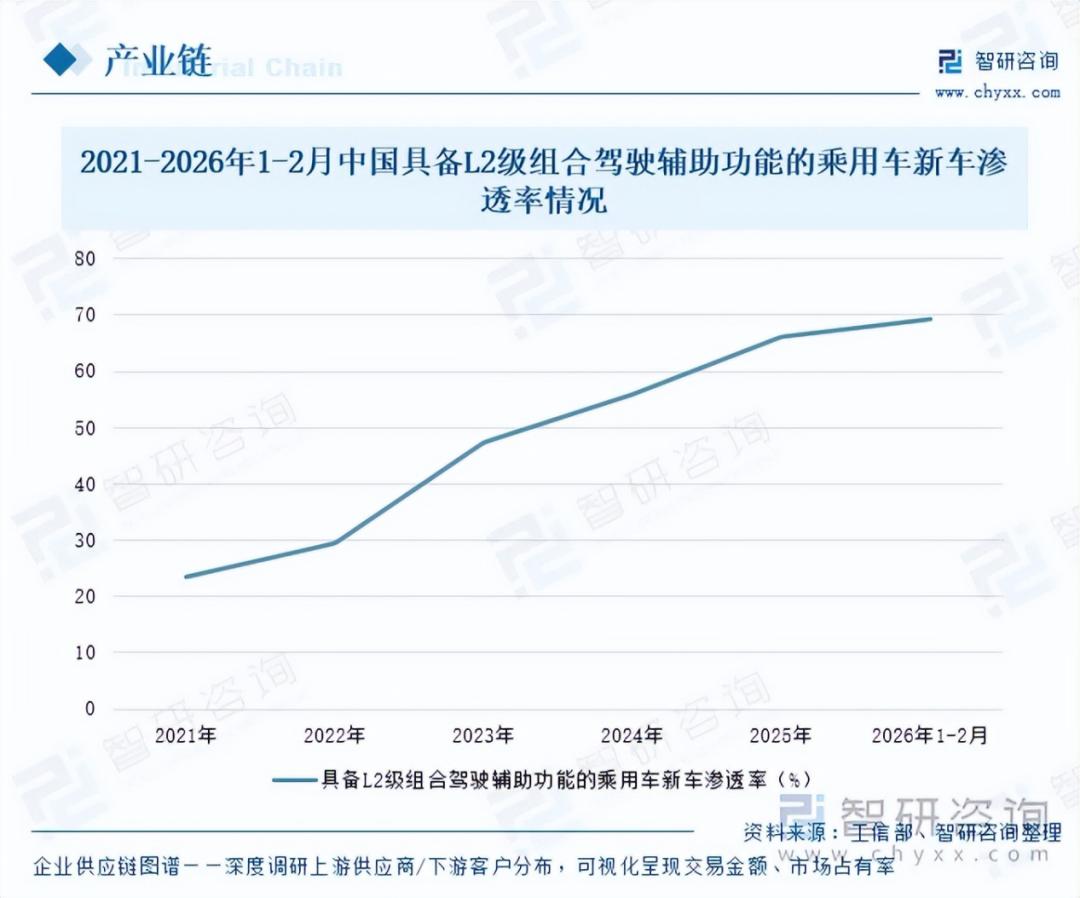
As of July 2026, the penetration rate of passenger cars equipped with L2 level combined driving assistance functions in China has reached 70.5%, and the penetration rate of passenger cars equipped with Navigation on Assisted (NOA) functions has reached 34.2%. This means that more than 70% of new cars on the market are equipped with L2 level assisted driving, and there is no change in the ownership of driving responsibility for these cars, with the driver still being the primary responsible subject.
Source: Zhiyan Consulting
The Ministry of Industry and Information Technology has previously clearly required automakers to refrain from using vague expressions such as "autonomous driving" and "high-level intelligent driving". Many automakers have quietly changed their wording, but the reversal of consumer cognition takes time. Some lawyers pointed out that many car owners are misled by promotional words, mistakenly believing that after turning on city NOA and navigation assisted driving, the vehicle can drive automatically and the automaker will be responsible for accidents. "In fact, the vast majority of NOA systems on the market currently belong to L2 level assisted driving."
In sharp contrast to the 70% penetration rate of L2 systems is the extreme scarcity of L3 systems. In December 2025, the Ministry of Industry and Information Technology granted access licenses to the first batch of L3 level conditional autonomous driving models. The models are Changan brand SC7000AAARBEV pure electric sedan (which can realize autonomous driving at a maximum speed of 50 km/h in a single lane of highways and urban expressways under traffic congestion on specific sections in Chongqing) and Arcfox brand BJ7001A61NBEV pure electric sedan (which can realize autonomous driving at a maximum speed of 80 km/h in a single lane of highways and urban expressways on specific sections in Beijing). In addition, many automakers including BYD, NIO, FAW and SAIC have entered the process of access pilot programs.
Obviously, although the law stipulates that "automakers shall bear the responsibility", this rule currently only applies to a very small number of L3 models, and only when the function is in the activated state. To put it plainly, more than 70% of new cars on the market are equipped with L2 assisted driving, which do not apply the "automaker responsibility" rule; while the L3 autonomous driving that can really make automakers take responsibility not only has a low penetration rate, but also can only be used in specific cities and specific road sections.
Source: Xiaohongshu
On the whole, the transfer of rights and responsibilities from "human driving" to "vehicle taking responsibility" has obtained legal basis at the national level for the first time. But how far this step goes depends on three variables: when the supporting standards will be in place (the mandatory national standards will not be implemented until 2027), how supporting regulations and judicial interpretations will fill the gaps (the gray area of "exiting in the last second" has no solution yet), and when the penetration rate of L3 systems will increase on a large scale (before that, the vast majority of people are still driving under the old rules).
Based on this, for ordinary consumers, the most pragmatic attitude may be: take the draft as a signal, not as a protective amulet. The signal is clear: the state is promoting the legal road access of autonomous driving, and the system is catching up with technology; the protective amulet is illusory. At least for now, hands cannot leave the steering wheel, eyes cannot leave the road, and the responsibility still lies with yourself.
The legislation has started, but it still takes time to fully realize the "automaker responsibility" rule. How long this time will be depends on the race among legislative progress, standard implementation and industrial evolution.
This article is from the WeChat official account "Zinc Scale" (ID: znkedu), written by Meng Huiyuan, edited by Li Wenjie, and published with authorization from 36Kr.