Is the U.S. Department of the Treasury pushing down U.S. Treasury bond yields to rescue the U.S. stock market, or laying a bigger time bomb?
The most influential mentor-protégé pair on Wall Street has suddenly taken opposing sides in the world's most important bond market.
The protégé is Bessent, the current U.S. Secretary of the Treasury;
The mentor is Druckenmiller, the core trader who led George Soros' famous shorting of the British pound and a widely recognized macro investing legend on Wall Street.

Over 30 years ago, when Bessent first entered the industry, he called Druckenmiller almost every day to seek advice. Today, the pair have placed completely opposite bets on the future of U.S. Treasuries.
The cause of this situation is very straightforward.
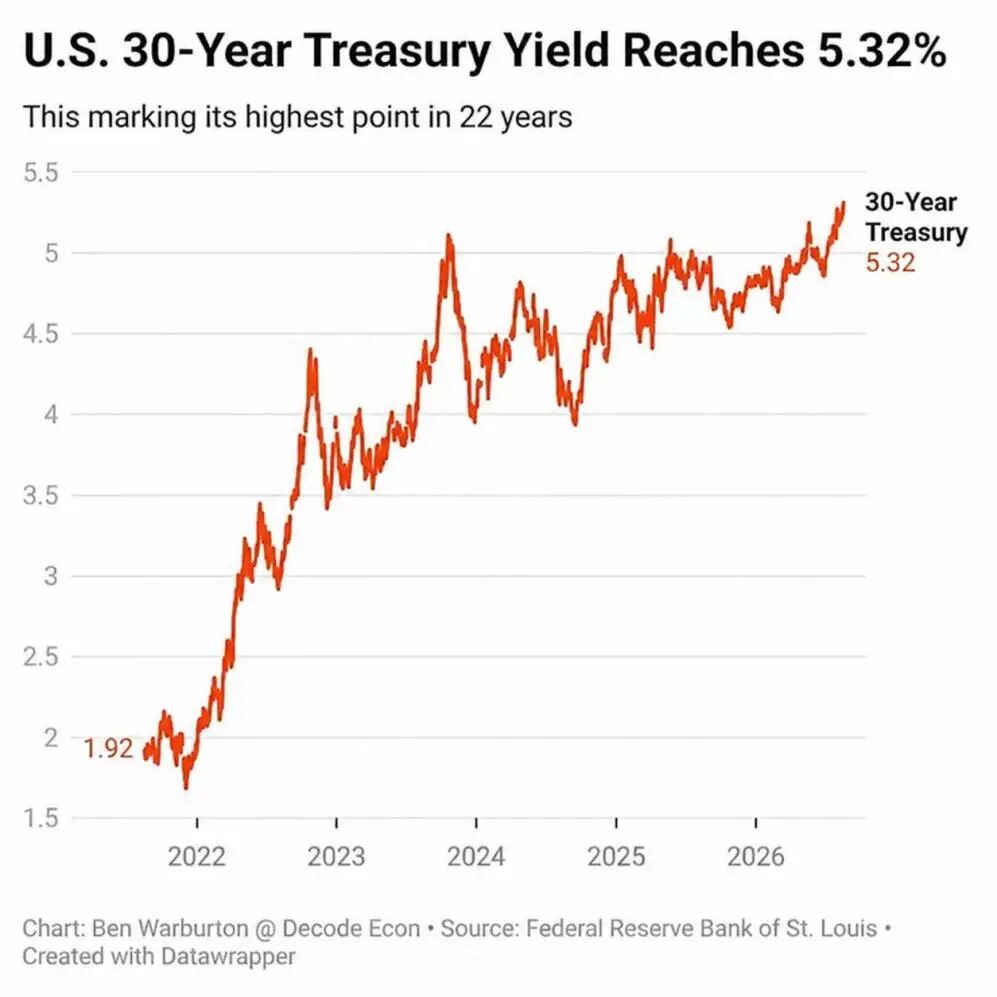
On August 18, the yield on 30-year U.S. Treasuries surged to around 5.34% at one point, hitting a new high since 2007.
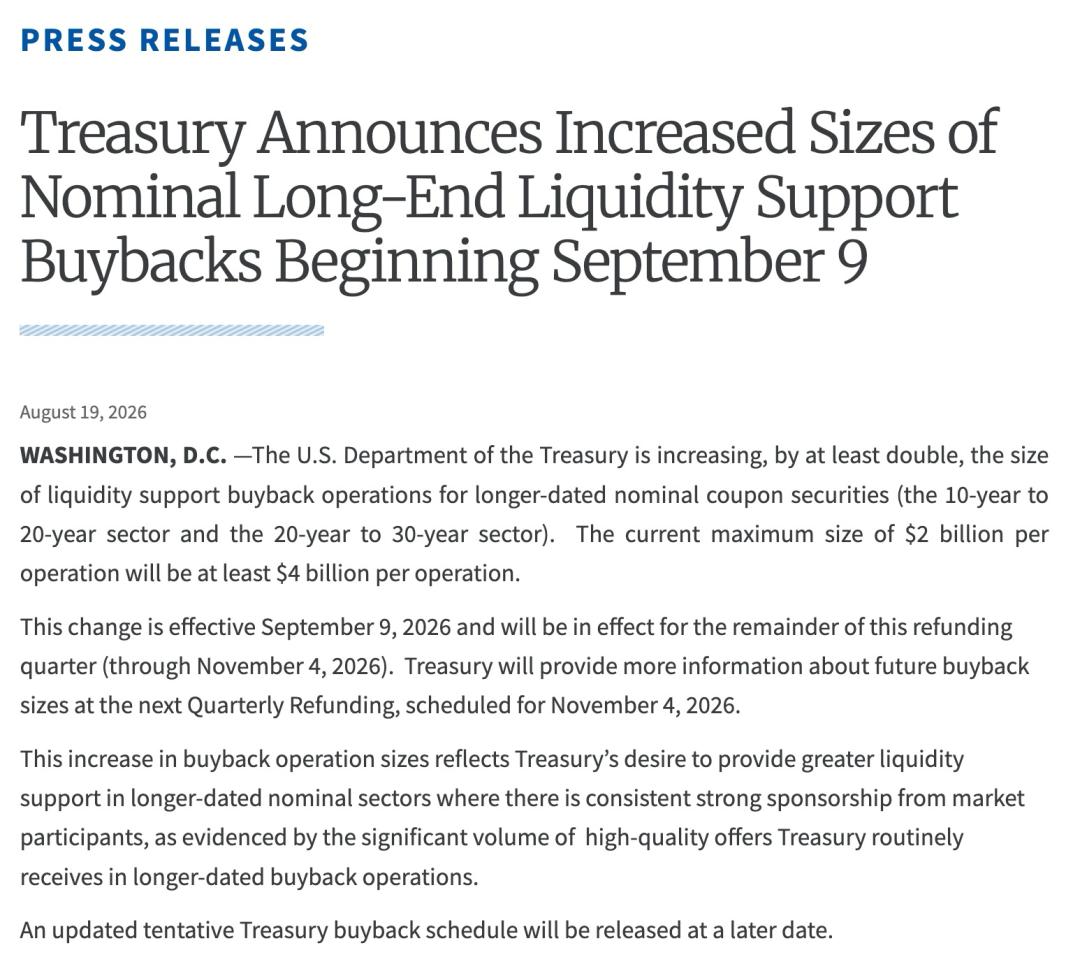
The next day, on August 19, the U.S. Department of the Treasury announced: Starting from September 9, the upper limit of liquidity-supporting repurchases for 10-year to 30-year long-dated U.S. Treasuries will be raised from $2 billion per operation to at least $4 billion; the first expanded long-dated repurchase operation will be conducted on September 10.
A few days later, Druckenmiller published an article publicly in *The Wall Street Journal*, which was further covered by Reuters later:
《Let the Bond Market Speak》 — Let the Bond Market Speak.
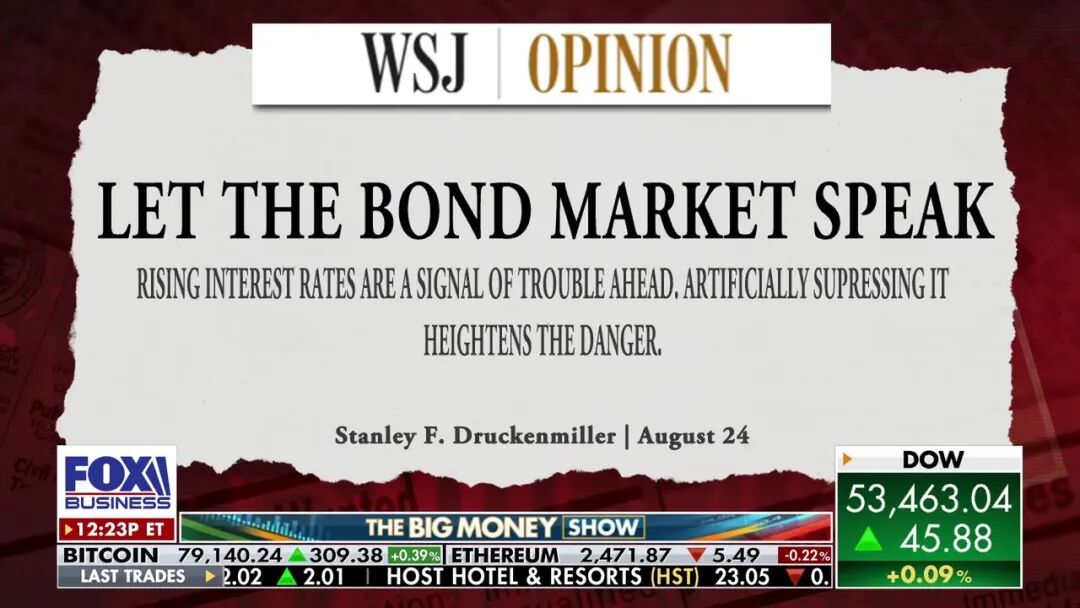
His core criticism is: If the rise in long-term yields reflects pressures from deficits, inflation and debt supply, using liquidity tools to suppress prices will not solve the real problem, but may instead undermine the long-established credibility of the U.S. Treasury market.
Now, a few days later, the market's response is clearer than it was initially: The $4 billion repurchase can affect short-term trading, but it is not enough to change the pricing logic of long-dated interest rates.
As of August 28, the 30-year U.S. Treasury yield stood at around 5.21%, and the 10-year yield at around 4.72%. That means long-dated yields have pulled back from above 5.3%, but have not returned to a level that fully reassures the market.
Therefore, what this article is really discussing is no longer just "whether the Treasury has stepped in", but whether the level around 5.3% will gradually be regarded by the market as a policy red line. If so, can this line be held, and where will the pressure be shifted to?
Treasury Repurchase Is Not QE
First, let's clarify the most easily confused point: The Treasury buying long-dated U.S. Treasuries is not QE.
QE refers to the Federal Reserve buying bonds by expanding its balance sheet and creating bank reserves, which will increase the base money in the financial system accordingly.
But the Treasury does not have the ability to create money. When it repurchases Treasuries, it can only use existing cash, or raise funds by issuing Treasuries of other maturities.
Therefore, Treasury repurchases are not the same as QE. If the repurchase is financed by issuing new short-dated bonds at the same time, it is essentially an adjustment of the debt maturity structure; if it directly consumes cash in the TGA account, it will release liquidity to the market temporarily, but the Treasury will still need to replenish its fiscal cash balance later.
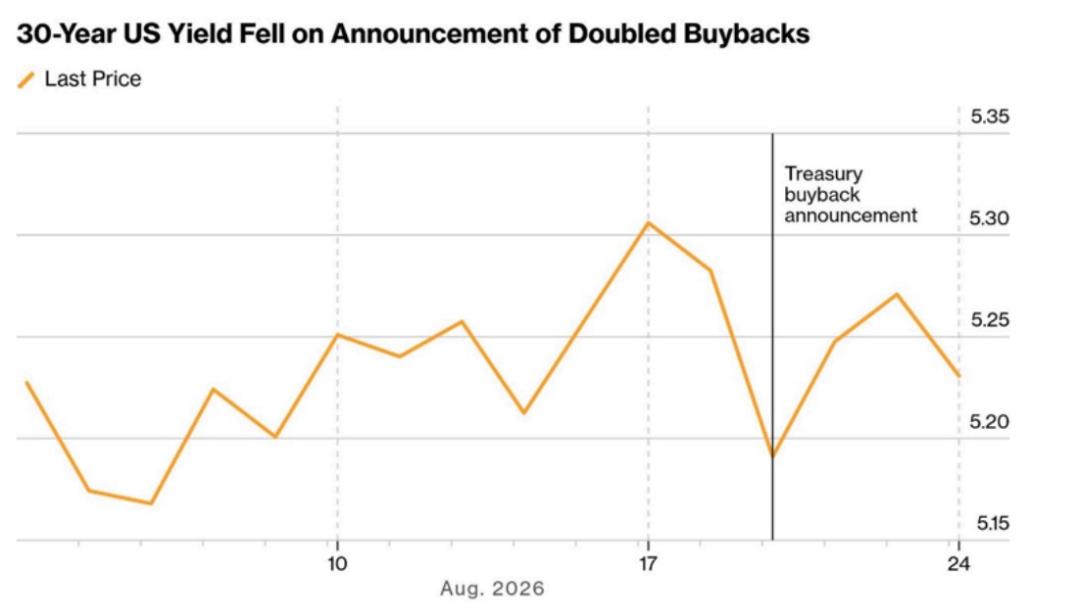
The initial market reaction also proves this point. After the Treasury announced the expansion of repurchases, the 30-year yield fell rapidly for a while, but then rebounded significantly.
As of August 28, it remained around 5.2%. The market accepted the signal that "the Treasury is willing to step in", but did not give up re-pricing inflation, deficits and long-term supply.
However, there is a key point that has been overlooked in this process:
What is really worth paying attention to here is not to assert that a certain type of capital is already at an "extreme historical position", but that the policy signal itself will change trading behaviors.
As long as the market begins to believe that the Treasury will increase its efforts when the long-dated market gets out of control, short sellers will be more cautious, and long holders will also be more willing to bet on policy intervention in advance.
Therefore, what the Treasury is leveraging is not just a single $4 billion buying flow, but more importantly, expectations: The market will keep guessing at what yield level the Treasury will step in again.
The new change that emerged this week is that this kind of speculation is no longer just theoretical.
On August 20, Bessent publicly stated that the expanded repurchase scale can be further increased in the future;
But on August 24, he emphasized that the Treasury will still adhere to the regular bond issuance plan announced in August, including long-dated Treasury auctions.
These two signals together are very important: The Treasury is willing to be more proactive on the repurchase side, but at least for now, it has not officially announced a new financing system of "issuing fewer long-dated bonds and more short-dated bonds".
Therefore, a more accurate statement now is: The Treasury is taking more initiative to influence long-dated liquidity and market expectations, but this cannot be directly equated with a formal yield control policy that has taken shape.
The Bessent Put
Once the market really starts to think this way — that the Treasury will not stand by and watch long-dated U.S. Treasuries keep falling — a very interesting phenomenon will emerge next.
Some people in the market have already used a very vivid expression to describe this expectation:
"Bessent Put", that is, the Bessent put option.
But it needs to be emphasized that this is only the market's name for the policy reaction function, not an official upper limit of yields promised by the Treasury.
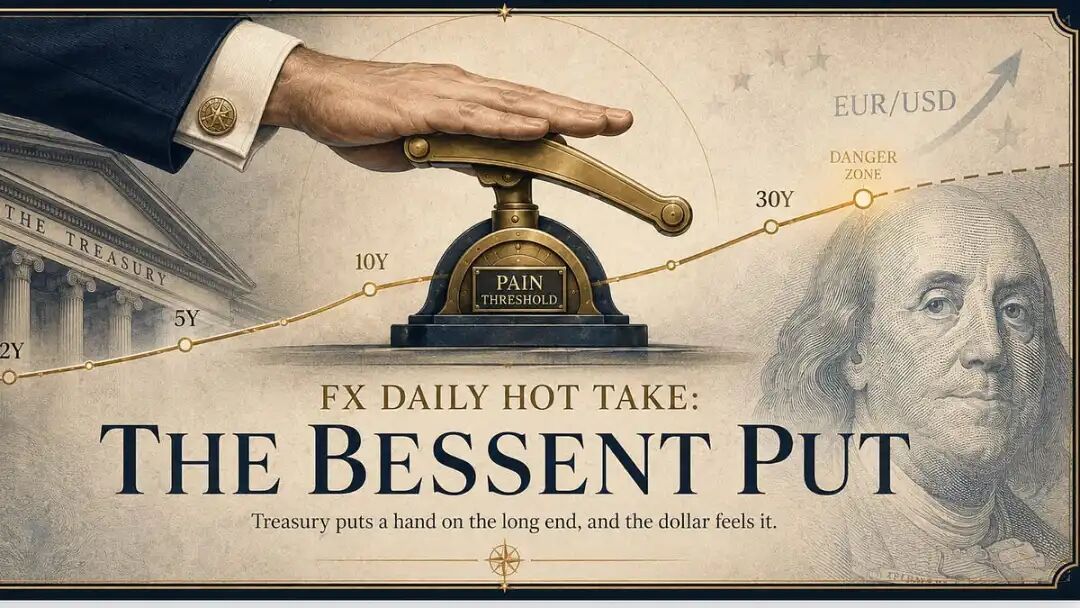
This is actually very easy to understand. Previously, people were familiar with the "Fed Put" — which means that once the stock market falls sharply, the market will guess whether the Fed will step in to support the market.
If every time the 30-year yield approaches the 5.3% level, the Treasury releases a stronger repurchase signal, over time the market may form a consensus:
When the yield approaches this level, Bessent may step in again.
Once this expectation takes root, its influence will be far greater than that of a single $4 billion repurchase. Because the market will react in advance on its own — short sellers will be more cautious, long holders will be more willing to wait, and some will even bet on policy support in advance. At this point, what the Treasury is really influencing is no longer just the buying flow on that day, but the positions and expectations of the entire market.

However, this logic has a quite fatal flaw: as long as the market believes that there is a bottom line, someone will definitely test where exactly this bottom line is over and over again.
Therefore, instead of mechanically asking whether the Treasury will step in to rescue the market at 5.4%, 5.5% or 5.6%, it is better to focus on a more realistic test: if the 30-year yield rises back above 5.3% again, will the Treasury continue to raise the "at least $4 billion" cap.
Every rebound is essentially forcing the Treasury to answer the same question: To what extent are you willing to hold on?
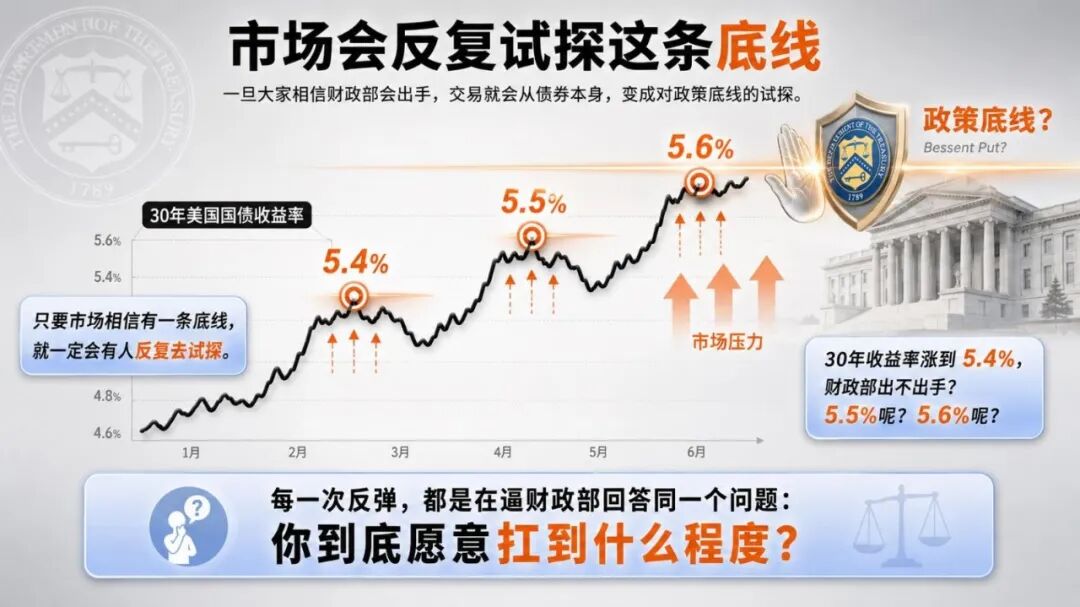
Therefore, the "Bessent Put" may work very effectively in the short term, but in the long run it will make the Treasury increasingly passive. Because once the market assumes you will step in, the disappointment will be even greater if you do not step in next time; but if you step in every time, the scale of intervention will only keep growing.
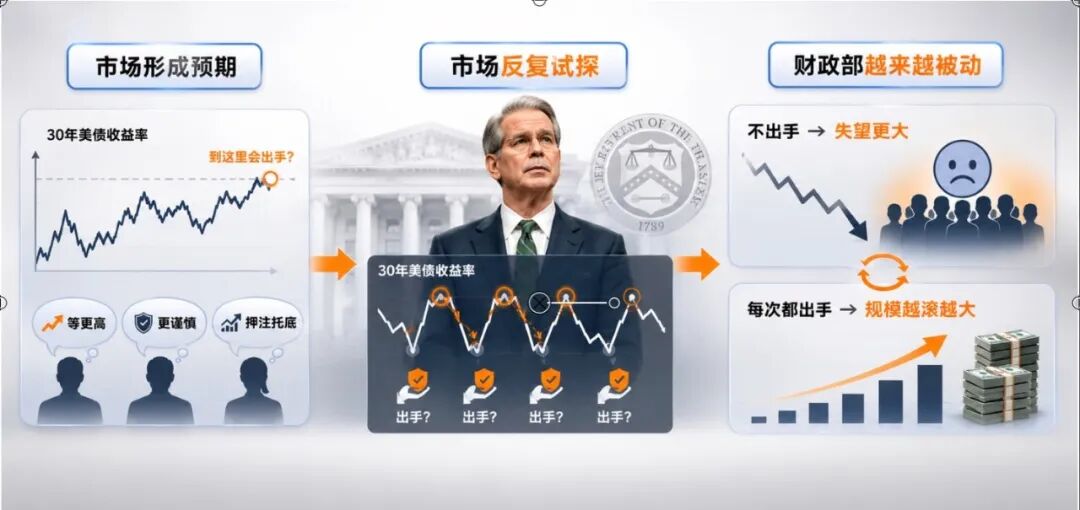
Therefore, what is really worth tracking is not whether the Treasury has stepped in to support the market once, but —
Whether this kind of market support will gradually evolve from a one-off liquidity management measure to a policy bottom line recognized by the market.
If repurchases need to be further expanded in the future, the Treasury does have other tools at its disposal. But different from the situation a few days ago, Bessent has personally clarified one point now: at least for now, the regular long-dated Treasury auction plan will not be cancelled due to the expansion of repurchases.

What Else Could the Treasury Do in the Future?
The first possible measure is to further adjust the financing maturity structure of the U.S. government, but this is still a market deduction rather than an announced policy for now.
Wall Street calls this idea the "Treasury version of Operation Twist": reduce the net supply of long-dated bonds, increase short-dated bond financing, and cooperate with the repurchase of old long-dated bonds.
But on August 24, Bessent clearly stated that the Treasury will continue to implement the regular auction plan announced in August, including long-dated Treasury bonds. Therefore, at least in the current quarter, it is not accurate to take "issuing fewer long-dated bonds and more short-dated bonds" as the confirmed next step.
What is really worth watching is whether the Quarterly Refunding plans in the next few quarters will start to change the maturity structure. If the scale of long-dated Treasury auctions is really reduced, that will mean the "Treasury version of Operation Twist" has evolved from market speculation to policy reality.
But the cost is that the debt does not disappear, it only shifts the pressure from the long term to the short term. It is like replacing a 30-year fixed-rate mortgage with a short-term loan that needs to be rolled over constantly. If interest rates really go down in the future, this move will work very well.
But if inflation cannot be kept under control and the Federal Reserve cannot cut interest rates significantly, the United States will have to re-borrow at the market rate at that time every time old debt matures, and the refinancing pressure will become more and more concentrated.
The second more sensitive variable is TGA, the Treasury's cash account held at the Federal Reserve.
As of late August, the TGA balance was approximately $940 billion. It can indeed become one of the funding sources for repurchases.
But this cannot be simply interpreted as "the Treasury has $940 billion in hand that can be used to support the bond market at any time". TGA is first and foremost the cash account for the federal government's daily expenditures and debt service, and the Treasury needs to maintain a sufficient cash buffer.
Bessent has not announced which specific financing source will be used for the expanded repurchases, so "directly using TGA to buy large amounts of long-dated bonds" is still only a possible path, not an implemented plan.
Why is this measure different from others?
If the Treasury directly consumes TGA to repurchase Treasury bonds, cash will flow from the Federal Reserve account back to the banking system, which will increase market liquidity in the short term; but if the Treasury then issues new bonds to replenish TGA, this part of liquidity will be withdrawn again.
Therefore, it is more like a tool that can adjust the rhythm of liquidity, rather than an unlimited "fiscal version of QE".
This also means that the real controversy is not whether TGA can temporarily push down yields, but whether the Treasury will use cash management more and more frequently to influence market prices.
And this step is exactly what Druckenmiller is most worried about.
What Druckenmiller Is Really Concerned About
What Druckenmiller really worries about is whether the Treasury will gradually slide from "maintaining market liquidity" to "actively managing prices according to yield levels". On August 25, he called the expanded repurchase a form of "price management" and warned that it would erode the most valuable asset of the U.S. Treasury market — credibility.
The U.S. Department of the Treasury has always