Star-making through short dramas no longer requires "humans".
If the "uncanny valley effect" of AI short dramas initially stemmed from visuals realistic enough to fool viewers, what truly sends a chill down the audience's spines are the moments when AI actors attempt to invade every aspect of real life.
For example, post-credit side stories featuring AI leads start to appear at the end of short dramas: they chat on the street, sit across from each other in coffee shops, with slightly shaky camera shots as if someone is secretly taking photos with a mobile phone; on short video platforms, AI "actors" are shown going out and being surrounded by fans, with bodyguards clearing a path, crowds screaming, and cameras jostling around, whose camera movements and positions are almost frame-for-frame replicas of the paparazzi shots of real-life celebrity influencers; on social platforms, AI leads have their own accounts, posting daily content of having breakfast, buying flowers, and visiting exhibitions like regular bloggers, even taking on commercial endorsements, with fans in the comment sections calling them "babe" and asking for the same products they use. Even "fan photographers" have emerged: some people use AI to generate "proxy shot" photos of the leads reading scripts on set, with overexposed lighting and blurry backgrounds that are identical to those posted by fan accounts on Weibo...
This summer season, AI has rewritten the rules of the short drama industry with an overwhelming, unstoppable momentum. Real human actors are having a hard time: the pay of top-tier short drama actors has been cut by half, actors who used to earn 10,000 yuan a day now have no roles to take, and some even publicly post "job-seeking" notices on social platforms. Even relevant personnel from Tingshuadao, a leading short drama production company, stated bluntly that "domestic real-person projects are no longer profitable." On the other hand, AI virtual actors are being deployed in batches: popular characters such as Yan Jiming in *Green Plum by the Inkstone*, Duan Yan, Rong Jiqiao, and Ji Chuan in *Deeply Infiltrating Your Rest of Life* have settled on the Hongguo platform like real entertainers, with their own character homepages opened.
To put it more plainly, the short drama industry is undergoing a "de-carnalization" revolution. The content remains, the character settings remain, the traffic remains, but the people acting in the productions may no longer need to "exist" in physical form.
From in-show characters to independent IPs, the commercialization path has been fully validated
The commercialization of AI virtual actors is entering a new stage from "whether it can make money" to "how to make sustainable long-term profits".
The most typical case is Yan Jiming.
This character comes from the AI short drama *Green Plum by the Inkstone*, independently created by amateur creator "Wanwan" after two months of self-learning AI tools, and the content is adapted from the record of only 234 words in *Eulogy to My Nephew* by Yan Zhenqing. The drama has received active ratings from tens of thousands of users on the Hongguo platform, and is hailed as a "masterpiece among AI short dramas".
But the value of Yan Jiming far exceeds this single drama: he settled on Hongguo as an independent actor, interacting with the audience under the modern name "Yan Xu"; Xi'an Beilin Museum released a co-created video *Return to the Stele* with *Green Plum by the Inkstone*, in which Yan Jiming "travels through time" to visit the Yan Family Temple Stele in the museum; side stories and modern romance plots of the two leads of *Green Plum by the Inkstone* are continuously updated on Xiaohongshu; Yan Jiming is even made into a Douyin special effect for users to take duet videos, so fans can "appear in the same frame" with this virtual character; even Sina Entertainment has conducted exclusive character interviews for the AI CP of Yan Jiming and Li Youwei...
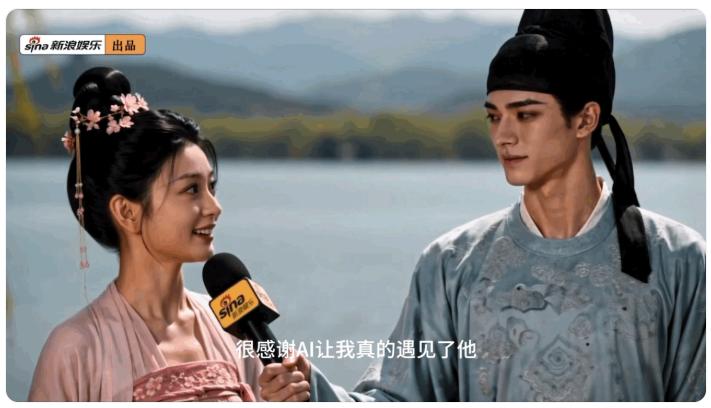
Source: Sina Entertainment
Fang Taozi, the female lead of *The Laid-off Girl*, is another sample verified by the market.
Less than two months after her debut, Fang Taozi has gained more than 412,000 followers on Douyin, with over 28.22 million likes. The listed quotation on Juliang Xingtu shows that the quotation for her 120-second video is 168,000 yuan, and the price for videos longer than 60 seconds is as high as 258,000 yuan, which has exceeded a large number of real-life internet celebrities with millions of followers, and some tiers are even higher than many internet celebrities with tens of millions of followers.
Outside the drama, Fang Taozi opened an independent social account, posting daily content of making sandwiches, buying flowers, working out, dancing and so on. The "imperfections" such as dark circles and facial blemishes make the AI character more realistic, and fans are not only following the drama, but also attached to this character as a real person.
Facts have proved that derivative consumption driven by hit roles in AI short dramas is becoming a viable monetization path.
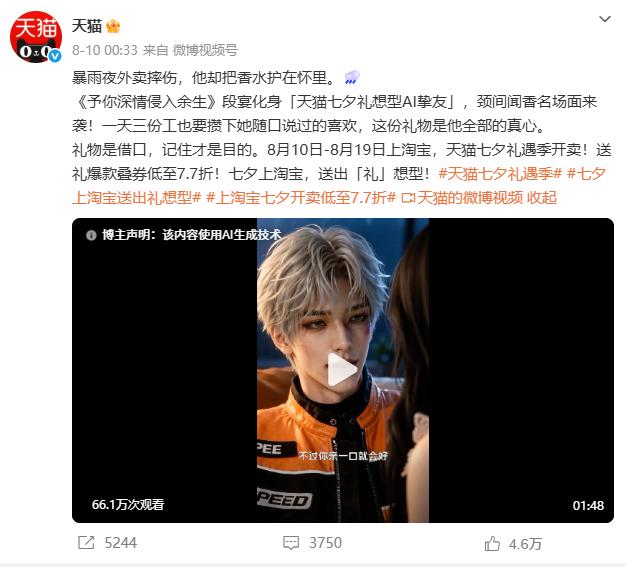
Duan Yan is officially announced by Tmall as the Qixi Festival "AI Best Friend". Source: Tmall official Weibo account
Lv Shaolong, Deputy General Manager of leading manhua drama firm Lingju Technology, said bluntly in an interview with NewRank, The IPization of native AI actors may become a key opportunity in the next stage of the AI short drama industry. "Different from creating a digital human based on an existing popular celebrity, this model starts from character design and personality setting, and incubates a native AI entertainer from scratch like cultivating an grassroots star. Once recognized by the audience, the AI entertainer can not only make guest appearances across different drama crews, but also run personal accounts, take commercial orders, and do live-streaming marketing. This path is more difficult, but once fully validated, it will be subversive to the entire monetization model of the AI industry."
Judging from various trends, this path is indeed being paved: at the platform level, although Hongguo Short Drama has tightened the minimum guaranteed policy for ordinary AI dramas, retaining the minimum guarantee only for S+/S level high-quality AI projects, the maximum minimum guarantee for real-person + AI integrated production projects can still reach 1 million yuan; the Copyright Center of Douyin Short Drama has introduced incentives, setting tiered cash rewards for AI dramas that meet the popularity standards on the Hongguo platform; the market size is also exploding simultaneously: from January to May 2026, the domestic market size of AI dramas and manhua dramas has exceeded 220 billion yuan, and the whole year is expected to hit 400 billion yuan, with the number of AI manhua drama users exceeding 600 million in the first half of the year...
It is clear that the "de-carnalization" revolution of AI actors is no longer a lab toy for tech geeks, but has fully formed a complete closed loop covering content production, traffic distribution and commercial monetization.
With hit rate lower than 0.5%, AI actors enter a "battle royale" phase
The core point is that the prerequisite for supporting the independent IP commercialization of AI actors is that the actor must be a huge hit, but in reality, the vast majority of AI characters can never reach the stage of becoming an independent IP.
According to *Data Report on AI Dramas and Manhua Dramas in the First Half of 2026* released by DataEye, more than 221,900 new AI short dramas were launched across the internet in the first half of 2026, among which only 1055 works had views exceeding 100 million, with a 100-million-view hit rate of 0.47%; the report defines hits as works that enter the overall traffic investment pool with ROI>1, and the overall industry hit rate is 0.47%. In the AI manhua drama track, the competition is even more brutal, with a hit rate of less than 0.1%, meaning that only 1 out of every 1000 new works can form a complete commercial closed loop. The industry regards 50 million views as a rough reference line for break-even, and only 1.3% of the works can reach this level. More than 90% of AI short dramas have low traffic after launch and become "cannon fodder" in the industry.
Statistics from China Netcasting Services Association show that in the first quarter of 2026, about 128,000 new short dramas were launched across the internet, among which 122,000 were AI micro-short dramas, accounting for more than 95%. In March alone, nearly 50,000 new AI dramas and manhua dramas were added on Douyin, with more than 1300 new works launched per day on average; but among the new works added in March, only 62 had views exceeding 100 million, with a hit rate as low as 0.124%. Data from third-party monitoring agencies such as Yunhe and Guoduo also reflects this structural contradiction: AI short dramas account for an extremely high proportion of production capacity, but their share in the top list of effective views is much lower.
After AI short dramas pushed real-person short dramas into a situation where "many short dramas with over 2 billion views cannot even start filming their second seasons", they have maximized their "survivorship bias" on their own. When thousands of new AI dramas and manhua dramas flood into the market every day, the audience's right of choice is infinitely diluted, and algorithm recommendations naturally favor top hits, leaving those AI characters that fail to generate good data with almost no chance to be seen.
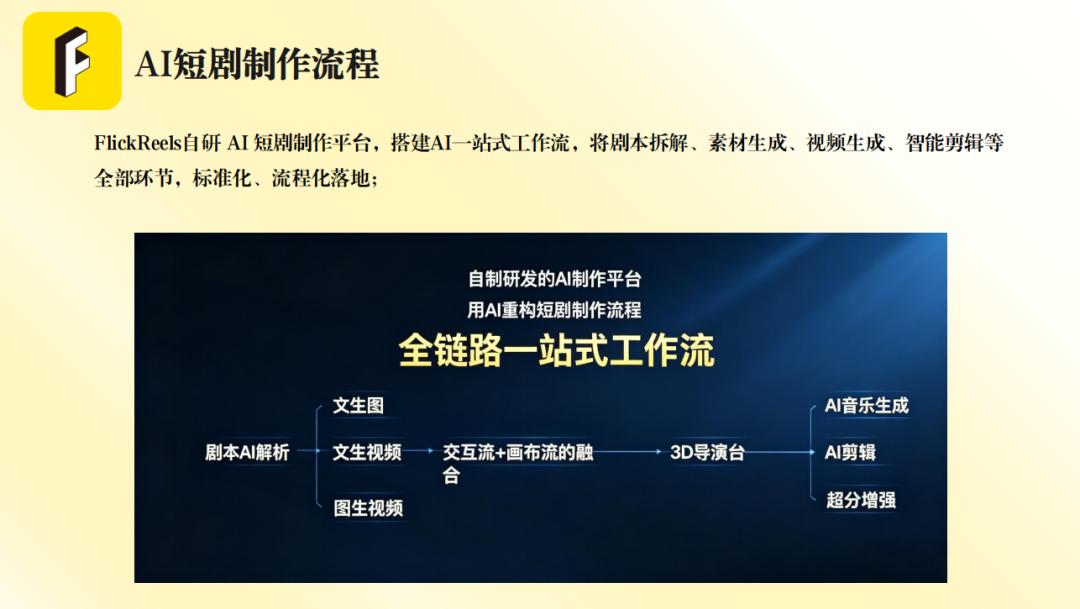
Tingshuadao has started its transformation to produce AI short dramas
What is more brutal is that the "battle royale" of AI actors exposes the Matthew Effect of the industry earlier and more thoroughly than real human actors. Real human actors still have non-data-based living space such as talent agencies, personal connections, and offline activities, while AI actors are judged by data of all dimensions from the moment they are born: view count, completion rate, interaction rate, conversion rate, all of which are rigid indicators.
No data means no commercial value; no commercial value means no subsequent investment in IP incubation; no investment makes it even more impossible to generate good data. This is a vicious cycle, as regulations are tightening rapidly and the entry threshold is rising simultaneously, the window of opportunity left for unregulated players is visibly closing.
Some time ago, a large number of AI manhua drama users posted complaints on the internet. They found that the AI manhua dramas they were following suddenly stopped updating, some accounts deleted all their works overnight, and even the fan groups were disbanded.
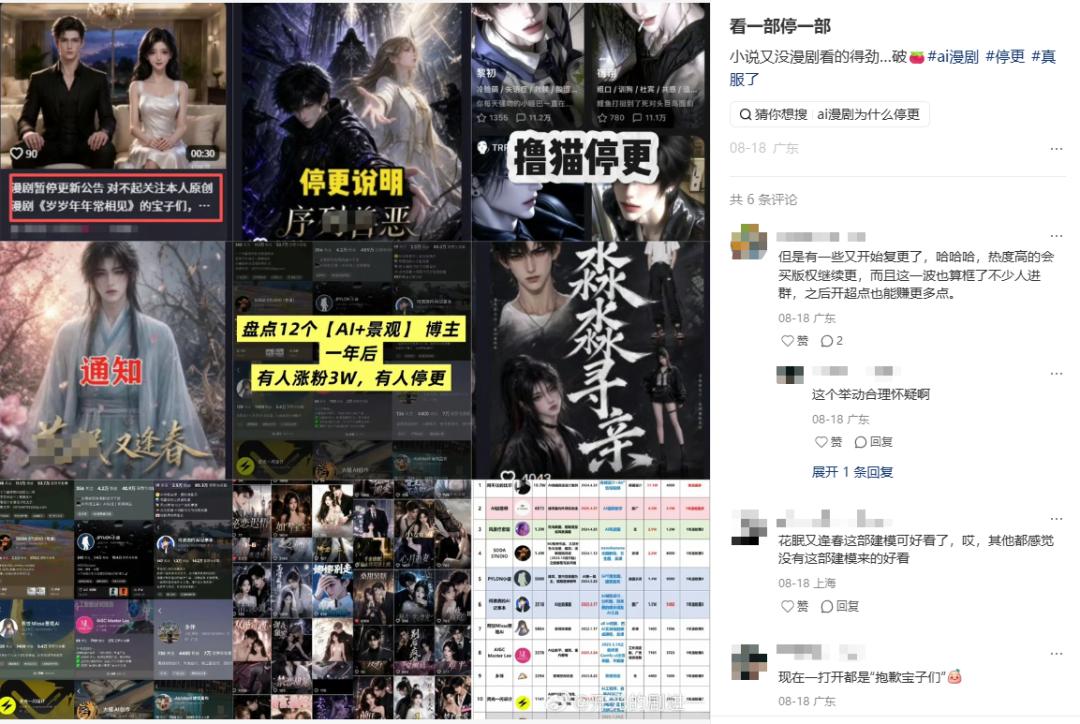
Source: Xiaohongshu
The driving force behind this is the tightening of supervision. Since April 1, 2026, AI manhua dramas have been officially included in the regulatory system for online micro-short dramas, implementing the rule of "filing before launch", and stock works that have not completed the filing will be removed from all platforms across the internet. In August, platforms including Fanqie and Hongguo implemented detailed review rules, strengthening the control of copyright and personality rights. AI manhua dramas that do not have complete web novel IP authorization, steal other people's portraits, or clone other people's voiceprints cannot pass the platform review. Starting from August 17, Fanqie introduced new rules for the web novel user acquisition promotion chain: non-compliant user acquisition content will lead to the cancellation of alias revenue; the length of a single promotional video shall not exceed 15 minutes, the plot clip content of videos used for novel diversion shall not exceed 10% of the original work, and the self-produced manhua drama category implements a 30% adaptation upper limit.
In addition, on September 1, the *Administrative Measures for the Development of Micro-Short Dramas* issued by the National Radio and Television Administration will come into force. The regulation requires that micro-short dramas produced with AI participation must add an AI identification mark in a prominent position of the drama, and broadcasting institutions shall verify the copyright of AI materials simultaneously. Taking the theme attribute and investment amount as dual criteria, this regulation establishes a three-level differentiated supervision system covering all micro-short dramas, which also applies to AI-generated micro-short dramas. The superimposition of multiple regulations and platform rules means that the extensive production mode of the past industry that relied on mass production to gamble on hits has come to an end.
Those players who crazily produce massive content in the background, release works with dozens of account matrices, and rely on "scattergun" strategies to hit hits, suddenly find that their "master key" no longer works. Filing numbers, copyright certificates, and material source statements, these "paperwork" that were once ignored, are now stricter lifelines than ROI (Return on Investment).
There is no doubt that the AI short drama industry is standing at a crossroads. On one hand, the "in-show character to independent IP" commercialization paths validated by successful cases such as Yan Jiming and Fang Taozi have proved the feasibility of AI starmaking; on the other hand, there is the cruel reality that only more than 1000 out of over 200,000 works have views exceeding 100 million, and the reshuffle of the industry brought by tightening supervision.
AI has lowered the threshold for content production, but not the threshold for creating hits. When the "quantity-over-quality" path is blocked, the industry has to return to the most simple proposition: whether it is a work or a character, what can truly precipitate into a long-term IP will always be things with cultural depth, emotional depth, and humanistic warmth.
This article is from WeChat Official Account "Zn Scale" (ID: znkedu), author: Zn Scale, published with authorization from 36Kr.