After being "fed" by major clients for a decade, Kesi Co., Ltd. should now walk independently on its own.
The hidden champion of sunscreen agents with a global market share of over 27% once reaped easy profits relying on major clients for a decade. Since the third quarter of 2024, its attributable net profit has declined for seven consecutive quarters, and the downward trend did not stop until the second quarter of 2026. When major clients left and a price war broke out in the domestic market, the "external factory" model of Cosmos Co., Ltd. reached a crossroads.
On August 27, leading sunscreen agent manufacturer Cosmos Co., Ltd. released its 2026 semi-annual financial report. The data shows that in the first half of 2026, the company achieved operating revenue of 893 million yuan, a year-on-year increase of 23.78%. In the same period, its attributable net profit reached 58.4807 million yuan, a year-on-year decrease of 10.44%.
From the fourth quarter of 2024 to the fourth quarter of 2025, both the operating revenue and net profit of this company kept falling. It was not until the second quarter of 2026 that the continuous downward trends of both indicators finally came to a halt, but the attributable net profit for the first half of the year still recorded a double-digit decline.
The company repeatedly emphasized in its financial report that the previous performance decline was caused by the cyclical changes of the sunscreen agent industry and the inventory digestion of downstream customers. However, after dissecting the industry data, we found that the situation is not so simple.
This hidden champion with a global sunscreen agent market share of over 20% is experiencing a belated "weaning" from its major clients.
The Hidden Champion "Raised" by Major Clients
To understand the predicament of Cosmos Co., Ltd., we need to first look at how it developed step by step.
Founded in 2000, Cosmos Co., Ltd. is mainly engaged in active ingredients of sunscreen agents. Its products cover mainstream sunscreen categories such as Avobenzone (AVB), Octocrylene (OCT), Ethylhexyl Methoxycinnamate (OMC), Homosalate (HMS), Ethylhexyl Salicylate (OS), as well as new sunscreen agents such as P-S and EHT.
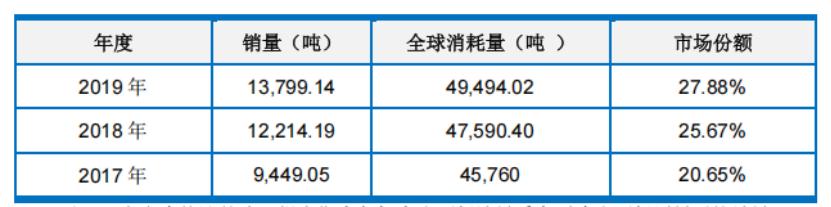
Figure / Prospectus of Cosmos Co., Ltd.
With complete production line layout and stable supply capacity, Cosmos Co., Ltd. has gradually grown into a leading player in China's sunscreen agent manufacturing sector. By 2019, the sales volume of its sunscreen agents reached 13,800 tons, and its market share in the global sunscreen market had reached 27.88%.
In the same year, the business of cosmetic active ingredients and their raw materials dominated by sunscreen agents generated a revenue of 809 million yuan, contributing 74.22% of the company's total revenue, which pushed the performance of Cosmos Co., Ltd. to rise all the way.
In the development history of Cosmos Co., Ltd., there is an unavoidable role - DSM, which has almost participated in every important development node of Cosmos Co., Ltd.
In 2015, Cosmos Co., Ltd. won the client of DSM, the global giant in the flavor and fragrance industry. At that time, the global sunscreen market was dominated by international giants such as BASF and Symrise, and it was not easy for Chinese manufacturing enterprises to enter the international supply chain. With stable supply capacity and cost advantages, Cosmos Co., Ltd. successfully entered DSM's system.
In 2016, Cosmos Co., Ltd. was listed on the New Third Board. To further bind with DSM, the two sides signed a cooperative development agreement for new sunscreen agents P-S and P-M, stipulating that Cosmos Co., Ltd. would produce and supply the products exclusively to DSM.
Information from the GEM prospectus of Cosmos Co., Ltd. shows that the two sides jointly developed P-S and P-M products in early 2016. The production line of Cosmos Co., Ltd. was completed and put into trial production at the end of 2016, and it began to supply products exclusively to DSM from 2017.
From 2017 to 2019, the two sides entered the closest exclusive supply stage of cooperation.
With this agreement with guaranteed minimum orders, Cosmos Co., Ltd. was listed on the GEM in 2020, raising 785 million yuan, of which 430 million yuan was invested in the first phase project of Ma'anshan Factory, mainly for the production of Avobenzone (AVB), methyl salicylate, coumarin, benzyl salicylate, and n-hexyl salicylate.
From the perspective of cooperation mode, Cosmos Co., Ltd. was more like an "external factory" of DSM at that time, building factories according to the demands of major clients and producing according to the orders of major clients.
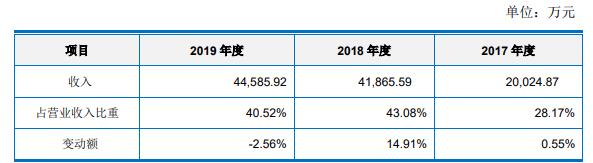
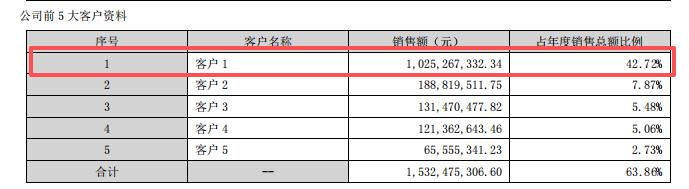
Figure / Prospectus of Cosmos Co., Ltd. (Left: Sales revenue from DSM of Cosmos Co., Ltd. from 2017 to 2019; Right: Sales revenue from DSM in 2023)
The prospectus shows that from 2017 to 2019, the revenue contributed by DSM to Cosmos increased from 200 million yuan to 446 million yuan, and its proportion in the total annual operating revenue increased from 28.17% to 40.52%. In 2023, DSM even contributed 1.025 billion yuan in revenue to Cosmos Co., Ltd., accounting for 42.72% of the total operating revenue of that year.
Correspondingly, the revenue of Cosmos Co., Ltd. increased from 711 million yuan in 2017 to 1.1 billion yuan in 2019. In 2023, the revenue of Cosmos Co., Ltd. reached 2.4 billion yuan. It can be said that Cosmos Co., Ltd. grew and expanded step by step relying on the orders from DSM.
If the story ended here, Cosmos Co., Ltd. would still be a hidden champion that never worried about selling its products as long as it had production capacity. However, the gift of fate has long been marked with a price in the dark.
In 2023, DSM and Firmenich completed the merger and became dsm-firmenich. The merged new group has richer supplier resources and multi-dimensional business development demands, so its dependence on Cosmos Co., Ltd. naturally decreased.
As a result, Cosmos Co., Ltd., which once made easy profits relying on major clients' orders, suddenly found that the orders were no longer guaranteed, while the market never waits for anyone.
In 2025, the operating revenue of Cosmos Co., Ltd. dropped from 2.4 billion yuan in 2023 to 1.483 billion yuan, a decrease of over 900 million yuan. Among them, DSM contributed 321 million yuan in revenue to Cosmos Co., Ltd. in 2025, accounting for 21.63% of the total revenue of Cosmos Co., Ltd. The cooperation amount between the two sides shrank by 704 million yuan compared with 2023, accounting for more than 70% of the revenue decline of Cosmos Co., Ltd.
Data proves that what defeated Cosmos Co., Ltd. is not the external market, but its own excessive dependence on a small number of clients.
With Advantages in Market Share, But No Bargaining Power
At the upstream of the hundred-billion-yuan sunscreen industry chain, ranking first in market share does not mean having bargaining power.
According to the cost structure calculation of domestic beauty brands, sunscreen agents are expected to account for about 20% of the cost of downstream clients' terminal products.
Take Proya as an example. Its gross profit margin in the first half of 2026 is as high as 74.32%, and the operating cost (including raw materials, production, packaging, etc.) only accounts for 25.68%. The survey information of Every Headline on sunscreen production factories points out that the core cost of sunscreen is the sunscreen material, which accounts for about 79.17% of the total cost of sunscreen products.
Calculated according to this, for a sunscreen with a final price of 159 yuan, the cost of the sunscreen agent contained in it is about 32 yuan. This is not a negligible number. When demand shrinks, brands have sufficient motivation to reduce this 20% of the cost.
And the demand is indeed shrinking.
One of the reasons for the slowdown in the demand growth of sunscreen cosmetics is the rise of hard sun protection. In recent years, physical sun protection methods such as sun-protective clothing, sun hats, and sun umbrellas have quickly diverted the demand for traditional sunscreen products by virtue of their unique convenience.
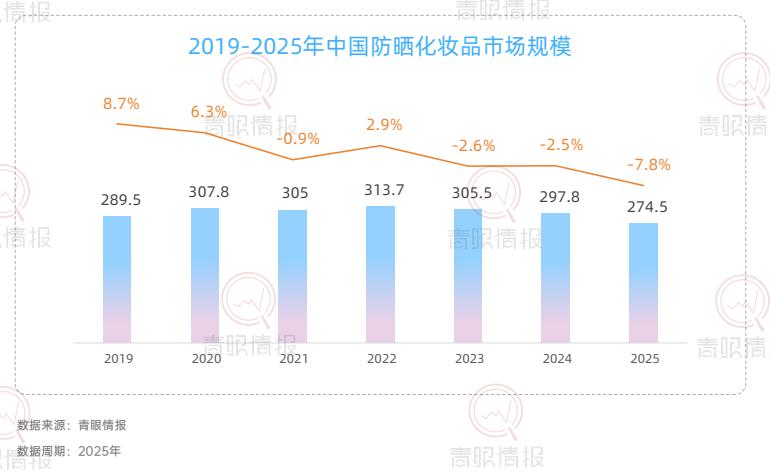
Figure / Blue Eye Intelligence
In 2025, the market size of sun-protective clothing and accessories in China has exceeded 88 billion yuan, and it is expected to reach 95.8 billion yuan in 2026. In contrast, the retail sales of sunscreen cosmetics in China in 2025 was 27.45 billion yuan, a year-on-year decline of 7.8%, which is the third consecutive year of negative growth after the industry scale reached its peak of 31.37 billion yuan in 2022.
While the demand is slowing down, the price competition on the brand side is also intensifying.
From January to November 2025, sunscreen products priced below 100 yuan contributed 5.588 billion yuan, accounting for 39.5%, with a growth rate of 20.44%, which is the fastest growing among the three price bands of below 100 yuan, 100-200 yuan, and above 200 yuan. This means that sunscreen brands are not only facing the slowdown of demand growth, but also need to compete downward in the price band.
Brands need to reduce product costs and lower selling prices to seize market share. As a cost item accounting for about 20% of the terminal selling price, sunscreen agents are naturally the first to be suppressed in price.
From the perspective of supply, sunscreen agents are a category under strict supervision. Major global markets have implemented strict regulations on the use of sunscreen agents. The US FDA has approved only 17 types of sunscreen agents for use, the EU has 29 types, and China has 27 types. To add new sunscreen agents to the access list, long-term and strict certification is required.
At present, most of the sunscreen agents circulating in the market have gone through long safety verification and regulatory approval, with mature technical routes, stable production processes, and highly homogeneous products.
In such a market, in the face of price suppression from upstream brands, even Cosmos Co., Ltd., which has the advantage of market share, has little room for maneuver.
In 2025, the sales volume of the cosmetic active ingredients and raw materials business of Cosmos Co., Ltd. was 14,000 tons, a year-on-year decrease of 21.35%; the average price was 81,100 yuan/ton, a year-on-year decrease of 24.14%, and the price decline was even more severe than the sales volume decline.
Under this background, it is not easy for Cosmos Co., Ltd. to turn back to the domestic market.
The financial report shows that in 2025, the domestic revenue of Cosmos Co., Ltd. was 270 million yuan, a year-on-year decrease of 9.02%, and it is still under obvious pressure in the face of the price war in the domestic sunscreen agent market.
In the same period, the proportion of the company's top five clients in total revenue decreased from 63.86% in 2023 to 41.68%. Although the client structure has improved, the volume contributed by new clients is still not enough to hedge the dual pressure of major client shrinkage and price decline.
The export dividend has turned into the risk of client concentration. When major clients reduce their demand, Cosmos Co., Ltd. tries to turn back to the domestic market, only to find that the growth rate of the domestic terminal market is slowing down and the price band is continuously moving downward.
Once major clients are lost, idle production capacity will make production costs soar rapidly, and then fall into the cycle of idle production capacity → rising costs → declining profits.
In 2025, the gross profit margin of Cosmos Co., Ltd. dropped from 48.83% in 2023 to 29.68% in 2025. In the first half of 2026, the gross profit margin of the company further dropped to 27.89%.
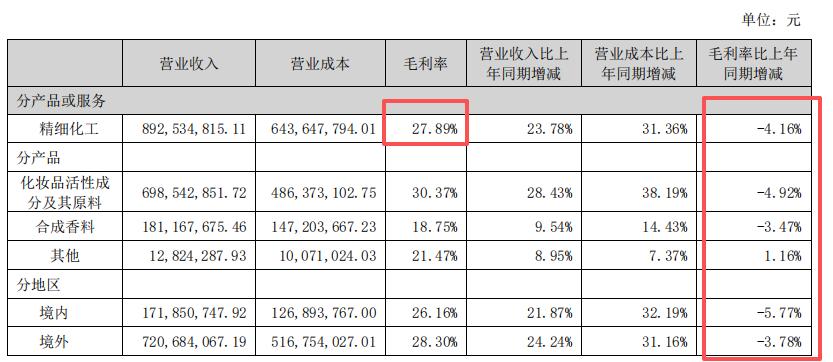
Figure / Financial report of Cosmos Co., Ltd. (Gross profit margin of Cosmos Co., Ltd. in the first half of 2026)
How Far Is It From Being an "External Factory" to an Independent Platform?
Although the 2026 semi-annual report data shows that the operating revenue of Cosmos Co., Ltd. has rebounded, its net profit is still bottoming out. Under the multiple pressures of underperforming company performance, shrinking major clients, and domestic market price war, Cosmos Co., Ltd. is not waiting for death.
With the three parallel strategies of building factories overseas, diversifying products, and expanding back to the domestic market, this leading enterprise trapped in the buyer's market is looking for a new way out for itself.
In addition to the cosmetic active ingredients and raw materials business dominated by sunscreen agents, Cosmos Co., Ltd. has been engaged in the synthetic fragrance business for more than 20 years, and it is one of the main manufacturers of products such as Lilial, 2-Naphthylethanone, and Synthetic Anethole.
In 2025, the revenue of the company's synthetic fragrance business was 324 million yuan, a year-on-year decrease of only 8.01%, which is far better than the 40.32% decline of the cosmetic active ingredients and raw materials business. However, its absolute value is still small, less than one third of the sunscreen business, and cannot make up for the decline of the latter.
In terms of personal care raw materials, Cosmos Co., Ltd. has expanded personal care raw materials such as amino acid surfactants and piroctone olamine (PO), which have now entered the supply chain of leading brands such as Unilever.
According to the financial report, the revenue of personal care raw