Has AI taken over all the deceptive product photos in the cross-border e-commerce industry?
Product images are becoming increasingly "stunning".
In the past, cross-border e-commerce merchants who wanted to shoot a set of product images had to find local models, rent studios, set up scenes, and retouch each image one by one. Now, by uploading one product photo, AI can change models and scenes in just a few minutes, and even generate a full set of images directly. The production cost of visual content has been greatly reduced, and products have gained more possibilities for "display".
However, as product images become more and more attractive, another problem has gradually emerged: Is "attractiveness" really what consumers want to see?
What AI pursues is promotional effect — making clothes more photogenic, products more exquisite, and images more compelling to drive purchasing desire; what consumers care about after receiving the goods is another thing: Is this the exact item I saw when placing the order?
This discrepancy is particularly prominent in the women's clothing sector. A dress worn by an AI model can be figure-flattering, drape smoothly, with perfect size and fitting effect; but when consumers actually receive the product, they may find that the length, cut, and fabric texture do not match the image at all. Earlier, Australian fashion brand Atoir was once questioned by consumers for using AI-generated model images, as it was considered that the brand might fail to truly present the cut and wearing effect of the clothing.
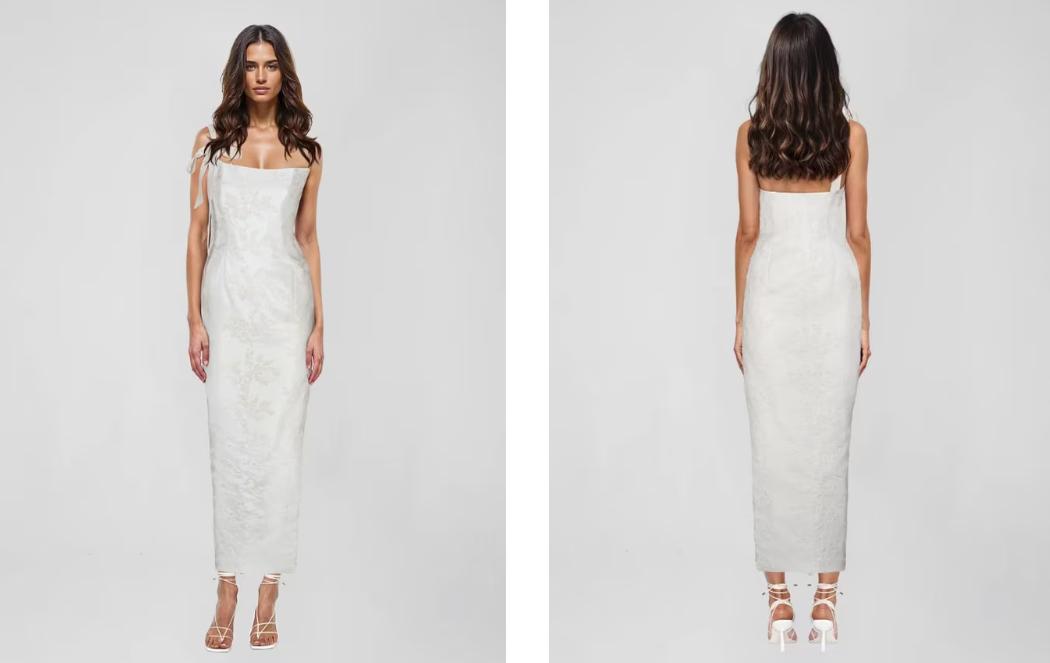
(AI-generated model images by Atoir, Source: The Iconic)
When similar problems keep popping up, e-commerce platforms have also started to draw red lines for AIGC content. Recently, TikTok Shop US explicitly required that AI-generated content must be authentic and accurate, and must not mislead consumers about the products, otherwise relevant accounts may face penalties.
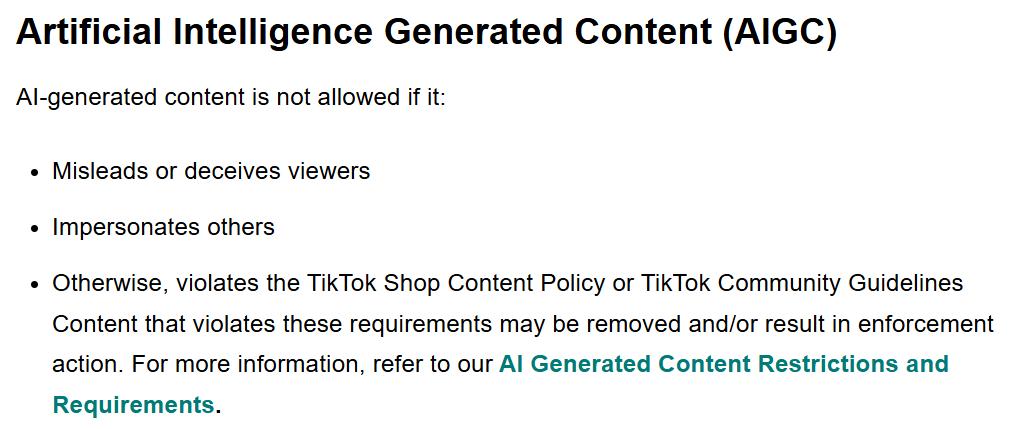
(Regulations on AIGC content on TikTok Shop US)
Visual attractiveness obviously still has value; but for the e-commerce industry, what truly determines whether consumers will place an order or return the product is the authenticity behind the "good-looking" images.
To this end, we selected 3 AI products launched this year that focus on cross-border e-commerce — SellShots, Morzai and Instant Studio for actual testing, and conducted a horizontal comparison from 6 dimensions: ease of use, generation speed, aesthetics, cross-border scenario adaptability, content authenticity, and workflow completeness.
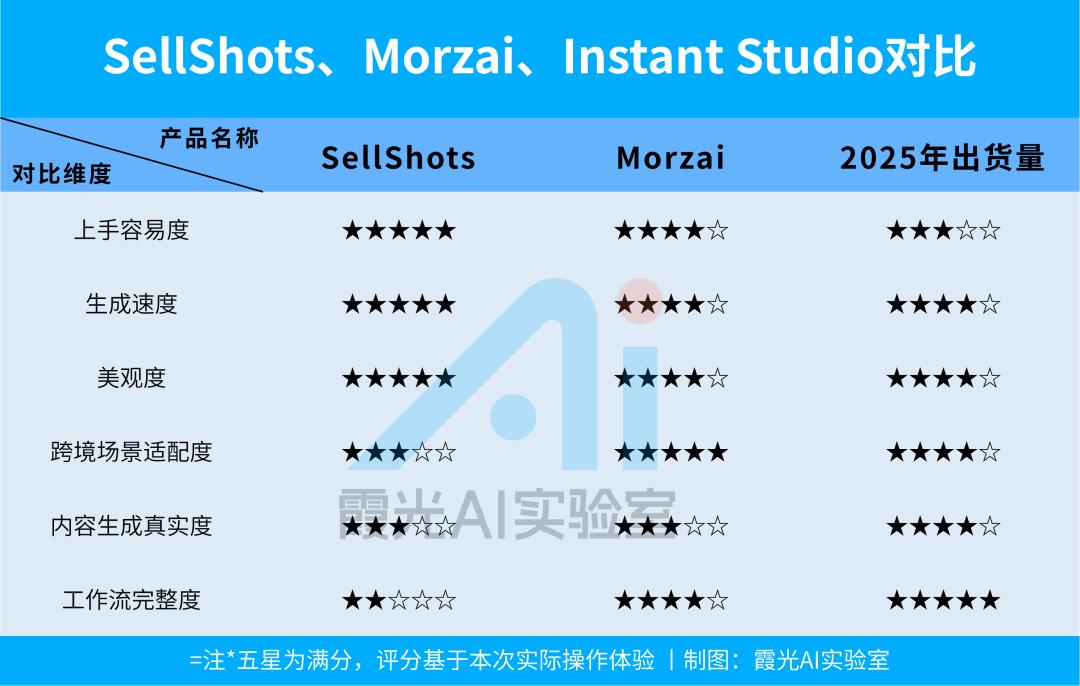
Among them, ease of use reflects the operation threshold and the complexity of steps; generation speed refers to the actual waiting time; aesthetics focuses on the overall texture and promotional expressiveness of the images; cross-border scenario adaptability covers multi-platform support, localization capabilities, and applicability to different regional markets; content authenticity pays attention to the restoration of product details and information accuracy; workflow completeness is used to judge whether the product can cover links beyond material production such as editing, publishing and testing.
SellShots: Generate stunning product photos in one minute
The first impression SellShots gives people is: It is simple, and can even be described as extremely minimalist.
The whole operation is almost zero-threshold "fool-style" operation. After uploading an original physical product photo, you only need to select the product category, sub-category, size, scene, and gender of the character in the scene. If you have specific ideas, you can add a few more requirements for the desired image, and you can directly generate 4 effect pictures. In actual operation, the whole process from uploading the image to getting the result only takes one minute.
If we only judge by the standard of "whether images can be generated quickly", SellShots performs quite well. Especially for merchants who are not familiar with prompts and have no professional design capabilities, they do not need to adjust parameters repeatedly, and can get results basically by following the options on the page. It also allows direct import of product links from Amazon, AliExpress, Shopify and other platforms to identify images directly. Although this function is not particularly novel, it does save the step of reorganizing product materials.
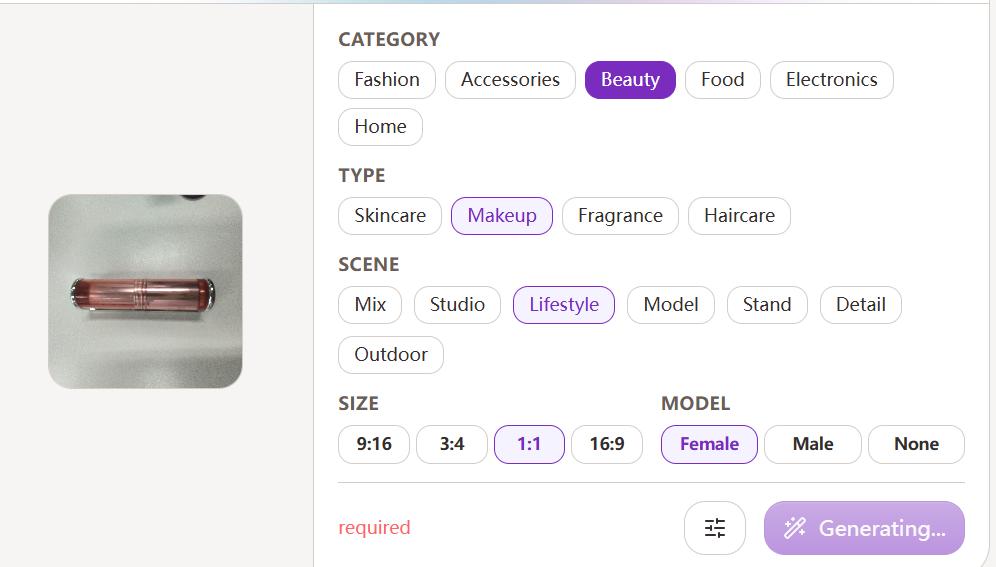
We used a real shot of a lipstick to generate 4 material images with one click:

It can be seen that the most obvious advantage of the generated content is that the product subject is prominent and the restoration degree is relatively high. The images do not simply change several backgrounds for the product, but add daily life elements such as bathrooms, dressing tables, flowers, and towels to integrate the lipstick naturally. There are both close shots and long shots, which are beautiful and full of atmosphere.
However, if you look carefully at the 4 images together, problems will also be exposed.
SellShots seems to be better at generating images that "look reasonable as a whole", and is not yet good at handling details that need to strictly follow real-world logic.
For example, in the second image, although the female shadow behind the window adds a sense of life to the picture, a closer look will find that the spatial relationship is a bit strange, and the shadow on the window looks like a "flaw".
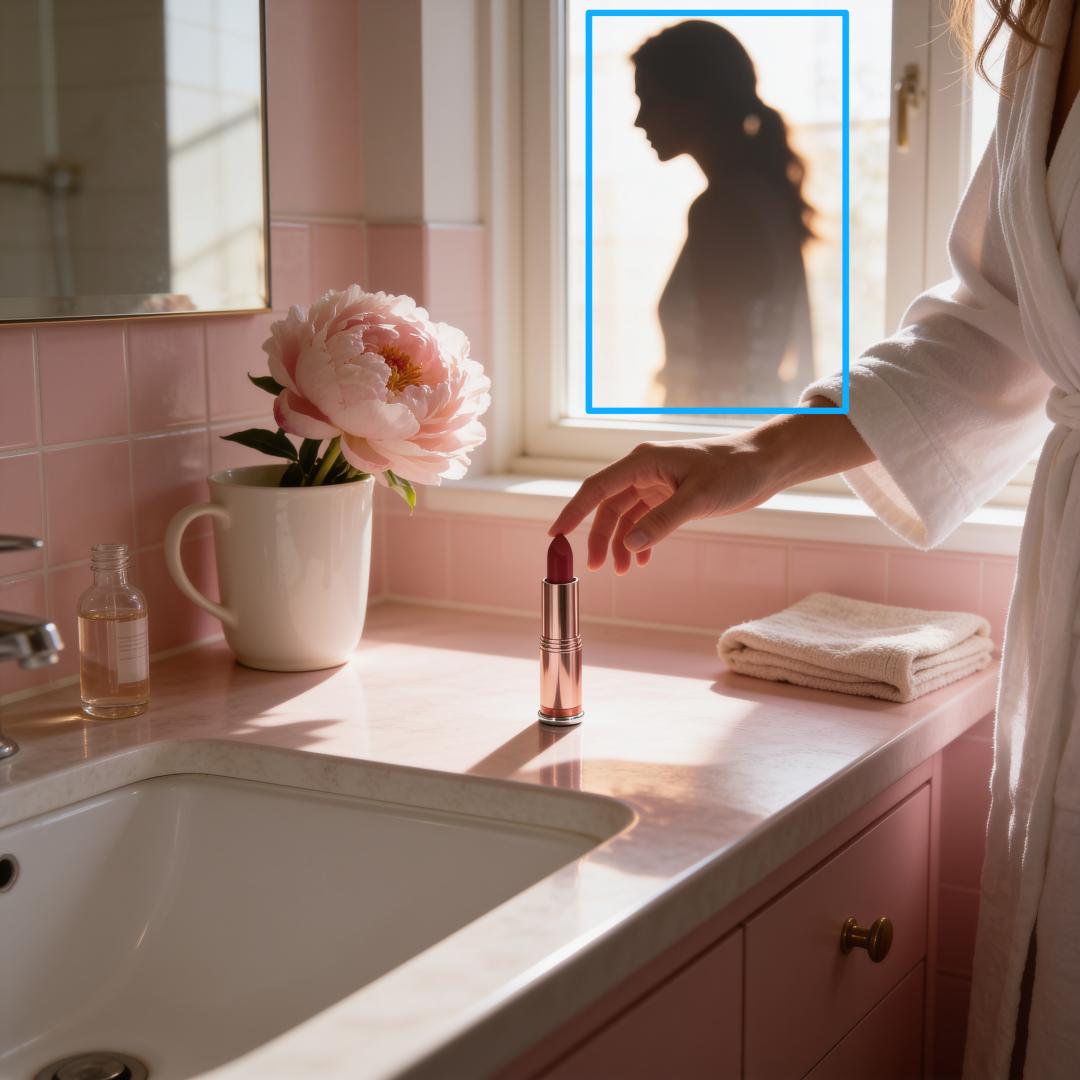
In the fourth image, the structure of the lipstick cap also changes, which is not completely consistent with the previous images.

These details may be difficult to notice at first glance when viewed alone, but if these 4 images are to be used as a set of promotional materials for the same product, they will appear not rigorous enough, but 1-2 images that can be used directly can still be selected.
Overall, for products such as lipsticks, perfumes, accessories, and home supplies that have high requirements for scene atmosphere and visual aesthetics and relatively simple product structures, SellShots has obvious advantages.
However, for products that are sensitive to structure, interfaces, number of buttons, logos and even product sizes, such as keyboards, headphones, 3C accessories, and mechanical equipment, more caution is needed. Because consumers of such products not only care about "whether it looks good", but also confirm "whether it is the exact item I bought". Once the structure changes during AI generation, the visual bonus may turn into misleading information.
In terms of price, SellShots adopts a monthly subscription system, with subscription plans of $19, $49, and $129. The most cost-effective plan is the $129/month plan, which includes 500 generations corresponding to 2000 images, equivalent to about $0.065 per image.

(SellShots subscription plans)
All in all, for merchants who need to produce a large number of visual materials quickly, the value of SellShots is quite clear. But it is not realistic to regard it as a complete substitute for real product shooting at present. At least from the content generated this time, the images are good enough, and the details still need manual checks. This is also a more important standard than "how fast it generates" when judging whether an e-commerce AI image generation tool can really enter the commercial process.
Morzai: Generate a full set of marketing materials from one image
If SellShots takes the "small but beautiful" route, then Morzai is more like a "large and comprehensive" e-commerce visual content factory. Its positioning is not just to generate a few product images, but to convert one product into a full set of relatively controllable content that can be directly used for marketing.
The most intuitive feeling when opening Morzai for the first time is: The functions are really comprehensive.
It has not only complete workflows such as AI videos and AI product image sets, but also very fine-grained tools such as AI color grading and clothing defect removal. However, it does not simply pile up popular AI functions. After careful experience, you will find that most of the platform's capabilities are developed around the vertical scenario of "apparel".
After creating a new project on the homepage, you can experience generating white-background images, detail images, and selling point images for apparel, completing product color changing, model try-on, AI clothing changing, and multi-language translation of image text, etc. These functions are not rare on their own, but what really differentiates Morzai is that it integrates the specific usage scenarios in cross-border e-commerce into the operation process.
Take the selling point image as an example. Users can not only choose the layout and language, but also set the copy tone (such as highlighting selling points, professional technology, strong promotional sense) and placement channels, including scenarios such as Amazon, Shopify product pages, advertisements and social media.

This means that what it generates is not just "a good-looking image", but will consider where the image will be placed, what market it faces, and what way to use to express. For merchants operating multiple platforms at the same time, this kind of localized adaptation is often more valuable than simply improving image quality.
The model wearing function also follows this idea. Morzai provides male models, female models, and model images of different skin colors and regional characteristics, and you can also choose poses, orientations and camera types. Merchants can quickly adjust models for different countries and sites, without reorganizing shooting for each market. From the perspective of efficiency improvement, this process is really attractive.
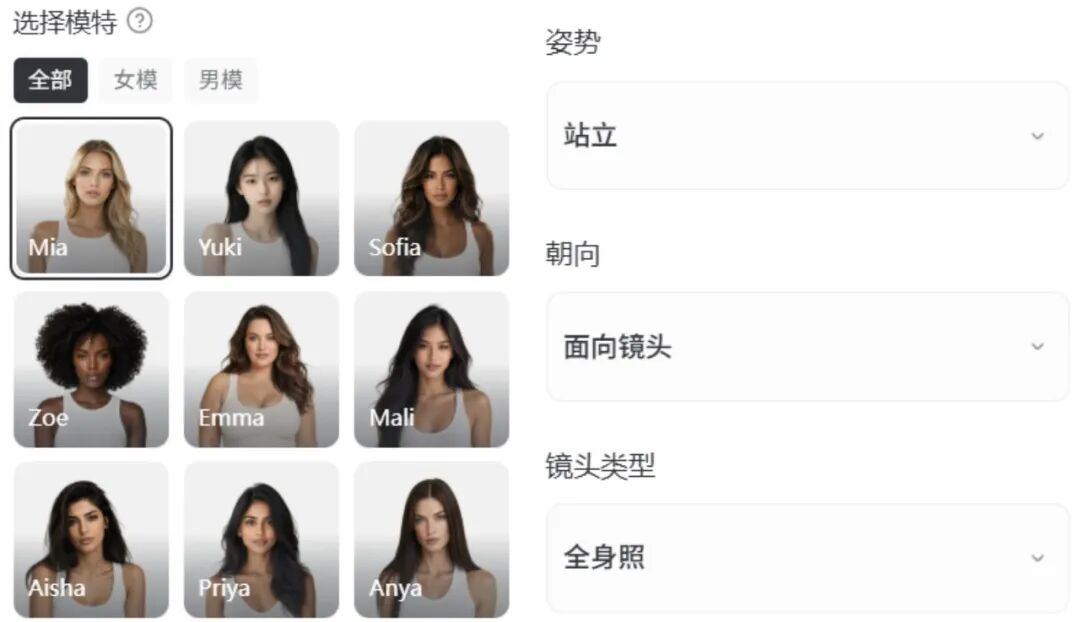
However, the generated content also exposes the typical problems of AI try-on.
We used the same off-white dress to match a plus-size black model and a petite Asian model respectively. In the generated results, the dress fits perfectly on both of them, with natural fabric, coordinated proportion, and exquisite visual effect. At first glance, it well conveys the feeling that "different body shapes can easily pull off this dress".
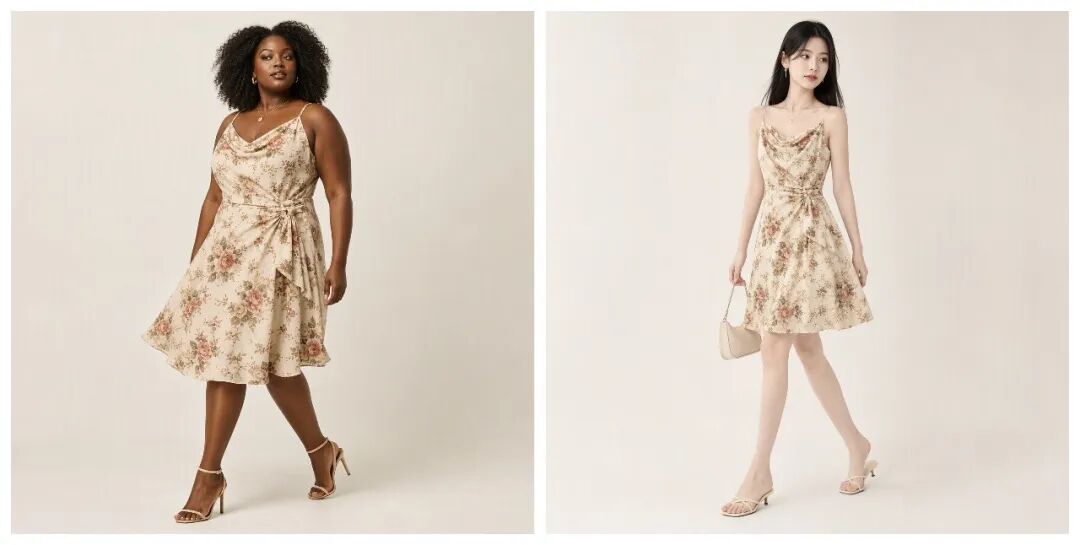
But the problem lies exactly in "it fits too perfectly".
In reality, even if the same dress provides different sizes, it is difficult to present almost the same fitting effect on consumers with large differences in body shapes. The waistline, shoulder width, skirt length and fabric drape will change, while AI often takes the initiative to correct these imperfections and make the dress automatically fit the model. The final generated image is more like an idealized advertisement image, rather than a try-on reference that can help consumers judge the cut and wearing effect.
In other words, Morzai knows very well how to make products look more sellable, but it may not necessarily allow consumers to understand the products more accurately. For merchants, it is an efficiency tool; for consumers, they need to be alert to the gap between the image and the real wearing experience.
Among all the functions, the one that best reflects the value of Morzai is the AI product image set. It can generate 7 images in total around one product image, including main image, model wearing image, scene image, detail image, selling point image, marketing poster and multi-angle display image.
We continued to use the above off-white dress as the base material, and selected "Amazon, European site, French". Due to points limit, only 4 of them were generated, and the whole process took about 1 minute. From the results, this set of images has almost no obvious problems in visual completeness: unified style, mature layout, clear product subject, and French copy is naturally integrated into the images. For merchants who lack design teams, they can be put into use directly after minor adjustments.
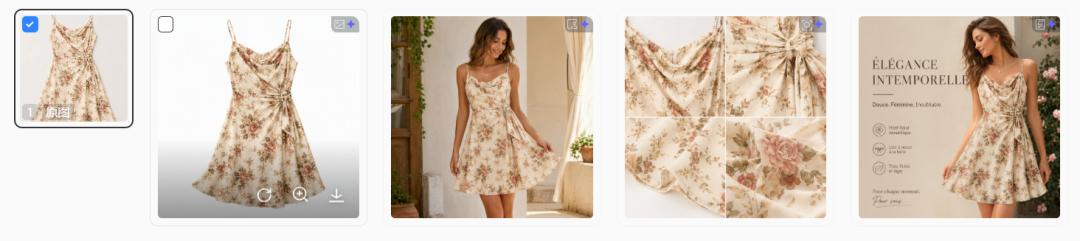
(Morzai AI product image set)
In terms of price, Morzai currently adopts the method of one-time purchase of points. The entry plan of $9.9 can get 5000 points, which can generate about 50 images or 7 videos; the $