The robot competition arena has begun to eliminate "participants with unbalanced capabilities".
Finishing 100 meters in 8.64 seconds — the moment when the humanoid robot Tiangong Ultra refreshed the human-related record, is one of the most exciting scenes at this World Humanoid Robot Games. Its "small-sized" teammate Tiangong Omni won the championship of the 400m small group with 45.66 seconds, and its slightly amusing "face-covering running" posture also quickly became a hit across social networks.
On the other side of the track, the atmosphere is far quieter. In the scenario competitions, robots are uniformly put into various tasks covering new energy vehicle charging, book sorting, hotel services, industrial operation, garden inspection, emergency rescue and other fields. These projects rarely have the dramatic scenes that come with record-breaking moments, but are much closer to the real scenarios where people are willing to pay for robot services.
The two types of competitions have perfectly laid out two core challenges of the humanoid robot industry in the same venue: one side pushes the physical performance to the limit, while the other side verifies the completion quality of real-world tasks.
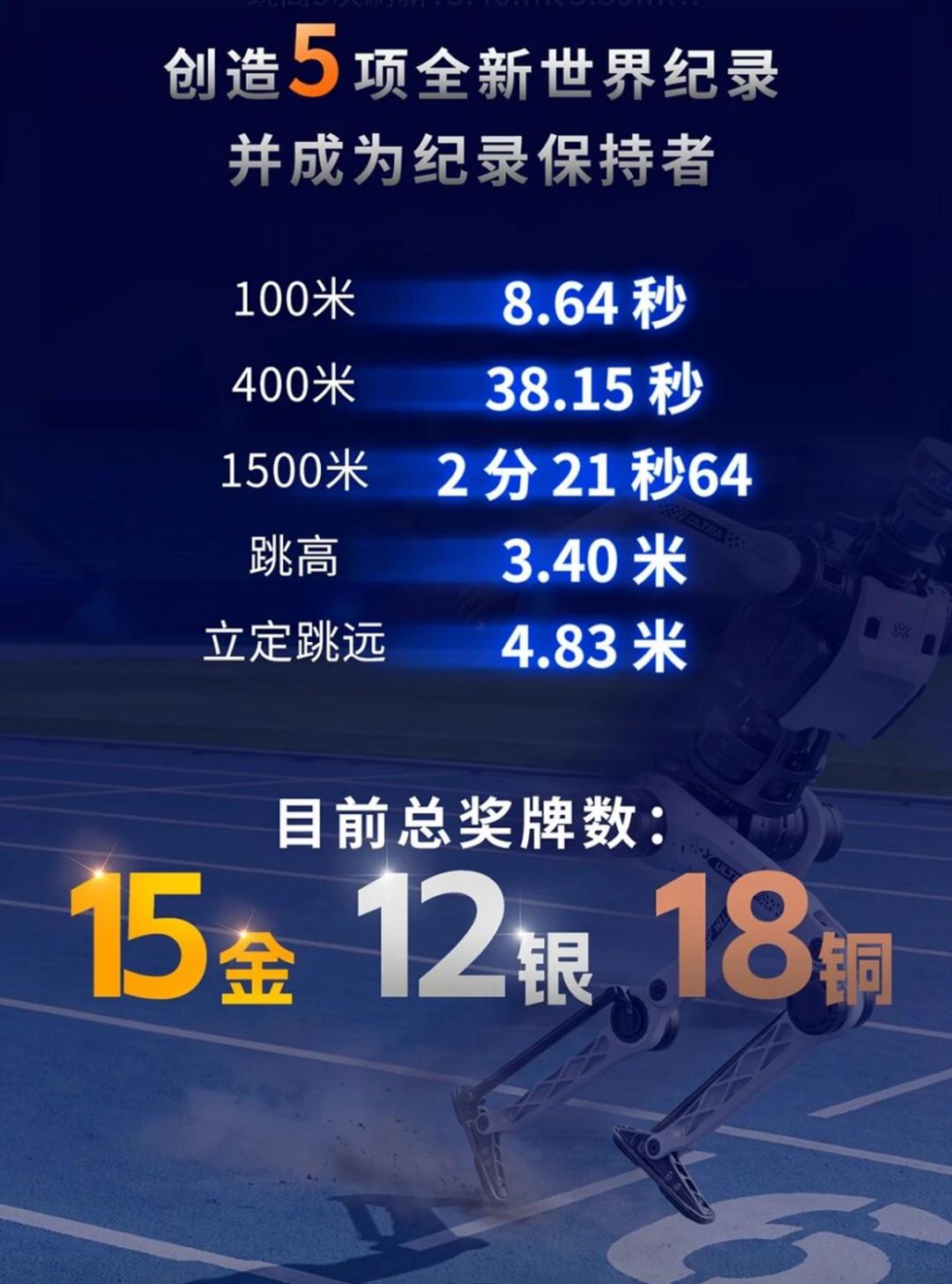
Beijing Humanoid Robot Innovation Center Co., Ltd. (hereinafter referred to as "Beijing Humanoid") has delivered an impressive result. It brought four robots including Tiangong Ultra, Tiangong Omni, Tiangong 3.0 and Tietian 2.5-TE to participate in 41 events, and finally took 15 gold medals, 12 silver medals and 18 bronze medals, ranking first in the total number of medals (data from official announcements). It performed outstandingly in both competitive races and scenario challenges, and is one of the very few all-around players in this event.
More interestingly, this report card that looks very much like a commercial company's "strength demonstration" comes from a national-local co-built innovation center. Commercial companies usually prove their strength through orders, but while focusing on the present, Beijing Humanoid also heavily invests in technologies whose market returns are not yet clear. Now, this platform route with heavier investment and longer cycle is ushering in its harvest period.
01. The robot competition eliminates "lopsided students"
In the past few years, humanoid robots have been particularly good at generating hot topics, and a dozen-second video of boxing or dancing can attract massive attention. But at the games, they face a completely different environment: no retakes, no post-editing, under live broadcast, countless mobile phone lenses and spotlights, the competition field will expose the real capabilities of robots under the timer and task rules.
When it comes to excitement, track and field must be on the list. The 100m race tests explosive power, the 400m race begins to challenge curve control, and the 1500m race needs to balance speed and energy consumption. Tiangong Ultra not only set the fastest 100m record of 8.64 seconds, but also won the 400m gold medal with 38.15 seconds, and claimed the 1500m championship with 2 minutes 21.64 seconds. Once the speed of the robot increases, it will bring huge challenges to the joints, motors and control systems.
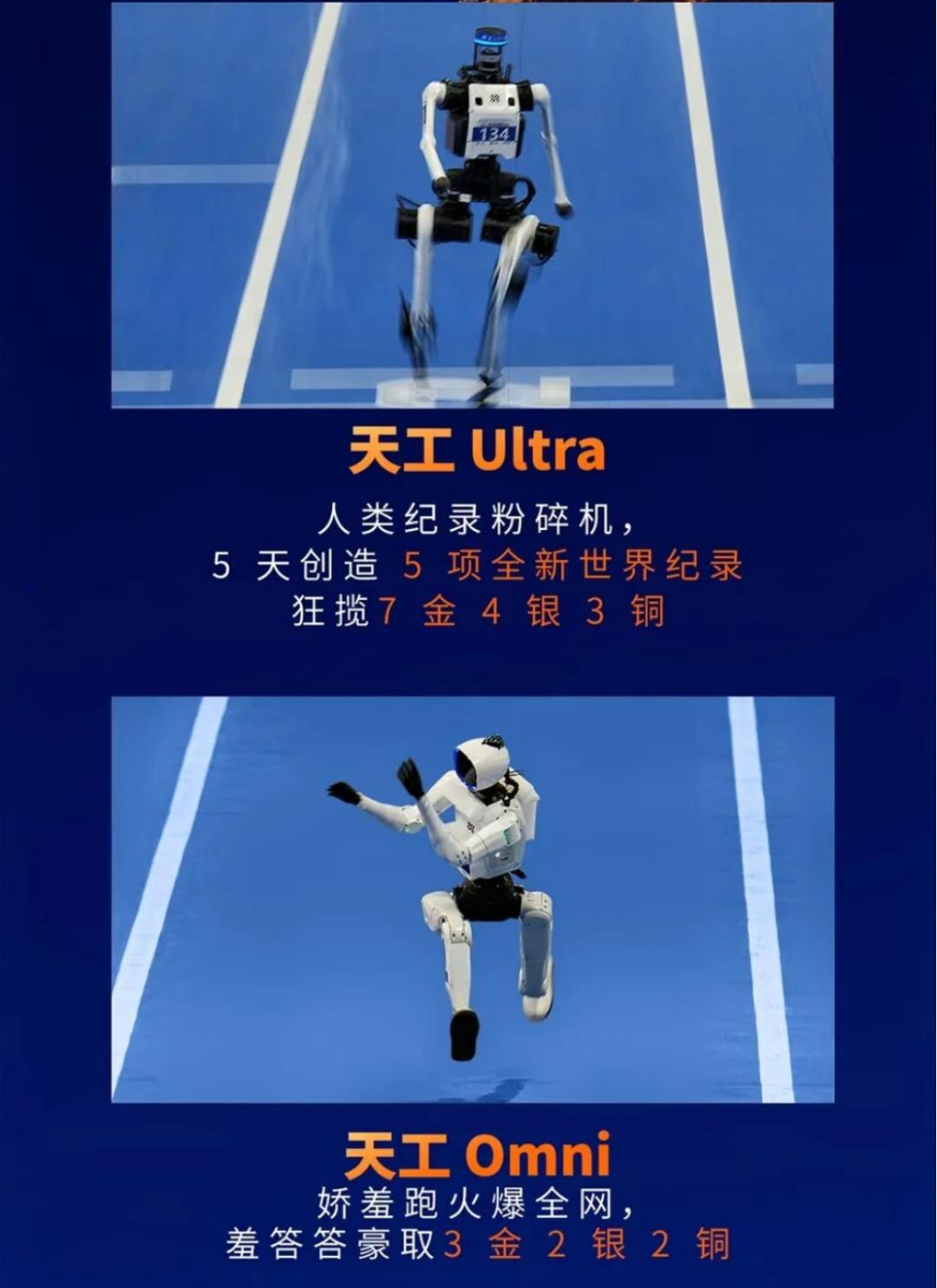
The faster the speed, the greater the landing impact and joint load the robot bears, and the higher the motor temperature will be. This requires the R&D team to find a balance between body weight, power and heat dissipation, and the algorithm must also correct the gait at any time. If any link fails, the competition may be lost at any time.
The rules of scenario competitions are more complex. Taking the "smart charging service post" as an example, the robot needs to open the charging port covers of three types of cars, and then complete the actions of taking the gun, inserting the gun and pulling out the gun with accurate movements. Book sorting is similar: the robot needs to learn to judge the position of books and bookshelves, so as to "pick up" and "place" correctly. Even if the surrounding environment changes, the robot can still continue to complete the task, which is the embodiment of generalization capability.
In the closing ceremony, the "Comprehensive Five Events" as the finale project of scenario competitions is more like a complete display of Beijing Humanoid's technical concept. Tiangong 3.0 won both gold and silver medals with the whole-body control (WBC) technology, and also became the only biped humanoid robot that won the gold medal in the scenario competitions. Unlike most peers in the industry that apply whole-body control to demonstration movements such as dancing and gymnastics, Beijing Humanoid further pushes WBC to real task execution, which requires the robot not only to "complete the movements", but also to perceive and operate while moving in continuous tasks, to coordinate the legs, torso and arms uniformly, and complete whole-body mobile operations such as grasping, handling and interaction during the movement process.
Behind this, it is necessary to deal with complex problems such as dynamic balance, multi-contact constraints, hand-foot coordination and external disturbances at the same time, which puts forward higher requirements for control accuracy, real-time performance and robustness.
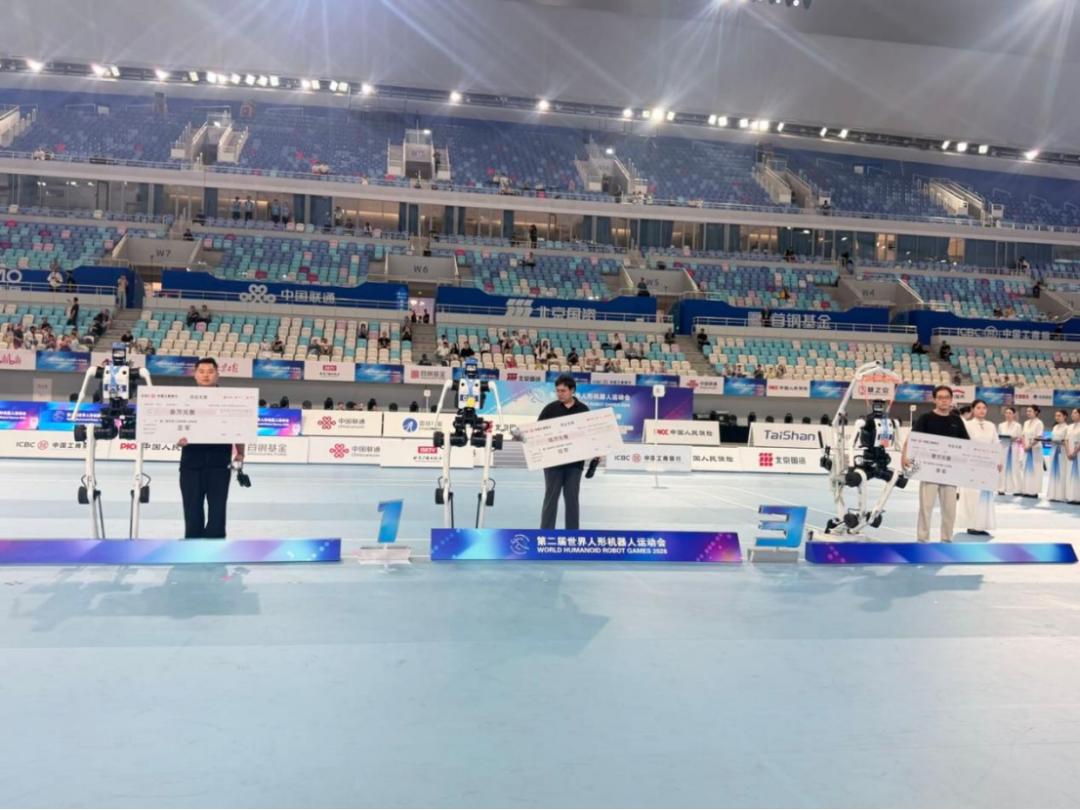
If the track and field field pushes the instantaneous performance to the limit, the scenario tasks will test the reliability and generalization ability of the robot, and both capabilities are indispensable puzzles that general-purpose humanoid robots must complete. Especially in low-fault-tolerance scenarios such as factories and rescue, one mistake may interrupt the whole process, or even bring safety risks.
It is not easy to take into account both capabilities. The body needs to respond quickly to model instructions, and feed back the deviation in the execution process to the system in real time. The faster the speed, the shorter the time left for error correction; the longer the task, the higher the probability of error accumulation. Algorithms and hardware need to be repeatedly adjusted and optimized in a large number of practical experiences, which is also the reason why embodied intelligence is more difficult than pure software models.
In this event, Beijing Humanoid sent four "examinees" with clear divisions of labor. Tiangong Ultra is responsible for sprints, long-distance races and jumps, pushing the high dynamic motion capability to the upper limit; the smaller-sized Tiangong Omni is responsible for sprints and obstacle races, verifying perception movement and agile control; Tiangong 3.0 is responsible for the comprehensive five events, challenging cheerleading, weightlifting, tug-of-war and emergency tasks, and won the championship in the comprehensive five events with obvious advantages; Tietian 2.5-TE is responsible for operation projects such as new energy vehicle charging and book sorting, demonstrating long-process operation capabilities.
In the end, they not only ranked first in the total number of medals, but also became a rare company in this event that successfully fought and won on two fronts in both competitive races and scenario competitions.
02. How is the all-star team built
Among a large number of embodied intelligence manufacturers, why is it a national-level innovation center that ranks first in the medal table? This starts with its platform route.
In November 2023, Jingcheng Electromechanical, UBTECH, Xiaomi Robot, Yizhuang Robot and other units jointly initiated the establishment of Beijing Humanoid. At the beginning of its establishment, it listed general ontology and embodied intelligence models as the direction of common technology research. In April 2024, the robot mother platform "Embodied Tiangong" was released; in March of the following year, the general embodied intelligence platform "Huisi Kaiwu" was launched.
In the same year, Beijing Humanoid was upgraded to the National and Local Co-built Embodied Intelligent Robot Innovation Center, and the parallel development of software and hardware has become the core of its platform route.
"Embodied Tiangong" is a scalable ontology foundation, where joint systems, mechanical configurations and motion capabilities are precipitated, and then form products such as Tiangong Ultra and Tiangong Omni. "Huisi Kaiwu" adopts the architecture of "embodied brain for decision-making, embodied cerebellum for execution": the brain is responsible for parsing instructions and on-site information, and the cerebellum converts decisions into movements.
Both the competitive tasks and scenario tasks this time are built on these two layers of platforms. The four robots fight separately, but share the same set of technical logic behind them: One brain for multiple robots, one technology for multiple uses — this solves the two most realistic costs of robots: development time and delivery cost.
"One brain for multiple robots" refers to the cross-ontology reuse of robot models. Traditional robot systems are usually developed around one specific ontology. After replacing the ontology, the "brain" is forced to be redeveloped from scratch. The unified embodied model Pelican-Unify released by Beijing Humanoid this year solves this problem: the same plug-in task can be migrated to another robot without retraining from the very beginning. This can not only reduce redundant R&D work, but also allow one set of model and data to serve more products.
"One technology for multiple uses" enables robots to achieve cross-scenario migration. "Huisi Kaiwu" splits a complex task into basic skills such as moving, grasping and placing, and then recombines them according to specific tasks. For example, the grasping skill learned by the robot in handling tasks can be used for sorting projects; the mature navigation capability that has been well trained can also serve charging or inspection tasks.
This idea has obvious effects in practical tasks.
Li Guozhen, head of the embodied intelligent industrial application team of Beijing Humanoid Robot Innovation Center, mentioned when reviewing the scenario competitions that there are many engineering problems in the new energy vehicle charging scenario. For example, outdoor light will amplify the perception error, and the robot may encounter cable winding during the movement process. The robot needs to coordinate navigation, obstacle avoidance, plan movements, and complete the final fine plug-in operation.
Thanks to "Huisi Kaiwu", the team assigned perception, movement and plug-in operations to different models for processing. Li Guozhen said that even if there is a problem in a certain link, the team can carry out independent optimization for this specific link, thus reducing the debugging complexity of long-process tasks. At the same time, this architecture can also precipitate capabilities into skill packages, which can be used in unmanned vehicle station energy replenishment, highway charging services and other scenarios in the future.
The ontology solves the problem of "what you have", the model solves the problem of "how to use it", and the ecosystem determines "how far you can go". It brings Beijing Humanoid's platform out of the original R&D team and allows more forces to participate.
At this games, Beijing Humanoid cooperated with more than 30 universities and industrial partners including Tsinghua University, Peking University and Shenzhen University, organized more than 60 teams, and used nearly 200 robots to participate in the competition. Beijing Humanoid opened platforms and toolkits for participants, allowing different teams to develop on the same technical base, and also allowing the platform to get more exercise in real scenarios.
The ecosystem is also the only way for embodied intelligence to cross the threshold of large-scale application. The industrial tasks faced by robots are highly scattered, and it is difficult for one company to fully master all processes alone. After opening the underlying capabilities, industrial partners can solve problems they are more familiar with respectively, and finally make the platform capabilities stronger.
Only when technical capabilities go beyond the boundary of a single company, can the experience of all participants be transformed into the common accumulation of the whole industry. This road is destined to take a longer cycle, and it also brings Beijing Humanoid to the next exam question: as a national-level innovation platform, it must also tackle those tough problems that are difficult to get returns in the short term but determine the future of the industry.
03. The "national team" tackles tough problems
The whole embodied intelligence industry is facing a reality: when more and more robots enter factories and service places, "lopsided" players are increasingly difficult to get new orders. Nowadays, robots that can only dance or box are no longer new. Only systematic capabilities can determine whether an enterprise can cross the most important commercialization threshold.
For this reason, the "national team" attribute of Beijing Humanoid is even more important. It not only needs to develop models and complete machines, but also build a base around common industry problems, and promote the flow of achievements to the whole industry.
This means that it has to do some work that is not commercially convenient. The model R&D cycle is very long, and making standardized interfaces can hardly generate revenue immediately. Facing the pressure of survival, pure commercial companies usually give priority to developing scenarios that can quickly form orders, while national-level innovation platforms not only need to look up to the technical no-man's land, but also bow down to deal with various "dirty work" in engineering.
Beijing Humanoid chooses to precipitate these underlying investments into an open platform. It opens both ontology and software at the same time: the mechanical drawings, robot description files and SDK of Tiangong have been opened to developers, and "Huisi Kaiwu" provides model capabilities and tool chains. Developers can continue to train and deploy on the existing achievements, reducing the cost of repeatedly building basic systems.
The industry often says "don't reinvent the wheel", but for humanoid robots, even the size and interface of the "wheel" have not been unified yet. A lot of adaptation work is needed when different ontologies connect to the model, and application parties need to re-understand the underlying system after purchasing robots. The role of Beijing Humanoid is to "empower": it helps partners skip the stage of repeatedly building underlying systems, directly carry out adaptation around industry demands, and make robots move towards project delivery faster.
In other words, this "national team" is taking a more practical industrial route: while promoting the implementation of technology, it expands scenarios together with partners through the open platform, and brings capabilities into more industries.
As mentioned in the comprehensive five events above, Beijing Humanoid is promoting the evolution of WBC from a "single skill controller" to a general whole-body control model. Aiming at the challenge of huge differences in motion capabilities required by different tasks in the competition, by introducing the MoE multi-model fusion architecture, different motion and operation capabilities are unified into one set of control framework, which dynamically calls and combines different control capabilities according to robot status, task objectives and environmental changes, realizing the natural connection of skills such as walking and running, posture and height adjustment, and whole-body collaborative operation. The gold medal in this event verifies not only a single movement, but also the general motion intelligence and whole-body autonomous operation capability of the robot when facing continuous, diverse and unstructured tasks, which is also an important verification for the whole-body control technology to move from "high-dynamic demonstration" to "working in real scenarios".
For Beijing Humanoid, this is a kind of long-termism: continu