Posting a historic single-day rally, NVIDIA's market value surged by nearly 3 trillion overnight.
"The AI industry has reached an inflection point, where every token generates productivity and profits." This remark by Jensen Huang, CEO of NVIDIA, has been proven by the capital market with a trillion-level market value after the release of the financial report.
At the close of trading on August 27, Eastern Time, NVIDIA's share price surged 8.74% to close at $227.98, with its total market value skyrocketing to $5.49 trillion. The single-day market value increased by $441.5 billion, equivalent to about 2.97 trillion yuan, marking the second-largest single-day market value increase in the history of the US stock market, only second to the previous $450 billion single-day growth record set by Microsoft.
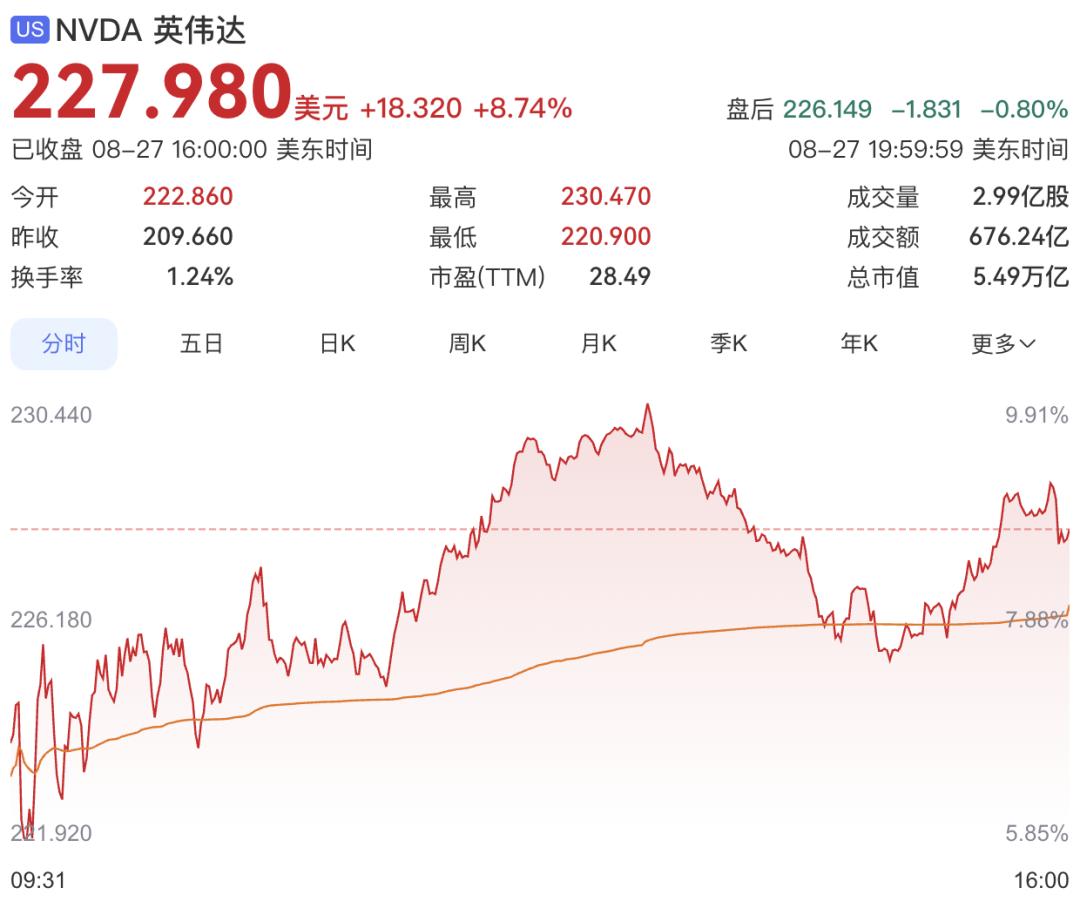
Just a few trading days ago, this AI chip giant experienced a round of stock price pullback, falling for seven consecutive trading days at one point, setting the longest consecutive decline record since September 2022. On August 24, its market value evaporated by $151 billion in a single day, equivalent to about 1.02 trillion yuan, and the total market value fell back to the range near $5.05 trillion.
At that time, the market was permeated with worries. The rising yield of US Treasuries suppressed high-valuation tech stocks, and many investors began to discuss whether the AI capital expenditure cycle was approaching its peak, and the market chose to take refuge and flee in advance before the financial report disclosure.
Three trading days later, NVIDIA ushered in a skyrocketing market value again, mainly due to the company's newly released financial report for the second quarter of fiscal year 2027.
This financial report, which ended on July 26, shows that its total quarterly revenue reached $96.221 billion, up 106% year-on-year and 18% quarter-on-quarter. Both GAAP (under U.S. Generally Accepted Accounting Principles) and non-GAAP gross margins remained at a high level of 75.0%, and non-GAAP diluted earnings per share reached $2.22, far exceeding the consensus expectation of the Wall Street market.
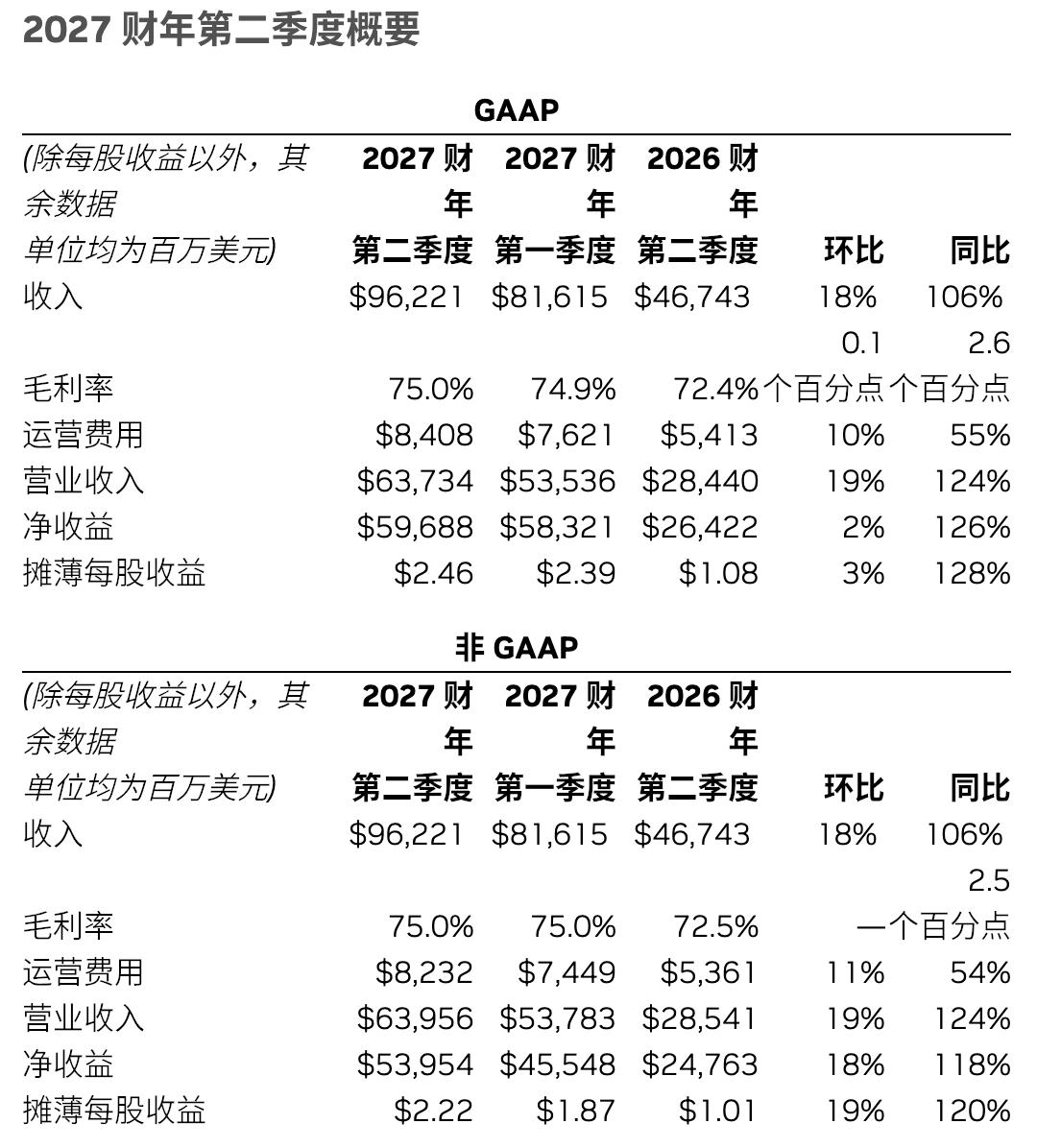
Data source: NVIDIA financial report
The data center business remains the absolute core of NVIDIA's performance growth, with single-quarter revenue of $89 billion, a year-on-year increase of as high as 117%, contributing the vast majority of the company's revenue increment. At present, NVIDIA's new-generation Vera Rubin platform has entered full mass production, and a number of software and hardware products for AI agents and physical AI have been launched simultaneously. Meanwhile, the company announced that it will cooperate with a number of global financial institutions to leverage more than $5 trillion in third-party capital to invest in AI infrastructure construction, further expanding the imagination of industry growth.
What really stimulated the stock price, however, was the future growth expectation given by the management. When talking about the performance outlook for the third quarter of fiscal year 2027, NVIDIA said it expects quarterly revenue to reach $108 billion, with a fluctuation of plus or minus 2%. This performance outlook does not include the revenue from the data center computing business in Chinese mainland and Hong Kong, and the expected GAAP and non-GAAP gross margins are 74.0%, with a fluctuation of 50 basis points.
In the subsequent earnings call, NVIDIA rarely gave the full fiscal year's growth guidance in advance, predicting that the total revenue for fiscal year 2028 will achieve a year-on-year growth of about 70%. This figure is much higher than the previous market consensus expectation of 45%, and it is also the first time in NVIDIA's history to release the full-year revenue growth outlook to the public.
Jensen Huang said in the earnings call that the current actual market demand growth rate is higher than the 70% guidance figure, and supply constraints are the core bottleneck limiting the company's further expansion.
In the after-hours phase right after the release of the financial report, the market reaction was once very contradictory. NVIDIA's share price fell briefly in the after-hours trading session, and some traders only focused on the quarterly financial report figures.
As the management disclosed key information such as long-term orders, supply constraints, and full-fiscal-year growth guidance during the earnings call, the market perception reversed rapidly, and capital began to re-evaluate NVIDIA's long-term value logic. The market focus shifted from "how much money did it make this quarter" to "how far can the growth cycle of AI computing power go". The huge undelivered orders from cloud vendors, the new computing power demand brought by AI agents and physical AI, and the global wave of large-scale AI factory construction together form the realistic foundation supporting high growth.
After the release of the financial report, Wall Street quickly set off a wave of raising target prices, and more than a dozen mainstream investment banks updated their research reports simultaneously, collectively bullish on NVIDIA's subsequent trend. According to preliminary statistics, at least 13 institutions have raised NVIDIA's target price.
Among them, Raymond James raised NVIDIA's target price from $352 to $515, becoming the highest target price in the current market, corresponding to a target market value of nearly $12.4 trillion. Goldman Sachs raised the target price from $285 to $300, reiterating the buy rating. James Schneider, an analyst at Goldman Sachs, believes that if NVIDIA continues to cooperate with technology companies to promote data center construction and further bridge the gap between customer demand and supply, the company is expected to achieve performance exceeding the guidance in fiscal year 2028.
Charu Chanana, chief investment strategist at Saxo Markets, commented that NVIDIA's biggest positive at the moment is not the better-than-expected performance of the latest quarter, but the management's guidance of about 70% revenue growth for fiscal year 2028, which is a strong refutation of the argument that "the AI capital expenditure cycle has reached its peak".
Of course, under the optimism of institutions, the market has not ignored potential risks. Research reports from a number of securities firms indicate that the rising cost of memory chips such as HBM will put certain pressure on the gross margin of subsequent quarters. Changes in geopolitical policies, the impact of competitors' self-developed chips, and fluctuations in the global macro economy may all disturb the subsequent performance delivery. NVIDIA also warned in the forward-looking statements of the financial report that the actual operating results may differ significantly from the current performance outlook.
From seven consecutive declines to a single-day surge that set a historical record, this round of drastic stock price fluctuations of NVIDIA has gone beyond the financial report market of a single company. In essence, it is a collective vote of the global capital market on the AI industry cycle. But whether the company can continue to deliver high growth guidance in the future still needs to be verified by the performance of subsequent quarters.
This article is from the WeChat official account "Jiemian News", written by Song Jiannan, and published with authorization from 36Kr.