The price of running shoes has dropped from 1699 yuan to 500 yuan, marking the end of the golden five-year era of the running shoe industry | Shenke
By | HE Zhexin
Edited by | QIAO Qian, YANG Xuan
At noon on July 1, 2026, Yan Peng, a 59-year-old Shaanxi-based businessman, fell to his death from the 7th floor of Xi'an SEG International Shopping Center.
Yan Peng was the head of Lihe Trading, the provincial distributor in Shaanxi for sports brands including Nike, Adidas, Puma, and New Balance. At its peak, he operated 400 to 500 stores, with annual sales reaching 850 million yuan.
One of the triggers was a contract dispute that took place four years ago: a store clerk split one order into two and used an extra shopping mall voucher, based on which the mall assessed a penalty of 11.456 million yuan. After years of declining performance, in June this year, the mall issued a clearance notice to Yan Peng's stores in accordance with the so-called "last-place elimination" system.
This tragedy is a microcosm of the changes in the sports retail channels over the past few years. China's athletic footwear and apparel market has experienced a period of rapid double-digit growth in the past five years, with shopping malls, distributors and brands sharing the expansion dividends. Among all categories, running shoes became the most imaginative segment: carbon plate technology pushed up product prices, the marathon boom drove market demand, and running shoes priced at over 1,000 yuan became a new engine for brand growth. Back then, no brand was willing to talk about discounts voluntarily.
In the past five years, the running shoe market has been in an undisputed "super cycle", standing out as the biggest growth highlight in the entire sports industry. However, in July this year, the industry observation released by the International Association of Department Stores (IADS) stated that this "super cycle" is showing obvious signs of slowing down.
Distributors felt the chill much earlier: Topsports, the largest retail distributor of Nike and Adidas in China, recorded a 4.7% year-on-year revenue decline to 25.7 billion yuan in fiscal year 2025, with net profit dropping by 1.5%. In 2025, the growth rate of China's athletic footwear and apparel market was only 7%, and the latest quarterly reports (2026Q2) of sports brands began to release new signals: Xtep and Li-Ning recorded low single-digit year-on-year declines in revenue, the growth rate of Saucony slowed down significantly, and the growth rate of ANTA fell to single digits.
All players are still talking about technology, materials and professional performance. But on the channel side, more and more people are doing the same thing — cutting prices.
A price war that no one is willing to admit has already broken out.
An Accelerating Cycle
The running trend in China has lasted for more than a decade: Wang Shi led the running culture among entrepreneurs and elites, running apps such as Codoon and Joyrun, as well as city running groups emerged, and the number of marathon events in China kept rising. But running shoes did not become a highly profitable business until after 2021.
In 2021, several major events took place in China's footwear and apparel market: the Xinjiang cotton incident boosted the rise of domestic trendy consumption, European and American fast fashion brands withdrew from the market, international sports brands successively implemented direct sales channel reform, and the recurring COVID-19 outbreaks made outdoor sports unexpectedly one of the few growing segments in the apparel market.
A consumer investor judged that the rapid growth of the running shoe market was first the result of business adjustments by traditional sports giants. As the saying goes, "When a whale falls, all things thrive": after Nike withdrew from major North American retailers, On Running gained more shelf space and also recruited marketing talents from Nike. Around the same time, after Nike shrank its domestic distribution channels in China, HOKA secured a cooperation opportunity with Topsports. International sports brands lost a lot of market share due to the Xinjiang cotton incident, which also gave domestic brands a window to overtake on a curve.
The explosive growth of the running shoe business is obvious to all: On Running and HOKA, which take running shoes as their core category, have delivered impressive growth curves for consecutive years, and all domestic brands hope to seize this round of consumption dividends as soon as possible. In November 2023, Xu Yang, then CEO of ANTA's footwear division, said in an interview: "What are the best brands in the market right now? On Running, HOKA, Arc'teryx, Salomon, right? They all share a common feature: they are small, focused on niche segments, and flexible."
That year was also a turning point for ANTA's running business. At the beginning of the year, Xu Yang recruited CHENG Yang from Joyrun to serve as the head of the running category. ANTA's midsole technology "Nitro Technology" was also iterated that year, with an energy feedback rate of 89% as claimed by the brand — 100 units of force applied when stepping down would return 89 units from the midsole. The new material was adopted in the top-tier racing shoe C10Pro launched that year, priced at 2,599 yuan, 1.5 times more expensive than the first generation. A year later, Eliud Kipchoge wore it to finish the marathon at the Paris Olympics.
But that pair of shoes for the Olympics was not designed to drive sales. To really catch up with the growth curve of On Running and HOKA, the brand relied on hundreds of other shoe models under that top-tier product line, and the development logic of those shoes was much simpler and more straightforward than the stories displayed in the shop windows.
"You can't make arbitrary design judgments, you can only rely on data. Data never lies." A former designer of a domestic sports brand recalled the development logic of most running shoes back then to 36Kr.
"The boss would ask: Who is selling well this year? Okay, then you break it down: what material is the upper, what material is the outsole? People from the supply chain come over to quote, calculate the cost of their product, and see if we have similar materials. After the cost is calculated, the planning department discusses the pricing. Their product is sold at 1,100 yuan, okay, then we will price ours at 700 yuan."
"Almost the entire industry operates in this way," he added. This practice is the "benchmarking" and reverse development logic that has long been popular in China's manufacturing industry.
Cutthroat competition is also a conventional operation for Chinese brands. Different from international sports brands that hold two order fairs a year, domestic sports brands usually hold four quarterly order fairs, and there are two rounds of selection meetings before each order fair. Taking ANTA as an example, it goes through 12 product selection sessions a year. "And ANTA is well known in the industry for trying its best to present highlights in every selection meeting."
Such a high-frequency and high-demand development rhythm kept the product team in a non-stop rush for a long time. Working overtime until late at night was the norm. After several years, the designer's physical health indicators showed widespread abnormalities.
But over the past few decades, Chinese brands represented by ANTA have accumulated strong sales capabilities and scale advantages, making this high-paced operation possible. "If any other brand tried to do this, the factories would not even bother to respond."
The mature upstream supply chain further makes it possible for domestic brands to quickly imitate products and cut prices rapidly.
The midsole used to be the main source of premium for running shoes. Traditional running shoe design requires a balance between cushioning, weight and energy feedback. New technologies represented by supercritical foaming materials have improved the performance of the midsole while reducing the weight of the shoe. In the past few years, China's supply chain has been a key promoter of the technological progress of running shoe midsoles.
Renowned running shoe reviewer Wang Hui once revealed to *The Atlantic* that the cost of domestic polyether block amide (the chemical component of midsole foam) is only about 35% to 50% of that of imported versions. He also explained that other components of running shoes, such as the outsole and upper, are produced in factories in Fujian and Guangdong provinces, adjacent to the midsole foam plants. "Basically everything needed to make running shoes — even shoe boxes and hangtags — is concentrated in this industrial cluster."
The high concentration of the industry makes technology iteration much easier. In China, it may take only three months from prototyping to mass production orders, while the development cycle of international brands is usually two years or longer.
As a result, all players quickly reaped the dividends of this boom. By 2024, the running category had become the core growth pole of Chinese sports brands.
In that year, ANTA's running shoe revenue reached 7.657 billion yuan, accounting for 22% of the brand's total revenue, officially establishing running as its first growth engine. The proportion of running shoes in Li-Ning's total revenue jumped from 16% in 2021 to 31% in 2025, surpassing basketball shoes to become the brand's largest category. Xtep is even more dependent on running shoes, with this category contributing more than 80% of its total revenue.
As for brands in the third and fourth tiers such as Qiaodan, Peak and ERKE, they have achieved breakthroughs against the market downturn relying solely on the running shoe category, avoiding the fate of bankruptcy.
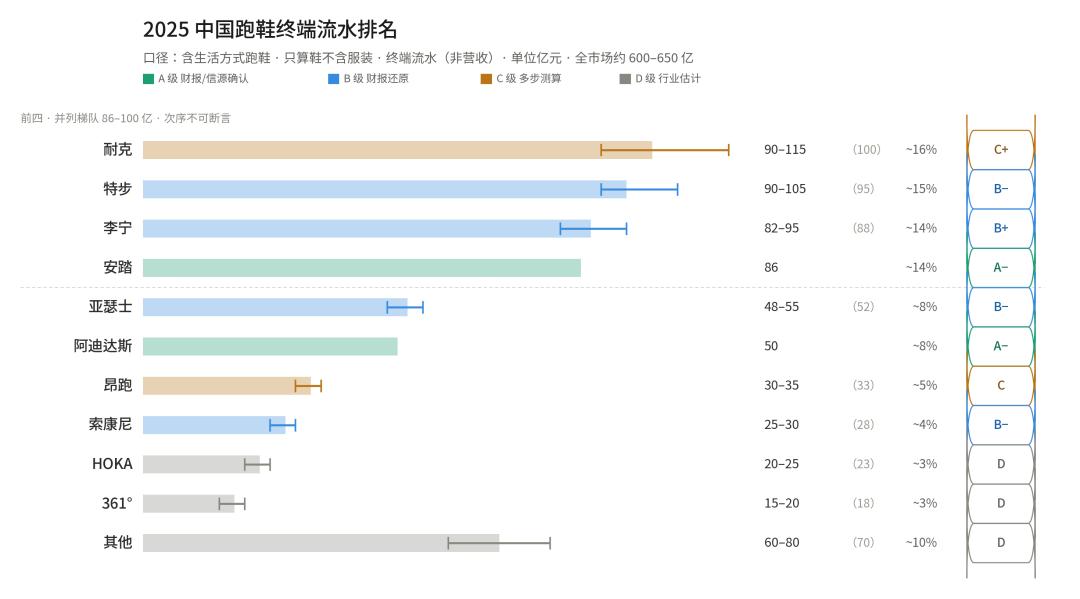
Data source: Synthesized from author interviews, brokerage research reports, official financial reports and other sources
However, such growth was achieved in advance by rapidly rolling out "mid-to-low end" products, resulting in a large number of running shoes with similar positioning and close prices in the market.
Every quarter, ANTA's "main push and main sell" running shoes reach 2 million pairs, Li-Ning's reach 2 million pairs, and the total volume of Xtep, Qiaodan, ERKE and other brands adds up to about 1 to 2 million pairs. This means that within just one year, the new supply of running shoes from domestic brands alone can reach at least 20 million pairs. In contrast, the global total sales of the best-selling running shoes of Nike and Adidas in the past year only just exceeded 10 million pairs each.
"Making minor adjustments on the basis of the previous generation, you can launch it as a new shoe. But Nike and Adidas usually don't do that," an employee of an international sports brand told 36Kr.
The upstream industrial chain feels even more strongly. A shoe factory owner in Jinjiang, known as the "Shoe Capital of China", once revealed to *Life Week* that during the pandemic, "there were only 150 styles for 2 million pairs of shoes", but now "there are 180 to 200 styles for 1.5 million pairs of shoes". Orders are shrinking in volume while becoming more fragmented.
As a result, the dividend was compressed to only a short period of three to five years.
"Now, except for high-end running shoes priced at two to three thousand yuan, the technological gap between brands in the mid-to-low price range has been eliminated. When runners get the running shoes and break them in before the race, their performance will not differ much," a person related to marathon events said.
What will happen when homogenized products and rapidly saturated demand are superimposed?
"Promotion competition is intensifying" — this simple sentence was taken as the reason for the slight decline in gross profit margin of brands like Li-Ning and Xtep in 2025. But at the sales terminal, the reality corresponding to this sentence is brutal.
During the conversation with the aforementioned designer, he opened an app that queries the transaction price of running shoes in real time. It showed that the transaction price of ANTA's flagship racing running shoe with an original price of 1,699 yuan has dropped to around 500 yuan. In the lower price range, flagship running shoes of the same level from 361° and Qiaodan Sports can be sold for only 100 to 200 yuan.
"How many people can afford shoes priced at over 1,000 yuan? Not many."
The price expectation accumulated over the past few years is crumbling, and the entire market is like a barrier lake, "looking calm on the surface, but actually not far from bursting."
Demand Pushed to the Bottom
For a long time, successful sports brands have a familiar roadmap: first establish technical advantages in the competitive field, then gradually transfer high-end technologies to more popular price ranges to achieve large-scale returns.
This is a process that can capture maximum profits bit by bit, with a very long life cycle that can last for five years, ten years or even longer.
But China has never been a market that allows players to take their time. In the running shoe market in recent years, the intermediate stage has been directly flattened, and players have rapidly pushed the entire demand to the bottom.
"The beginning of the running shoe cycle is highly accidental, and there is no very stable new demand in this market," the head of a consumer investment institution told 36Kr.
Industry insiders estimated to 36Kr that the number of people in China who actually participate in marathons and finish the races is less than 700,000. The core user group that can support the consumption of racing running shoes priced at over 1,000 yuan is only about 100,000 — and the growth of this group has peaked.
Large foreign brands have long firmly controlled this group of core users. According to 36Kr, the revenue of Adidas China's running shoe business reached about 5 billion yuan last year, of which 2 to 3 billion yuan came from racing/training running shoe series — about half of which were professional runners. Adidas's racing running shoes also captured the market share that Nike voluntarily withdrew from or passively lost, "especially the market share of products priced at over 1,000 yuan."
Then what should domestic brands do?
The incremental growth of domestic brands mostly came from the opposite direction. The faster the market share rose, the lower the proportion of people who actually run among shoe buyers. A large number of new running shoe buyers of Li-Ning and ANTA in recent years have never appeared on the running track — some of them are not even old enough to run.
Li-Ning's Chitu series is the most representative and best-selling running shoe series of the brand. Its main consumer group is children born in 2015 and 2016 — exactly the offspring of the post-80s and post-90s generations during the peak childbearing period. The Chitu series has the nickname of "special shoes for physical education exams", and its popularity among the "little boys" group is no less than that of Air Jordan in its heyday.
In 2024, ANTA launched the first generation of the "Lübu" running shoe, whose name contains the most down-to-earth competitive logic: the homophony of "Lübu" refers to the famous ancient Chinese general, whose mount is Chitu — the exact product of Li-Ning's Chitu series at the same price point.
The success of Lübu did not come from runners, but from a group of "middle-aged men" — those who just got rid of the anxiety of formal wear, took off their leather shoes, and were dragged by their wives to walk around the scenic spot on weekends. After a whole day of walking, their feet were squeezed painfully by leather shoes, and they just wanted a pair of breathable and comfortable shoes. The team members involved in the project recalled to 36Kr that the product was designed completely based on the needs of this group: wide last, differentiated midsole foot feel at first step, jacquard mesh same as that of 1,000-yuan shoes, leather-shoe-like dark colorways that fit formal wear well, plus a price tag that does not cause any psychological burden. "1,699 yuan is too expensive, 299 yuan is too cheap, 399 yuan is just right."
The positive market response verified the team's guess. Coupled with ANTA's large number of stores covering cities and even counties at all levels, the first generation of Lübu sold 1 million pairs within three months after its launch, making it the fastest-selling product in ANTA's group history. "It took a big chunk of the running shoe market, and competitors were shocked."
According to 36Kr, ANTA's running shoe revenue reached 7.657 billion yuan in 2024, and in 2025, the spillover effect of the Lübu series still drove the revenue to grow at a rate of 12% to 13%. The series has sold more than 10 million pairs in total, becoming an undisputed revenue pillar of ANTA.
In this way, the two brands took the third and fourth positions in the running shoe market share by relying on the "middle-aged men" and "little boys