In the final stage of the finals, what kind of automakers can survive?
As Li Bin recently stated, China's automotive industry is entering its most brutal final stage of competition.
This is first reflected in the decline of the domestic passenger vehicle market. Data from the China Passenger Car Association (CPCA) shows that retail sales in the national passenger vehicle market in July fell by 20.9% year-on-year. The latest August data shows that from August 1 to 23, retail sales in the national passenger vehicle market reached 956,000 units, down 22% from the same period in August last year.
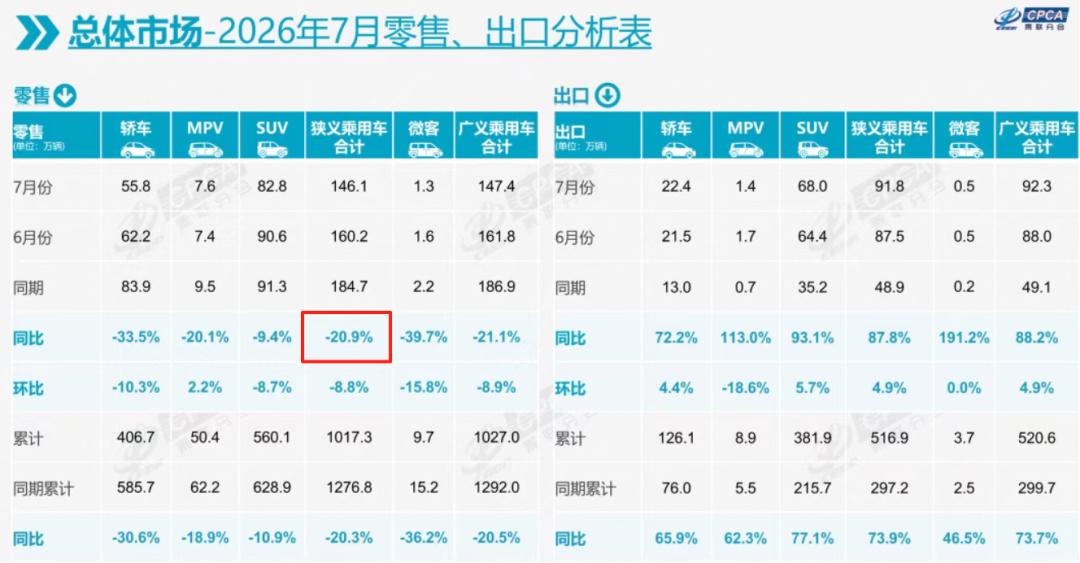
Figure / National passenger vehicle retail data for July 2026 Source / Screenshot from New Energy Observer on the Internet
When the incremental market shifts to a stock market, it is undoubtedly a "zero-sum game". The sales volume of Leapmotor, Geely, GAC and Great Wall has increased, while the domestic sales of automakers such as BYD, Changan, Chery, XPeng and Li Auto have declined.
Of course, a decline in domestic sales does not necessarily mean being eliminated, and the performance of overseas expansion is also critical.
The brutality of competition among automakers is also reflected in their financial reports. The 2026 semi-annual reports of major automakers are coming to the final stage of release, and from the published data, we can clearly see the phenomenon of "revenue growth without profit growth".
For example, Great Wall Motors' revenue exceeded 100 billion yuan for the first time, growing by 10.58%, while its net profit fell by 61.11% year-on-year; Chery's revenue increased by 1.2%, and its net profit fell by 11.7% year-on-year; Leapmotor, as the only new power automaker that has been profitable for three consecutive "half-year periods", recorded a revenue of 38.11 billion yuan in the first half of the year, up 57.2% year-on-year, but its net profit only increased from 30 million yuan to 210 million yuan.
Coupled with the recently exposed issues such as "irrational competition in new energy vehicles" named by the Ministry of Industry and Information Technology, a profound structural reshuffle is taking place in China's automotive industry.
1. How tough the situation is for automakers
As we all know, financial reports are the "physical examination report" that gives insight into the operating status of an automaker. As of August 27, 2026, almost all mainstream automakers have released their semi-annual reports, with the exception of NIO, GAC and BYD.
Li Auto recorded an operating revenue of 48.65 billion yuan in the first half of the year, down 13.4% year-on-year; its net loss reached 3.981 billion yuan, compared with a net profit of 1.743 billion yuan in the same period last year. It only took one year for the company to turn from making profits to losing 4 billion yuan.
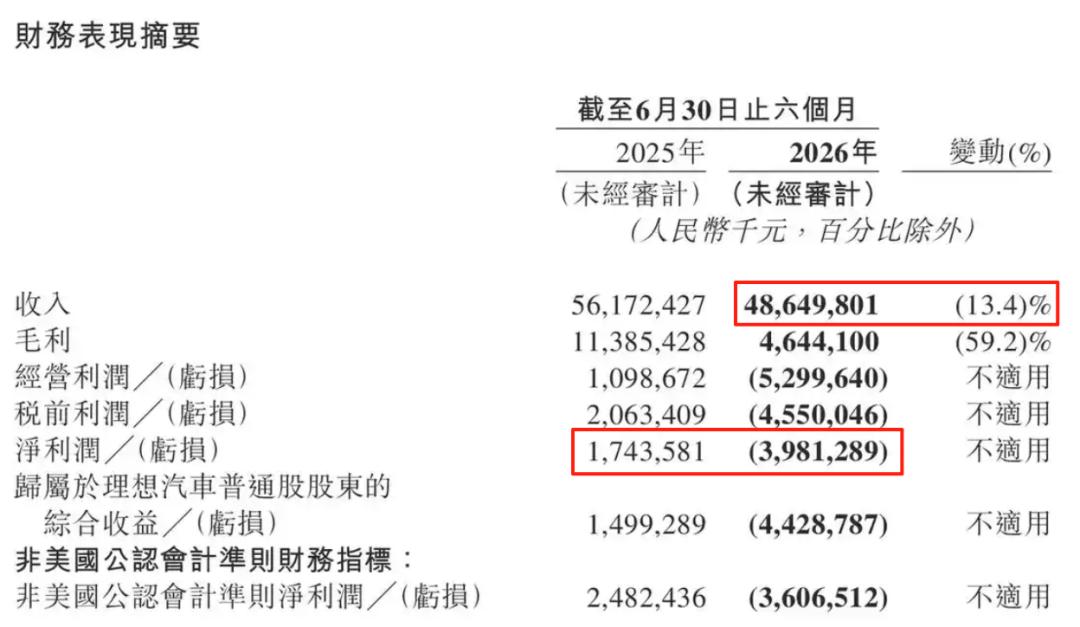
Figure / Partial financial data of Li Auto for H1 2026 Source / Screenshot from New Energy Observer on the Internet
XPeng's total revenue in the first half of the year was 32.78 billion yuan, down 3.8% year-on-year; the net loss attributable to common shareholders reached 3.121 billion yuan, expanding by 173.35% year-on-year.
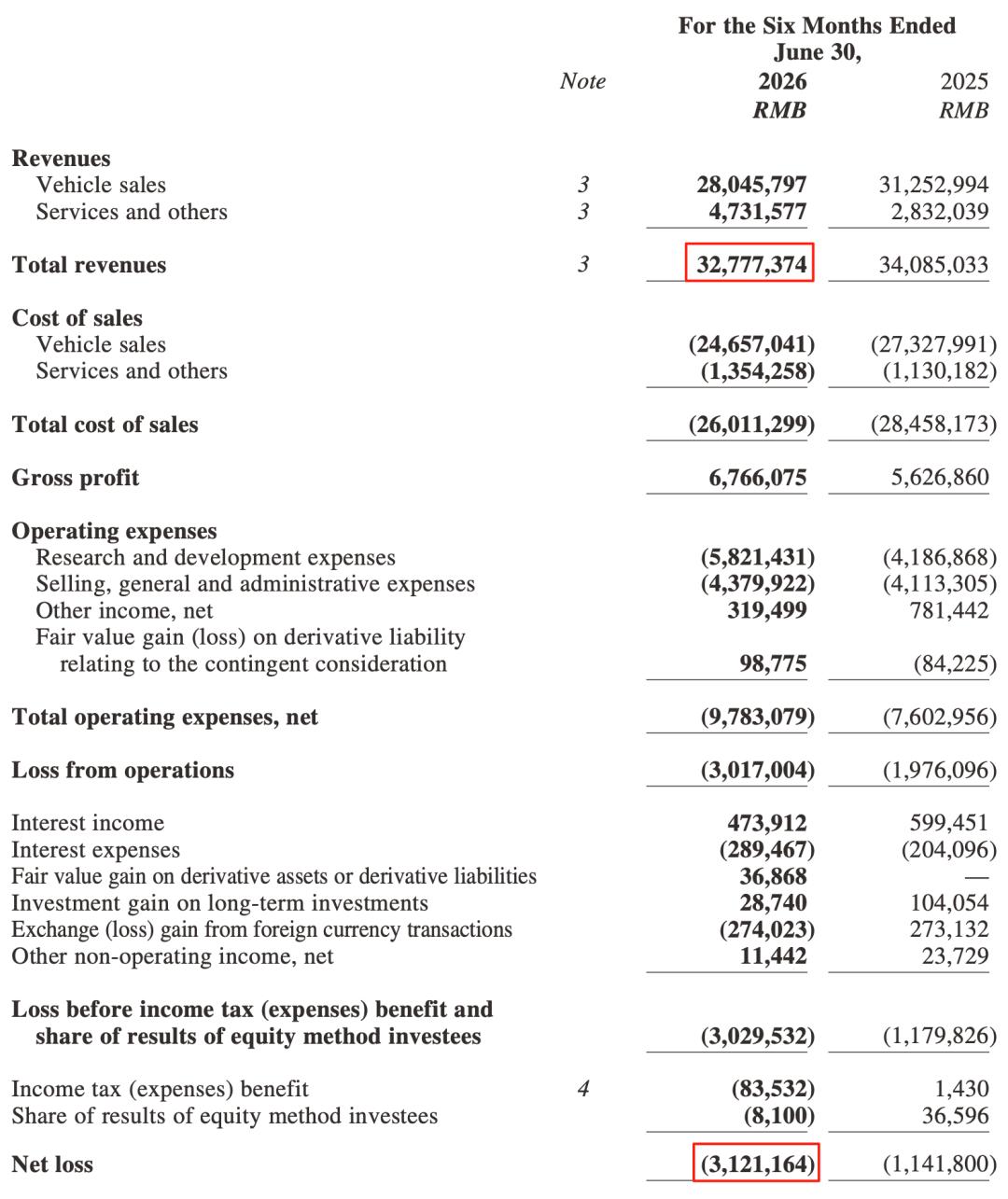
Figure / Partial financial data of XPeng for H1 2026 Source / Screenshot from New Energy Observer on the Internet
Leapmotor is one of the few bright spots among new power automakers. Its revenue in the first half of the year was 38.11 billion yuan, up 57.2% year-on-year; its net profit was 210 million yuan, marking three consecutive semi-annual profitable periods. However, a net profit of 210 million yuan against a revenue of 38.1 billion yuan means a net profit margin of only 0.55%, which is extremely thin.
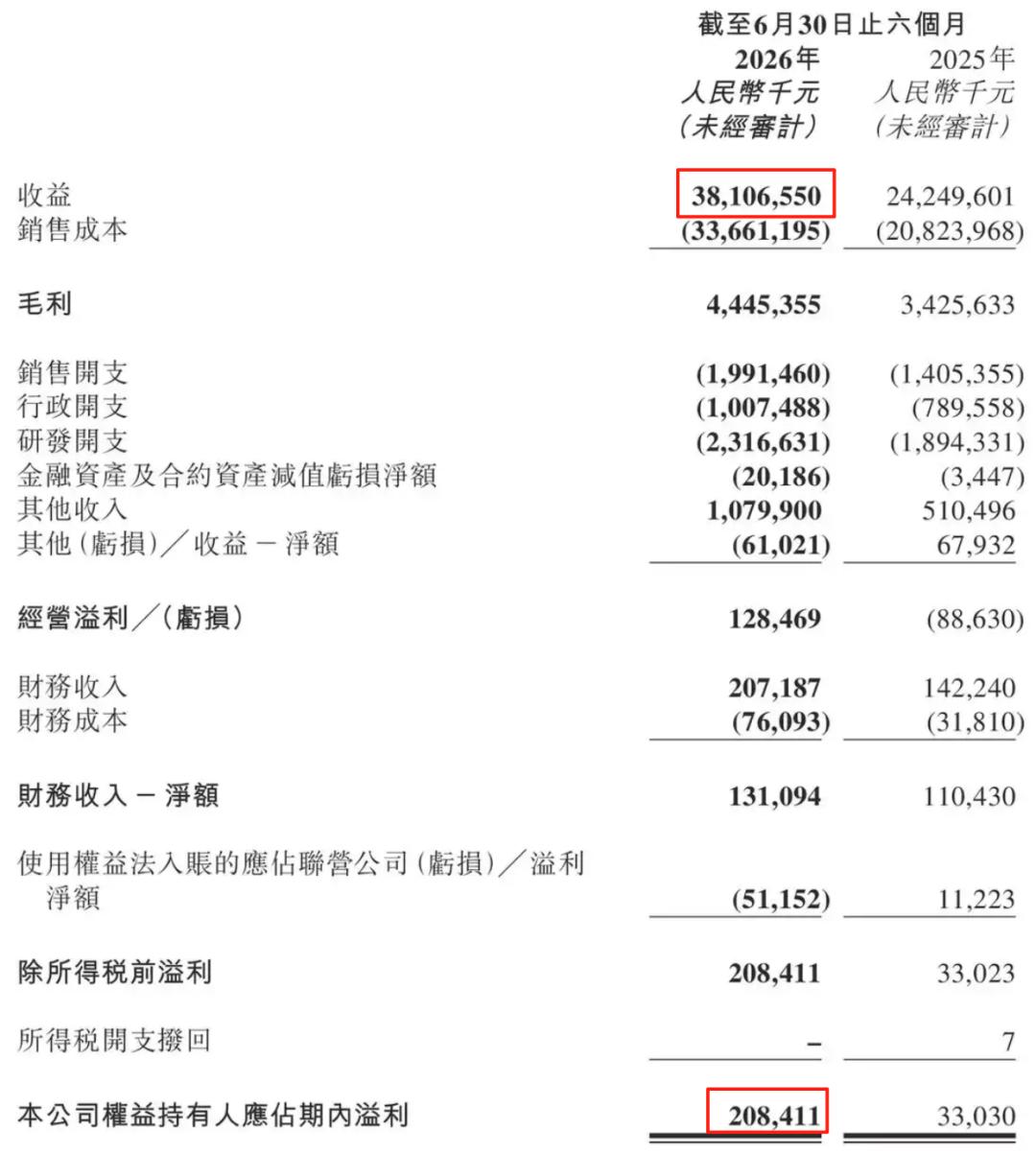
Figure / Partial financial data of Leapmotor for H1 2026 Source / Screenshot from New Energy Observer on the Internet
Traditional automakers face even more severe situations. GAC Group disclosed its semi-annual performance pre-loss announcement for 2026 as early as July 10. It is expected that the net profit attributable to shareholders in the first half of the year will be between -4.06 billion yuan and -4.57 billion yuan, compared with a loss of 2.538 billion yuan in the same period last year, representing an expansion of 60% to 80%. In particular, the loss range in the second quarter is about 3.4 billion yuan to 3.9 billion yuan, a significant quarter-on-quarter expansion.
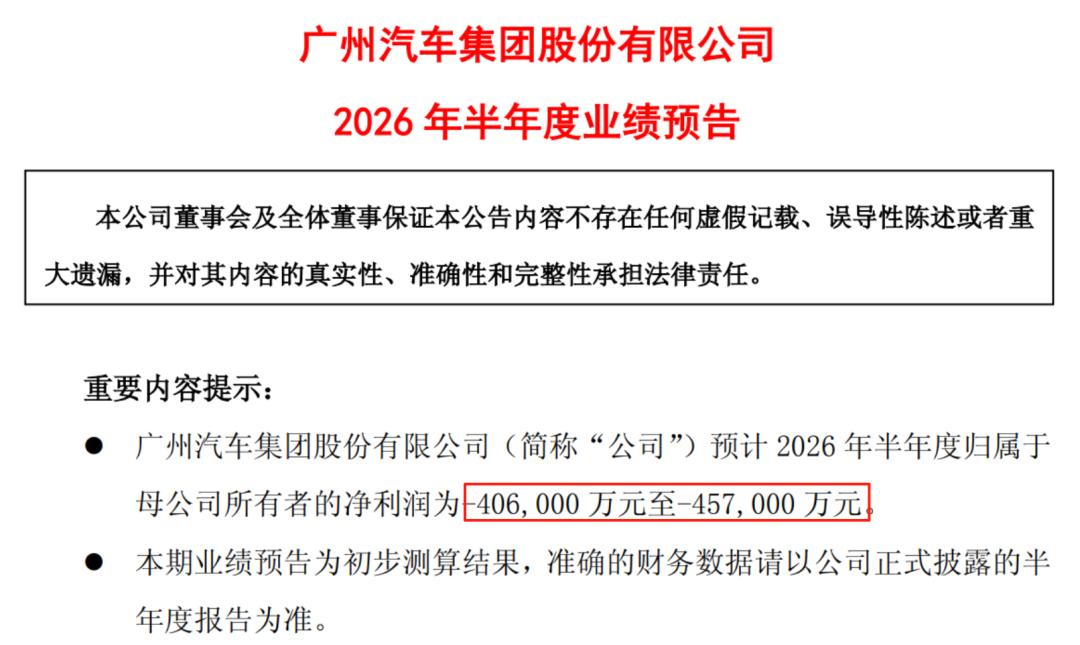
Figure / 2026 semi-annual performance forecast of GAC Group Source / Screenshot from New Energy Observer on the Internet
Great Wall Motors' revenue reached 102.101 billion yuan for the first time, but its net profit attributable to shareholders was only 2.465 billion yuan, plummeting 61.11% year-on-year.
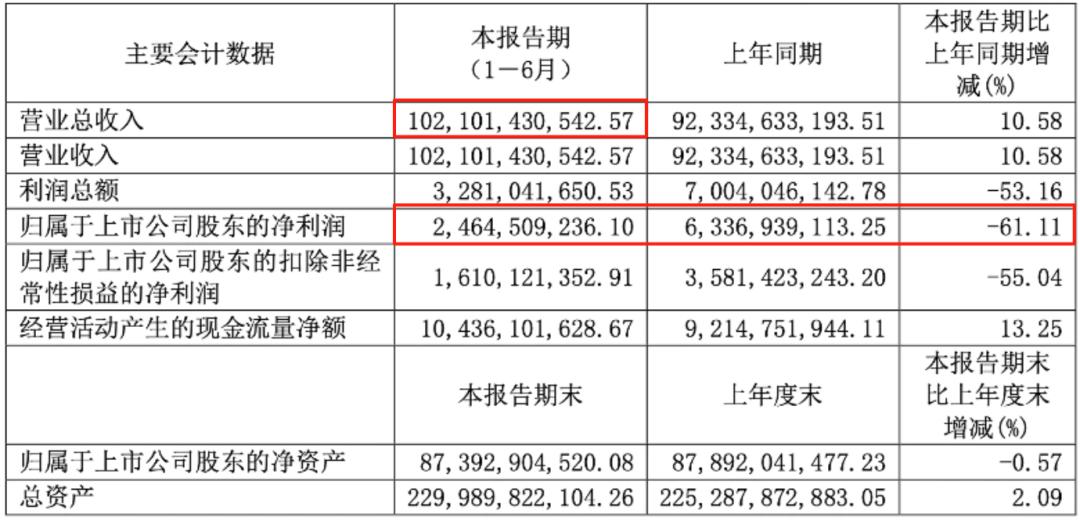
Figure / Partial financial data of Great Wall Motors for H1 2026 Source / Screenshot from New Energy Observer on the Internet
Chery Automobile's revenue in the first half of the year was 143.28 billion yuan, with a year-on-year growth of only 1.2%; its net profit attributable to shareholders was 8.567 billion yuan, down 11.7% year-on-year.
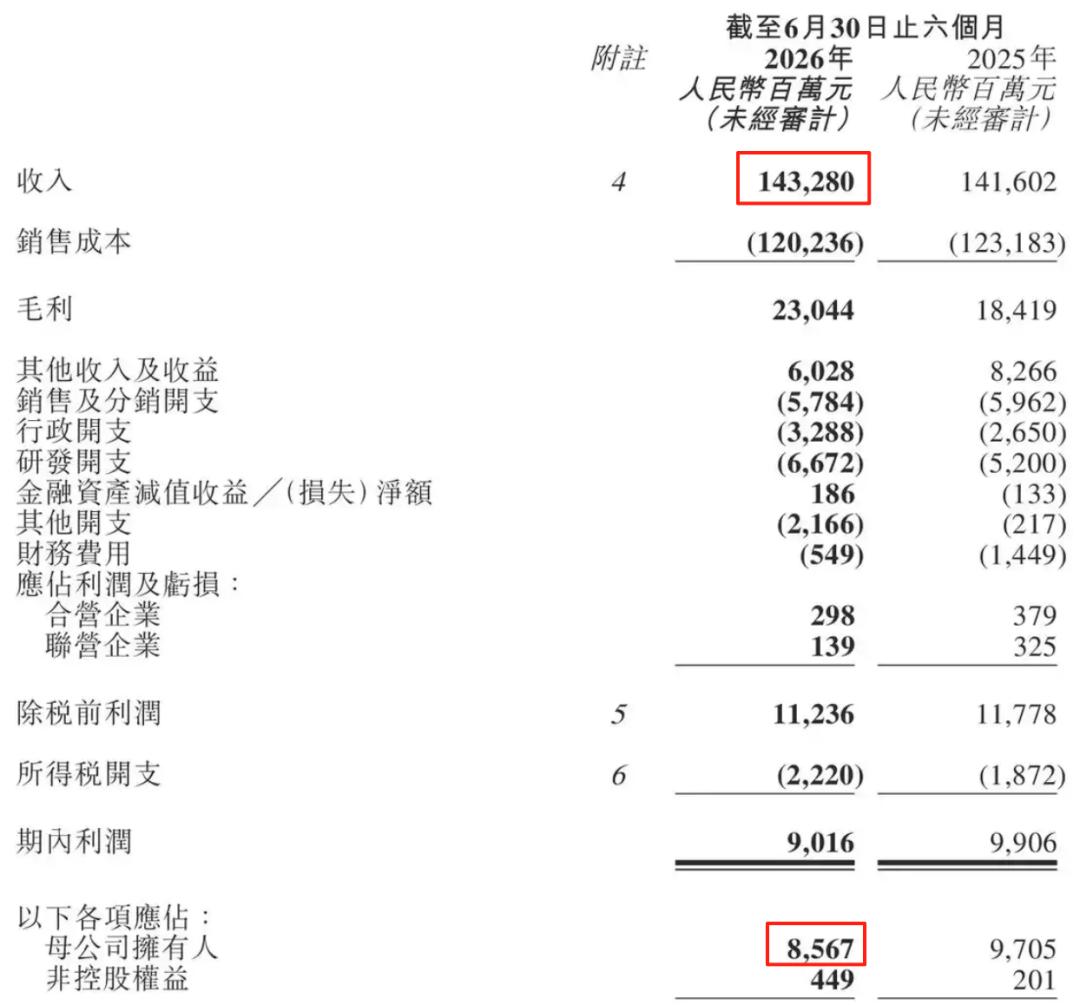
Figure / Partial financial data of Chery Automobile for H1 2026 Source / Screenshot from New Energy Observer on the Internet
Geely Automobile's total revenue in the first half of the year was 173.6 billion yuan, up 15% year-on-year; its net profit attributable to shareholders was 9.091 billion yuan, a slight decline of 2% year-on-year. Excluding the impact of exchange rate and other factors, the core profit was 9.684 billion yuan, up 46% year-on-year.
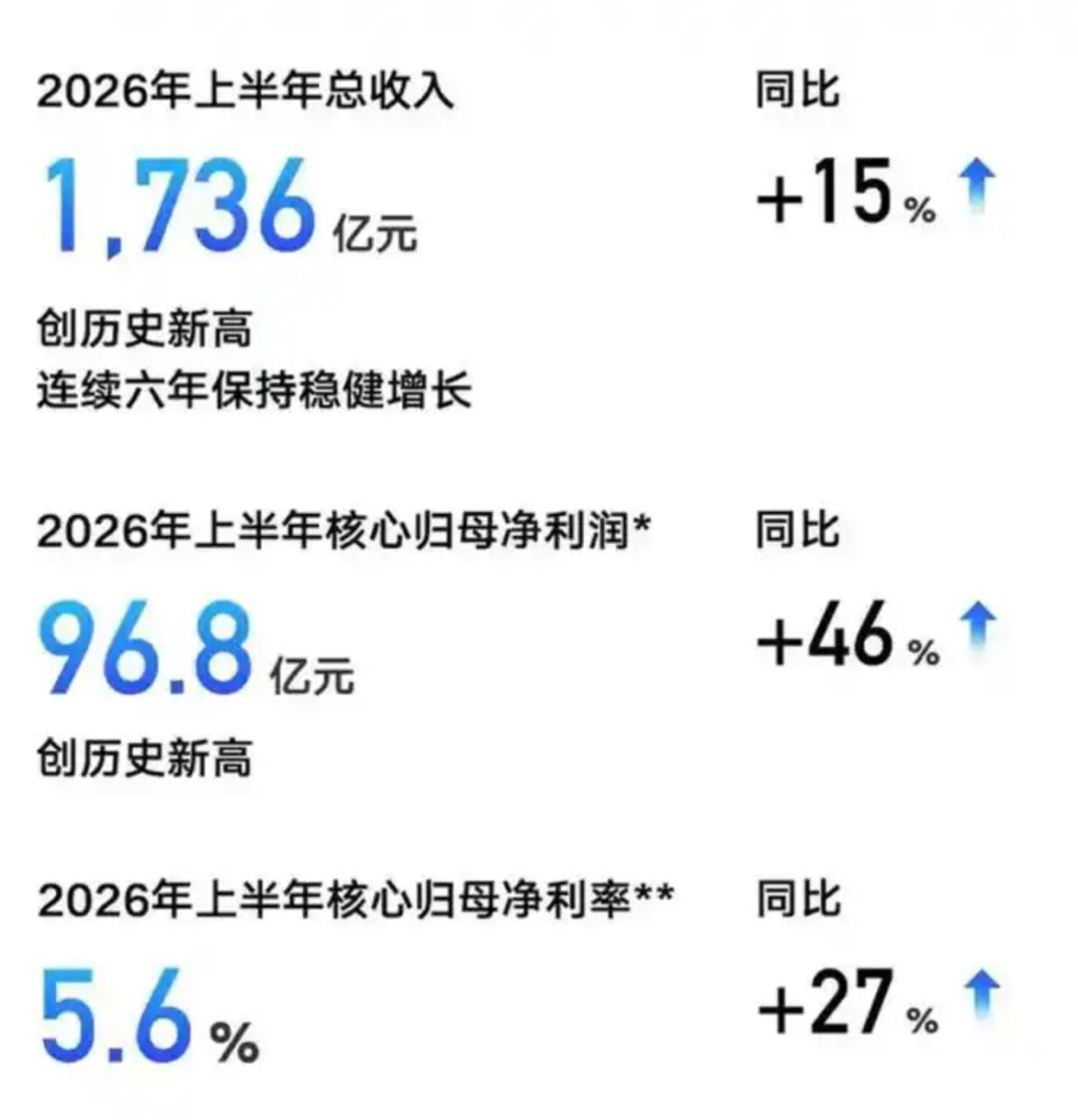
Figure / Partial financial data of Geely Automobile for H1 2026 Source / Screenshot from New Energy Observer on the Internet
Against the backdrop of the overall industry market declining by more than 20%, Geely's performance is already commendable. However, Gui Shengyue, Vice Chairman of the Board of Geely Automobile, also admitted that "the Chinese automotive industry in the first half of the year is in the most severe situation in recent years".
A set of macro data can better illustrate the problem. From January to May 2026, the profit margin of the automotive industry dropped to 3.4%, hitting the lowest level in the same period in five years; the profit margin of complete vehicle manufacturing was only 1.5%. This means that for a car priced at 200,000 yuan, the average profit of the automaker is only 3,000 yuan, while three years ago this figure was 5%.
The market has shifted from incremental to stock, the price war has reached its limit, and raw material costs are still rising. Automakers are caught in the middle, and their profits are being squeezed dry little by little.
2. The competition logic has changed
The predicament of automakers seems to be the dual squeeze of cost and price on the surface, but in-depth analysis shows that it is the switch of competition logic in China's automotive industry.
Of course, the primary driving force still comes from the market itself. Cui Dongshu, Secretary General of the China Passenger Car Association, said in a media interview last month that the concentrated decline in automakers' profits in the first half of the year is the result of the superposition of three pressures: skyrocketing upstream costs, intensifying terminal price wars, and rigid investment in transformation.
On the cost side, the price of storage chips has risen 5 times, from about 20 yuan per chip to nearly 100 yuan; the price of lithium carbonate has risen from 80,000 yuan per ton in the same period last year to 180,000 yuan.
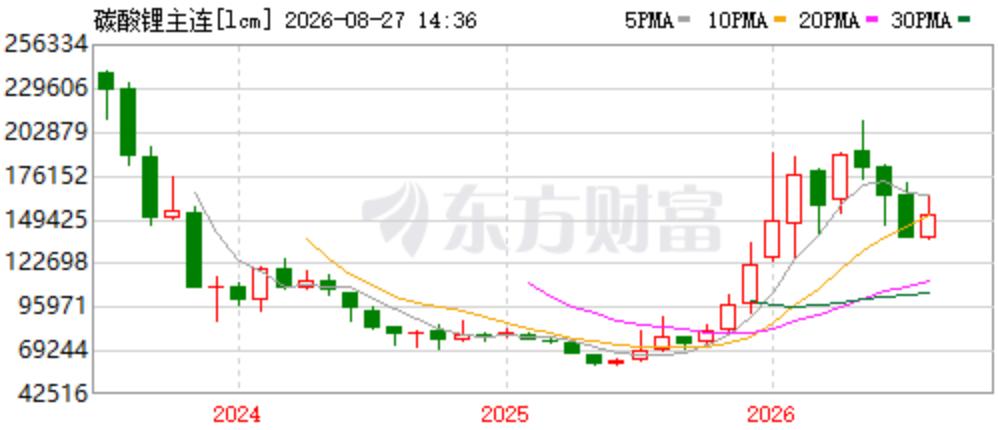
Figure / Lithium carbonate price trend in recent years Source / Screenshot from New Energy Observer on the Internet
If you have no intuitive concept of this, Zhang Xinghai, Chairman of Seres Group, gave a more straightforward explanation: Affected by the rising prices of major raw materials such as storage chips, industrial metals and lithium carbonate, the average cost increase for each AITO vehicle is between 15,000 yuan and 20,000 yuan.
On the demand side, according to Cui Dongshu, automakers still had the buffer of orders from the beginning of the year in the first quarter. In the second quarter, inventory pressure rose, promotions were intensified, and costs could not be effectively passed on to downstream consumers, which eventually led to concentrated pressure on the profit side.
The most intuitive data on the investment side is R&D expenditure. Taking XPeng as an example, it recorded a loss of 3.12 billion yuan in the first half of the year, while its R&D expenditure reached 5.82 billion yuan. Together with 4.38 billion yuan in sales and administrative expenses, the total of the two items is about 10.2 billion yuan, far exceeding its gross profit of 6.766 billion yuan.
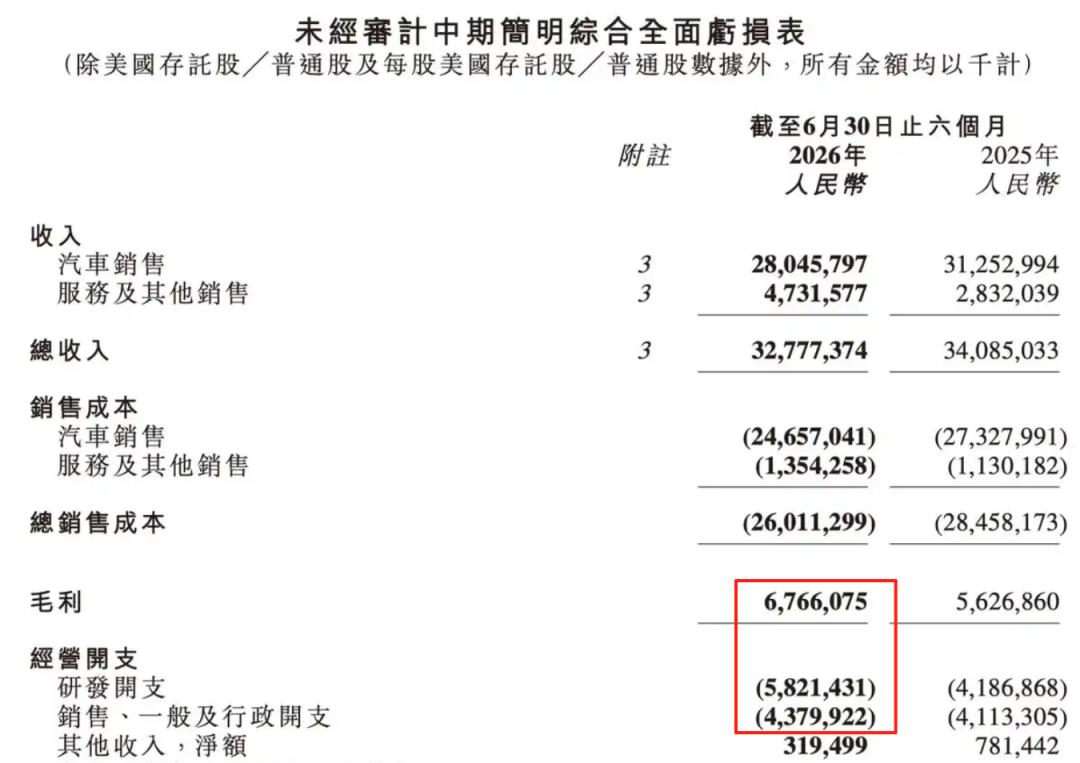
Figure / R&D expenses and gross profit of XPeng Source / Screenshot from New Energy Observer on the Internet
The second driving force comes from the regulatory authorities. On August 26, Xin Guobin, Vice Minister of the Ministry of Industry and Information Technology, clearly stated at a press conference of the State Council Information Office that "we will strengthen access review for product innovation and design as well as test and verification management, and strictly prohibit products that have not undergone sufficient test and verification from entering the market".
Everyone can imagine how important this statement is. In the past few years, some automakers installed insufficiently verified technologies in vehicles in order to grab the first launch and catch the window period, making consumers "public beta users".
Even some radical innovative designs were installed and applied in vehicles without sufficient experimental verification, and individual incidents that aroused public concern such as automotive product quality problems and autonomous driving safety issues occurred.
At the same time, the State Administration for Market Regulation released news on August 21 that 9 automakers including Tesla and Xiaomi recalled multiple new energy vehicle models due to door handle safety issues. This is not a technical difficulty, but a design detail. But in the final stage of competition, details are the life-and-death line.
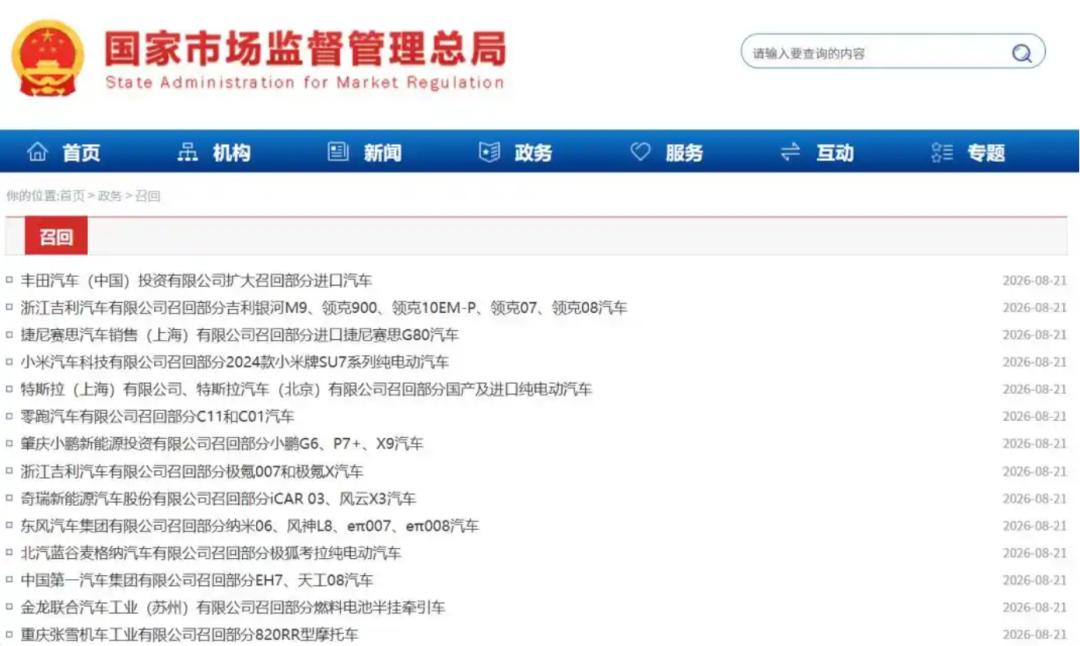
Figure / Multiple automakers recall a number of new energy vehicles Source / Screenshot from New Energy Observer on the Internet
Market pressure and tightened supervision are converging at the same time. The logic of winning by "speed" in the past no longer works, and the competitiveness built by piling up "parameters" also fails.
A new logic