Open-source models no longer intend to allow everyone to use them for free.
Most people's understanding of open-source models is simple: free to download and use at will.
Then how do open-source model companies make money? The current answers are APIs, private deployment, enterprise services, or developing their own products. In any case, the model weights themselves are not sold for profit. Over the past two years, Chinese large model companies have long regarded openness itself as a type of competitiveness, which to some extent alleviated the "profit-making" dilemma.
This landscape is now beginning to shift.
As the narrative that "open-source models are catching up with closed-source ones" becomes increasingly prevalent, the core model weights themselves should have reached a certain critical point of competitiveness. Is it possible to find a way to charge for them?
Some changes have quietly taken place. Model weights can still be downloaded, but model companies have started to set different terms for the scale and type of business users run with them.
Open-source model providers no longer want everyone to use their open-source models for free.
Some moves made by Kimi K3 clearly illustrate who these changes are targeted at.
K3 still allows downloading, modification, fine-tuning, and commercial use. The newly added terms mainly target MaaS, which refers to directly providing model inference, fine-tuning and other capabilities to third parties. If a company or its affiliates operate such business and the total revenue in any consecutive 12-month period exceeds 20 million US dollars, they need to sign a separate agreement with Moonshot AI, while internal enterprise use is explicitly exempted.
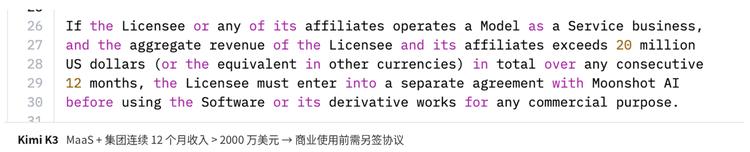
This means that a startup with an annual revenue of 19 million US dollars all coming from model APIs will not trigger this rule. However, a large cloud vendor with an annual revenue of tens of billions of US dollars that starts to provide external model services using K3 may immediately meet the threshold.
K3 focuses on the business type and the overall scale of the company, and does not calculate how much revenue the company actually earns from Kimi. It reserves a right for Moonshot AI to re-participate in the commercial relationship after large platforms turn open models into a standalone business.
The background of this development is that inference itself has become an increasingly large industry. For third-party inference platforms such as Together, Fireworks, and SiliconFlow, running open models for other users is one of their core offerings. Coding and Agent scenarios have also significantly increased the number of tokens consumed per task. Who deploys open models, who undertakes inference work, and who obtains the corresponding revenue has begun to directly affect the commercial space of model companies.
It is thus not difficult to understand that the recent license updates of Kimi and Qwen are mainly focused on MaaS.
Commercial Boundaries Are Now Written Into Licenses
Since April this year, the practices of five companies have shown obvious differentiation.
MiniMax is the one that made the fastest adjustments. The M2.7 released in April stipulates in its license that commercial use is prohibited without prior written authorization from MiniMax, with no revenue threshold.
Two months later, the terms for M3 were significantly relaxed. Commercial products with an annual revenue of no more than 20 million US dollars only need to mark "Built with MiniMax M3" and send a one-time notification, while users with annual revenue exceeding 20 million US dollars need to sign a separate authorization agreement. It is worth noting that the M3 threshold is calculated based on the annual revenue of the "relevant products or services", which is different from the standard of "total combined revenue of the company and its affiliates" adopted by K3 later. After the release of M3, the community's attitude towards the license softened, with some users directly thanking the team for "taking feedback on M2.7 on board", but some developers still believed that the commercial use definition of M3 remained vague.
However, the more restrictive the terms are, the more the license itself becomes a cost of use. When MIT-licensed models with similar performance are available as alternatives, developers and inference platforms have other options.
The license of Qwen3.8-Max has an extra layer of restrictions compared with K3. In addition to MaaS, it separately defines a category of "AI Work Assistant", which mainly refers to programming and office productivity products, and even uses its own Qoder and QwenWork as examples. Vertical applications such as translation tools and e-commerce shopping are explicitly excluded instead. The threshold is also higher, at 50 million US dollars, which is also calculated based on the total combined revenue of the licensee and its affiliates.

This is hardly a license that only stipulates "whether commercial use is allowed". It has begun to participate in defining the competitive boundaries of model companies. Alibaba does not mind users building various applications with Qwen, but does not want users to use its flagship weights to develop products that directly compete with Qoder without paying anything.
At the same time, the Qwen3.8-27B of the same generation still retains the Apache 2.0 license. The flagship model sets access restrictions while smaller models remain open to build an ecological funnel, with the two lines running in parallel. This is not the first time Alibaba has adjusted its strategy. The original Tongyi Qianwen had a 100 million monthly active user application threshold back in 2023. Later, to expand its ecosystem, a large number of its open model versions were switched to Apache 2.0, and now some of the restrictions are being restored.
These rules are still evolving. Qwen3.8-Flash-Next, released on August 26 as an experimental preview of the Qwen4 architecture, has adopted the Qwen Community License 1.0 instead. Different from Qwen3.8-Max, it no longer sets the 50 million US dollar revenue threshold for MaaS and AI Work Assistant, and users operating these two types of businesses need to obtain separate authorization before commercial use.
Such changes are not unprecedented. Since 2018, MongoDB, Elastic, and HashiCorp have all modified their licenses because cloud vendors hosted their open-source products for free. AI models are facing the same contradiction, except that the carrier has changed from code to model weights.
Answers Beyond Licenses
Not all companies choose to make adjustments on licenses.
DeepSeek V4-Pro still uses the standard MIT license, and companies with the capability to deploy it can freely provide commercial services based on it. However, a noteworthy event took place on August 13. On the same day, DeepSeek open-sourced the new V4-Pro weights under the MIT license, and at the same time announced a full adjustment to its API prices with the introduction of peak-valley pricing. The output price during peak hours rose from 6 yuan per million tokens to 27 yuan, an increase of 350%.
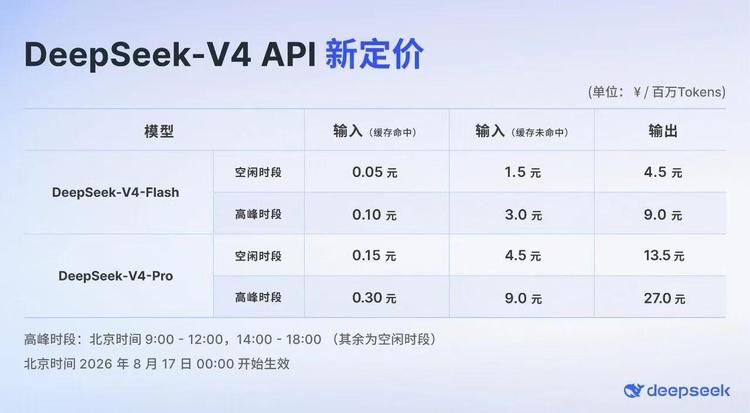
Openly releasing weights while raising API prices seems contradictory, but it follows a complete logical framework. Weights remain free to access, but the original vendor's services are no longer low-cost. Users pay not just for the model files, but also for computing power, inference speed, stability, and service quality.
The choice of DeepSeek is also supported by cost considerations. According to the leaked investor meeting minutes, Liang Wenfeng stated that DeepSeek set its pricing based on a 10-month payback period, "third parties cannot achieve this cost level." He judged that even if the model is fully open-source, the barrier for other players to reach the same deployment cost is extremely high, "not every company has the willingness and ability to organize manpower to achieve this goal." However, the price increase in August objectively raised the profit margin for third parties, and whether this judgment still holds completely under the new pricing system remains to be seen.
The financial reports of Zhipu AI provide another reference. Starting from GLM-4.5, Zhipu AI's new generation of open flagship models has switched to the MIT license, and GLM-5.3-Flash just released on August 26 also continues to adopt the standard MIT license, with no new restrictions on commercial revenue or business types. Prior to this, the initial version of ChatGLM-6B only allowed non-commercial research use, and the later ChatGLM2 and ChatGLM3 allowed free commercial use but still required enterprise registration and authorization.
Zhipu AI has actually gone through a cycle of "setting thresholds → lifting restrictions", which is similar to the path of Qwen. In 2025, Zhipu AI's total revenue reached 724 million yuan, of which local deployment revenue was 534 million yuan, accounting for 73.7%, and cloud API revenue was 190 million yuan, with its proportion rising from 15.5% in the previous year to 26.3%, nearly tripling year on year. In the first quarter of 2026, API prices rose by 83%, but call volume increased by 400%, and the MaaS platform ARR reached 1.7 billion yuan. The logic expressed by Zhipu AI's management at the performance meeting is that when model capabilities are strong enough, API services themselves can form pricing power.
The MIT license lowers the adoption threshold and expands the ecosystem, while private deployment and API services directly generate revenue. The path Zhipu AI takes is in the same direction as DeepSeek, and its revenue structure has already taken initial shape as reflected in its financial reports.
Therefore, the license is just one of the knobs for the commercialization of open models. Kimi and Qwen have started to adjust their licenses. DeepSeek has adjusted its API pricing. Zhipu AI has established a revenue structure consisting of enterprise deployment and cloud services. MiniMax operates multiple consumer-facing AI applications and an open platform for developers at the same time, and is trying to manage third-party commercial use through licenses.
The recently released video model H3 of MiniMax also shows that restrictions in licenses do not necessarily come from commercialization considerations. The H3 license excludes the United States, the European Union, the United Kingdom, and South Korea. Ryan Lee, Head of Developer Relations at MiniMax, stated in the official Hugging Face discussion forum that the geographic restriction on the US stems from ongoing copyright lawsuits against the company filed by Hollywood studios over generated video content; MiniMax's official Q&A explains that the restrictions on the EU, the UK, and South Korea are mainly due to their regulatory environments that are still evolving. Institutions in the excluded regions can still apply for separate authorization from MiniMax, but they need to commit to taking corresponding compliance measures.
How Much Revenue Can This Generate?
Are these increasingly refined license terms really bringing revenue to model companies? The answer is not certain yet.
Several confirmed commercial activities have taken place. On July 20, China Software International announced in a Hong Kong Stock Exchange filing that it has reached a token revenue sharing cooperation with Moonshot AI, with the specific ratio undisclosed. DigitalOcean CEO Paddy Srinivasan confirmed to Reuters that there is a commercial agreement with Moonshot AI. He did not disclose the specific terms, but stated that the paid cooperation includes deployment optimization support and early access to next-generation models, calling it a "proven open-source freemium model". However, according to Reuters citing sources, Kimi requires a revenue share of up to 30% in some of its cooperations.
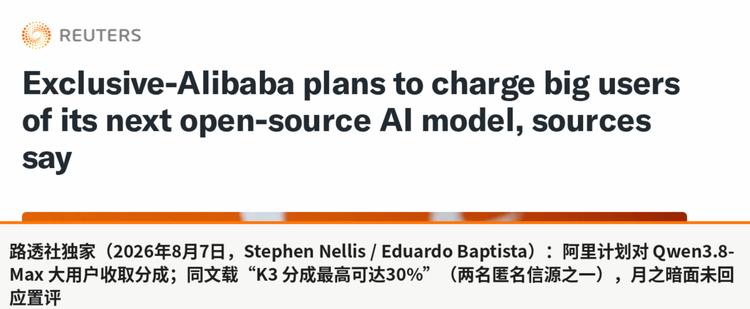
On August 26, Reuters reported that Moonshot AI is negotiating K3 revenue sharing partnerships with Microsoft, Amazon, and Google respectively, hoping that K3 can be accessed on Azure, AWS, and Google Cloud. People familiar with the matter said that Moonshot AI is seeking a revenue share of up to 30% of the revenue generated from K3-related services, but the negotiations are still in the early stage, and none of the three cloud vendors or Moonshot AI have confirmed the specific terms.
According to the prospectus recently submitted to the Hong Kong Stock Exchange (the reporting period ends at the end of 2025, prior to the release of K3 and Qwen3.8-Max), SiliconFlow, the top independent token supplier in China, recorded a total revenue of about 7.7 million US dollars in 2025, which is far below the thresholds set by K3 and Qwen. At present, these license revenue thresholds in the Chinese market are actually only binding on larger platform enterprises such as Volcano Engine, Alibaba Cloud, and Baidu Intelligent Cloud.
A more definite conclusion is that these licenses have first created a negotiation table, rather than a significant revenue source that has been proven in financial reports. The fact that weights can be obtained for free does not mean that no negotiation is required after the business scales up.
For most enterprises and developers who have the capability to deploy open-source models on their own, these changes may make no difference in daily operations. Downloading DeepSeek to run a local service, using Qwen to build an internal tool, or fine-tuning an industry model based on Kimi will not be affected.
The changes take place in the layer of the open ecosystem that has the strongest profitability capabilities. Licenses do not bring a new revenue source that replaces APIs, deployments, and services. What they start to define is something else: which downstream businesses can operate freely, and which ones need to renegotiate with model companies once they reach a certain scale. This logic is somewhat similar to the business model of game engines. Unreal Engine is provided to all developers for free, and revenue sharing is only charged after the game's revenue exceeds a certain threshold.
The question of how open models can make money has not disappeared just because the weights are open. It has only become concrete now that inference is growing more valuable.
This article is from the WeChat public account "Siliconist Pro", written by Zhou Yixiao, and authorized for release by 36Kr.