After incurring a loss of 1.7 billion yuan, Li Xiang wants to turn Li Auto into "Apple and Huawei".
Like Apple and Huawei?
In the Q2 financial report of this year, Li Xiang set new goals for Li Auto.
He believes that Li Auto has gone through the previous startup stage, and will enter a phase of continuous R&D investment and building technical barriers next.
The latest disclosed Q2 financial report confirms that Li Auto is indeed at a turning point now:
In the second quarter of this year, Li Auto delivered 98,300 new vehicles, a year-on-year decrease of 11.5%; total revenue reached 25.7 billion yuan, a year-on-year decrease of 15.1%.
Both sales volume and revenue are declining, and the decline rates are relatively close. However, at the profit end, the change suddenly expanded.
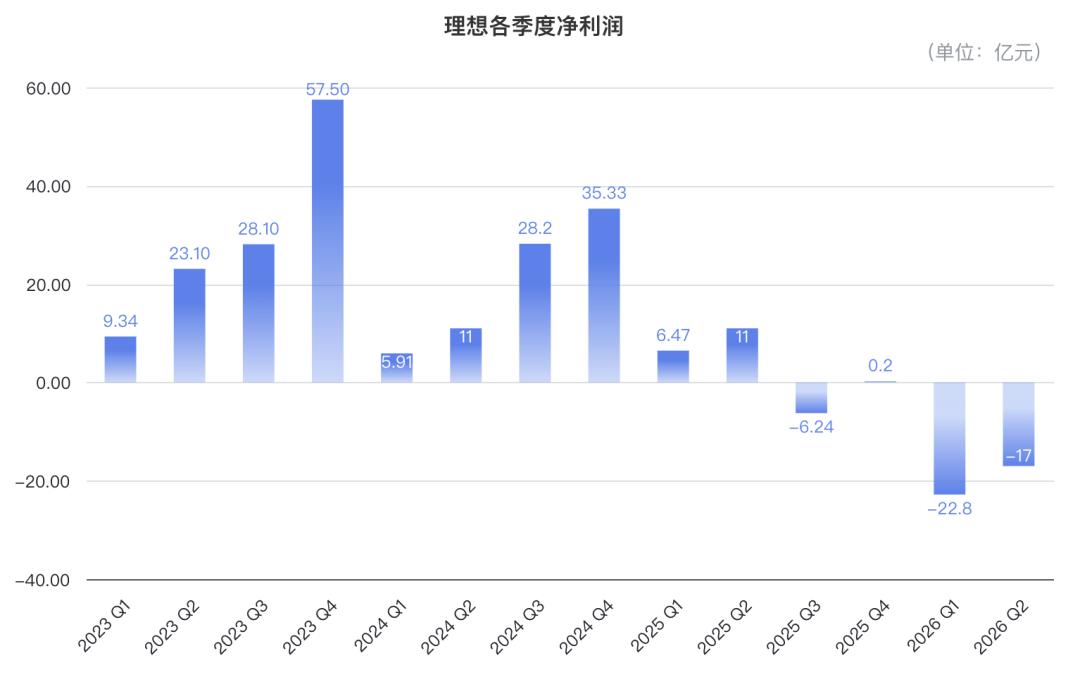
In the second quarter, Li Auto's gross profit fell 53.3% year-on-year; the vehicle gross margin dropped from 19.4% in the same period last year to 9.4%, almost halved; the final net loss was 1.7 billion yuan, while there was a net profit of 1.1 billion yuan in the same period last year.
In other words, the sales volume only decreased by about 10%, but the profitability changed far more than the sales volume.
What's more subtle is that compared with the first quarter of this year, Li Auto's situation is improving: the vehicle gross margin rebounded from 6.1% to 9.4%, the net loss narrowed, and the operating cash flow turned positive from net outflow.
What happened to Li Auto between these two quarters?
Li Auto Q2: 10% drop in sales, 50% drop in gross profit
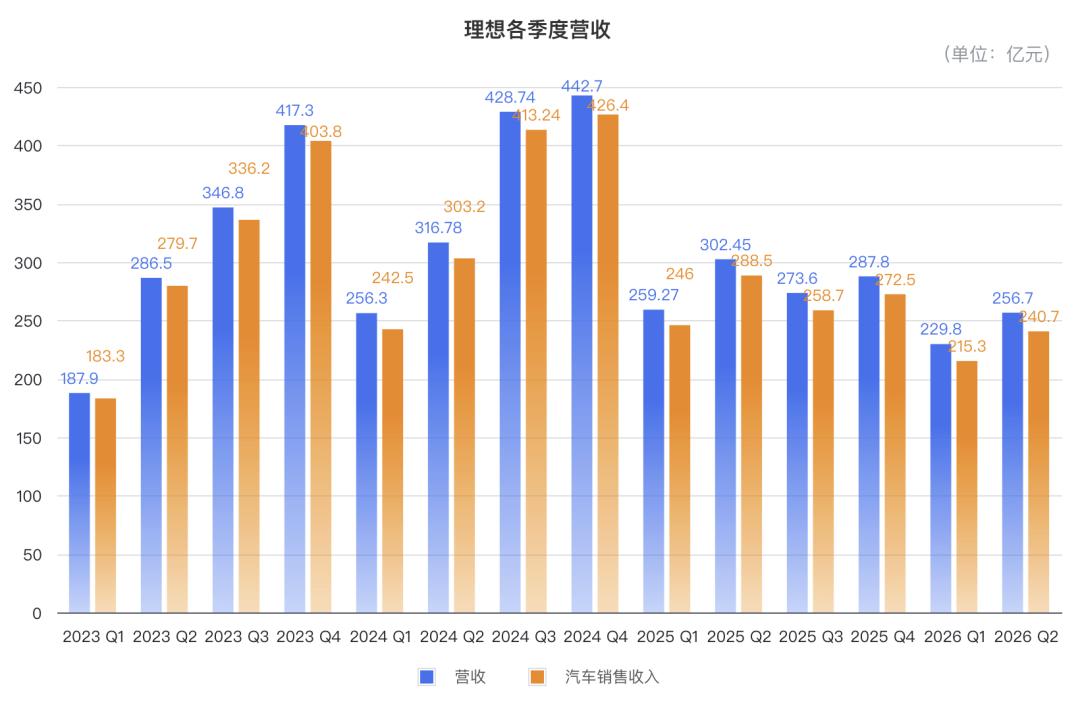
First look at the revenue: Li Auto's total revenue in the second quarter of this year was 25.67 billion yuan, down 15.1% year-on-year and up 11.7% quarter-on-quarter.
Among them, Li Auto's vehicle sales revenue in the second quarter was 24.1 billion yuan, down 16.7% year-on-year, a decline higher than the 11.5% drop in delivery volume, and up 11.8% quarter-on-quarter.
For the revenue decline, the financial report gives two explanations:
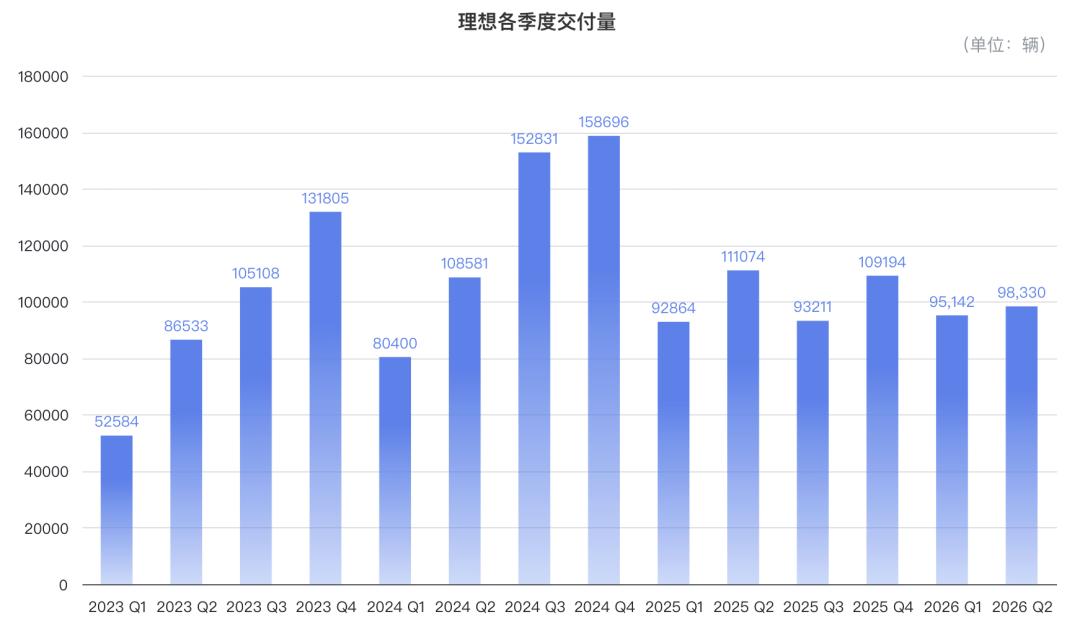
On the one hand, it is the reduction of delivered vehicles. Li Auto's sales volume in the second quarter was 98,330 units, down 11.5% year-on-year and up 3.4% quarter-on-quarter.
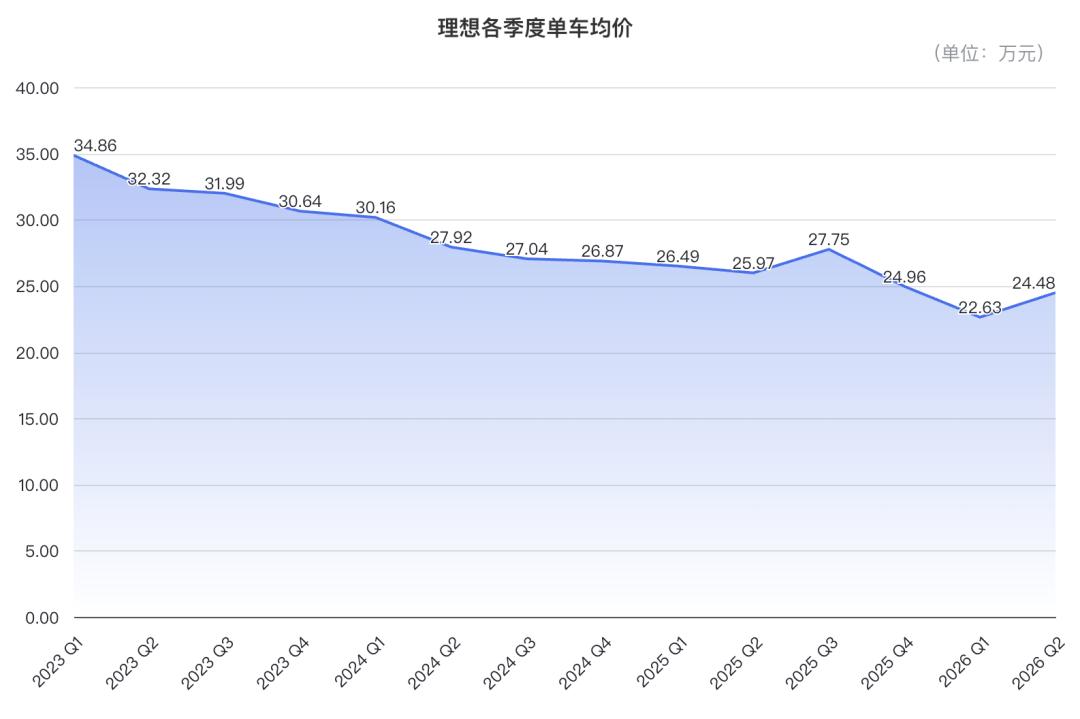
On the other hand, the change in Li Auto's product mix led to a decrease in the average selling price.
According to a simple calculation of vehicle sales revenue and delivery volume, in the second quarter of this year, the average revenue per vehicle of Li Auto was about 245,000 yuan, lower than 260,000 yuan in the same period last year.
However, while the revenue declined, the cost did not drop by the same margin.
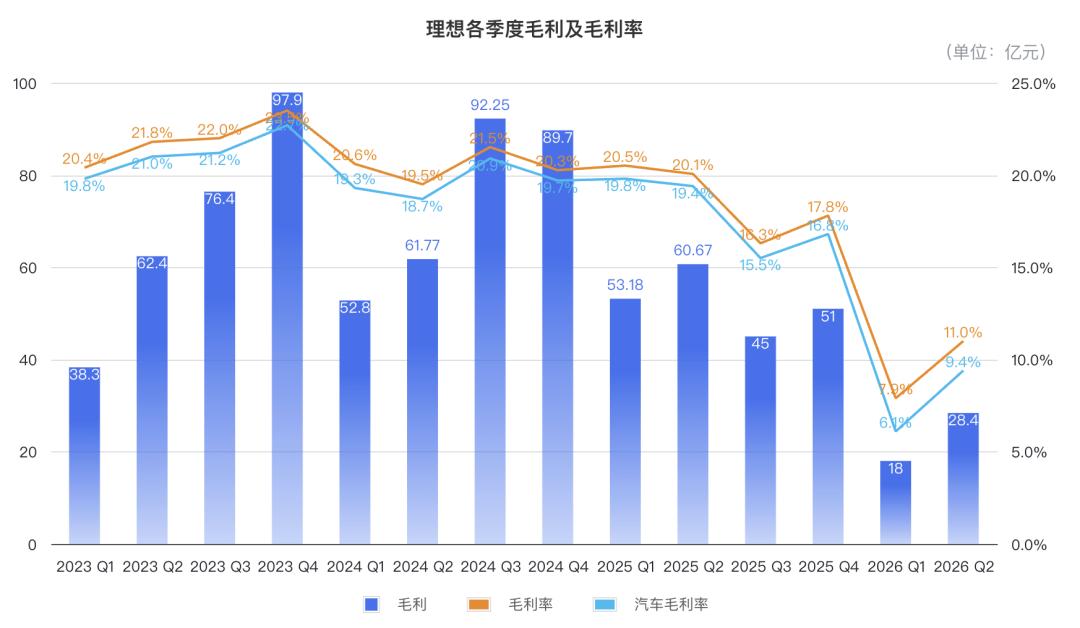
In the second quarter of this year, the company's total operating cost was 22.8 billion yuan, down 5.6% year-on-year, while the revenue decline was larger in comparison.
This led to Li Auto's gross profit in Q2 dropping from 6.1 billion yuan in the same period last year to 2.8 billion yuan, down 53.3% year-on-year and up 56.9% quarter-on-quarter; the vehicle gross margin also dropped from 19.4% in the same period last year to 9.4%.
These changes mean that the pressure Li Auto faces not only comes from selling fewer vehicles, but also from changes in its vehicle model mix.
This year, Li Auto is carrying out centralized generation replacement for the L series, switching from L9, L8 to L6 to new generation products one after another.
Ma Donghui, co-founder and President of Li Auto, mentioned that this process is affected by multiple factors including old model inventory clearance, new product launch, and policy transition, causing phased disturbances to operations.
When vehicle models are replaced in a concentrated manner, old models need to clear inventory, new models need to go through production ramp-up, which will affect both sales volume and price structure; while new platforms, new technologies and new components begin to be installed on vehicles, they will change vehicle costs again.
At the same time, Li Auto also mentioned another external variable this year in the earnings call:
Prices of chips, PCBs and memory chips are all affected by changes in supply and demand, and the price of lithium carbonate also shows cyclical fluctuations.
Li Xiang specially emphasized that due to the high intelligence level of Li Auto's models, the usage of semiconductors and memory is also higher, so it is more obviously affected by the related cost increase.
This point is indeed worth noting, because intelligence is becoming an important investment in automotive product competition, and the higher the intelligence level, the higher the demand for computing power chips, memory and other electronic components.
At the stage of rising semiconductor prices, this part of technological upgrading will first be reflected in cost pressure.
At least from the perspective of the second quarter, this pressure has been included in the income statement. Li Auto turned from a profit of 1.1 billion yuan in the same period last year to a loss of 1.7 billion yuan in Q2.
In contrast, Li Auto's expense side has not shown obvious out of control.
The company's R&D expense in the second quarter was 2.8 billion yuan, down 1.2% year-on-year and basically stable; Sales, General and Administrative Expenses were 2.3 billion yuan, down 16.2% year-on-year.
Therefore, the main contradiction Li Auto currently faces still focuses on vehicle revenue and gross margin.
However, compared with the first quarter, the company's financial position in the second quarter has changed.
From the first quarter to the second quarter, the vehicle gross margin has recovered from 6.1% to 9.4%, the overall gross margin has increased from 7.9% to 11%, and the gross profit has increased by 56.9% quarter-on-quarter.
In terms of cash, Li Auto's cash flow from operating activities in Q2 also recovered from a net outflow of 6.1 billion yuan in Q1 to a net inflow of 15 million yuan, and the free cash flow narrowed from -7.4 billion yuan in Q1 to -1.3 billion yuan.
This financial report shows that Li Auto is still in the generation replacement period, but the difference is that Q1 was more like the low point of profitability, and the repair has already started now.
Next, Li Auto needs to solve two problems: first, whether new vehicles can pull the sales volume back up to scale, and second, whether new product and technology investments can be converted into premium and profits again.
How to do it specifically?
What is Li Auto going to do next?
In the earnings call, Li Auto planned the company's approach for the next stage.
After sorting out, it can be found that Li Auto is planning to integrate product generation replacement, pure electric vehicles, self-developed chips, batteries and intelligent driving into one system. The most notable change is that intelligence has begun to enter product definition and cost structure from auxiliary configurations.
Let's start with the most practical thing — the company needs to rely on new generation products to pull back sales volume and product mix first.
The L series has completed major generation replacement, and there will be the facelift of MEGA and Li Auto i9 in the follow-up.
MEGA will add rear-wheel steering, steer-by-wire, active anti-roll bar, self-developed M100 chip, and update the intelligent driving perception hardware.
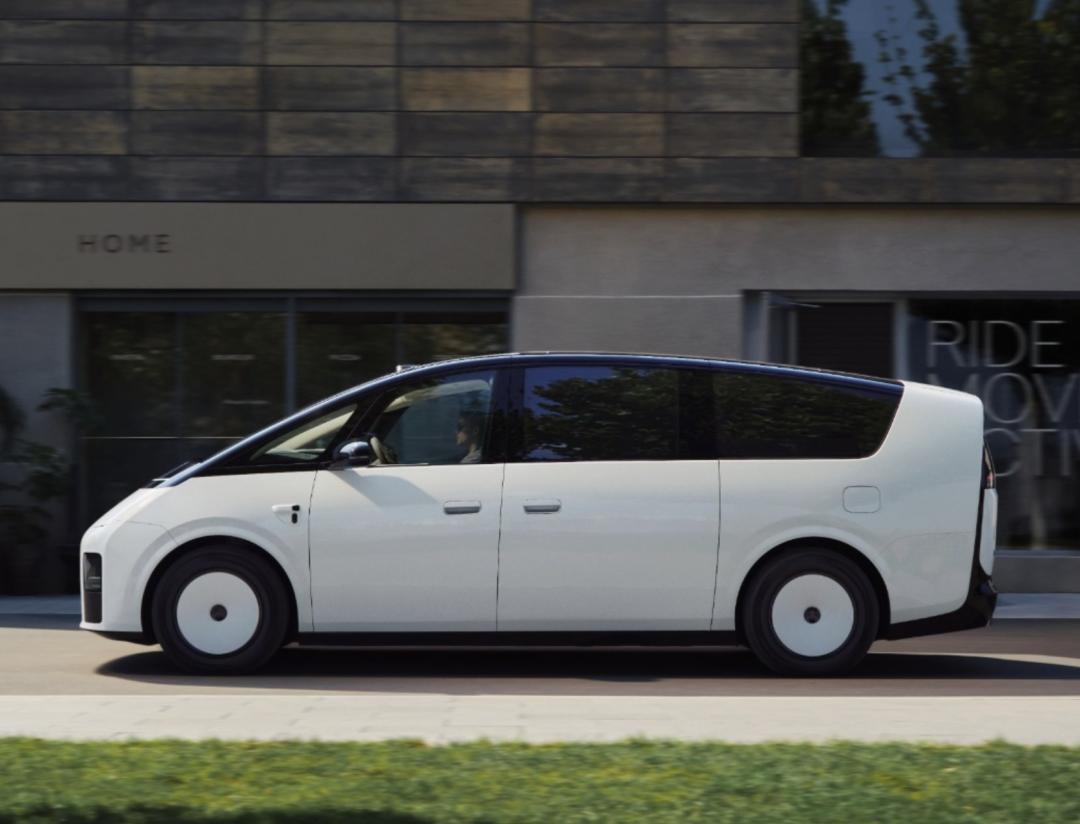
The i9 is equipped with 800V 5C platform, new generation self-developed electric drive, M100 chip and new generation cockpit chip, and will be launched in mid-September.
For this round of L series generation replacement, Li Xiang summarized it as a synchronous upgrade of software and hardware.
New generation products have been successively equipped with self-developed Ma Hong M100 chip, Ma Hong VLA model, 800V, active suspension, full drive-by-wire chassis, third generation self-developed range extender and 5C ultra-fast charging battery.
These technologies have been put into mass-produced vehicles uniformly, and have begun to become the common technical base of Li Auto's new generation products.
The fastest changing part among them is intelligent driving.
In May this year, the full set of intelligent driving system equipped with M100 chip began to be delivered, and the current chip shipment volume has exceeded 50,000 units.
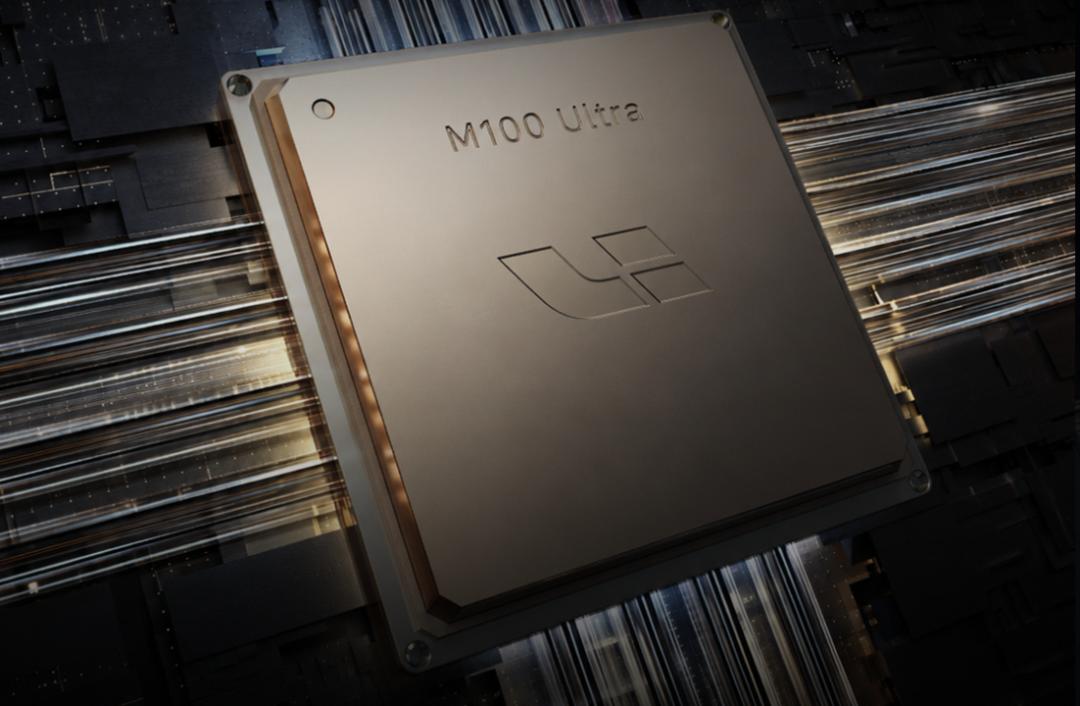
After OTA 9.1 was pushed at the end of July, Li Auto stated that the overall performance of Ma Hong VLA increased by 20%, and the mileage penetration rate of urban assisted driving for models equipped with M100 chip nearly doubled compared with the previous generation of computing power platform.
In the earnings call, Li Auto also broke down the subsequent model upgrade into more specific quantitative indicators for the first time:
In the next phase of OTA 9.2, the model will be fully upgraded to the 3D Vision Transformer architecture, the number of parameters will be increased to 3 times of the original, and the computing power demand will be increased to 4.6 times.
By the fourth quarter of this year, Li Auto has also made several plans:
The effective perception distance will be increased to more than 250 meters, thus reducing behaviors such as sudden braking, hesitation and unnecessary lane change by more than 30%;
The 3D spatial perception accuracy of key targets will be improved to within 5 cm, and the success rate of complex scenarios such as narrow roads and passing through ticket gates will be increased by 50%;
In scenarios such as construction detour and unprotected turning, unnecessary parking, slow driving and hesitation are expected to be reduced by more than 20%...
It can be seen that when Li Auto talks about new models, it emphasizes less and less on traditional product labels such as space, refrigerator and color TV alone. Technologies such as self-developed chips, VLA, and software OTA are mentioned more and more, running through different models.
One of the important factors for Li Auto's quarter-on-quarter recovery in Q2 is actually the improved product mix brought by the launch of the all-new L9.
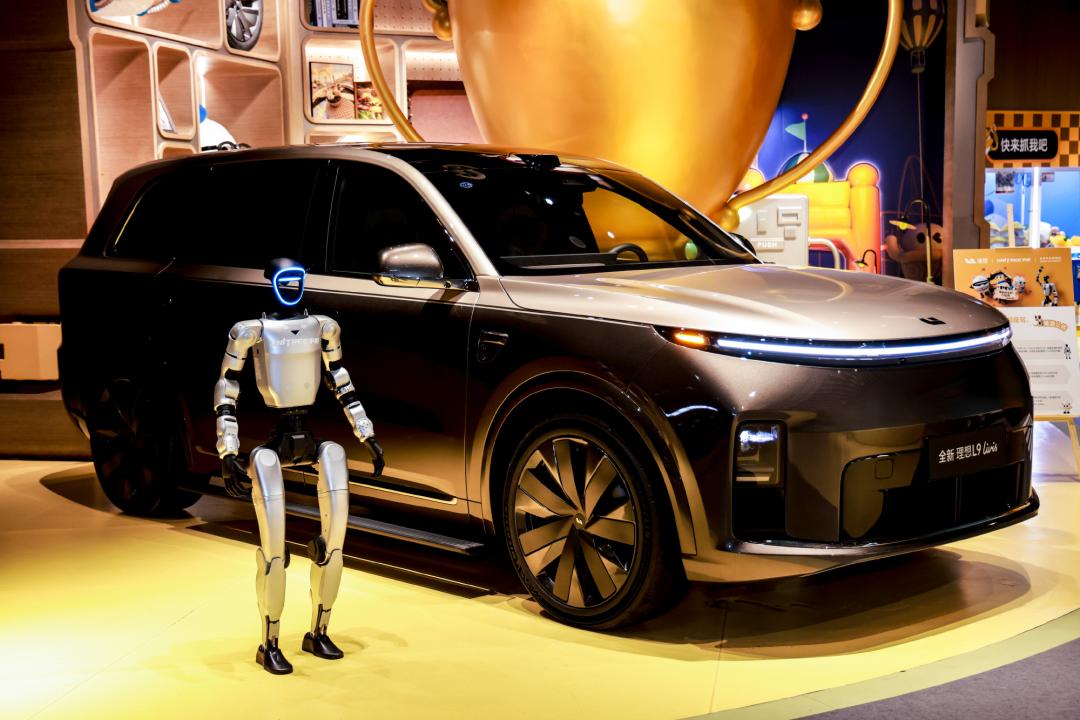
Li Auto disclosed in the earnings call that the quarter-on-quarter increase in gross margin in the second quarter benefited from the all-new L9, especially the order proportion of the Livis version of the new L9 has reached about 85%.
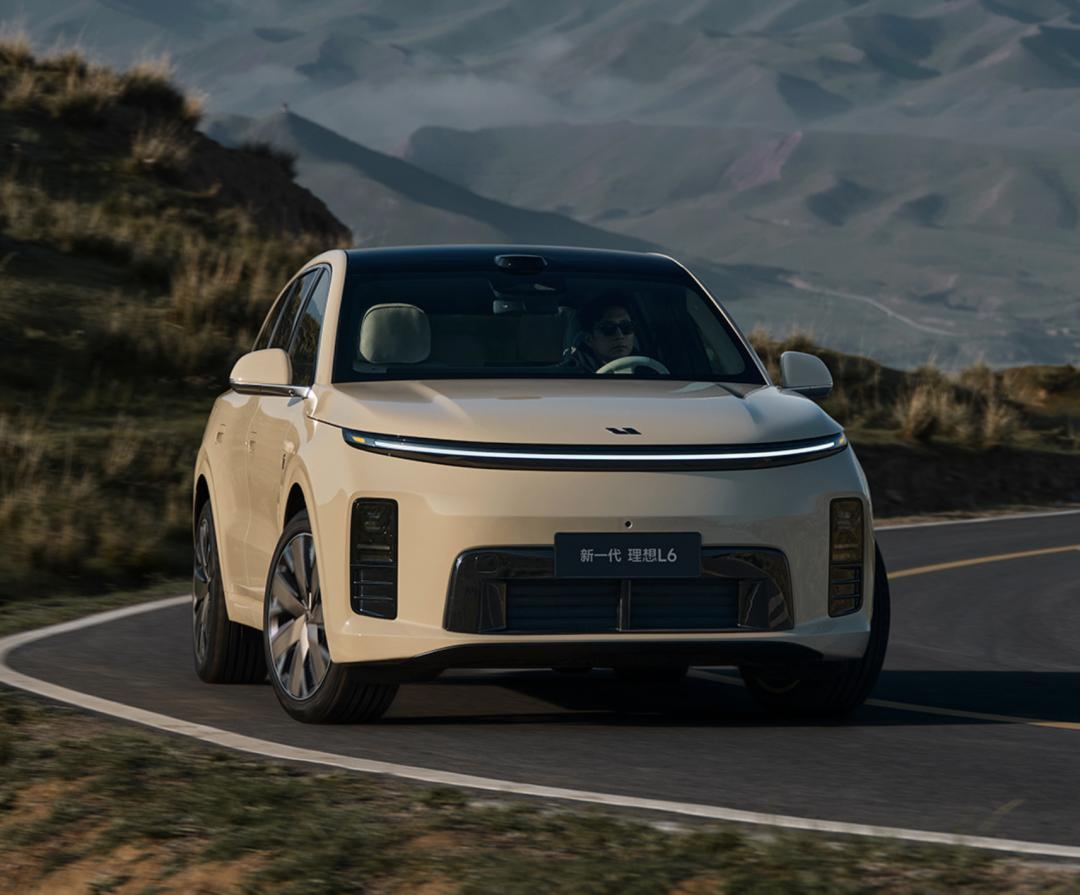
The new generation L6 is regarded by Li Auto as the most important base model in the price range of 200,000 to 300,000 yuan, and the management's expectation is to form a stable scale of about 10,000 units of monthly sales.
Li Auto's CFO clearly stated that it is expected that with the increase in the proportion of Livis version sales, the replacement of pure electric models and the launch of i9, the gross margin will further improve in the second half of the year.
However, compared with the model parameters themselves, another indicator may be more worthy of attention — <