RoboSense: Its robotics business has already accounted for half of its total business.

From "automotive" to "humanoid", RoboSense's semi-annual report reveals a strong "robot" undertone.
On August 26, RoboSense released a highly transformative semi-annual report.
The financial report shows that the company achieved a total revenue of 1.02 billion yuan in the first half of the year, a year-on-year increase of 30.2%; total LiDAR sales reached 719,200 units, a year-on-year increase of 169.6%.
But what is more noteworthy than the figures is the profound change in business structure: The robot business has accounted for nearly half of the company's product revenue, contributed almost all of the revenue increment in the first half of 2026, and become the main source of gross profit.
"The robot business has become the core pillar of the company." At the subsequent earnings call, CEO Qiu Chunchao further concretized the company's vision: "In the past, everyone defined RoboSense with LiDAR. Today, we can redefine this company with robots."

Qiu Chunchao, CEO of RoboSense
He judges that embodied intelligent robots will be a larger industry with a scale comparable to the mobile phone market and a per-unit value close to that of automobiles. In such a huge track, the division of labor in the industrial chain will be more refined, covering computing power, models, massive data and robot bodies. "Our boundary is very clear: we do not make computing power chips, nor basic large models, but focus resources on deploying the most core and hardest-to-scale incremental components on the robot body — the eyes, skin and muscles, as well as the source capability of high-quality physical world data."
In Qiu Chunchao's view, the industrial rhythm of embodied intelligent robots will be faster than that of Robotaxi and LiDAR in the past, and the hardware convergence cycle will no longer last for ten years. RoboSense's strategy is to occupy the commanding height of cost proportion in core incremental components, just like CATL occupies the core value proportion in electric vehicles.
01. From "Perception" to "Execution", the Robot Business Achieves Leapfrog Development
RoboSense's robot business is not just a concept.
In the first half of this year, LiDAR sales in the robot field alone reached 282,600 units, with a year-on-year increase of 510.4%. Behind this figure is the company's in-depth penetration in multiple scenarios such as lawn mowing robots, unmanned delivery, industrial and embodied intelligence.
The bigger highlight lies in the incremental components. Qiu Chunchao elaborated on the company's "three core robot components" strategy at the earnings call.
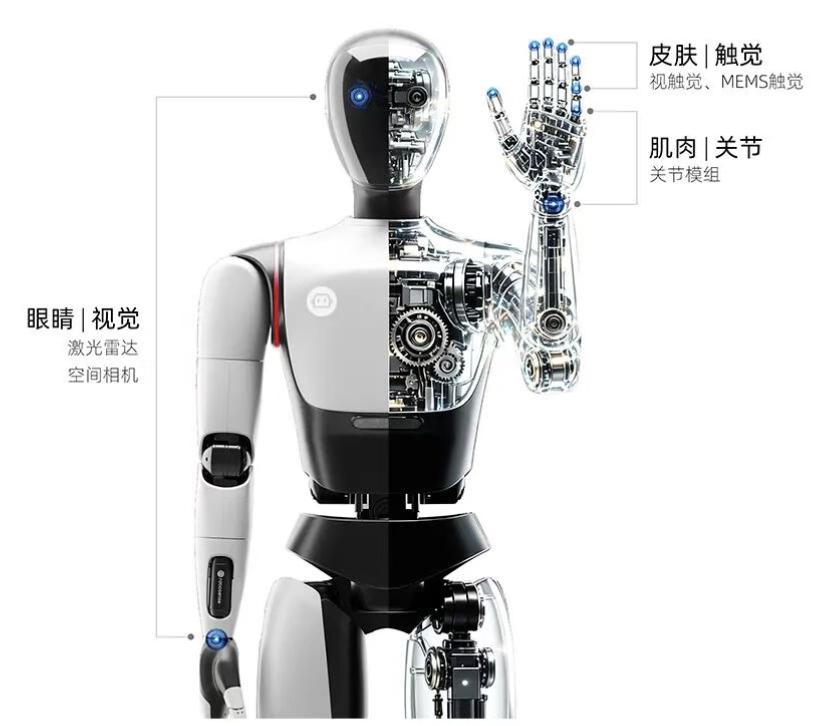
"Eyes", spatial camera. Its core breakthrough lies in the self-developed large-area array SPAD chip, which enables the spatial camera to natively align color images and depth information at the hardware bottom layer, and output 4D (RGB-D) information with millimeter-level accuracy.
Different from most 3D cameras on the market that rely on back-end algorithms to "guess" depth, RoboSense's solution directly "measures" depth. There is an essential difference in reliability between the two in edge scenarios such as long distance, strong light, weak light and transparent objects.
Qiu Chunchao emphasized that for physical AI training, the quality of perception data directly determines the efficiency of the model. The spatial camera solves the data quality bottleneck from the source, so it is recognized by leading customers. This product has received orders from global leading enterprises, and is scheduled to start delivery after the third quarter of 2026, and enter full mass production in 2027. The management positions it as "one of the core growth engines for performance in 2027".
"Skin", tactile sensor. Contact perception is an essential part of robot fine operation. RoboSense's layout in the tactile field is divided into two technical paths.
Vision tactile sensor (fingertip) uses optical principle to perceive multi-modal force information, and greatly simplifies the optical path through architecture innovation, realizing complete optical integration in the fingertip-sized cavity.
MEMS tactile sensor (finger pad) directly outputs physical force signals based on MEMS technology, avoiding the common zero drift, time drift and temperature drift problems of traditional electronic skin. The source of this capability is the design, process and production operation experience accumulated by RoboSense in the R&D of MEMS LiDAR, "from technology to production line, they are completely interconnected".
At present, the R&D of related products has been completed. The first enterprise-level mass production project will start commercial delivery at the end of September 2026, and enter mass production in the fourth quarter.
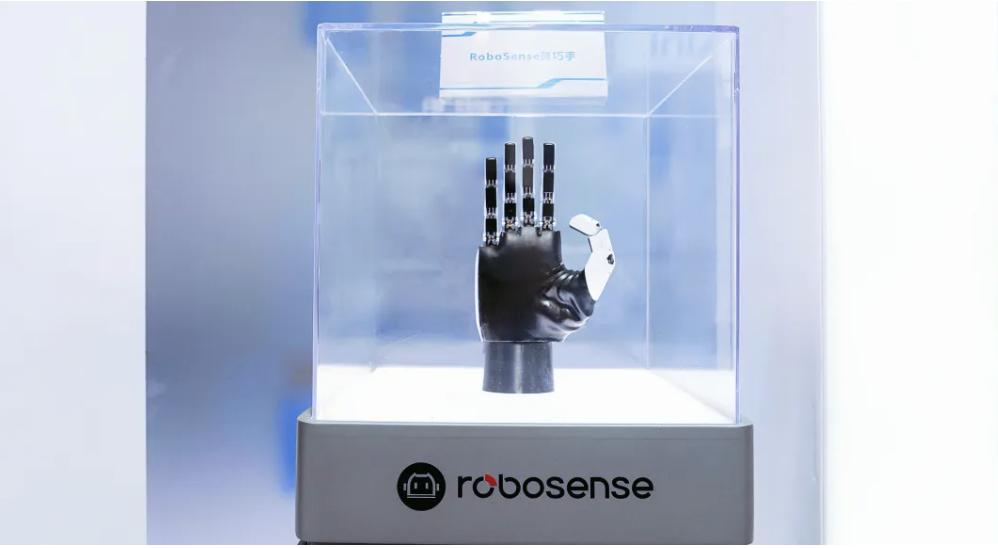
"Muscle", joint module. It mainly migrates the precision motor technology of LiDAR to the joint module, and solves three core industry pain points: miniaturization (meeting the space constraint of 22 degrees of freedom of dexterous hands), torque density and control efficiency, and service life (the common shortboard in the current industry). RoboSense has a self-built motor production line, which is its manufacturing asset accumulated with the iteration of multiple generations of LiDAR platforms over the past ten years.
Qiu Chunchao pointed out that the first product has completed R&D, and the first batch of 10,000-level joint module procurement demands have been formed, and mass delivery will be launched in the fourth quarter of 2026.
RoboSense's robot strategy is self-consistent in business logic: accumulate customers with robot LiDAR as the entry point, and then expand categories to the same group of customers through spatial cameras, tactile sensors and joint modules, so as to increase the per-unit value and customer stickiness. The company clearly does not make complete robot machines, and positions itself as a "core incremental component supplier". With the increase of categories and the improvement of platform reuse efficiency, this model is regarded by the management as its core competitive barrier.
02. Financial Perspective: The True Face of the Transformation Period
The robot business is growing rapidly, but the financial data also truthfully presents the pains of the transformation period.
In terms of revenue, in the second quarter of this year, RoboSense achieved a total revenue of 561 million yuan, a year-on-year increase of 23.2% and a month-on-month increase of 22.3%. Total LiDAR sales reached 388,000 units, a year-on-year increase of 145.8%, of which ADAS sales were 291,800 units, a year-on-year increase of 135.7%, hitting a new high in a single quarter. Sales in robots and other fields were 97,100 units, a year-on-year increase of 182.3%.
The cumulative total revenue in the first half of the year was 1.02 billion yuan, a year-on-year increase of 30.2%, and total LiDAR sales were 719,200 units, a year-on-year increase of 169.6%. Among them, ADAS sales were 436,600 units, a year-on-year increase of 98%, and robot field sales were 282,600 units, a year-on-year increase of 510.4%.
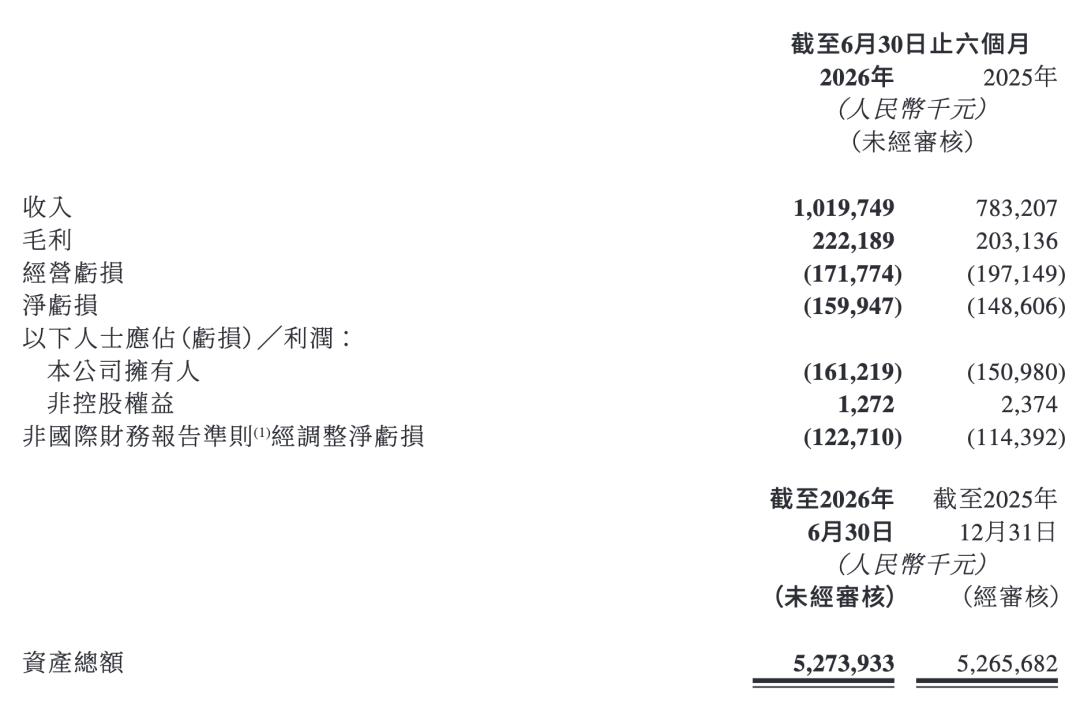
RoboSense's financial performance in the first half of 2026
At the earnings meeting, Qiu Chunchao also disclosed two key figures: In the first half of 2026, the revenue of the robot business has accounted for nearly half of the product revenue, and contributed almost all of the revenue increment; more importantly, the robot business has become the main source of product gross profit, and the management clearly stated that this business has achieved independent profitability.
This is mutually verified with the company's strategic narrative of "becoming a robot technology platform company".
In the past, the market labeled RoboSense as an "automotive LiDAR company", but now its revenue driving force has changed. The customer base of the robot business has covered more than 60 leading domestic and foreign enterprises such as Unitree and Agibot. The shipments of multiple products in the first half of the year have exceeded the total of last year, and some products are expected to achieve several times of growth throughout the year.
The financial data in the transformation period is not unilaterally positive, and several pressure points are also worthy of attention.
Gross margin dropped sharply. The comprehensive gross margin in the first half of the year was 21.8%, down about 10.1 percentage points year-on-year. The management attributed it to two factors: first, the average unit price of LiDAR products fell, reflecting the competitive situation of the automotive industry and the downward pressure of the cycle; second, the price of material procurement rose, the upsurge of AI computing power drove the price of upstream materials such as PCB, storage and FPGA to rise, and the temporary additional orders caused by the deviation of automobile customer forecasts further aggravated the fluctuation of supply chain cost.
Net loss expanded. The net loss in the first half of the year was 160 million yuan, expanding by 7.6% year-on-year. Revenue growth failed to translate into narrowing losses, the core lies in the overall increase in expenses: R&D expenses were 346 million yuan, up 12.2% year-on-year, mainly invested in smart chips, digital platforms and new robot components; total sales and management expenses were 168 million yuan, up 23.9% year-on-year, including the increase of salary, professional services, marketing and other items.
The cycle drag of the automotive business. In contrast to the high-boom robot business, the automotive industry is going through a cold winter. The management admitted that "the current automotive industry is going through the cycle", the automotive gross margin is under great pressure, and the temporary additional orders caused by customer forecast deviation further disturb the cost.
The market is used to comparing RoboSense with Hesai. From the financial data:
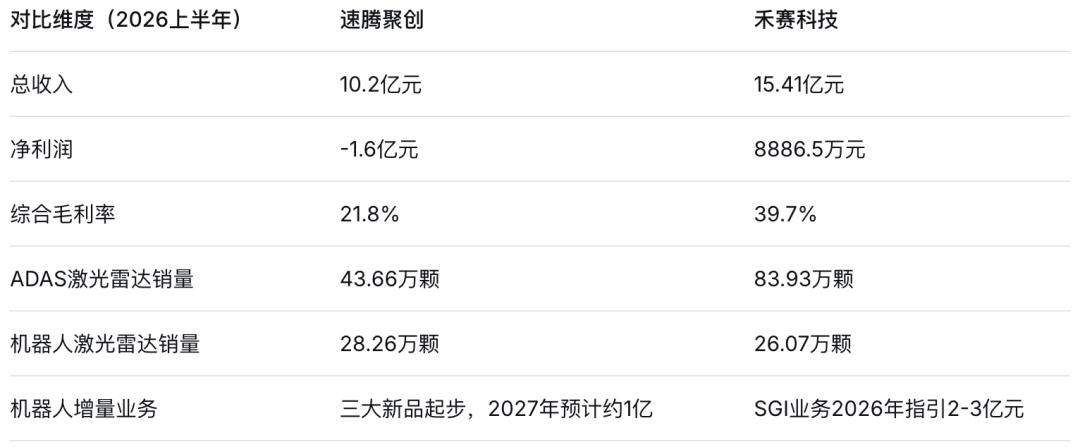
Comparison of core financial data between RoboSense and Hesai Technology
In the automotive ADAS market, Hesai ranks first with ADAS shipments of 839,300 units; RoboSense shipped 436,600 units, which is still catching up, and the pressure on automotive gross margin is more severe.
In the robot LiDAR market, RoboSense slightly surpassed Hesai (260,700 units) with shipments of 282,600 units, taking the lead in segmented markets such as lawn mowing robots, unmanned delivery and embodied intelligence.
In terms of the cashing rhythm of incremental business, Hesai's SGI business (power module, spatial intelligent platform Kosmo) has contributed revenue for the first time in the second quarter, and the full-year revenue guidance has been raised to 200-300 million yuan; RoboSense's three new products will be delivered successively from the end of Q3 to Q4, and are expected to contribute a total of about 100 million yuan in 2027, with a slightly later start of commercialization.
On the whole, Hesai is temporarily leading in revenue scale, profitability and commercialization rhythm of incremental business, while RoboSense has overtaken in robot LiDAR shipments, with a more detailed category layout at the perception layer. The final result of the competition between the two sides remains to be verified by large-scale volume release in 2027.
03. Future Outlook: From Node Delivery to Large-scale Verification
Compared with the vague guidance in the past, the management gave a specific timetable at this earnings call. For the automotive business: The E2 LiDAR equipped with the self-developed "Peacock" chip has been mass-produced, and more than 200,000 units are expected to be delivered in the second half of the year; the "Phoenix" chip will welcome the first mass-produced vehicle project SOP in Q4.

New robot products: the three new products of spatial camera, tactile sensor and joint module will enter mass delivery in the second half of the year according to the rhythm, opening the first year of commercialization.
This means that the second half of 2026 is the transition period for RoboSense from "telling robot stories" to "generating robot revenue". The company's full-year shipment guidance is: 1.2-1.8 million units for ADAS, 800,000-900,000 units for robots (about three times the growth); the full-year revenue target is 2.5-3 billion yuan.
The management's judgment on gross margin is frank and prudent.
"I am not satisfied with the company's gross margin in the first half of the year," said Yun Junchun, Vice Chief Financial Officer. With the advancement of the company's new projects, the overall gross profit is already recovering, which is mainly driven by four factors: large-scale release of digital products, yield improvement and fixed cost amortization; the procurement cost of self-developed chips (Phoenix, Peacock) is significantly lower than that of outsourced chips; platform-based BOM optimization and supply chain integration; the proportion of high-gross-margin robot overseas and industrial business increases.
Regarding the upward pressure on upstream material prices, Yun Junchun said that it has been dealt with through long-term order price locking, multi-supplier strategy and material substitution, and believes that this "will not change the direction of medium and long-term structural cost reduction".