It's not just that cars are hard to sell; even young people no longer bother to get a driver's license.
Guys, don't say that selling a car is no easy thing. Young people nowadays don't even want to take driving tests anymore...
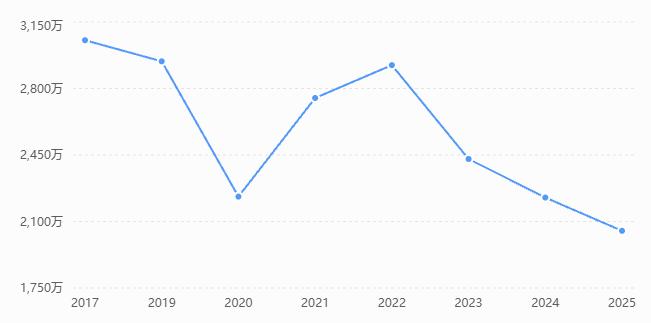
Let's look at the number of people getting certificates in recent years, uh, I mean driving licenses.
Apart from a brief rebound after the pandemic, this figure has basically hit a new low every year. There were 30.54 million people in 2017, but only 20.51 million in 2025, a sharp drop of one third over 8 years.
Many people may say, isn't it because there are fewer newborns now so the demand is not that high?
No, buddy, the inflection point of new population growth was in 2016, those people are only 10 years old now, what driving test can they even take?
The number of young people who are actually eligible to take driving tests is still on the rise, but they all coincidentally choose not to take it.

Specifically, the proportion of test takers under 25 has dropped from 60% five years ago to less than 30%. The reason is very likely that everyone has become more rational about taking driving tests and buying cars.
This is definitely a good thing.
Take a college roommate of Neck Guy as an example. Right after he finished the college entrance exam back then, he rushed to get his driving license. It's not because he wanted to drive in college, but he treated it like completing a side quest, clearing the question marks on the map first to avoid not having time for it later when he's busy, after all, you can never have too many skills.
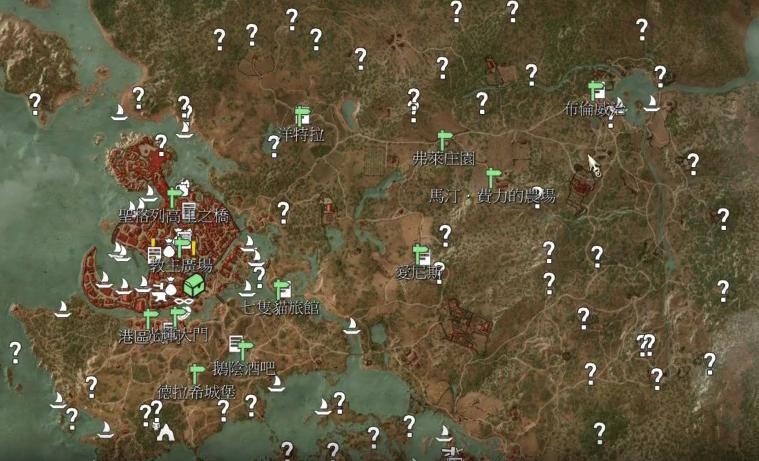
But later he found out that from college to postgraduate study, he barely touched a car, so that driving license was basically obtained for nothing.
Not to mention, after working in a big city, you will find that the cost of using a car is so high. Parking fees, fuel/electricity costs, maintenance and repairs add up to thousands of yuan a month, which is not as cost-effective as taking a taxi every day, not to mention there are subways.
So for most young people who have just stepped into society and have little money, there is really no need to get addicted to driving early.
However, if everyone thinks that way, the driving school industry will be in complete chaos, right?
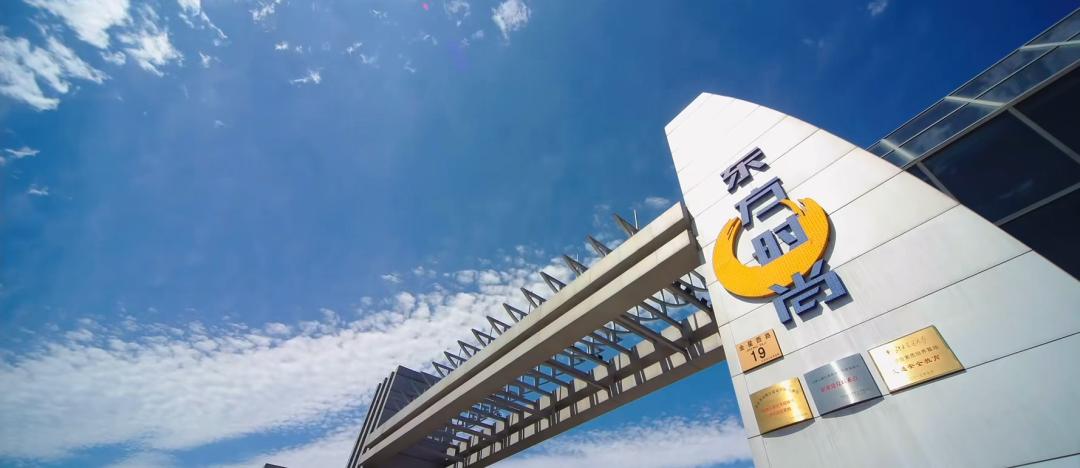
You know, around 2005-2015, driving schools were extremely prosperous. Many business owners made their first bucket of money from this business back then, and one driving school called Oriental Fashion even got listed on the A-share market.
But now you can't replicate that old trick anymore, I'm afraid.
Since 2015, the number of people signing up for driving schools has peaked. By 2018, nearly 40% of the training vehicles had a utilization rate of less than half, indicating that the industry already had severe overcapacity. As a result, driving schools went through a long phase of cutting prices to attract customers.
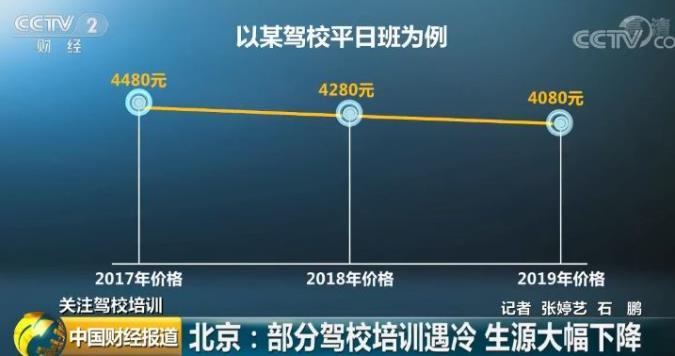
In 2019, China Central Television exposed that the driving training price in Beijing dropped from 4480 yuan to 4080 yuan in two years, and some even offered an ultra-low price of less than 3000 yuan to seize the market.
Neck Guy is based in Hangzhou. Although the situation is not as exaggerated as reported in the news, back when I took my driving test, 4000 yuan was the lowest price, and some places charged 5000-6000 yuan. But nearly ten years later, the price is still around 4000 yuan.
Even in some county-level cities and third- and fourth-tier cities, since they can't stand the fierce competition anymore, driving schools simply huddle together and jointly raise prices. As a result, the fees are high, the service is poor, and the whole industry is completely messed up.
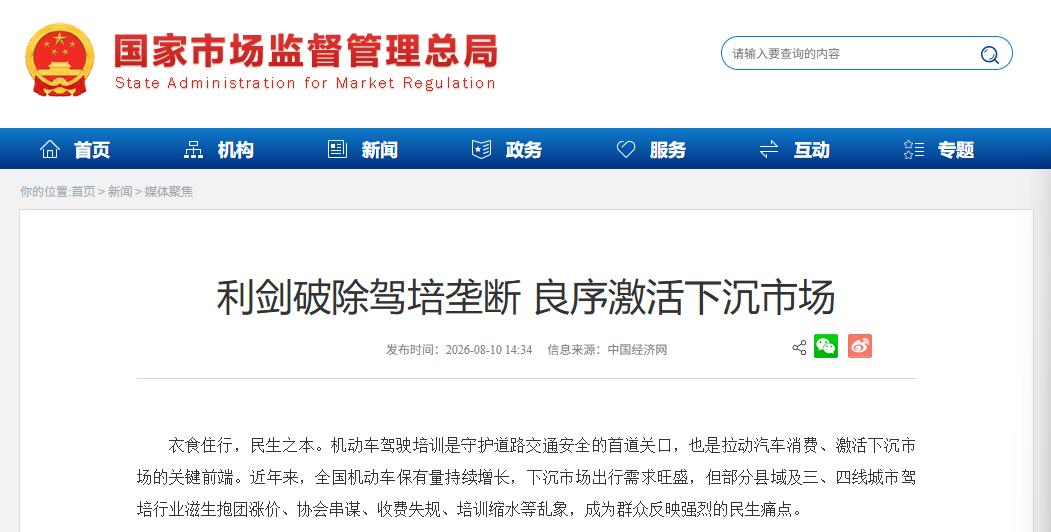
So the regulatory authorities soon started to take action. Not long ago, the State Administration for Market Regulation announced 12 monopoly cases in the driving training industry investigated across the country since 2022, which is exactly what this is about.
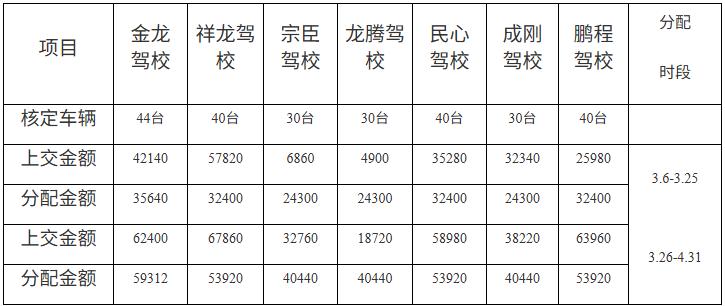
For example, 7 driving schools in Tongliang, Chongqing formed a "price alliance", mandating that the training fee must be higher than 2980 yuan. If any member violates the rules, there will be corresponding punishment mechanisms, and the fine will be deducted from the 100,000-yuan security deposit.
They even designed the profit distribution plan: 1000 yuan goes directly to the driving school, 1000 yuan is distributed to the coach, and the remaining 980 yuan is the overall fund of the alliance, which will be "redistributed" according to the proportion of the number of training vehicles each school owns.
This is like a weak party protection mechanism. If you recruit very few students this year and are on the verge of bankruptcy, you can still get a small guaranteed share from the overall fund based on the number of your training vehicles.
Wait, that sounds pretty kind, isn't it? It guarantees profits and is full of human touch, why was it banned directly?
Actually if you look at it from another angle, it's true that the driving schools helping each other out brings some warmth, but in the end, the ordinary consumers are the ones who suffer. As long as this price alliance exists, we have no other choices at all when taking driving tests.
For example, in neighboring Jiangjin, Chongqing, 6 motorcycle driving schools also set up a similar alliance mechanism, as a result, the training price skyrocketed directly from 200 yuan to 900 yuan, that profit multiplier is even higher than making money from stock trading, isn't it?
Not to mention, the key problem is not the price increase, but the alliance itself, because this kind of behavior already constitutes monopoly.
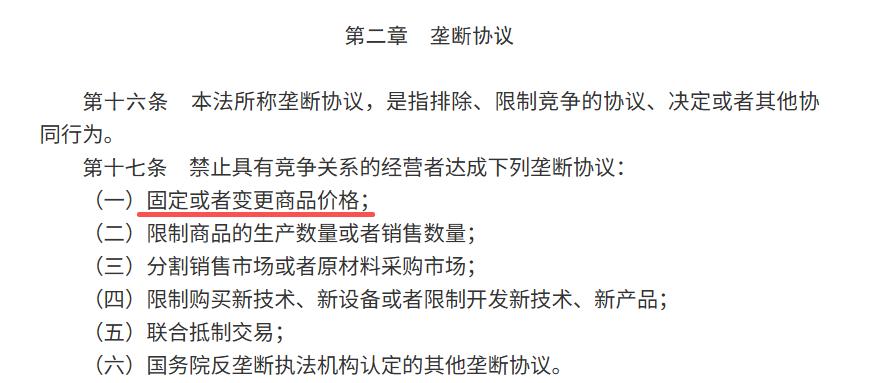
China's Anti-Monopoly Law clearly stipulates: Operators with a competitive relationship who monopolize prices through agreements are breaking the law.
More than 30% of the above cases were even led by industry associations. If joint price raising becomes the "unspoken rule" of the industry, the market law of survival of the fittest will no longer work.
If you do this, who will optimize their services in the future? Everyone might as well lie flat and muddle along, anyway, you can still sell your services at a high price with a shabby site and a few broken cars.
Apart from monopolistic behaviors, the State Administration for Market Regulation also mentioned various chaotic charging problems in driving schools, such as false publicity, hidden charges, refusal to refund, fake training hour records and so on. Neck Guy has heard of many such cases long ago, but in the current general environment, driving schools have no way out, so these problems have become even more rampant.
Not long ago, a report on 1818 Golden Eye said a girl saw the advertisement of "2980 yuan all-inclusive", thought she got a great bargain, and went to learn driving excitedly. But the exam registration was never completed, the driving school even secretly changed its contact number, and later all kinds of physical examination fees and material fees came up one after another.

That's when the scene of her breaking down in tears at the gate happened. But she was lucky, she only spent a few hundred yuan more in total.
Last year, Legal Daily also reported a similar news that a driving school in Shandong first lured students in with the slogan of "2888 yuan all-inclusive", but when students actually started learning to drive, they had to pay "test site simulation fee", "exam service fee" and other extra fees, adding up to 1300 yuan more, and they were not allowed to take the exam if they didn't pay that money.
Not to mention when you are learning, you may also meet some unethical coaches who give you 20 yuan, implying that you buy him a pack of good cigarettes. Sometimes the coach doesn't say anything, but some students will try to please him in private, and you are also afraid that the coach will deliberately make things difficult for you, right?
When you encounter such things, you really don't want to continue taking the driving test anymore, really.
So this forms a vicious cycle: the fewer people take the test, the less money driving schools make, the worse their services and the more tricks they play, which in turn makes more people not want to take the test...
But Neck Guy never suggests propping up a false prosperity through "joint price raising", because the most essential problem of the industry is still the imbalance between supply and demand. Judging from the current trend, there is no sign of demand recovery at all, and even in a few years, the young population may really decline further.
Unless you trick all your aunts and uncles in the village into taking driving tests, then the people who suffer will be the coaches.
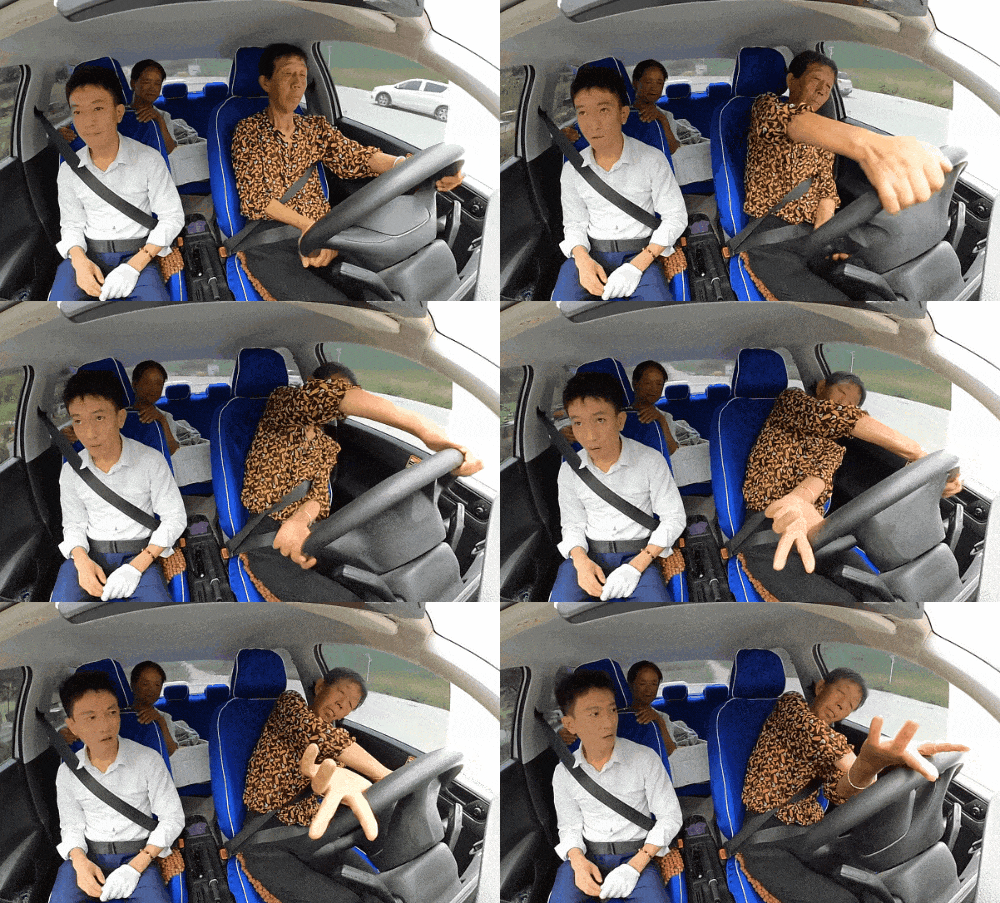
Actually for the industry, the way to get rid of these chaotic situations is quite straightforward: let those "bad driving schools" go bankrupt or merge, leave the driving schools with better services and higher efficiency, so that the production capacity can match the students' demand again.
But so far, we are still far from that goal.
For example in Jinan, there are 112 driving schools in the whole city, 5439 training vehicles, and 188 training sites. Theoretically, they can train 392,000 people a year, but the actual number of enrolled students in 2024 was only 105,000, with a utilization rate of only 26.8%.
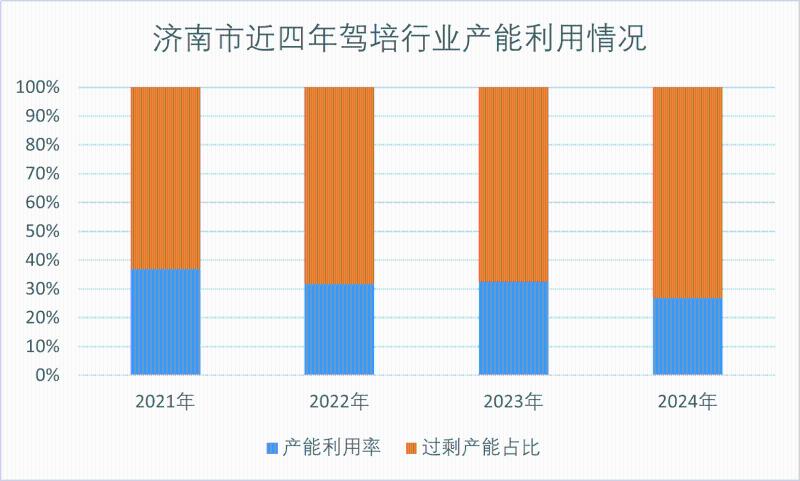
Moreover, judging from the change of utilization rate in recent years, the speed at which bad driving schools exit the market is far slower than the speed at which the number of students decreases.
The reason is that driving schools have very heavy assets, including training vehicles, coaches, qualifications and so on. Many business owners may know that the market is not good, but they have already invested so much money in the early stage, so they will think "I've already started this business, let's hold on for a few more years, maybe things will get better".
To put it bluntly, the real wave of driving school bankruptcies may not have started yet, but it will happen sooner or later, and the hard times are yet to come.
But the driving schools that survive in the end will definitely push the whole industry to a higher level.
For example, many driving schools have already started to promote simulator training. After all, even professional racing drivers who race on tracks train with simulators, so beginners who learn to use these simulators will definitely learn faster than those who know nothing and get in a real car directly.
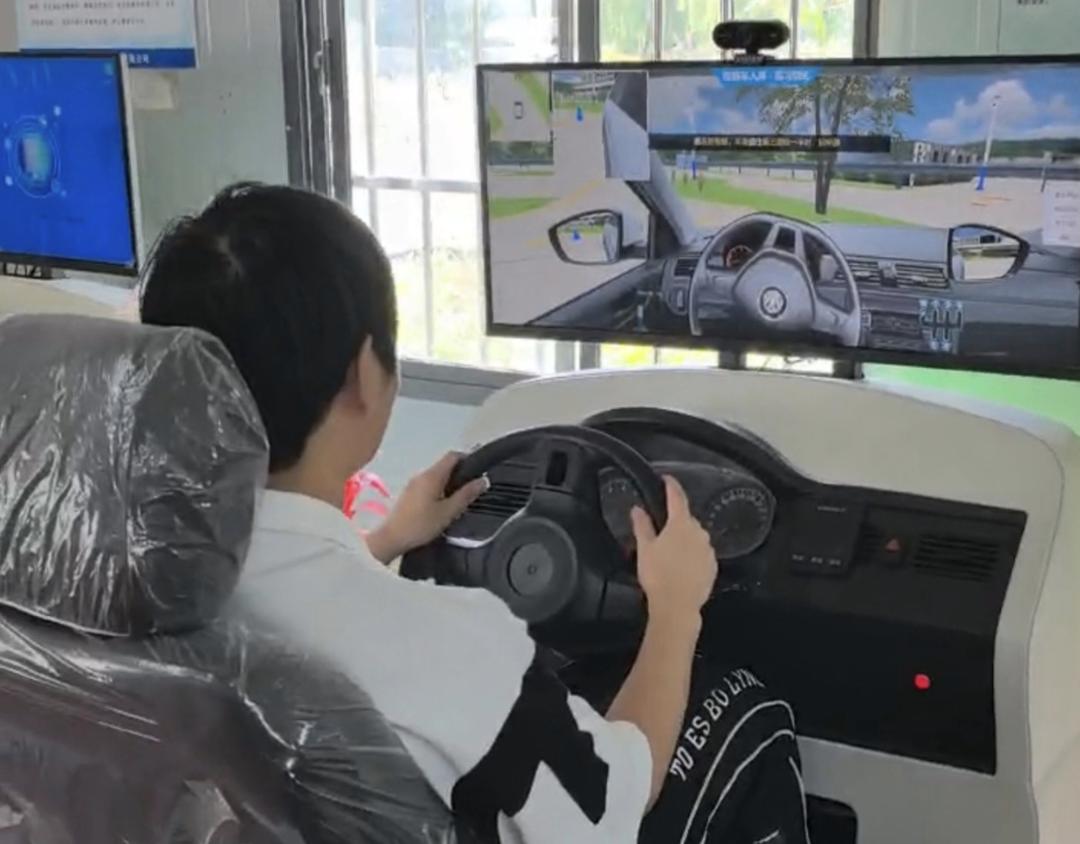
Although currently it is only used as the pre-training for subject 2, and students treat it as playing Forza Horizon, it may really help driving schools reduce costs quickly in the future.
Even compared with the exam-oriented training of memorizing reference points with coaches, the "real road" experience of simulators can help