The total scale of publicly offered funds shrank by more than 560 billion yuan in July
On August 26, the Asset Management Association of China (AMAC) disclosed the public offering fund market data for July.
By the end of July 2026, there were a total of 165 domestic public offering fund management institutions in China, including 150 fund management companies and 15 asset management institutions with public offering qualifications. The total net asset value of public offering funds managed by the above institutions amounted to 39.11 trillion yuan, a decrease of 563.063 billion yuan from the end of June.
This put an end to the previous "three consecutive increases" trend. From April to June this year, the total scale of public offering funds continued to refresh historical records, rising from 39.36 trillion yuan and 39.48 trillion yuan to 39.67 trillion yuan.
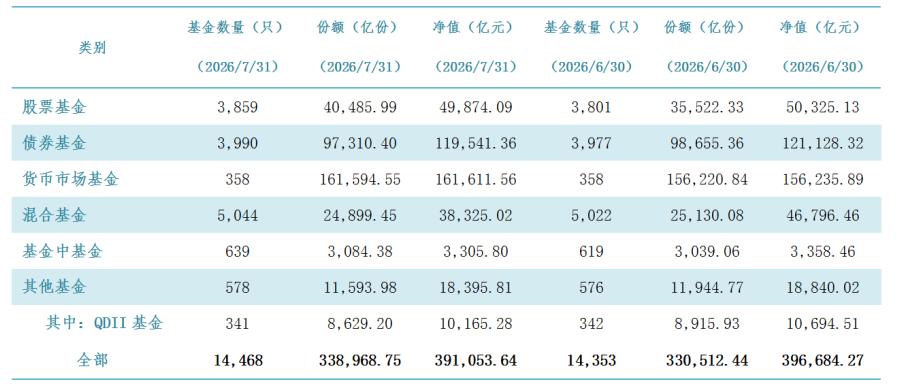
Compared with the data in June, the scales of equity funds, bond funds, hybrid funds, FOFs and QDIIs all shrank to varying degrees in July, which can be specifically divided into two scenarios.
The first scenario is "share growth but scale decline". This is most prominent for equity funds: with a share increase of 496.366 billion shares, their scale decreased by 45.104 billion yuan; a similar situation occurred to FOFs, whose scale decreased by 5.266 billion yuan despite a share increase of 4.532 billion shares.
The second scenario is "both share and scale decline". Hybrid funds were the most affected: although their share only decreased by 23.063 billion shares, their scale shrank by 847.144 billion yuan; followed by bond funds, whose share decreased by 134.496 billion shares and scale shrank by 158.696 billion yuan; in addition, the share of QDII funds decreased by 28.673 billion shares, with a scale shrinkage of 52.923 billion yuan.
Money market funds were the only product type that saw scale growth, with a month-on-month increase of 537.567 billion yuan.
The scale shrinkage of fund products is not only affected by investor redemptions, but also related to the net value decline caused by market correction.
The stock market as a whole was volatile in July. Morningstar China pointed out in its monthly report that the A-share market showed characteristics of structural differentiation. From the perspective of Shenwan industry classification, 14 out of the 31 Shenwan industry sectors closed higher, while 17 sectors declined. Among them, the coal, petroleum and petrochemical, banking, and food and beverage sectors all rose by more than 11%, while the electronics, communications, building materials, and machinery and equipment sectors all fell by more than 20%.
According to statistics from Morningstar China, more than half of the partial equity funds closed down in July, among which value-style funds outperformed balanced and growth-style funds. Large-cap value equity funds, a category with better performance among partial equity funds, recorded a monthly increase of 7.87%. Mid-cap balanced equity funds, large-cap growth equity funds and mid-cap growth equity funds recorded average monthly returns of -13.35%, -19.29% and -19.38% respectively, which were the three categories with relatively poor performance among partial equity funds.
"Fixed income funds showed differentiated performance in July," Morningstar China noted. Against the backdrop of a volatile and strengthening bond market, pure bond funds performed well on the whole. Interest rate bonds outperformed credit bonds, driving interest rate bond funds to record an average increase of 0.24%, outperforming credit bond funds (with an average return of 0.14%). Short-term bond funds and money market funds followed in terms of performance, recording average increases of 0.10% and 0.09% respectively. The weak performance of stocks and convertible bonds dragged down the performance of "fixed income +" funds: ordinary bond funds, active bond funds and convertible bond funds recorded average monthly declines of 0.26%, 1.54% and 5.82% respectively, which were the three lowest-performing categories among fixed income funds.
"Most QDII funds recorded losses in July." Data from Morningstar China shows that benefiting from the good performance of Hong Kong stocks, gold and crude oil, Greater China equity funds and commodity funds recorded average monthly increases of 7.01% and 5.27% respectively, which were the two best-performing categories among all QDII funds. Greater China equity and bond hybrid funds, global equity and bond hybrid funds, and global emerging markets equity and bond hybrid funds recorded average monthly returns of -8.69%, -12.88% and -14.80% respectively, which were the three worst-performing categories among all QDII funds. Bond funds performed poorly: only 4 out of 78 open-end global bond fund shares achieved positive returns in July, with an overall average yield of -1.03%.
This article is from "Caijing New Media", written by researcher Jiang Jinli, edited by Jiang Shizhou, and published with authorization by 36Kr.