One week after Unitree Technology went public, its market value has shrunk by nearly 200 billion yuan.
Source: Jiemian Image Library
Unitree Robotics, the leading humanoid robot enterprise that has been listed on the Sci-Tech Innovation Board for only one week, has staged a remarkable capital drama of rapid regression from sentiment-driven valuation to real fundamental performance in just a few trading days.
At the moment of its listing opening on August 19, Unitree Robotics (688836.SH) saw its share price surge to 1100 yuan per share, corresponding to a total market value of 444.9 billion yuan, setting a fiery opening record for new stocks under the registration-based system, with the maximum floating profit of one winning lot reaching nearly 475,000 yuan.
After consecutive days of pullbacks, as of the midday market break on August 26, the stock was quoted at 611.00 yuan, up 1.36%, but its market value fell back to 247.1 billion yuan, shrinking by nearly 200 billion yuan in a week. On August 25, Unitree Robotics' share price dipped to as low as 588 yuan during trading, closing at 602.8 yuan with a total market value of 243.8 billion yuan, and the maximum drawdown of its share price reached 46%.
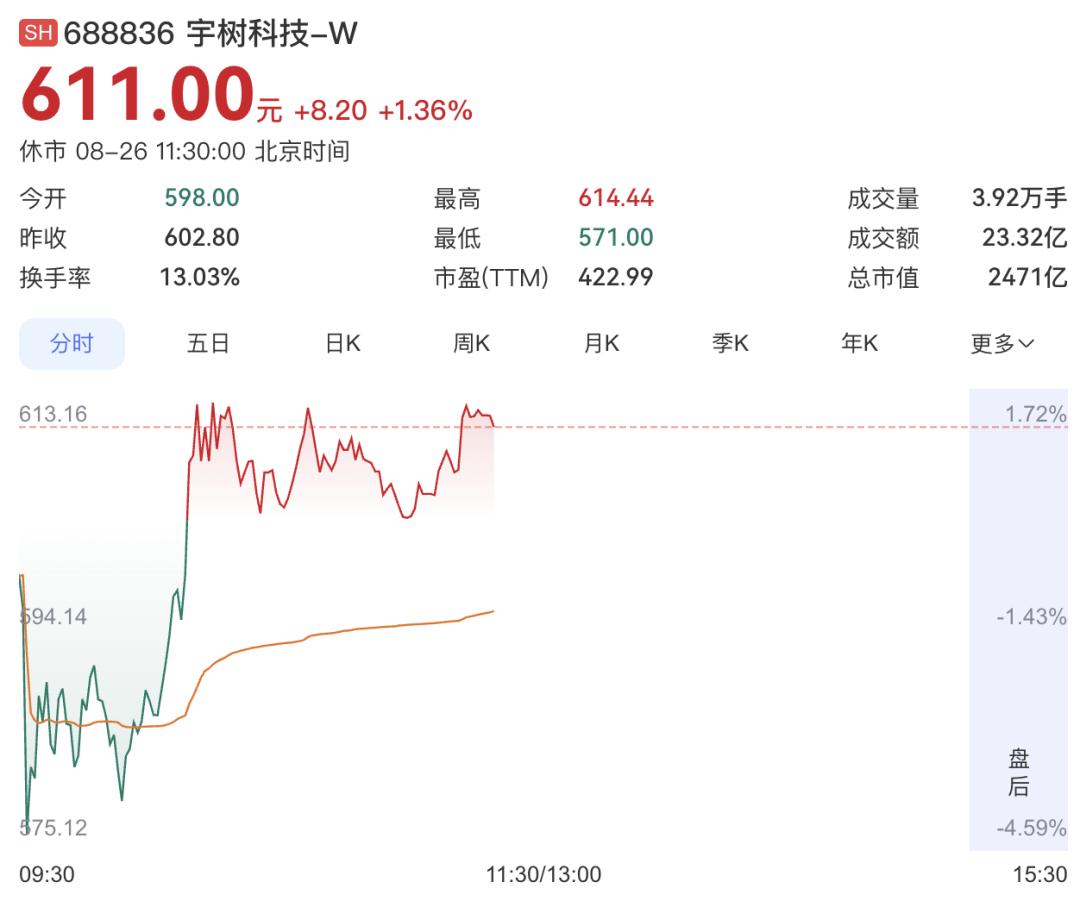
However, Unitree Robotics' current share price still has a significant premium over its IPO issue price of 150.8 yuan, with a static P/E ratio remaining at 877 times, which is far higher than the industry average of 38.56 times for the A-share general equipment manufacturing sector.
There are multiple influencing factors behind the drastic volatility of the company's share price.
The structure of the new stock's tradable floating shares is the direct technical reason for the abnormal sharp surge in its price on the first trading day. According to Unitree Robotics' public prospectus, the proportion of tradable floating shares in the total share capital was only 7.44% in the early stage of listing. The limited chips, facing the market's fanatical pursuit of the humanoid robot track, easily pushed up the short-term trading price. The peak market value of 444.9 billion yuan is more of a trading illusion spawned by liquidity, rather than a reasonable enterprise value widely recognized by institutions.
Many international and local securities institutions released research reports around its listing, putting forward valuation judgments that are vastly different from the sky-high speculative prices in the secondary market.
Nomura Securities initiated coverage on Unitree on its first trading day, giving it a "Buy" rating, but the target price was only 370 yuan, priced at 25 times the expected 2027 price-to-sales ratio, corresponding to a reasonable market value of about 150 billion yuan.
Nomura Securities pointed out that the company independently develops and manufactures core components such as motors, reducers, encoders and drive boards, with outsourced parts accounting for only 10% to 20% of the total cost. Its gross profit margin expanded from 44% in 2022 to 60% in 2025. The material cost of its humanoid robots has dropped below 100,000 yuan, and the R1 series is priced at only 29,900 yuan. The mature cash flow from its quadruped robots provides financial support for the R&D and market expansion of humanoid robots.
In addition, within 26 months, Unitree completed the iteration of four humanoid robot series, namely H1, G1, R1 and H2, building a complete product matrix covering "movement + operation + interaction".
Nomura Securities estimates that Unitree's revenue from 2026 to 2028 will reach 2.687 billion yuan, 5.396 billion yuan and 13.184 billion yuan respectively, with year-on-year growth rates of 58%, 101% and 144%.
However, the institution also mentioned three major risks facing Unitree: first, the risk of demand structure. In the first 9 months of 2025, 73.6% of Unitree's humanoid robot revenue still came from scientific research institutions, while industrial or commercial scenarios only accounted for about 5%; second, the risk of the FCC (U.S. Federal Communications Commission) ban. On July 28, the FCC added foreign-produced advanced robot equipment to its "Regulated List". Existing authorized products can continue to be sold, but subsequent new models will not be able to obtain FCC certification. The proportion of revenue from the U.S. market has dropped from 18.39% in 2023 to 13.30% in 2025; third, the risk of intensifying competition. In the first half of 2026, Unitree shipped about 5,900 units, but another robot company Agibot surpassed it with 8,400 units, making Unitree slip from the first place to the second in the world. The ASP (average selling price) of humanoid robots has dropped from 593,000 yuan in 2023 to 166,000 yuan in 2025.
As the lead underwriter of Unitree Robotics, CITIC Securities also gave very "practical" data, setting the target market value at 506-559 billion yuan. CCB International set the target price at 269 yuan, which translates to a total market value of about 109 billion yuan, only 24.5% of the peak value at the opening of listing. Institutions generally believe that the market trading price has overdrawn the industry's growth expectations for the next few years in advance.
The slowdown in performance growth is the underlying reason for the growing divergence among investors. Unitree's prospectus shows that the company's net profit attributable to shareholders in 2025 was 278 million yuan, with operating revenue of 1.699 billion yuan, and it had achieved explosive growth of several times in previous years. However, the growth curve changed in 2026: its revenue in the first half of the year reached 1.152 billion yuan, up 48.54% year on year, while the non-recurring profit-deducted net profit was 244 million yuan, down 19.34% year on year, showing signs of rising revenue without rising profit.
Some institutional analysts warned as early as the IPO stage that the 219 times P/E ratio of this issuance is based on the assumption of sustained ultra-high growth in the next few years, and the high valuation will be difficult to be justified by performance if the growth rate falls back.
As for when the embodied intelligence industry will usher in its explosive turning point, Wang Xingxing, founder of Unitree Robotics, stated at the main forum of the 2026 World Robot Conference on August 20: "It will take 2 to 3 years if everything goes well, or 5 to 10 years at most, for embodied intelligent robots to truly enter ordinary households." In his view, the core challenge for embodied intelligence to reach its "ChatGPT moment" comes from the difficulty of alignment between AI model outputs and physical robots.
He noted in his speech that language models are purely digitally coded, with almost no loss between input and output. But every execution of a physical robot will introduce errors at the physical level, and the accumulation of errors will weaken the generalization ability of the model, which is the key reason why current robots struggle to cope with unfamiliar environments, though he believes this problem will be solved in the future.
There are also different voices in the market. Some bullish investors point out that Unitree is one of the few profitable high-performance humanoid robot enterprises in the world, with shipments of bipedal humanoid robots exceeding 5,500 units in 2025. Its in-house hardware technology accumulation leads the industry, so the traditional valuation system for the manufacturing sector cannot be simply applied, and higher long-term premium should be given to hard technology growth enterprises.
For Unitree Robotics, listing is just a starting point. What it needs to answer next is the core proposition of the capital market: whether it can turn the grand narrative of the industry into tangible performance reflected in its financial statements step by step.
This article is from the WeChat official account "Jiemian News", written by Song Jianan, and published with authorization by 36Kr.