Exclusive First Release | StarYi Space Completes Several Hundred Million Yuan Series A Financing, The Eight-Year Arduous Journey and "Rebirth" of a Commercial Aerospace TT&C (Tracking, Telemetry and Command) Enterprise
Text | A Zhi
"To be an anonymous person and accomplish earth-shaking feats. This is a very distinct portrayal of our industry track." Xingyi Space has been established for eight years, and its founder Wang Zheng rarely steps onto the front stage.
This year, commercial aerospace has once again become the focus of the primary market. Rocket companies are sprinting for IPOs, satellite startups are emerging in batches, and space computing power has become the most imaginative concept at the moment. However, amid wave after wave of industry boom, the aerospace TT&C (Tracking, Telemetry and Command) and operation, the key link connecting the space and ground systems, has mostly stayed at the edge of the spotlight.
As a behind-the-scenes link, it does not have the flame and roar of a rocket launch, nor is it easy to become the protagonist in capital stories. But it actually carries the entire life line of the satellite from orbit insertion to the end of its value. In Wang Zheng's words, "from the moment the rocket ignites, the full life cycle management of the satellite is handed over to the TT&C and operation system, which continues until the last moment of its life."
Four years ago, in an exclusive interview with 36Kr, Wang Zheng compared the commercial aerospace cause to running a marathon. At that time, they had already built the domestic "Great Triangle" TT&C network, which had managed more than 150 satellites in total. Today, this number has quadrupled.
The latest set of data shows that Xingyi Space has provided on-orbit TT&C services for 611 satellites/rockets in total, with a mission success rate of 99.8%. Its annual revenue in 2025 exceeded 100 million yuan, and it is expected to achieve break-even this year. This is also a feature of the aerospace TT&C and operation link: as the "water seller" in the industry, its commercial closed loop comes faster than that of rockets and satellites, and it is expected to cross the survival line earlier.
Wang Zheng compared the past 8 years to laying a solid foundation, accumulating strength in places that others cannot see. At the same time, the company introduced multiple strategic investors since last year, completed the exit of state-owned assets while maintaining and increasing their value, and realized the holding of the technical team.
A strategic acceleration driven by the governance structure reform has taken place inside Xingyi Space.
36Kr Future Industry has learned that Xingyi Space has recently completed the A-round capital increase and share expansion and the introduction of strategic investors. The A-round equity financing raised hundreds of millions of RMB, and introduced many well-known investment institutions such as Suzhou Venture Capital, Lihe Qingtong, Septwolves Holdings, Zhichen Investment, Lanxi Capital, and Haisi Venture Capital. At the end of last year, Xingyi Space just completed a nearly 300 million yuan Pre-A round financing led by Shenzhen Venture Capital.
It has completed two consecutive rounds of financing within 8 months, introducing multiple industrial parties and strategic investors. This is a signal: when rockets and satellites continue to refresh the upper limit of market demand, this long-term "anonymous" company is also accelerating to step onto the front stage.
Starting a business is extremely risky, and surviving is the greatest innovation
The starting point of Xingyi Space bears distinct imprints of the era.
Catching up with the upsurge of the first batch of commercial aerospace entrepreneurship in China, Xingyi Space was established in 2018. The core members of the founding team come from the core of the "national team" in China's aerospace TT&C system. Also in this year, companies such as LandSpace and i-Space began to launch rockets, completing the first attempt from suborbital flight to orbital launch missions. Private rockets entered the "first year of launch", and the market heated up in an all-round way.
When rockets and satellites are going to space, the construction of ground infrastructure and the management of space assets cannot lag behind. Around 2018, more than a dozen commercial TT&C companies emerged including Xingyi Space. Up to now, commercial companies have covered more than 90% of China's civilian satellite TT&C and operation work.
Like all infrastructure construction industries, the return curve of TT&C and operation is "heavy first and then light". In the early stage, a large amount of capital investment is required to build stations, systems and teams. The network comes first, then the service, and the revenue needs to be gradually released with the growth of the number of satellites, charging by accumulating every satellite and every orbit cycle.
But the contradiction is that compared with the narrative of rockets and satellites, TT&C and operation as a behind-the-scenes link has weak explosiveness and is not attractive enough for the capital market.
It is conceivable how difficult it is to do a business in the primary market that "requires heavy investment and is hard to tell a compelling story".
In the early stage, with the support of local state-owned assets, Xingyi Space built a command and control center covering an area of 216 mu in Tongchuan, and deployed the Great Triangle TT&C network in Kashgar, Xinjiang, Hegang, Heilongjiang and Lijiang, Yunnan. Three sets of 12-meter large-aperture equipment and two sets of 7.3-meter equipment were all in place before the end of 2020. Up to now, Xingyi Space has formed a pattern of "Great Triangle + Central Center". The domestic "relay network" has been laid well, the next focus is the construction of overseas stations, which is also the main use of the funds raised by Xingyi Space this time.
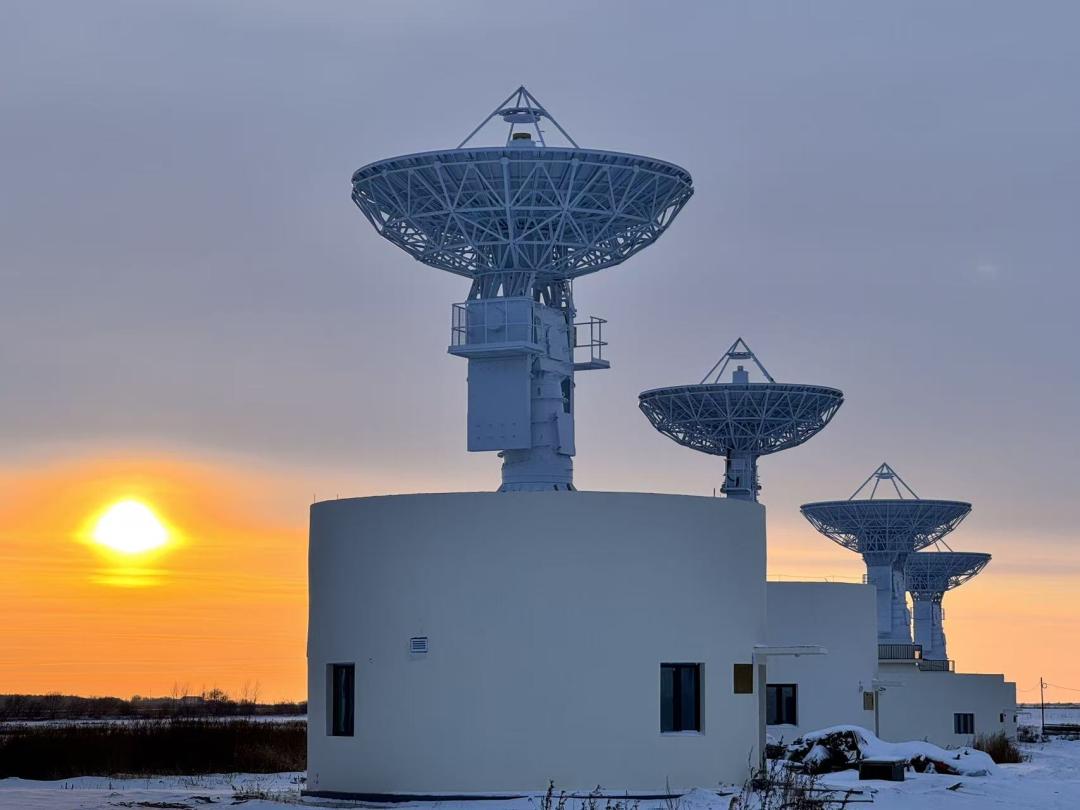
Real scene of the TT&C station
Equally important as ground station construction, the software system also requires long-term investment in R&D and iteration. Wang Zheng recalled that the software development team had more than 40 people when the company was founded, and now it has more than 70 people, which has always been the link with the largest proportion of R&D investment in the company. The Xingyi Space TT&C cloud platform has been iterated from version 1.0 to version 3.0, supporting core capabilities such as constellation operation control, precise orbit determination, and collision warning.
There was an episode that the company once experienced a period of capital shortage, even unable to pay salaries, and the team lost nearly 1/3 of its personnel at one point. After going through the first near-death moment, the people who persisted later became the mainstay of all businesses of the company.
Wang Zheng can still recall many such difficult moments to this day.
"Many investments cannot bring direct returns in the short term, but aerospace is a systematic project that cannot be achieved overnight." In Wang Zheng's view, the capability boundary of TT&C and operation is determined by infrastructure. Without ground stations of sufficient density, global coverage and high-frequency tracking cannot be realized; without a powerful software platform, it is impossible to manage hundreds of satellites and multiple large constellations at the same time.
Wang Zheng said that in the past eight years, the main line of Xingyi Space is to lay a solid foundation, which can be broken down into three things that the company insists on investing in: ground base stations, software foundation, and talent genes.
There is almost no secret here, and the commercial operation method is never a unique skill. The difficulty is to move forward at a rhythm that suits you on the established path, avoid fatal mistakes in this process, and wait for the market to explode.
Wang Zheng said, "Surviving itself is the greatest innovation."
In 2025, Xingyi Space completed a key adjustment of its corporate governance structure, realized team holding, and accelerated the pace of introducing social capital. Coinciding with the re-emergence of the commercial aerospace boom, the second batch of low-orbit constellations have entered the substantive networking stage, and the industry has shifted from telling stories to competing in launch, on-orbit operation and space asset management. The window of demand for technical support of TT&C and operation as a key link has been opened.
Eight years to maturity, "but far from being robust"
If we only look at the financial figures, Xingyi Space is currently only a medium-sized company with steady growth. But in the commercial aerospace field, especially in the TT&C and operation link, the evaluation dimension of a company's competitiveness also depends on its actual combat experience.
Up to now, there are more than 100 various satellite constellations planned for construction in China, with a total of more than 50,000 satellites planned to be launched. This does not include the more than 200,000 satellite frequency resources previously declared by China to the International Telecommunication Union. This means that in the next few years, China will need to launch at least 20,000 to 30,000 near-Earth satellites. The cost of each of these satellites is often tens of millions of yuan, and their design and service life are usually 5-10 years. Once they enter orbit, TT&C companies are needed to "manage them for their entire life".
Specifically, the TT&C and operation system undertakes the tracking, telemetry, remote control and data transmission of satellites, which is equivalent to the hub connecting the sky and the ground. Without it, satellites cannot confirm their orbital attitude, receive instructions, and transmit business data back, and are essentially just out-of-control lumps of iron. In particular, low-orbit constellations are composed of hundreds or thousands of satellites, and orbit control, collision avoidance, task scheduling, and data downlink must be coordinated uniformly by the TT&C and operation network.
"I always tell customers that TT&C companies have the most say in the activity level of service objects. How many satellites you actually have in space and how many operations you can perform every day represent your activity level," Wang Zheng said.
At present, Xingyi Space manages nearly 400 satellites on a regular basis, and has managed more than 600 satellites in total. Judging from the current ground TT&C network and system capabilities, Xingyi Space can currently support the on-orbit management of 1000 satellites, which can achieve an order-of-magnitude leap.
How to achieve it specifically? Wang Zheng's answer is still software, stations, people, and "experience accumulated repeatedly in actual combat".
"We can manage 1000 satellites thanks to the relatively complete TT&C network, the stable Xingyi Cloud platform, and an operation management team with more than 20 years of practical experience in system engineering." Wang Zheng mentioned, "Hardware is only the channel. The 'big pot' on the ground we see is the channel. What is more important is the maturity, robustness and reliability of the software. Our software team has expanded from more than 40 people to more than 70 people, and we will further introduce AI talents in the future. Based on our concept of 'Aerospace TT&C +', we will extend to the directions of situational awareness, mega-constellation configuration management, and space computing power."
On the basis of software and hardware, there is also a part of implicit knowledge that cannot be quantified, that is, engineering and actual combat experience.
It can be seen from two types of cases.
The first is satellite rescue. On May 23, 2025, the downlink signal of a domestic commercial satellite suddenly disappeared shortly after launch and orbit insertion. Based on past experience in satellite anomaly handling, Xingyi Space immediately organized all its TT&C stations to search and track with full efforts, and at the same time organized the satellite development unit to build a fault tree, sort out the ideas and directions of fault investigation, formulate a rescue plan and try repeatedly. 5 hours later, the satellite returned to normal.
Similar emergency handling is not uncommon at Xingyi Space. At the end of 2024, in the preparation stage of providing TT&C support for a satellite independently developed by a foreign party, all commercial TT&C companies participating in the mission in China were unable to receive the telemetry data of the satellite, and the mission preparation was once deadlocked.
Xingyi Space organized an expert team for analysis, and found that the telemetry mode of this foreign satellite was completely different from the domestic standard, and the existing TT&C equipment could not match the configuration of this satellite. After analyzing and reversely cracking the satellite telemetry spectrum and telemetry data structure, Xingyi Space found a solution within half a month. Other TT&C companies also carried out equipment adaptive transformation according to Xingyi Space's solution, and finally successfully completed this TT&C mission.
Another noteworthy case is the dual-satellite formation fly-around control. In June this year, the 05/06 satellites of China Siwei's "Gaojing-2" were launched into orbit in the way of "one rocket launching two satellites". The mission achieved four results: "200-kilometer follow flight, 180-degree phase locking, 200-meter pipeline capture, and 500-meter fly-around formation", with an orbit control accuracy of 99.9%. Xingyi Space exclusively undertook the TT&C and operation trusteeship of this mission.
You can understand it this way: two satellites approach each other in space at a speed of several kilometers per second. At such a high speed, it is extremely difficult to control the two satellites to a close distance of hundreds of meters and keep them stable, and a slight mistake will lead to a collision. The requirements for orbit determination calculation accuracy and space operation control accuracy behind this also reflect the current capability ceiling of commercial TT&C and operation.
The above cases all point to a judgment that the barriers of TT&C and operation lie not only in how many antennas there are, but also in the orbit calculation, anomaly handling and engineering experience behind the antennas. These operations supported by technology, experience, ground network and platform system constitute the real capability foundation of TT&C companies.
In addition to serving major national missions such as manned spaceflight, the early orbit and on-orbit services of 8 commercial remote sensing satellites of Aerospace Science and Technology, each with an average cost of over 100 million yuan, are exclusively hosted by Xingyi Space.
Wang Zheng mentioned that commercial companies cover more than 90% of the TT&C of commercial satellites, and Xingyi Space's participation in it exceeds 80%, with customers including China Siwei, Changguang Satellite, Geespace, GalaxySpace, Yunyao Aerospace and many other leading enterprises.
The latest progress we learned is that this year Xingyi Space has cut into the R&D work of many national-level ground equipment and facilities, and has won a number of new computing power companies and remote sensing constellation customers in batches; substantial progress has also been made in overseas TT&C business.
"A commercial aerospace company established for eight or nine years can only be said to be relatively mature, far from being robust. But this is indeed the year when the market makes me feel the most confident since the company was founded," Wang Zheng said.
China's commercial TT&C and operation needs 3 years to catch up with the international level
In recent years, China's commercial aerospace TT&C has developed rapidly, but to understand the final logic, we need to return to a more macroscopic global coordinate system.
The global leading commercial TT&C camps represented by the Swedish Space Center (SSC) and Norway's Kongsberg Satellite Services (KSAT) have built more than 120 core commercial stations, operating more than 800 antennas, realizing global distributed coverage, and more than 70% of them are self-owned stations. The peak number of stations built in China is equivalent to that, and the industry operates about 220 antennas as a whole, but 90% are concentrated in China, there are less than 15 overseas stations, the coverage of the Western Hemisphere and high-latitude areas is severely lacking, and the single-orbit TT&C duration is only 1/4 of that of foreign countries.
The formation of the coverage network gap is the result of decades of accumulation. SSC was founded in 1972, and it took half a century to build a TT&C network covering 21 locations around the world; KSAT was founded in 2002. With the combination of the Svalbard polar ground station (78.2° north latitude) and the Antarctic ground station, it has become the global leader in polar orbit TT&C. They are all typical examples of having infrastructure first and then business models.
For Chinese companies, overseas station construction involves multiple factors such as data application, overseas operation, compliance approval and geopolitics, which means that the construction of the overseas TT&C network will not be a "rapid supplement" process. But the advantage is that from the current industrial division of labor role, commercial companies are more suitable to fill this gap for China.
Wang Zheng revealed that Xingyi Space plans to build 8 to 10 overseas stations next, and 5 will be launched within this year. The first batch of stations are located in Asian and African countries along the "Belt and Road" and with traditional friendly relations with China, which also conforms to the development path of international TT&C giants. The global networks of SSC and KSAT also started