A U.S. company was sold at a sky-high price of 7 billion, why should the Chinese enterprise in the same track be worth only 1 billion?
In May 2026, Roche Diagnostics fully acquired PathAI, a US-based pathological AI enterprise, for 1.05 billion US dollars (about 7 billion RMB). This transaction is not only the largest M&A deal in the global pathological AI sector so far, but also acts as a mirror that reflects the valuation gap between Chinese and foreign pathological AI enterprises: The valuation of most leading domestic pathological AI enterprises ranges from 1 billion to 3 billion RMB, which is several times (1-7 times) lower than that of PathAI.
Where does this gap come from? Should domestic enterprises copy the pharmaceutical enterprise service route of PathAI? After Roche's acquisition of PathAI, how can domestic pathological AI enterprises that are accelerating their global expansion challenge Roche in the global market?
01
The essence of the valuation gap:
Not technology, but the maturity of the commercial closed loop
Judging from technical indicators alone, there is no generational gap between Chinese and foreign pathological AI, and domestic enterprises even have advantages in the scale of training data and the number of model parameters. Taking Seevision Technology as an example, multiple studies published in The Lancet and Nature series show that its product performance is at the world's leading level. This means that from the technical dimension, domestic pathological AI enterprises represented by Seevision have established their own right to speak on the international stage.
The core of valuation differentiation lies in the maturity of business models.
PathAI has already run through a commercially closed loop that can realize large-scale monetization. Its core products are highly bound to multinational pharmaceutical giants such as Roche, GSK and BMS, with more than 60% of revenue coming from pharmaceutical enterprises; the remaining revenue comes from diversified businesses such as hospital-end software licensing, SaaS services, laboratory testing, and algorithm licensing.
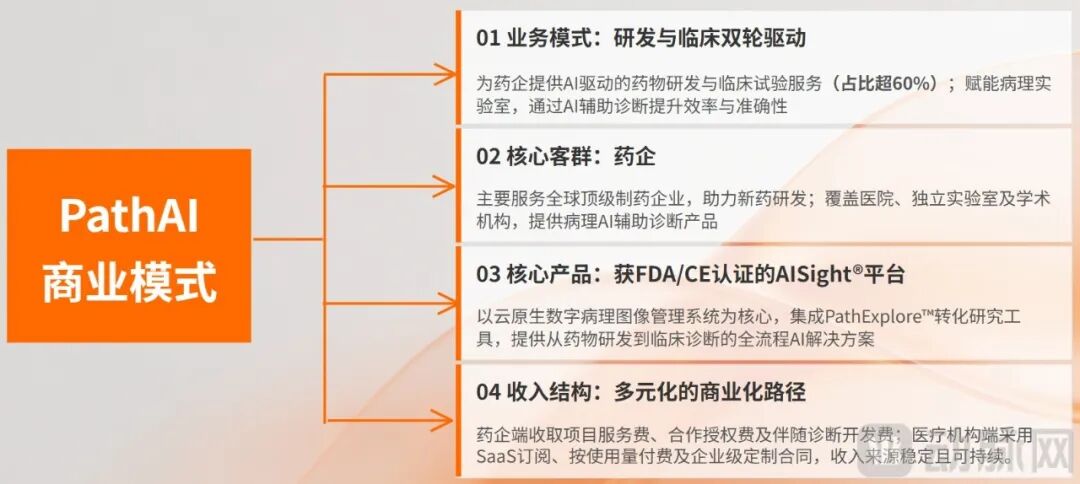
PathAI Business Model Structure Diagram
Pharmaceutical enterprise customers with high unit price, strong repurchase and high gross profit support PathAI's large-scale revenue. Third-party institutions estimate that its overall revenue in 2025 is about 100 million to 250 million US dollars, and the growth rate remains in the range of 30% to 40%. The higher the certainty of the business, the richer the valuation premium given by the capital market.
Looking back, in the domestic pathological AI track, the commercialization of pathological AI products is still being explored.
Lin Zhencheng, Partner of Doutuo Investment, pointed out: "For a long time in the past, pathological AI-assisted diagnosis lacked charging basis and was difficult to charge directly. At the end of 2025, the National Healthcare Security Administration issued the Guidelines for the Establishment of Pathology Medical Service Price Items (Trial), which completed the policy basis for compliant charging. However, in the price details implemented in various provinces and cities, pathological AI is mostly used as an extended diagnosis item without independent charging items, and the relevant costs are directly included in the original diagnosis fees, so it cannot be charged separately."
In response to this problem, the state has supported and promoted the charging of pathological AI services through a number of policies. For example, the Guidelines for the Establishment of Pathology Medical Service Price Items (Trial) issued by the National Healthcare Security Administration guides all provinces and cities to pay attention to the relevant resource input costs of AI-assisted diagnosis when pricing, make overall adjustment and guidance at the price level, and straighten out the charging path for the application of AI-assisted diagnosis technology. Medical institutions can independently decide whether to use AI-assisted diagnosis technology and which enterprise's products to choose, and the specific income distribution shall be determined through independent negotiation between medical institutions and enterprises.
Judging from the annual pathological examination volume of over 100 million person-times in China and the shortage of more than 100,000 pathologists, the domestic market has an extremely urgent demand for pathological AI, and the huge population size and examination volume will give birth to a pathological AI service market of over 100 billion RMB with a very high ceiling.
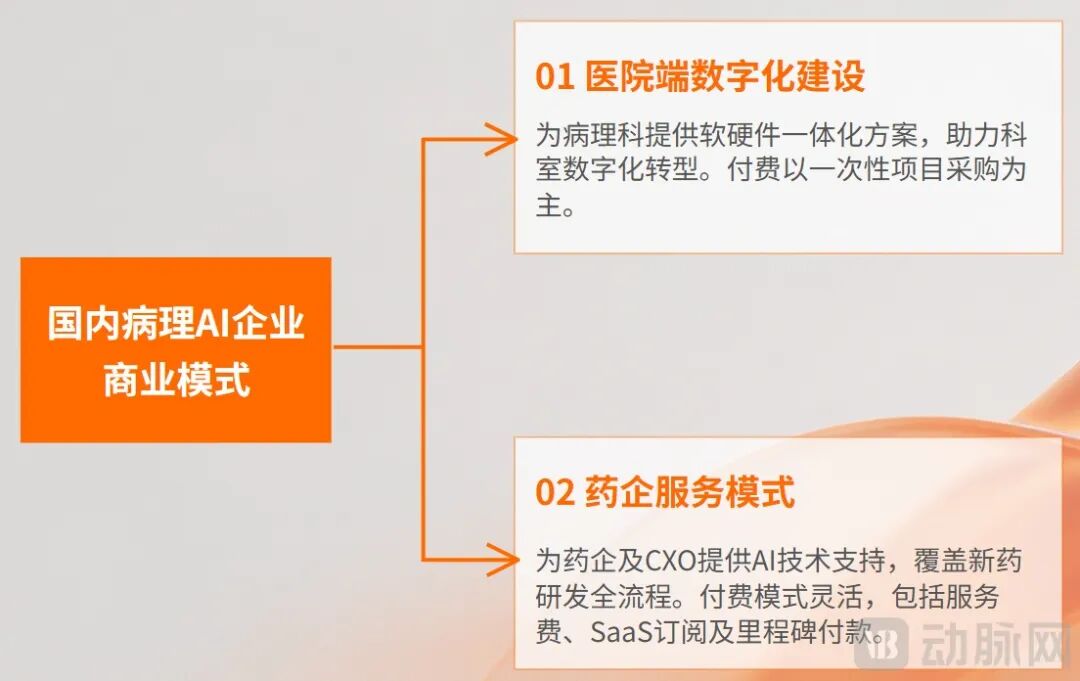
Current Business Model of Domestic Pathological AI Enterprises
At present, domestic pathological AI enterprises have explored another commercialization path. It is understood that the revenue growth rate of many leading domestic pathological AI enterprises has exceeded 100% for several consecutive years, and their revenue mainly comes from the digital construction projects of hospital pathology departments.
In the pathological digital construction, one-time projects such as hardware and software equipment sales and pathological information system construction account for the majority. This one-time revenue structure that leans towards equipment attributes restricts the valuation level of domestic enterprises.
However, digital construction itself is a high-dividend track. The policy issued by the National Healthcare Security Administration clearly states that if the hospital does not provide "pathological digital slice images", 5 RMB will be reduced per slice; the maximum reduction per single time shall not exceed 15 RMB.
Yang Lin, Founder of DigiPath AI, said: "The introduction of national policies is forcing hospitals to accelerate the digital transformation of pathology, and at the same time pointing out the direction for the industry — the construction of digital intelligent pathology departments is far more than simply adding a few scanners, software modules, or upgrading pathological information systems. Instead, we must take the AI large model as the central brain in the next 3-5 years to carry out forward-looking top-level planning. We are focusing on building a full-scenario intelligent platform covering clinical diagnosis, remote consultation, teaching and research, and data transformation, so that the massive pathological data accumulated by digitalization can truly 'come alive', and finally help the pathology department greatly improve the comprehensive competitiveness of industry-university-research."
With the acceleration of pathological digital construction, it is expected that the data volume of pathological digital slice images will surge, providing massive data for the optimization, upgrading and large-scale training of pathological AI-assisted diagnosis models, and paving the way for its commercial application.
By the end of 2024, there were about 38,700 hospitals in China, of which about 16,400 secondary and tertiary hospitals that are required to set up pathology departments according to regulations. These hospitals constitute the core demand subjects for pathological AI digital construction. But at present, the overall penetration rate of pathological digitalization is less than 10%. Under this background, it is expected that the dividend of pathology department digital construction will last for at least 3-4 years.
In addition, some domestic pathological AI enterprises have tried to lay out the pharmaceutical enterprise service track. However, local innovative enterprises in the United States enjoy valuation premiums, and the overseas innovative drug industry is highly mature, so the unit price of pathology-related service orders for pharmaceutical enterprises is much higher than that in China. Although China's innovative drug industry is rising rapidly, the scale of pharmaceutical enterprises' procurement of pathological AI is still limited, and the unit price of orders is low, which further widens the valuation gap between Chinese and foreign enterprises.
Overall, the differentiation of revenue structure and business models between domestic pathological AI enterprises and PathAI is rooted in the differences of industrial foundation, market demand and R&D maturity of innovative drugs between China and the United States. Behind the differences are different industrial pain points that the two sides need to solve.
When PathAI was born, although the resource of pathologists in the United States also faced a structural shortage, and the demand of medical institutions for efficiency-improving pathological tools was real; the overseas innovative drug industry is highly concentrated, and pharmaceutical enterprises have huge R&D investment, so they have greater demand for pathological AI to shorten the clinical trial cycle, reduce R&D costs and complete drug efficacy evaluation, and have stronger willingness to pay. The market environment determines that PathAI is naturally anchored in the pharmaceutical enterprise service track with high gross profit and high repurchase.
When domestic pathological AI enterprises started, they faced the reality of a large base of hospitals, a significant shortage of pathological talents, strong demand for national disease diagnosis, and weak digital infrastructure of pathology departments. The core demand of the industry is to make up for the shortcomings of clinical diagnosis and treatment, improve the efficiency of pathological diagnosis, and complete the digital construction of departments. This also makes the vast majority of domestic enterprises choose to take root in the clinical market.
Based on such industrial background, the industry should not regard clinical diagnosis and pharmaceutical enterprise services as a relay relationship between the first half and the second half, let alone judge that the value of the clinical track is lower. The two are not two successive stages, but two parallel and symbiotic value main lines — the rhythm has priority, but the value has no high or low.
Chen Rui, CEO of Seevision, said: "The domestic pathological AI track has its own unique ceiling logic — the huge population base and the rigid demand for screening and diagnosis of more than 100 million person-times every year determine that this is a basic plate with extremely high certainty, and it is also a unique real-world data pool in the world. So our strategy is very clear — dig deep and penetrate the clinical end to keep the basic plate; AI innovative services and globalization open up the second growth curve. The polishing and iteration of the current business model is only a necessary stage on the eve of the industry's outbreak, and the long-term value of the track does not need to be questioned."
Therefore, domestic pathological AI enterprises do not have to fully copy the pharmaceutical enterprise service route of PathAI. The success of Roche + PathAI is rooted in the local industrial soil of the United States, and is not fully adapted to the domestic market. However, the globalization layout ideas of overseas enterprises, high-end customer service systems, and professional delivery capabilities of pharmaceutical enterprise projects are worthy of reference for domestic practitioners.
Many interviewees also suggested that domestic pathological AI enterprises should walk on two legs of "clinical diagnosis + pharmaceutical enterprise services". Clinical diagnosis is the core source of data and an essential element for optimizing and iterating AI, which cannot be abandoned; pharmaceutical enterprise services are the key business to increase revenue and profit, and improve enterprise service capabilities and competitiveness.
What is more noteworthy is that a number of domestic pathological AI enterprises have accelerated their global expansion and are about to compete head-on with "Roche + PathAI" in the global market.
02
Global Breakthrough:
Domestic Enterprises Attack from Two Routes
After the acquisition is completed, Roche will export global channel resources to further amplify PathAI's overseas competitiveness. On the other hand, the pace of domestic pathological AI enterprises going global is also accelerating continuously:
● Seevision has landed in Italy with the "AI + SaaS" model, and is actively exploring markets such as South Korea, Vietnam, Russia, Mexico, Turkey, the Philippines, Bangladesh, Thailand, and Indonesia;
● Wuhan Lande Medical exports Chinese screening solutions, and its full-process intelligent cervical cancer screening system has been implemented in 16 countries including Pakistan, Brazil, and Cambodia;
● DigiPath AI's digital intelligent pathology solutions have covered more than ten countries around the world, and its AI-assisted diagnosis and pathology large models have achieved 7×24 hours of stable operation in more than 1,500 hospitals.
Head-on confrontation in the global market is inevitable. "Roche + PathAI" and domestic pathological AI enterprises each have their own competitive cards.
As a benchmark in the global pathological AI field, the advantages of "Roche + PathAI" are concentrated in three layers:
In terms of brand ecology, PathAI has been included in the supplier list of the world's top pharmaceutical enterprises, with high recognition from multinational pharmaceutical enterprises, and it is difficult for customers to be shaken in a short time;
In terms of compliance qualifications, it holds core certifications in Europe and the United States such as FDA clearance and CE-IVD, and has access qualifications for pharmaceutical enterprise R&D scenarios, holding the admission ticket to the pharmaceutical enterprise service market;
In terms of channel resources, Roche's industrial network will continue to empower PathAI, helping it expand pharmaceutical enterprise customers, deepen its understanding of pharmaceutical enterprise needs, and improve overall service capabilities.
But this combination is not invincible.
Backed by Roche, PathAI's independence is naturally limited: Roche's competing pharmaceutical enterprises will have concerns, and the lack of neutrality leaves room for domestic third-party enterprises to replace.
In terms of product form, PathAI's business focuses on pathological AI software services, and lacks full-link products such as hardware, consumables, and in-hospital information systems, making it difficult to meet the integrated implementation needs of medical institutions. In addition, the labor cost in North America remains high, and the project quotation is significantly higher than that of domestic enterprises.
Aiming at the strengths and weaknesses of PathAI, domestic pathological AI enterprises will launch attacks from two paths: the global primary market and the pharmaceutical enterprise service market.
■ Path 1: Target clinical auxiliary diagnosis and seize the global primary market
This is the segment market where PathAI has the lowest willingness to invest, but where domestic enterprises have the most prominent advantages.
Taking Lande Medical as an example, the starting point of its product R&D is to solve the common pain points of the global shortage of pathological talents, manual film reading errors, and insufficient detection efficiency.
Lande Medical has created a software and hardware integrated solution, covering full-link products for pathological diagnosis such as scanners, supporting consumables, AI vertical large models, and digital information management platforms. At the same time, it has built a full-process cervical cancer screening system of "primary sampling, intelligent film production, cloud diagnosis, and global traceability" for the global market.
By the end of July 2026, Lande Medical's products have covered more than 2,000 medical institutions in 30 provinces across China, and have completed more than 13 million person-times of women's screening in total. In terms of the global market, its business has been implemented in 16 countries including Pakistan, Brazil, and Cambodia, and has obtained clinical certifications in many countries.
Data is the most convincing for international customers: in Lande Medical's project in Pakistan, the sensitivity of positive clinical verification cases reaches 100%; data in Brazil shows that the positive detection rate of the AI system is 5.9% higher than that of manual work, and the film reading time is reduced by 45%.
In the past two years, Lande Medical has frequently appeared at international conferences, participated in more than ten industry activities such as the Annual Meeting of American and Canadian Pathologists and the European Cytology Congress, and customized digital pathology solutions for different countries through technical roadshows, online docking, and equipment trials. The model of "trial first and then purchase" reduces the decision-making concerns of overseas customers and gradually opens up the market situation.
Different from domestic pathological AI enterprises, PathAI pays more attention to high-gross-profit pharmaceutical orders, and has low willingness to lay out screening projects with low customer unit price, heavy implementation and long cycle.
Therefore, with a complete software and hardware product matrix, cost adaptation capabilities, and implementation experience, domestic enterprises are expected to capture the main share of the developing countries and the global primary market, so as to accumulate cash flow, clinical data and overseas brand reputation, and build up strength for entering the pharmaceutical enterprise service market.
■ Path 2: Tackle pharmaceutical enterprise services and cut into PathAI's core hinterland
The pharmaceutical scenario puts forward higher requirements for pathological AI in terms of international delivery, compliance and stable quality. PathAI has a mature commercial closed loop and the support of Roche's ecology, so it has taken the lead in customer trust and project service capabilities.
But domestic enterprises are not inferior in product strength. The scale of domestic pathological AI training data can reach 10 times that of similar overseas products, and the number of model parameters is 5 times that of overseas products. A soon-to-be-published study by DigiPath AI in Nature shows that in more than 20 pathological auxiliary diagnosis and gene phenotype prediction tasks, the performance of domestic pathological models is 2% to 3% higher than that of mainstream US vertical large models.
In addition to the product side, pharmaceutical enterprise services also value the comprehensive strength of pathological AI enterprises such as professional service capabilities and international delivery capabilities. In this regard, domestic enterprises are also accelerating the commercial implementation of pharmaceutical enterprise services: DigiPath AI has reached in-depth strategic cooperation with most of the world's top 50 multinational pharmaceutical and medical device enterprises, leading domestic pharmaceutical enterprises and CXO leaders such as AstraZeneca, Zeiss, Roche Diagnostics, Takeda China, Hologic, Astellas, and Beida Pharmaceutical; Yaosu Technology's AI pathological recognition system is embedded in Pfizer's global R&D