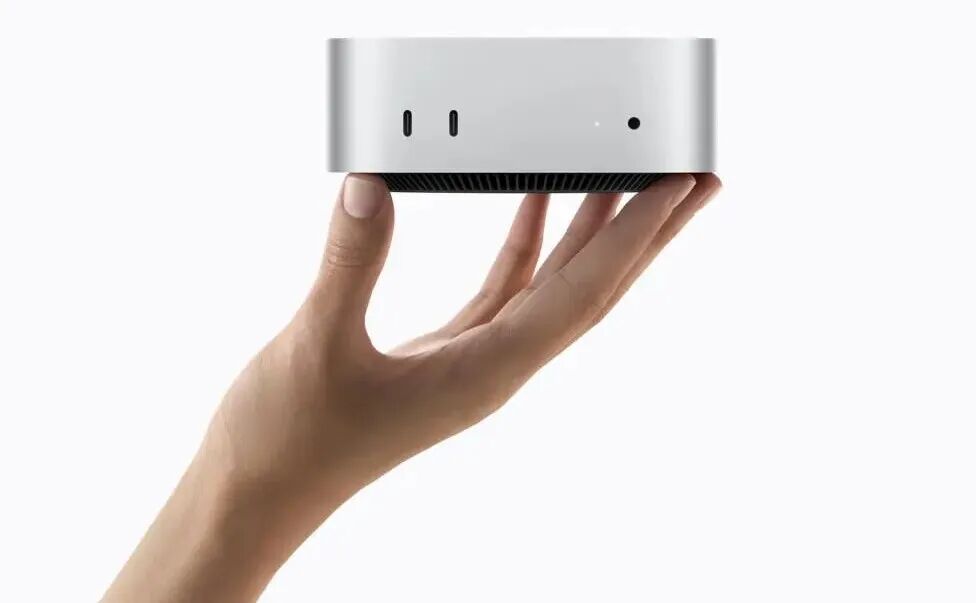
Just now, the new Mac mini was released, with its price increased by 2,500 yuan. This is the first time that Apple has built a computer specifically for AI.
The best AI PC of 2026 has just received a wave of major updates.
Apple has officially launched the all-new Mac mini and Mac Studio. The new generation of desktop Macs offers four chip options: M6, M5 Pro, M5 Max and M5 Ultra, further lifting Apple's performance ceiling in the field of local AI computing.
Among them, Mac mini comes in two versions: M6 and M5 Pro, with starting prices of 6999 yuan and 12999 yuan respectively.
Mac Studio offers two versions: M5 Max and M5 Ultra, with starting prices of 19999 yuan and 46999 yuan respectively, pushing model capacity, memory bandwidth and multi-device expansion to a higher level.
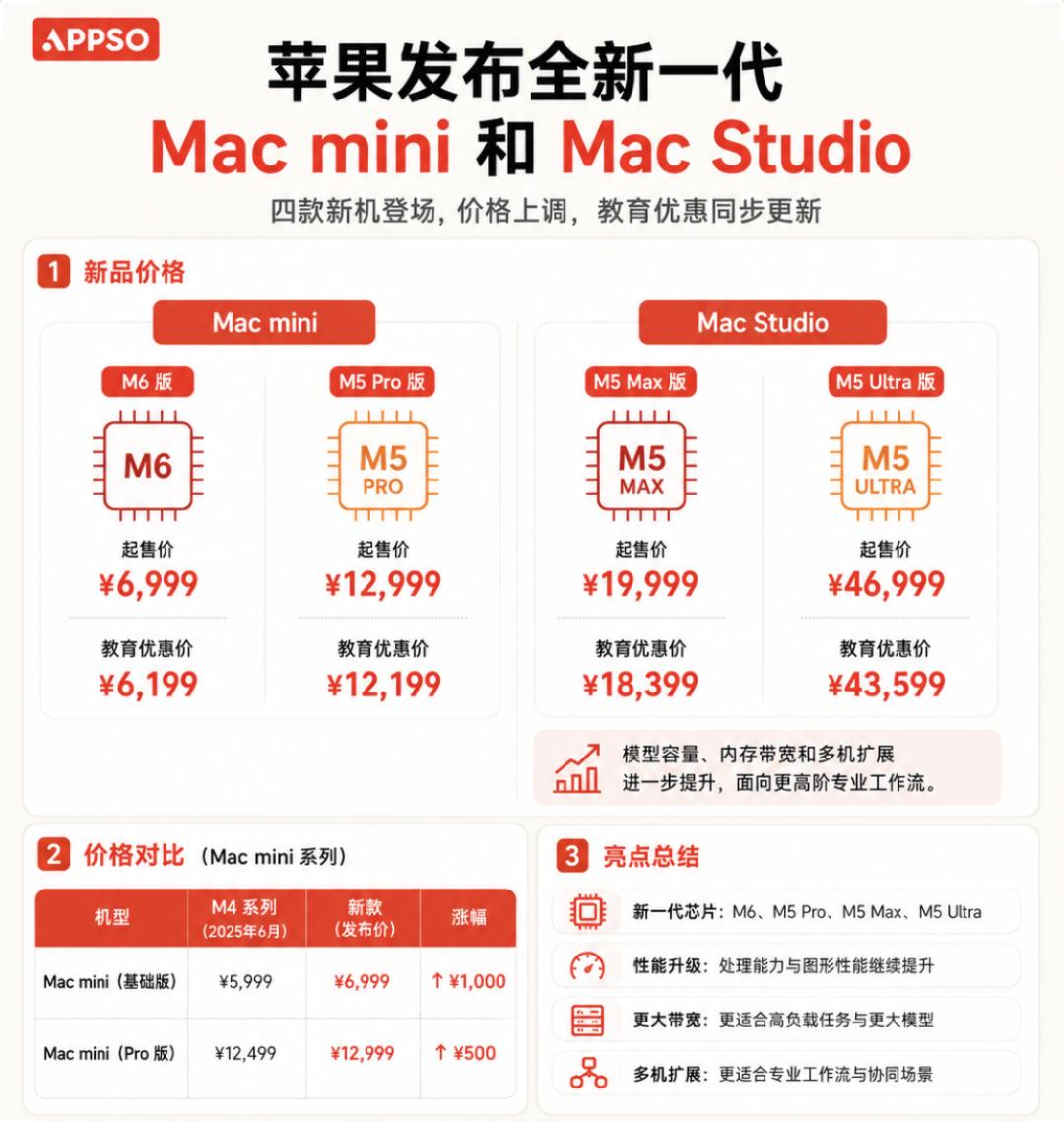
For comparison, the starting price of the M4 Mac mini in mainland China has risen from 4499 yuan to 5999 yuan in June this year, and the M4 Pro version currently starts at 12499 yuan. The new M6 and M5 Pro versions have increased by 1000 yuan and 500 yuan respectively.
All four new models will go on sale starting September 22. Among them, the Mac Studio with 512GB unified memory will be available in late October.
Apple's smallest Mac is becoming the new entry point for the AI era
In the past, the positioning of Mac mini in Apple's product line was very clear. It was a Mac with a relatively friendly price, allowing users to enter the macOS ecosystem at a lower cost.
But the task of the new Mac mini, along with the explosive popularity of OpenClaw earlier this year, is not limited to office, audio-visual and daily creation, and it has gradually become the device of choice for more and more users to run local AI models and AI Agents.
Specifically, the core change of the new Mac mini comes from the brand-new M6 chip.
As Apple's first M-series chip adopting a 2-nanometer process, the M6 is equipped with a 12-core CPU, a 12-core GPU, and two sets of 16-core neural engines. The CPU includes 2 ultra cores, 4 performance cores and 6 efficiency cores, with a total of 2 more cores than the M5.

Official data from Apple shows that the multi-threaded CPU performance of the M6 is up to 1.2 times that of the M5 and 2.4 times that of the M1. In the Mac mini, compared with the previous generation M4 version, its CPU performance is up to 40% higher, graphics performance is up to 2 times, and AI performance is up to 4 times.
The 12-core GPU of the M6 adds a neural accelerator to each GPU core of Mac mini for the first time. Its peak AI computing capacity is nearly 30% higher than that of the M5 and more than 8 times higher than that of the M1, which is mainly used to speed up prompt processing of large models.
The peak computing capacity of the two sets of 16-core neural engines is up to twice that of the previous generation. The system framework can call both sets of engines at the same time to improve the execution efficiency of on-device models.
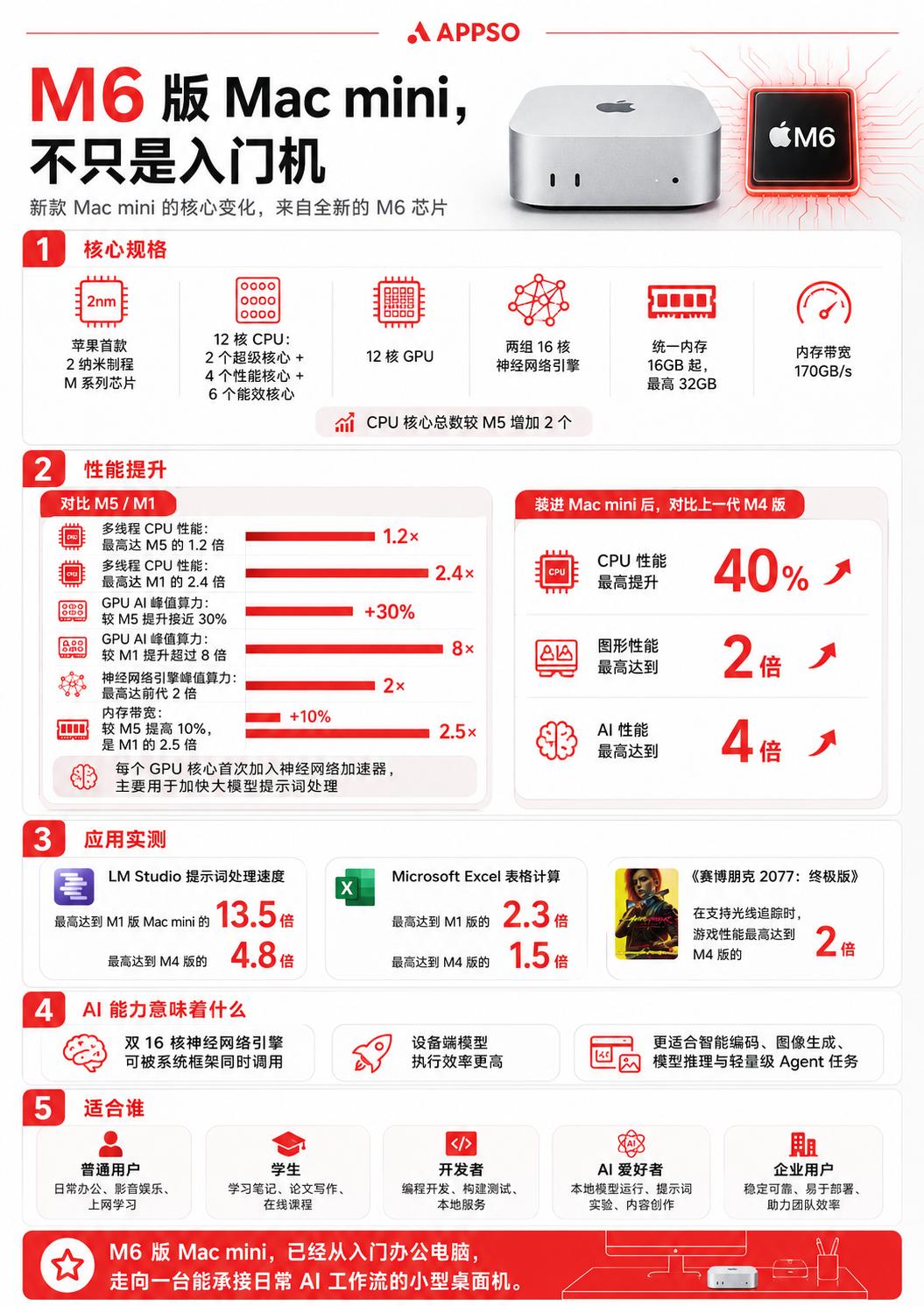
The M6 version starts with 16GB of unified memory, with a maximum optional 32GB, and the memory bandwidth reaches 170GB per second, 10% higher than the M5 and 2.5 times that of the M1.
In practical applications, this model can process large model prompts using LM Studio at a speed up to 13.5 times that of the M1 Mac mini and 4.8 times that of the M4 version.
Its Microsoft Excel spreadsheet calculation speed is up to 2.3 times that of the M1 version and 1.5 times that of the M4 version. In *Cyberpunk 2077: Ultimate Edition* which supports ray tracing, the game performance is up to twice that of the M4 version.
From this perspective, the M6 version of Mac mini is no longer just an entry-level office computer.
It is targeted at general users, students, developers, AI enthusiasts and enterprise users, and can handle intelligent coding, image generation, model inference and lightweight Agent tasks.
If you have more complex workloads, Apple also offers the M5 Pro version.
The M5 Pro is equipped with up to an 18-core CPU and a 20-core GPU, and each GPU core also contains a neural accelerator. The maximum unified memory reaches 64GB with a bandwidth of 307GB per second, which can accommodate larger models, complex 3D scenes, ProRes RAW video files and scientific research datasets.
In LM Studio, the M5 Pro Mac mini processes large model prompts at a speed up to 8.5 times that of the M2 Pro version and 4 times that of the M4 Pro version. Its Blender ray tracing rendering performance is up to 4.5 times that of the M2 Pro version, and its Affinity image processing performance is up to 2.1 times.
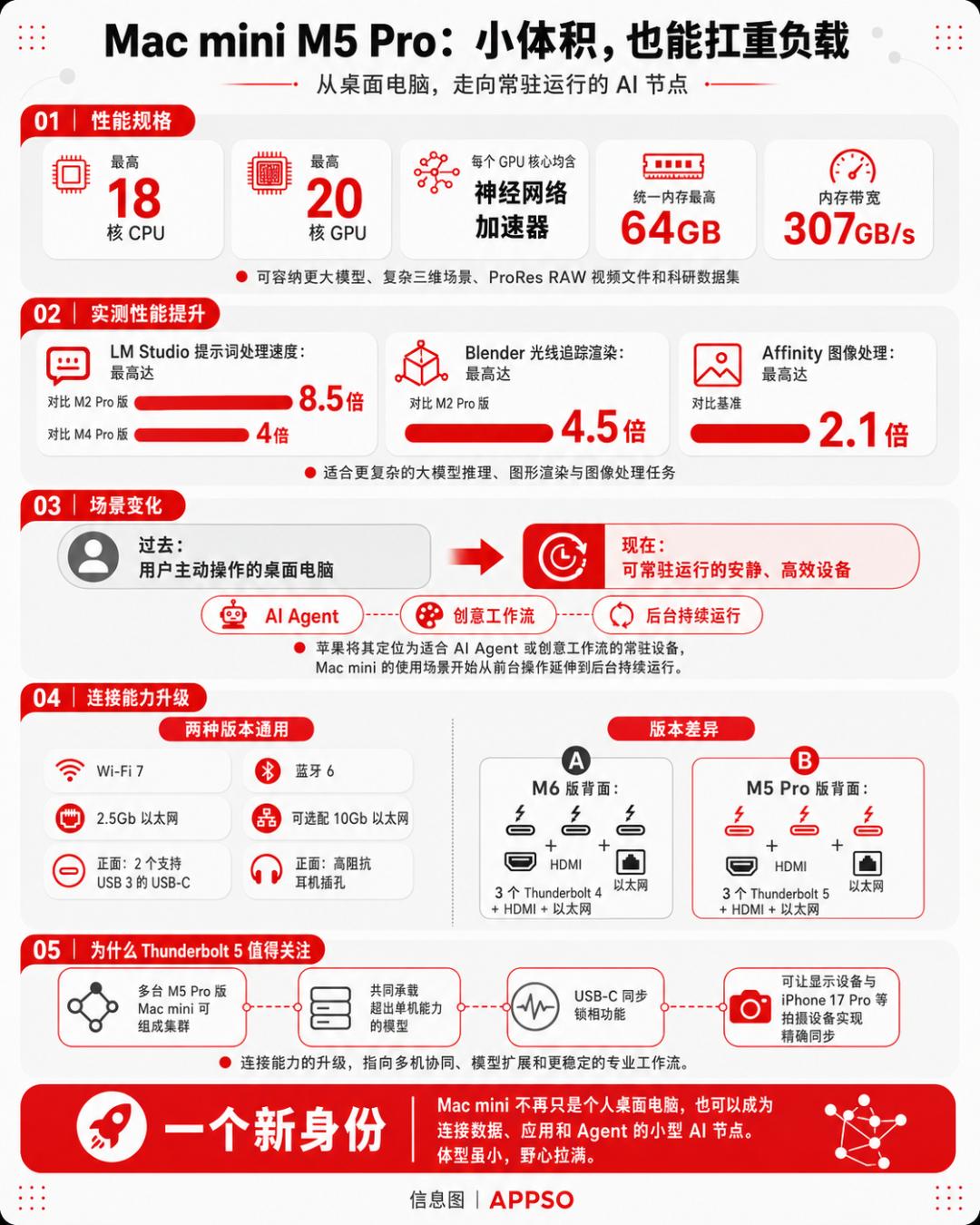
Apple's official introduction also describes it as a quiet and efficient always-on device suitable for AI Agents or creative workflows. This positioning indicates that the usage scenarios of Mac mini are extending from active user operation to continuous background operation.
Connectivity has also been upgraded in line with this direction.
Both versions support Wi-Fi 7, Bluetooth 6 and 2.5Gb Ethernet, with optional 10Gb Ethernet. The front of the device is equipped with two USB-C ports supporting USB 3 and a high-impedance headphone jack.
The M6 version is equipped with three Thunderbolt 4 interfaces on the back, while the M5 Pro version is equipped with three Thunderbolt 5 interfaces, as well as HDMI and Ethernet interfaces.
With the help of Thunderbolt 5, multiple M5 Pro Mac minis can form a cluster to jointly host models that exceed the capabilities of a single device. The newly added USB-C genlock function enables display devices to achieve precise synchronization with shooting devices such as the iPhone 17 Pro.
At this point, Mac mini has gained a new identity. It is not only a personal desktop computer, but also a small AI node that connects data, applications and Agents.
Small in size, full of ambition.
From single device to cluster, Mac Studio teams up to leapfrog levels
If Mac mini provides the entry point for personal AI computing, then Mac Studio undertakes higher-intensity model inference, training and creative work.
The new Mac Studio offers two versions: M5 Max and M5 Ultra.
The M5 Max is equipped with an 18-core CPU, including 6 ultra cores and 12 performance cores. The GPU has up to 40 cores, each of which has a built-in neural accelerator. The maximum unified memory reaches 128GB with a bandwidth of 614GB per second.
Compared with the M4 Max, the M5 Max processes large model prompts in LM Studio at a speed up to 3.9 times, text-to-image performance up to 3.5 times, and the Magic Mask performance of DaVinci Resolve Studio up to 3 times. Compared with the earlier M1 Max, its large model prompt processing speed is up to 10.7 times.
When it comes to the M5 Ultra, Apple simply implements the philosophy of "unbeatable raw power" into the chip architecture.
It uses the new generation UltraFusion technology to connect two M5 Max chips with a dual-die design, forming Apple's first four-die M-series system-on-chip.
The inter-die bandwidth of UltraFusion exceeds 4.4TB per second, and the connection density is increased by more than 6 times, enabling the four dies to run as a unified processor.
The M5 Ultra is equipped with up to a 36-core CPU and an 80-core GPU, and for the first time adds a neural accelerator to each GPU core of the Ultra chip. Its peak AI performance is up to 4.3 times that of the M3 Ultra and 9.8 times that of the M1 Ultra. Calculated by the peak GPU AI computing power at the chip level, its performance is up to 4.5 times that of the M3 Ultra.
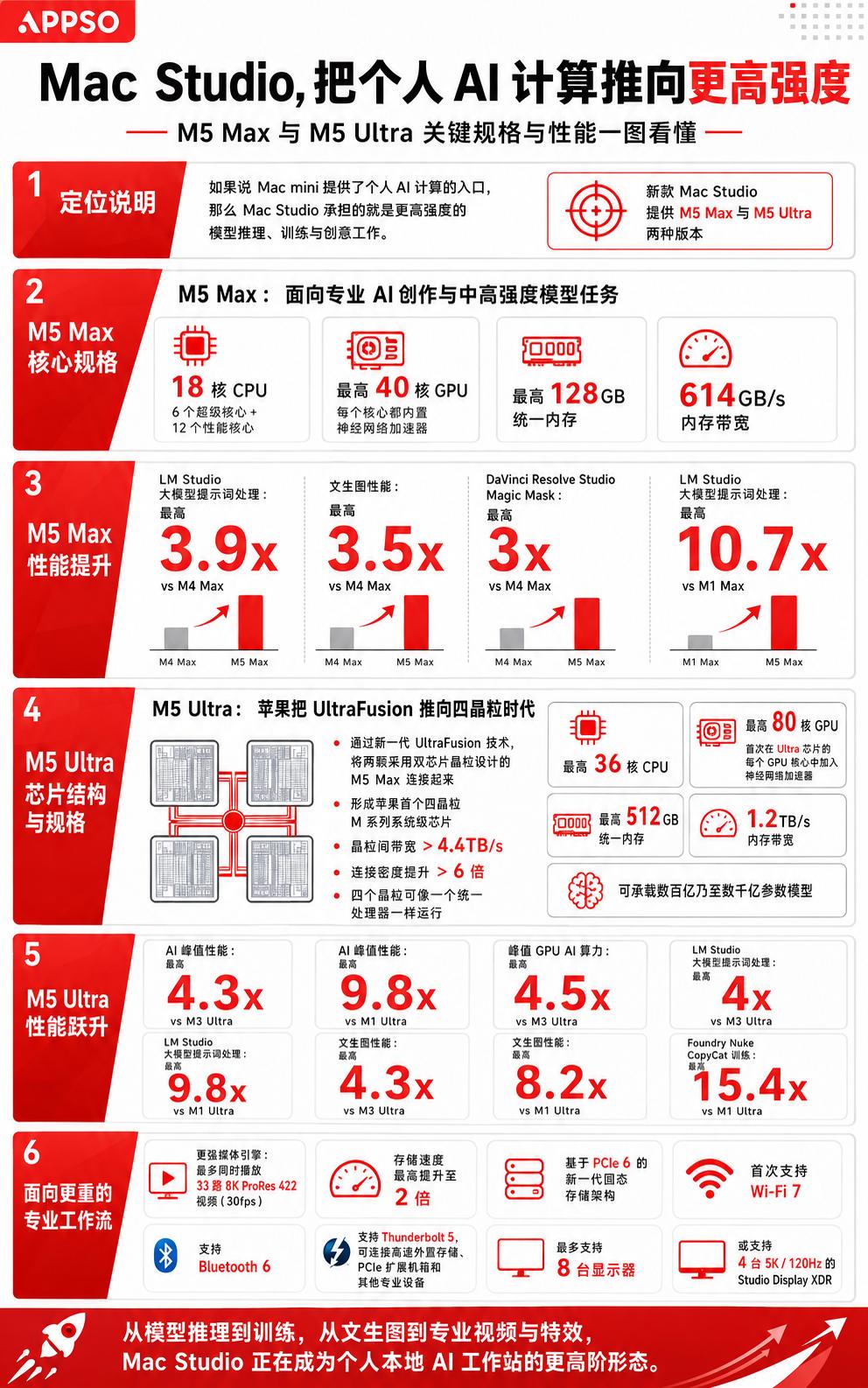
The Mac Studio equipped with M5 Ultra supports up to 512GB of unified memory, with a bandwidth of 1.2TB per second. Such capacity can store large datasets on the device and host models with tens of billions or even hundreds of billions of parameters.
In LM Studio, this model's large model prompt processing speed is up to 9.8 times that of the M1 Ultra version and 4 times that of the M3 Ultra version, and its text-to-image performance is up to 8.2 times and 4.3 times respectively; the CopyCat training speed of Foundry Nuke is up to 15.4 times that of the M1 Ultra version.
The M5 Ultra is also equipped with a more powerful media engine, which can play up to 33 streams of 8K ProRes 422 video at 30 frames per second at the same time. The storage speed of the new Mac Studio is increased to up to 2 times, adopting a new generation of solid-state storage architecture based on PCIe 6.
Mac Studio supports Wi-Fi 7 and Bluetooth 6 for the first time, and also adds Thunderbolt 5 connectivity, which can connect high-speed external storage, PCIe expansion chassis and other professional devices. The whole device supports up to 8 monitors, or 4 Studio Display XDRs running at 5K resolution and 120Hz refresh rate.
Compared with the performance of a single device, multi-device clusters better reflect the change of product logic brought by this upgrade.
The new Mac Studio supports connection through Thunderbolt 5 and Remote Direct Memory Access technology. Multiple devices can form a low-latency network to jointly perform distributed AI inference. According to the data released by Apple, the inference performance of a 4-device cluster can be up to 3 times that of a single device.
It is worth mentioning that in June this year, Apple demonstrated the actual operation mode of such a cluster at a special event during WWDC26.
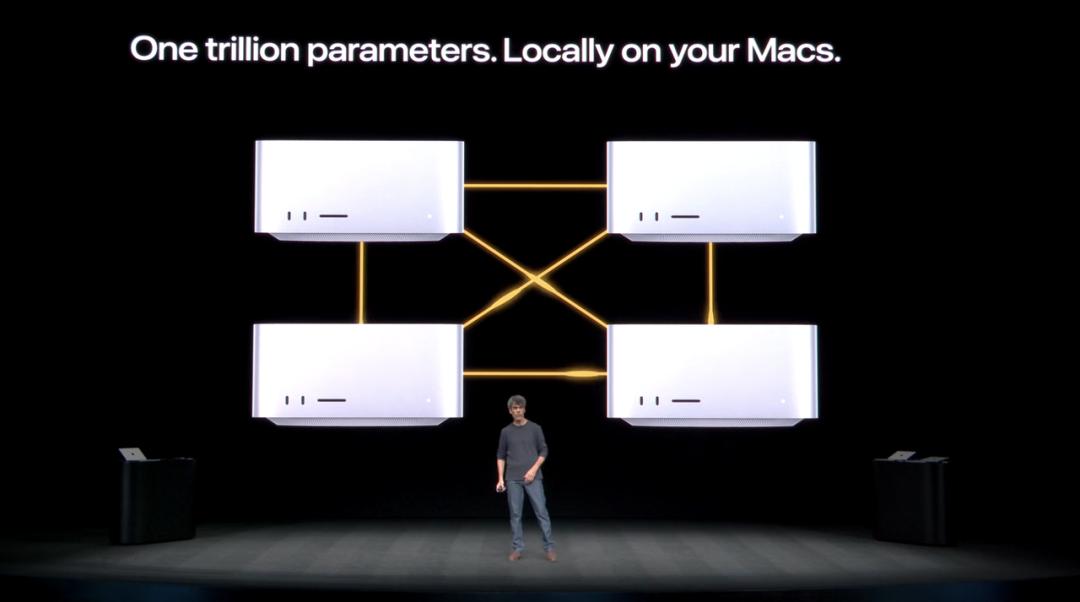
The 4 Mac Studios on site are connected via Thunderbolt 5, and use RDMA over Thunderbolt to establish a low-latency communication network.
With the help of the upcoming MLX Distributed-based feature in LM Studio at that time, LM Studio employees loaded and ran Kimi K2.6, an open-weight model with a trillion parameters.
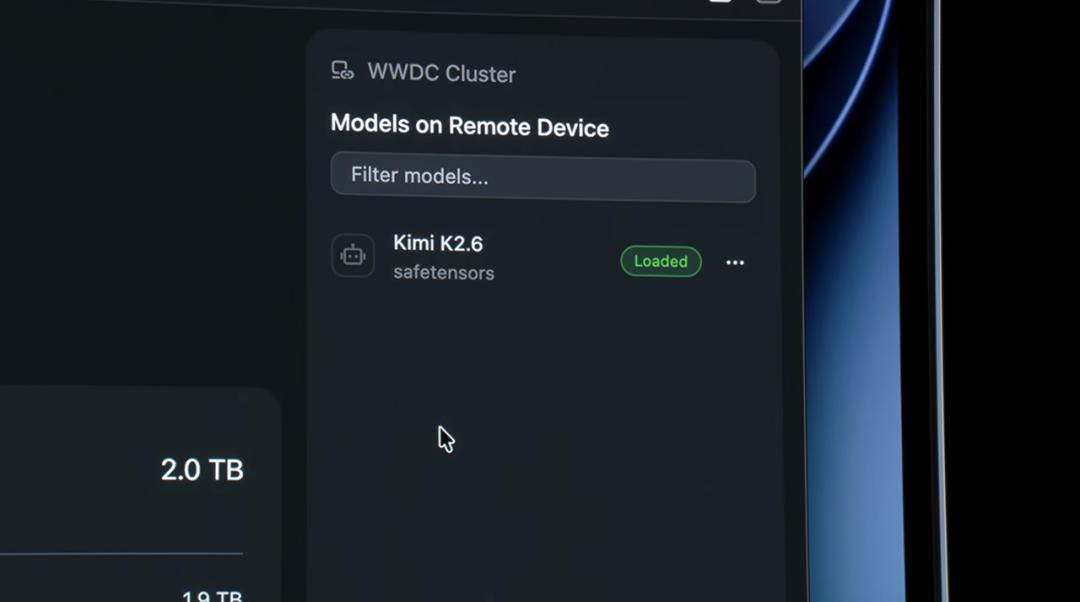
The key behind this is distributed computing.
For a trillion-parameter model, if FP16 precision is adopted, the model weights alone theoretically require about 2TB of memory, not including cache and other operating overheads. It is difficult for a single personal computer to provide such a large available space, and multi-device collaboration can expand computing power, memory capacity and bandwidth at the same time.
However, the actual performance of the desktop cluster is still affected by model precision, memory configuration, communication speed and model architecture.
The users of the next generation of personal computers may not be humans
February 6 this year may be the last time humans consume more tokens in AI services than AI Agents.
Data from OpenRouter shows that since then, the token usage of Agents has exceeded that of humans, and has grown to 14 times the original level in about half a year. Of course, humans have not reduced their use of AI, but more and more token trigger instructions are handed over to Agents for execution.

Mac mini, which has attracted attention due to the explosive popularity of OpenClaw, also demonstrates a previously unobvious hardware demand.
In the past, people typed on the keyboard, the computer executed, and then waited for the next instruction. The arrival of Agents has changed this supply-demand relationship.
A device for Agents needs to retain the user's files, historical records, application permissions, model status and task context. It must not only complete one inference, but also know what has been done before, what the current step is, and which resources can be called next.
From this perspective, the Mac represented by Mac mini has attracted attention not just because of its small size, low power consumption or sufficient performance. The deeper reason is that it has the basic conditions to become such a digital environment.
It can access the user's local files