A 12-year-long investment has seen major changes: Tencent has substantially reduced its stake in Netmarble, cashing out 1.82 billion yuan.
Tencent is significantly reducing its stake in South Korean game company Netmarble (commonly known as Wangshi in Chinese).
According to information disclosed by Netmarble, Bang Jun-hyuk, the founder and chairman of the company, will acquire the Netmarble shares held by Tencent's Han River Investment for 374 billion won (about 1.82 billion yuan), accounting for approximately 13.41% of the company's total share capital. The transaction is planned to be completed through an after-hours block trade on September 21.
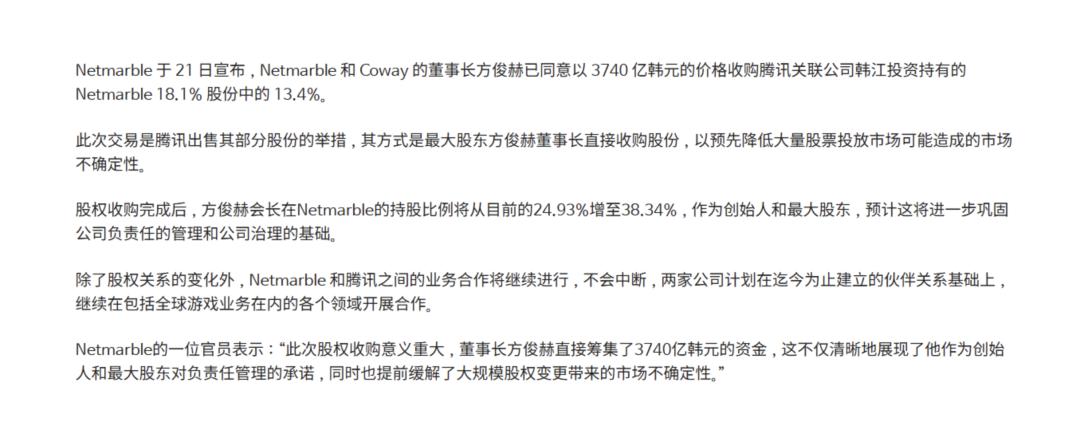
(Netmarble's official announcement)
After the transaction is completed, Bang Jun-hyuk's shareholding ratio will rise from 24.93% to 38.34%, further enhancing his control over the company; Tencent's shareholding ratio will drop from 18.11% to 4.69%. Tencent will retreat from the second largest shareholder of Netmarble to the fourth largest shareholder, and the shareholder rankings of CJ ENM and NCsoft will rise accordingly. According to the 5% major shareholder disclosure threshold under South Korea's Capital Markets Act, Tencent will be demoted from a "strategic investor" to a "minority financial shareholder".
Therefore, strictly speaking, this is not a complete exit of Tencent from Netmarble, but a substantial strategic stake reduction. Tencent still retains a small number of shares and has not terminated its business cooperation with Netmarble.
Netmarble stated that Bang Jun-hyuk's direct takeover of the shares can avoid market uncertainty caused by large-scale equity changes. The company also emphasized that the change in equity relations will not affect the business cooperation between the two parties, and it will maintain a partnership with Tencent in areas such as global game business in the future.
01
A 12-Year-Long Strategic Investment
The relationship between Tencent and Netmarble dates back to 2014. At that time, Tencent invested about 500 million US dollars in CJ Games, the predecessor of Netmarble, to obtain approximately 28% of the shares. This investment not only provided important funds for Netmarble to break away from the CJ system and complete the integration of its game business, but also secured Tencent a strategic seat among South Korea's leading mobile game R&D companies.
At that time, China's mobile game market was in a period of rapid growth. Tencent had traffic entrances such as QQ and WeChat, as well as distribution, payment and operation capabilities in the Chinese market; Netmarble had accumulated strong experience in mobile RPGs, card games and long-term commercialization. The two sides had obvious complementary relations in terms of capital, products and channels.

After the investment was completed, Netmarble's products such as *Tian Tian Fu Weng* and *Seven Knights* successively entered the Chinese market. Between 2014 and 2015, the two sides were in a period of intensive cooperation. After Tencent took shares, it successively introduced Netmarble's products in a short period of time, mainly relying on WeChat, Mobile QQ and Yingyongbao for distribution.
Around 2017, although *Stone Age* and *Lineage 2: Revolution* completed tests, they failed to be officially launched. This was related to the long-term difficulty for South Korean games to obtain import version approvals at that time, and the direct cooperation between the two sides in the Chinese market thus had a long gap.
After 2023, the cooperation became active again, but the model changed. Tencent no longer only acts as an agent for the original South Korean products, but introduces Chinese manufacturers such as Kaiying and Chuangmeng Tiandi to carry out joint development and localized transformation of IPs and products.
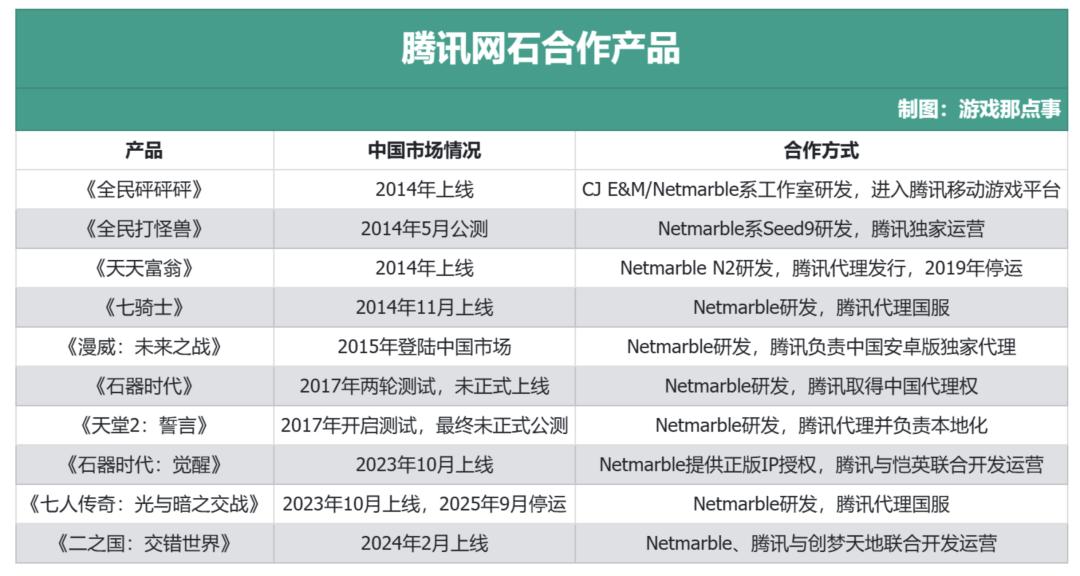
(The changing process of the cooperation between the two sides can be seen from this)
In this process, the cooperative relationship between the two sides is also gradually changing. After Netmarble went public in 2017, Tencent's shareholding ratio dropped to around 18% due to the listing and changes in share capital, but it has long maintained the position of the second largest shareholder. At the same time, Netmarble has gradually established a R&D and distribution system covering the North American, Asian and European markets by acquiring overseas companies such as Kabam, Jam City and SpinX.
Tencent's global game landscape has also expanded rapidly. In addition to its self-developed business, Tencent also controls important companies such as Riot Games and Supercell, and has invested in a large number of game studios in Asia, Europe and North America. As both sides have formed more complete globalization capabilities, the cooperation model dominated by deep capital and channel binding ten years ago has become less important.
In other words, Tencent and Netmarble still have cooperative value, but such cooperation no longer necessarily requires a stake of nearly 20% as the foundation. The relationship between the two sides is shifting from strategic equity binding to more flexible IP licensing, regional distribution and specific project cooperation.
02
Netmarble Emerges From the Trough
But Still Faces Growth Pressure
From the perspective of product cycle, Netmarble has experienced obvious ups and downs in recent years. From 2022 to 2023, the company recorded consecutive operating losses, which was affected on the one hand by the underperformance of new products, and on the other hand by the pressure brought by rising costs of overseas acquisitions, market promotion and R&D.
The turning point came in 2024. According to information disclosed by Netmarble, *Solo Leveling: ARISE* once topped the download charts of app stores in 141 countries and regions after its launch, and won the highest award at the 2024 Korea Game Awards. This work not only helped the company improve its revenue performance, but also proved Netmarble's capabilities in adapting popular IPs and commercializing mobile RPGs once again.
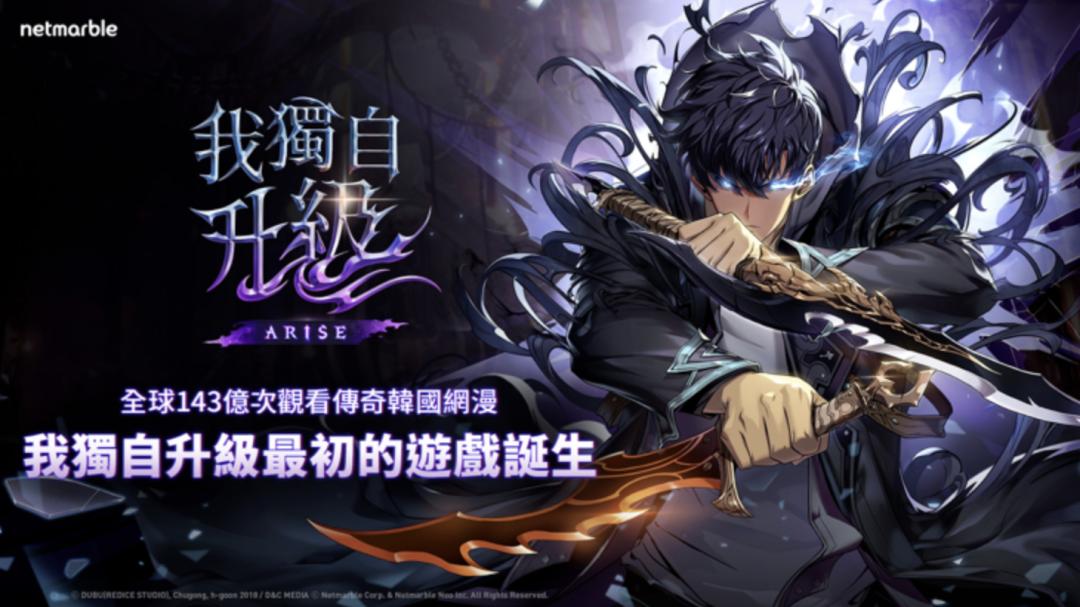
After that, Netmarble successively launched products such as *Raven 2*, *RF ONLINE NEXT*, *Seven Knights Re*, and *Game of Thrones: Kingsroad*. Among them, *RF ONLINE NEXT* and *Seven Knights Re* achieved relatively good results in the South Korean market, indicating that remaking and developing sequels based on mature IPs is still an effective product strategy for Netmarble.
However, this recovery also has limitations. Most of Netmarble's successful products in recent years rely on mature IPs, including its own *Seven Knights*, *Raven*, *RF Online*, as well as externally licensed IPs such as *Solo Leveling* and *Game of Thrones*. Mature IPs can reduce the difficulty of user acquisition, but they may also bring problems such as high licensing costs and limited space for product innovation.
In addition, the performance of global-oriented projects such as *Game of Thrones: Kingsroad* is relatively limited, and it remains to be seen whether some new products can achieve long-term retention and stable revenue. On the whole, Netmarble has come out of the operating trough of previous years, but has not fully returned to the stage when hits like *Seven Knights* and *Lineage 2: Revolution* appeared one after another.
03
Why Did Tencent Choose to Reduce Its Stake At This Time?
Compared with Netmarble, Tencent's game business has been much more stable in recent years. Long-running hits such as *Honor of Kings* and *PUBG Mobile* continue to contribute the main revenue, *Dungeon & Fighter: Origin* became an important incremental driver in the Chinese market in 2024, and *Delta Action* later grew into a new top-tier product.
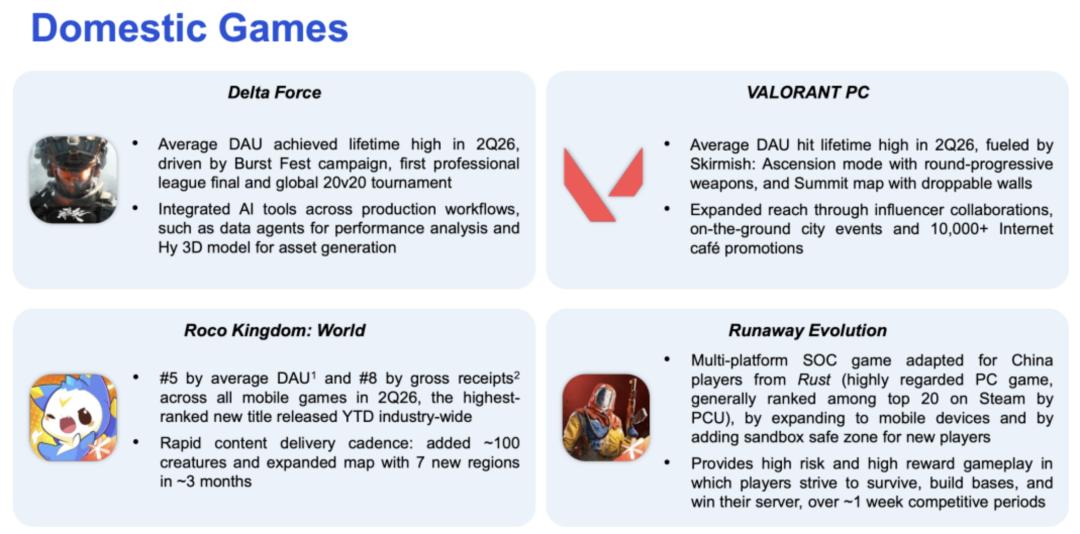
Tencent's disclosed 2025 interim report shows that the growth of its local game revenue is mainly driven by products such as *Delta Action*, *Honor of Kings*, *Valorant* and *PUBG Mobile*.
In the 2026 Q2 and first-half reports, *Roco Kingdom: World* and *Valorant: Frontier* have gradually shown the potential of long-running products. Tencent is also continuously increasing the number of products it defines as "evergreen games", hoping to reduce its dependence on a single hit through stable operation of multiple large-scale products.
At the same time, Tencent is increasing its investment in artificial intelligence, cloud services, computing power infrastructure and key self-developed projects. Even though Tencent has no shortage of cash, different businesses within the enterprise still need to compete for capital and management resources.
Against this backdrop, reducing minority equity investments in non-controlling stakes with weakening synergy helps improve overall capital efficiency.
Therefore, looking back, this is a long-term investment recovery that conforms to the normal cycle. Tencent has held shares in Netmarble for about 12 years, experiencing the company's restructuring, listing, overseas expansion and changes in product cycles. The direct reason given by Han River Investment in the application documents is also "to sell Netmarble's common shares and recover investment funds".
Secondly, the dependence of business cooperation between the two sides on equity relations has declined. In 2014, Tencent's Chinese channels and Netmarble's mobile game R&D capabilities were highly complementary; today, both companies have established relatively independent R&D, distribution and global operation systems. Even if Tencent is no longer the second largest shareholder, it can continue to cooperate with Netmarble through specific projects.
(In recent years, Tencent has successively reduced or exited its stakes in overseas game business investments such as Secret Mode and Marvelous)
Third, Tencent may be reassessing the capital efficiency of its overseas game investment portfolio. Tencent has invested in a large number of game companies, and there are obvious differences between different assets in terms of strategic value, growth space and financial returns. For stakes where control cannot be obtained, performance fluctuates greatly, or synergy has weakened, phased exit or stake reduction is a relatively common investment management method.
Furthermore, Tencent may be directing more resources to AI, core self-developed products and key studios. Selling Netmarble's shares can recover part of the funds that have been occupied for a long time.
On Netmarble's side, Bang Jun-hyuk happens to have the need to enhance control. If Tencent directly sells more than 10% of its shares in the market, it may put greater pressure on Netmarble's stock price. Bang Jun-hyuk's overall takeover not only provides Tencent with a definite exit channel, but also helps Netmarble eliminate the potential pressure of share selling. The two sides can be said to get what they need in the transaction arrangement.
This article is from the WeChat official account "Mobile Game Insider" (ID: sykong_com), written by Stephen who focuses on the game industry, and published with authorization from 36Kr.