The Downfall of Hangzhou's Internet-famous Coffee Sector: Hundreds of Outlets Closed, 100 Million Yuan Burned Through in 5 Years
If Li Xiao, the founder of T97, had not voluntarily "confessed" on his personal social media platform, many people might have long forgotten this coffee brand.
"Coffee, are you in? Go all in, go all in!" In 2022, the viral live stream with the host Dazui Mei's catchy yelling instantly made T97 Coffee a hit, which became a phenomenal case in the live streaming industry. But recently, Li Xiao, with messy hair and haggard look, appeared in front of the camera of his personal account "Shopkeeper Xiao", revealing the latest status of T97 in detail: in the past five years, T97 had signed more than 500 stores, but now there are only 11 left across the country, with a cumulative loss of over 100 million yuan. He even used the phrase "total fiasco" to sum up this entrepreneurial journey.
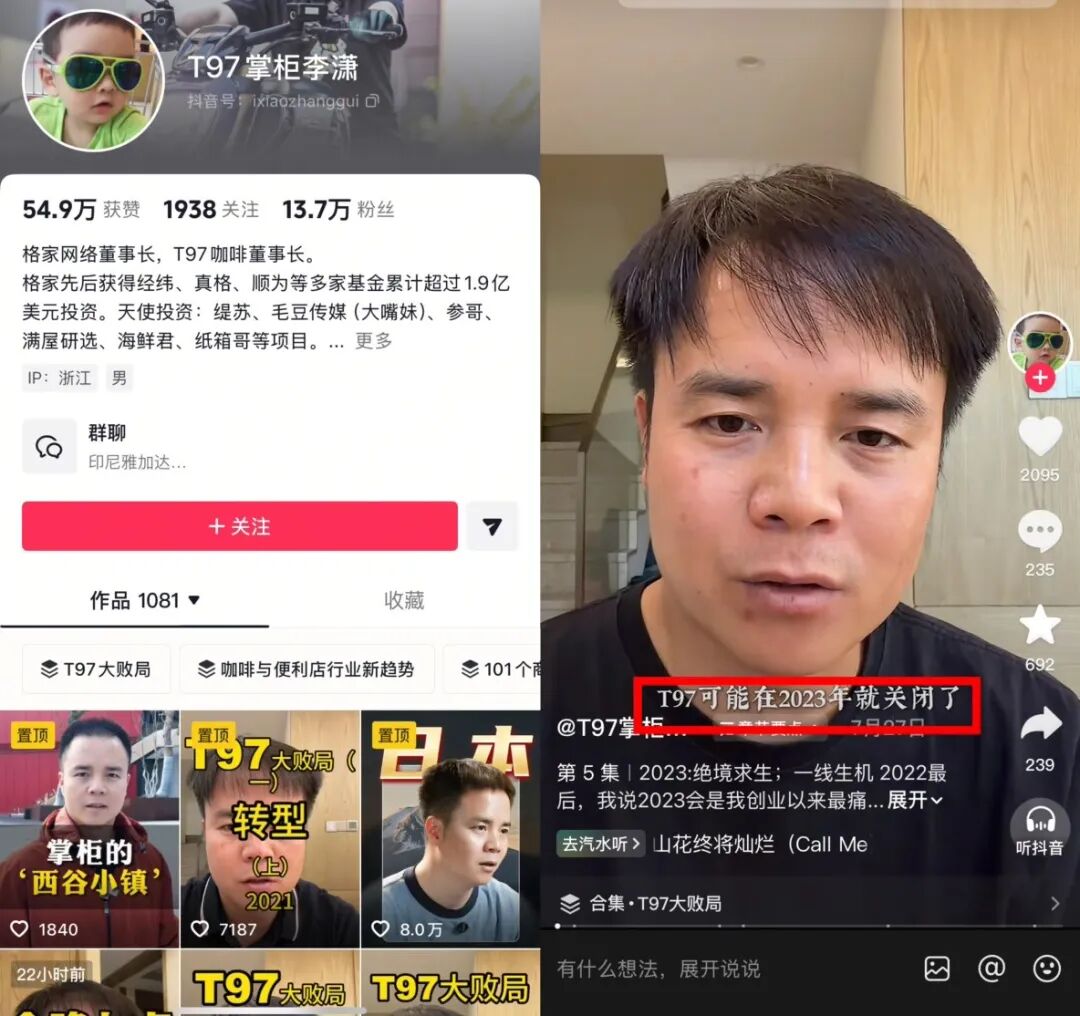
Li Xiao, founder of T97, exposed his entrepreneurial failure on social media
When Tianxia Wenshang searched on group-buying platforms, it found that in Hangzhou, where T97's headquarters is located, there is only one T97 store left at West Lake Zhongshan Park, and many other stores are closed or out of business.
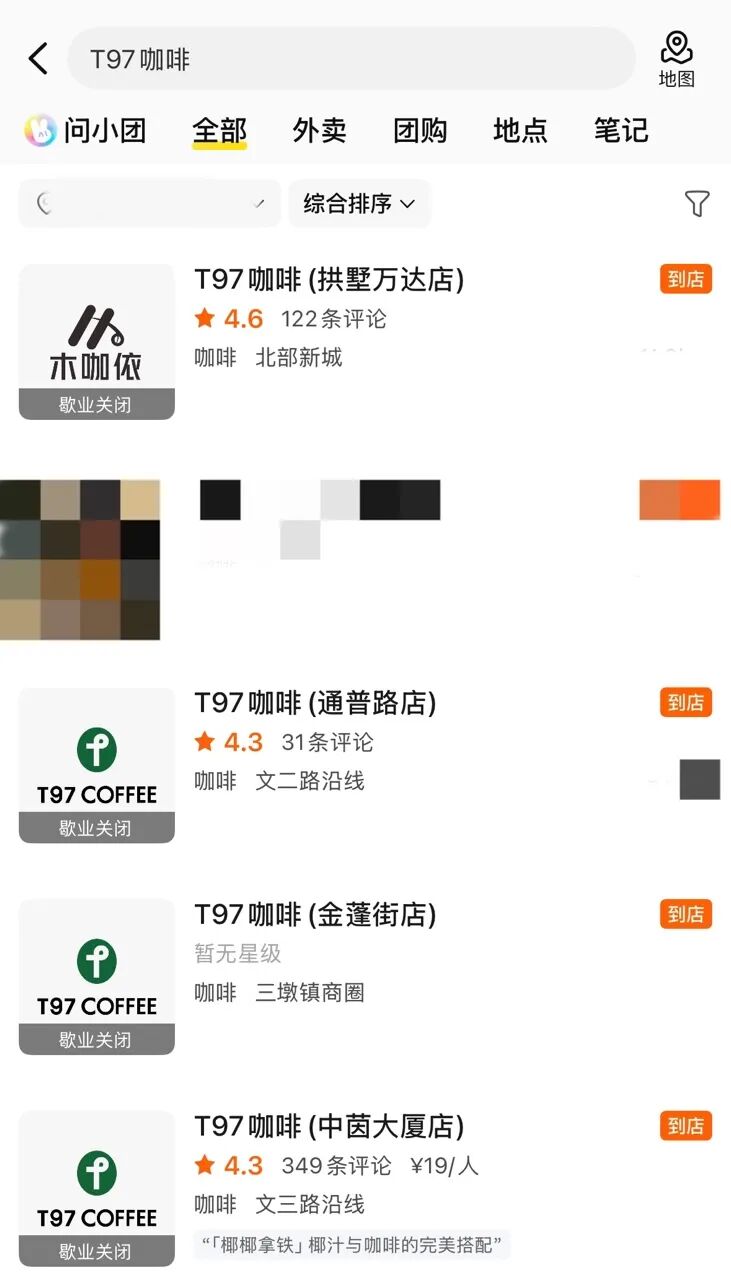
The aftershock of Seesaw's bankruptcy liquidation has not faded, and another once-popular internet-famous brand in the coffee track is collapsing. T97 has entered a clear contraction phase, and Li Xiao said he has shifted his energy to another project.
What is worth recording is not just the rise and fall history of a brand, but every trial and error that this brand once tried to defy the odds, as well as the new direction it groped for in the cruel market evolution.
"800 yuan attracted 6 million views"
Li Xiao has never been a "literary youth who loves coffee".
Before founding T97, he was known as "Shopkeeper Xiao", a veteran who fought his way out of the social e-commerce battlefield. From cross-border health products to "Yan Gege", the top brand on Tmall, and then to "Global Catcher" whose peak GMV (Gross Merchandise Volume) reached 10 billion yuan, Li Xiao is good at keenly capturing traffic and accurately grasping user psychology.
Li Xiao later said in a media interview: "I have already proved myself. I became the top in the whole industry when I was only 24 or 25 years old, and I could earn several million yuan a year. I have never really been short of money."
Entrepreneurs who have never been short of money will want to achieve greater results and leave a "representative work". At that time, social e-commerce platform projects fell into controversy, and the entrepreneurship of new consumer brands was in full swing. Li Xiao naturally set his sights on the coffee field, which has a sufficiently broad market track.
At that time, the weight-loss-focused "MCT Coffee" was popular in the market, and the original meaning of the T97 brand name was also "weight under 100 jin". In April 2021, T97 launched its first product, the fat-reducing coffee codenamed "Little Black Stick", whose sales exceeded 100 million yuan in the first month of launch. Li Xiao said that the launch of T97 was based on in-depth operation, and the team's private domain operation capability was at the top level in China at that time. The first batch of stock was worth more than 20 million yuan, with a cost of several million yuan, which was a considerable investment for a new brand, fully showing his determination.
It was the accidental live streaming experiment in September 2022 that truly made T97 break through the circle.
T97 started live streaming on Douyin as early as May, but the data was mediocre at first. Until September, the operation team combined the catchy yelling with product sales, and the popularity suddenly exploded. Dazui Mei's viral yelling swept the whole network, and the maximum number of views in a single live session reached 10.82 million. The number of T97's fans quickly exceeded 1.6 million in just a few months. Li Xiao said on WeChat Moments that he only spent 800 yuan to attract more than 6 million people to the live stream.
Offline T97 stores were also overwhelmed by customers. In 2022, T97 stores claimed to have an average daily revenue of over 3,000 yuan, and 90% of the stores made profits. Li Xiao revealed that this revenue figure at that time was "second only to Luckin Coffee".

Dazui Mei's viral live streaming yelling
At its peak, Li Xiao shouted bold slogans in the live stream such as "overtake Luckin Coffee in all aspects in 35 months" and "open 10,000 stores in 3 years". "That's of course impossible to achieve," Li Xiao reviewed afterwards. It was just his usual operation to attract traffic, to make users remember that "the boss of T97 likes to brag. What I want is to let you know me and remember me."
Li Xiao later said in the video that 2022 was a passionate year, and Dazui Mei was his "noble person". The live streaming team Dazui Mei belongs to has strong capabilities and is very dedicated, polishing the live scripts over and over again and iterating rapidly. He also mentioned that trust and patience are very important. A brand in the same period also used Dazui Mei's team to sell products through live streaming, but "gave up after only one or two months without seeing data feedback".
The extremely low-cost online traffic explosion made T97 a "phenomenal internet-famous" brand. According to Li Xiao, the brand once set a sales record of "nearly 1 billion yuan", including the total sales of offline stores and private domain product distribution. This kind of "promotion" also attracted some channel merchants to join in. However, the strategy of relying too much on traffic also made him see the ceiling in advance.
Once opened a store next to Seesaw, T97 can no longer move forward
No matter how popular T97 sold online, it could not escape the sales routine of a wechat business veteran. Li Xiao wanted to plan a longer growth curve for T97, so he opened a T97 Coffee flagship store next to Seesaw at Hangzhou Tianmu Li -- the rent alone cost millions of yuan, and the design cost more than 300,000 yuan.
Later, this became the "most unjustified expense" Li Xiao reviewed that T97 had spent. Together with another flagship store opened at Hangzhou in77, the two stores lost more than 8 million yuan.
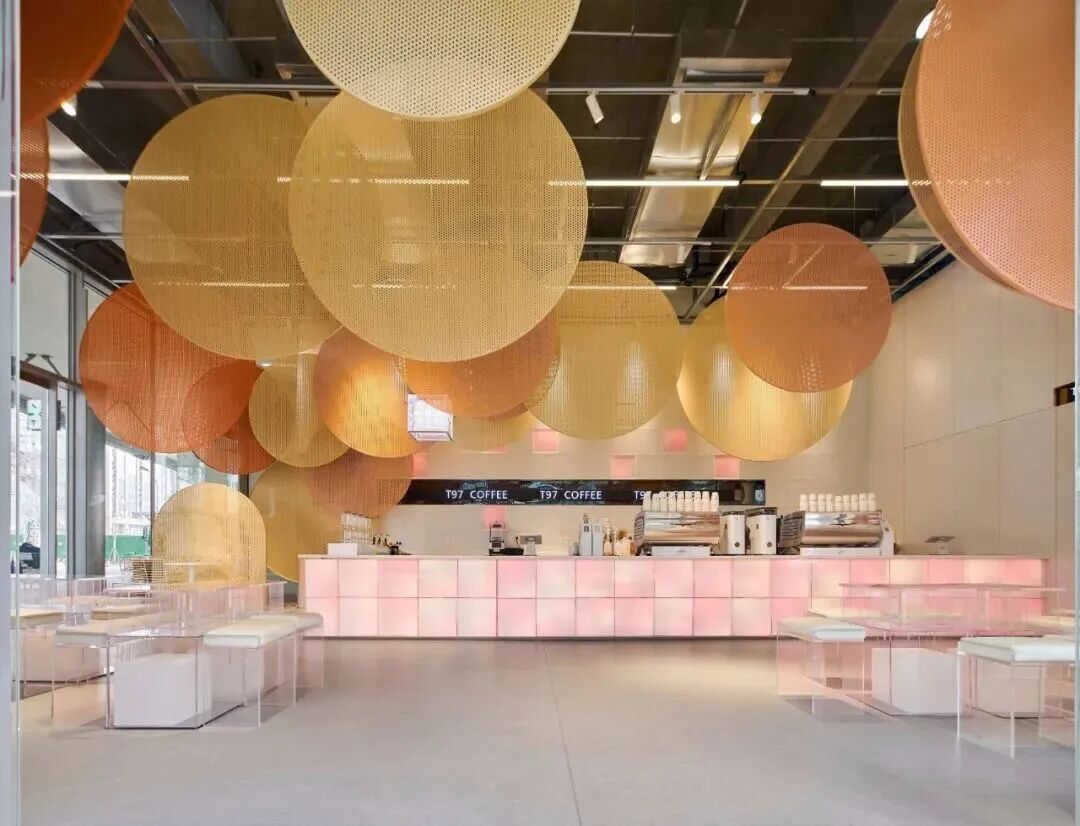
T97 Hangzhou Tianmu Li Store (Image source: Global Commercial Design)
Looking back now, T97's internet-famous flagship stores were not opened for consumers, nor for franchisees, but for capital.
Even in the subsequent review, Li Xiao did not think that the strategy of moving offline was wrong. One judgment is that online brands will be outperformed by offline chain brands with store locations -- this judgment can almost be verified now. On this basis, Li Xiao also had practical considerations.
On the one hand, T97 quickly achieved hundreds of millions of yuan in sales in the private domain. At that time, after the head brand Yuntianchuan invited top stars such as Xiao Zhan to be its spokesperson, its annual sales were only at the level of 1 billion yuan. On the other hand, at that time, capital favored offline innovative stores. For example, Hutaoju and Mimo Dim Sum Bureau in Changzhou used dozens of stores to get a valuation of billions of yuan. For Li Xiao at that time, moving offline was almost a certain path.
However, the foresight of strategic judgment failed to offset the defeat at the execution level, and every specific link in the implementation paid excess tuition fees. For example, due to strict site selection and the site selection cost borne by the brand, the travel cost of the site selection team alone exceeded 800,000 yuan a month, so that the team "traveled to Guizhou market 50 times but did not open any stores".
Li Xiao also responded to the disputes between T97 and franchisees. T97 had a total of 75 franchisees opening more than 200 stores, and there had never been any disputes. Due to the loose exit mechanism, the franchise fee is fully refunded if the franchisee closes the store within one year, and the equipment is recycled at 50% discount. On the one hand, this caused the company to lose more than 200,000 yuan for each store closed. On the other hand, it also made some profitable stores choose to close in advance to lock in profits, leading to the rapid shrinkage of the number of stores in the later period.
But what is more fatal than the flaws in the execution level is actually the market gravity.
2023 was a turning point for T97, and the store expansion quickly stalled. Li Xiao concluded that the brand was directly hit by many severe challenges.
The first one came from the capital market. Li Xiao hoped to get large-scale financing by rapidly increasing volume, then use capital to expand scale, and use scale to improve the supply chain. But in 2023, the investment boom in the consumer goods track faded, and investors began to adopt a more cautious attitude towards the story of "exchanging scale with traffic". T97 completed the amazing journey from 0 to 1, but found that the "gas station" was closed on the way from 1 to 10.
The second one came from the consumer side. The intensity of competition in the coffee consumer market was unexpected by Li Xiao. In rounds of "price subsidy wars", when Cotti Coffee, which competed with Luckin for the market, pushed the coffee price to the floor price of 1 yuan, the living space of other coffee brands including T97 was instantly squeezed.
Li Xiao called the coffee market a "death track", but it is not accurate to attribute all T97's decline to the track itself. In the past few years, China's coffee consumption and store scale are still expanding. What has really changed is the competition threshold of this business.
What T97 is best at is getting attention at low cost, but offline chain operations ultimately compete for site selection, supply chain, cup making efficiency, repurchase rate and single store profitability model. The live stream can push a brand to the hot search list in a few weeks, but it cannot replace the continuous profit of each store.
The ebb of capital and price war only exposed the gap in this business capability faster: when traffic cannot be converted into stable single store profit, the larger the scale, the more the loss may be amplified synchronously.
Looking for an exit in the "death track"
In 2026, Seesaw, a specialty coffee brand once called "China's Blue Bottle", shrank from 135 stores at its peak to only 34, and the company entered bankruptcy liquidation. Since 2025, suppliers have been chasing for overdue payment for goods, and some employees have been in arrears of wages.
T97 relied on traffic, Seesaw relied on premium brand narrative. The two almost opposite paths led to similar endings.
Even Luckin, the head brand in this track, is feeling the pressure.
As of the end of the second quarter of 2026, Luckin had 36,310 stores worldwide, with quarterly revenue of 15.886 billion yuan, a year-on-year increase of 28.5%, and is still expanding rapidly. However, the same-store sales of self-operated stores decreased by 5.3% year-on-year, while the figure in the same period of 2025 was an increase of 13.8%. The number of stores and users is still increasing, but the output of existing stores has begun to be under pressure.
The pressure on Cotti is more direct. According to the data of Canlian Eye, in the first half of 2026, Cotti opened 1674 new stores and closed 2484 stores, with a net decrease of 810 stores. The number of closed stores exceeded the number of new stores for the first time. As of the beginning of August, its global store scale remained at about 15,000.
Tims China is also actively clearing inefficient stores. The company's latest financial report shows that the total revenue in the second quarter of 2026 was 273.4 million yuan, a year-on-year decrease of 21.7%. The system same-store sales decreased by 17.8% year-on-year.
But the industry is not all in ebb. Manner provides another sample. According to the 2025 China Coffee Industry Report, Manner opened more than 700 new stores in 2025, with a growth rate of over 40%, and the total number of stores is close to 2500. While expanding rapidly, it is also raising prices. Starting from April this year, Manner announced that the price of single-origin SOE coffee would increase by 5 yuan, stepping out of the price war narrative.
According to the data from Zhaimen Canyan cited by Kamen, as of July 2026, there are about 227,000 coffee stores in China, 53,000 new stores opened in the past year, but the net growth is only 1,065. Rough calculation shows that about 52,000 stores exited in the same period. The market does not lack demand, but is redistributing traffic, locations and profits at an extremely high speed of store opening and closing.
"The coffee industry is really too difficult. Every brand is trying to leap over the dragon's gate. But after leaping over, it will become a real dragon."
Li Xiao did not give up trying. After losing 100 million yuan, the opportunity he saw was convenience store coffee. He revealed that the new brand he invested in has opened more than 100 offline stores, and the store model is still being polished.
The leading player in this track is Nowwa Coffee. With the "store-in-store" model, the number of Nowwa stores exceeded 2000 at the beginning of 2025, and broke through 10,000 at the end of the year. In early 2026, it completed a new round of C-round financing of hundreds of millions of yuan. The overall store scale of the convenience store track exceeds 200,000, and there is still huge room for penetration.
T97 once rose by the viral yelling in the live stream, implanting the brand name into the minds of consumers. Now Li Xiao hopes to attach to