Forced liquidation from stock speculation and taking out massive loans to buy houses: Young people in South Korea are almost at their breaking point.
The ongoing boom of "borrowing money to invest in stocks" and "borrowing money to buy property" has pushed South Korea's household debt to a new all-time high.
On August 19, data on household credit for the second quarter released by the Bank of Korea showed that driven by a sharp surge in housing-related loans and credit loans used for leveraged stock investment, South Korea's household credit in the quarter stood at 2019.8 trillion won (about 9.82 trillion yuan), an increase of 25.9 trillion won (about 1.25615 trillion yuan) from the previous quarter.
This is the first time on record that the figure has broken through the 2000 trillion won mark, and the quarterly increase is also the largest single-quarter growth since the third quarter of 2021.
At the same time, the repayment overdue rate is also rising. Data from the Bank of Korea shows that the household loan overdue rate in the first quarter was 0.4%, the highest level in more than a decade.
The market is worried that such a high level of borrowing will increase the financial pressure on South Korean households, further drag down domestic demand, bring pressure to the entire financial industry, and even trigger economic turmoil.
01
Trapped Young People
27-year-old Son Jung-min lives in a single-room unit in Sillim-dong, Seoul.
Small as the unit is, the security deposit for the apartment amounts to 10 million won (about 48,600 yuan), and the monthly rent, management fee and accommodation miscellaneous expenses alone cost nearly 1 million won (about 4,860 yuan) per month. For Son Jung-min, who has taken a two-year hiatus from school and is preparing to find a job, the housing cost alone is unaffordable.
Son Jung-min admitted: "At first, I only took out a credit loan of 3 million won (about 14,600 yuan), and later took out a living expense loan from the Korea Scholarship Foundation. But due to improper investment, my debt has now accumulated to 30 million won (about 146,000 yuan)."
The debt has swelled to 10 times its original size, and Son Jung-min's situation is not an isolated case.

△ Trading room of Hana Bank in Seoul, South Korea Source: Visual China
Since the beginning of this year, South Korea's stock market has once entered a crazy bull market. Driven by the global explosion in demand for AI computing power, the share prices of Samsung Electronics and SK Hynix have skyrocketed, pushing the KOSPI index higher all the way. The total market value of South Korea's stock market doubled in the first five months of this year, and the KOSPI index even historically broke through the 8800 point mark in early June.
The crazy surge has attracted a large number of retail investors to borrow money and join the stock investment boom.
Son Jung-min is one of the army of retail investors. Although he has no job and no stable income, with the dream of "getting rich overnight", he borrowed money from financial institutions through various means and finally invested 5 million won (about 24,300 yuan) in the stock market.
He once fantasized about earning 2 million won back in 10 days, but unexpectedly, the so-called "bull market" soon suffered consecutive sharp drops. Data from South Korea's Financial Supervisory Service shows that as of July 13, more than 1.2 million leveraged retail investor accounts across the South Korean market have hit the margin call line.
Son Jung-min's money was also wiped out overnight. "When people get carried away, they will ignore everything. I joined the stock market when I saw many people getting rich overnight there. I didn't realize how hard money is to earn until I lost all my investment."
Now Son Jung-min no longer dares to invest in stocks, but he still worries about the most basic accommodation. Now he stays in his room in a daze every day, only eats instant noodles, often suffers from insomnia all night, does not want to work or socialize, and has no idea how to pay off the loans he owes.
There are many other young people in South Korea like Son Jung-min who borrow money to invest in stocks. Survey data from the Bank of Korea shows that the per capita debt of the 19-34 age group has reached 16.37 million won (about 79,400 yuan), surging by about 40% in two years, far outpacing the income growth rate in the same period, with housing and investment leverage being the main driving forces.
Among them, the debt of South Koreans in their 20s accounts for nearly half of their assets, a proportion much higher than that of other age groups, and this group also has the highest loan overdue rate.
The "Current Status of Household Loans by Age Group" released by South Korea's five major banks (KB Kookmin, Shinhan, Hana, Woori, NH Nonghyup) at the end of 2025 shows that the average loan overdue rate (overdue for more than 1 month) of the 20-something group is 0.41%, ranking first among all age groups.
Unemployment, unstable income or limited credit have forced more and more young South Koreans to turn to secondary financial institutions or even illegal usury.
"There is no hope whether I want to buy a house or invest in stocks. I feel we are a cursed generation." Son Jung-min said.
02
Still Unwilling to Step Away from the Table
Either buying a house or investing in stocks, many young South Koreans are trapped in debt.
"I want to buy a house with my salary, but I can't see any way out." 30-something Seoul office worker Park Young-ha borrowed 10 million won (about 48,600 yuan) to invest in stocks in June this year, when stock prices were hitting new highs for consecutive days.
Park Young-ha calculated that this market rally would at least earn him enough money for marriage, but the result was very bleak: not only did he lose all his principal, he also owed millions of won.
"I just wanted to earn as much money as others, but as a result I owed even more." Park Young-ha sighed, his marriage has been postponed indefinitely, and buying a house is an unimaginable dream. "In order to pay back the money, I have to live frugally and work very hard every day. But for those who have taken greater risks, they will feel real pain." Park Young-ha is glad that he at least has a job and a stable income.
According to data from the Korea Securities Depository, the number of people holding shares of listed companies in South Korea has reached 14.56 million, which is equivalent to one in every four South Koreans investing in stocks. For many South Koreans, stock investment is no longer just a ladder to wealth, but also a competition to avoid falling behind.
As a result, the youth group with weak asset base does not hesitate to make high-risk investments. This behavior is not so much personal speculation as a sense of insecurity brought by the insurmountable social gap.
In this regard, Park Joong-woo, director of Yonsei Mental Health Medical Clinic, analyzed: "People are willing to borrow money to invest in stocks because of the anxiety brought by fear of missing out. The rally that continued until June this year further exacerbated excessive anxiety."
In fact, South Koreans have also experienced the same unease and anxiety in the property market. Many young people are well aware that the growth rate of wages is far behind that of housing prices. If they don't "get on the property ladder", they may never be able to afford a house. This has spurred panic buying, and even gave rise to the term "soul homebuyers" - the generation that does not hesitate to "sell their souls" to borrow money and take on debt to buy a house.
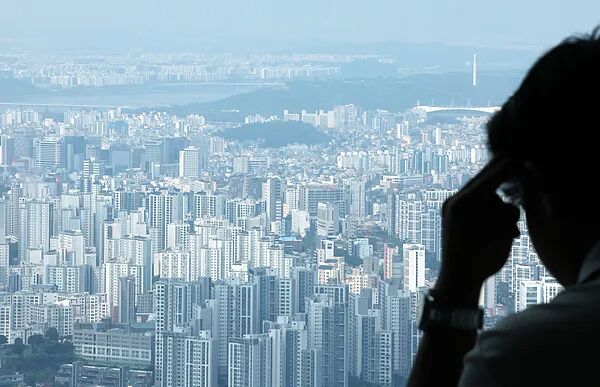
△ Seoul, South Korea Source: Visual China
How much money have South Koreans borrowed to buy a house?
In the newly released second-quarter household credit data of South Korea, loans borrowed from financial institutions stood at 1891.3 trillion won, an increase of 24.9 trillion won in three months, the largest increase since the third quarter of 2021.
Housing-related loans are one of the main driving forces behind the growth of South Korea's household loan data in the second quarter. Among them, housing-related loans reached 1190.8 trillion won, an increase of 12.2 trillion won from the previous quarter.
According to relevant surveys, as high as 87% of South Koreans still believe that they must own their own house. It can be seen that even today when almost the whole population invests in stocks, South Koreans' obsession with buying houses has not been shaken.
Another major force driving up South Korea's household loan data in the second quarter is the credit loans used for leveraged stock investment.
An official from the Bank of Korea said that while the growth of housing loans has expanded, other loans have also risen sharply driven by credit loans from deposit banks.
The so-called "other loans" refer to household loans other than housing mortgages, which are the main channel for South Korean retail investors to borrow money to enter the stock market. This figure increased by 12.8 trillion won in the second quarter, reaching a total of 700.5 trillion won.
With the recovery of South Korea's stock market, retail investors have begun to increase leverage and borrow money to invest in the stock market again. Data from the Korea Financial Investment Association (KOFIA) shows that the balance of margin trading in the South Korean stock market rose from 27.44 trillion won on August 3 to 30.93 trillion won on August 13.
On the other hand, South Korea's property market remains hot.
Data recently released by South Korea's Court Real Estate Registration Information Plaza shows that the number of first-home purchases in Seoul in July was 7,547, hitting a new high in 4 years and 8 months, with a sharp increase in transactions of mid-to-low-priced housing mainly by the actual homebuyer group aged 20 to 39. The Korea Real Estate Research Institute predicts that the overall housing price in Seoul will still maintain an annual positive growth of 4.2% in 2026.
Not only Seoul, housing prices in semiconductor industrial belts such as Hwaseong, Gyeonggi-do, South Korea have risen by a cumulative 11.3% in the first half of this year.
The violent volatility of the stock market and the persistently high housing prices still fail to deter South Koreans who are burdened with debt. For many of them, this wealth-chasing game is not over yet, and it is not time to leave the table.
This article is from the WeChat Official Account "Times Weekly" (ID: timeweekly), written by Ma Huan, edited by Liang Li, published with authorization from 36Kr.