Doubao will launch WorkBuddy-type products, and the capabilities Feishu has accumulated over the past decade are being modularized.
ByteDance is accelerating to complete its AI office layout.
According to Yicai's "Neocortex" report, the Doubao team will launch an office product benchmarking Tencent's WorkBuddy as early as next week. This product is not developed entirely from scratch, but is independently split from the "Work Task" mode launched on Doubao App in June this year to form a new office entry.
From the perspective of product form, this is far more than adding an office function to Doubao. The deeper change is that Doubao is beginning to transform from an AI chat tool to an AI work platform that can call tools, execute tasks and connect to enterprise systems.
Chatting solves the information interaction between humans and AI. What enterprises need is for AI to enter the real work process, understand organizational knowledge, call business data, and promote task completion. Office scenarios are becoming an important entry point for the commercialization of large models.
For ByteDance, the strategic weight of this entry point far exceeds a new product — it is related to whether Doubao can truly enter the enterprise production system from an AI assistant with huge traffic.
Five updates in five days, Doubao is in a hurry to catch up with WorkBuddy
In the past week, Doubao has been advancing office scenarios at a speed of almost one new capability per day: virtual desktop, mobile phone remote control of computer, dual mode of local and cloud computer, side workbench, skill store and connector.
Individually, these functions are not complicated. But combined, they exactly correspond to the complete chain of AI Agent completing work — the virtual desktop solves the problem of "where the AI works", the computer control solves "how the AI acts", the dual mode of local and cloud computer solves the constraints of equipment and computing power, and the skill store and connector extend to the external ecosystem.
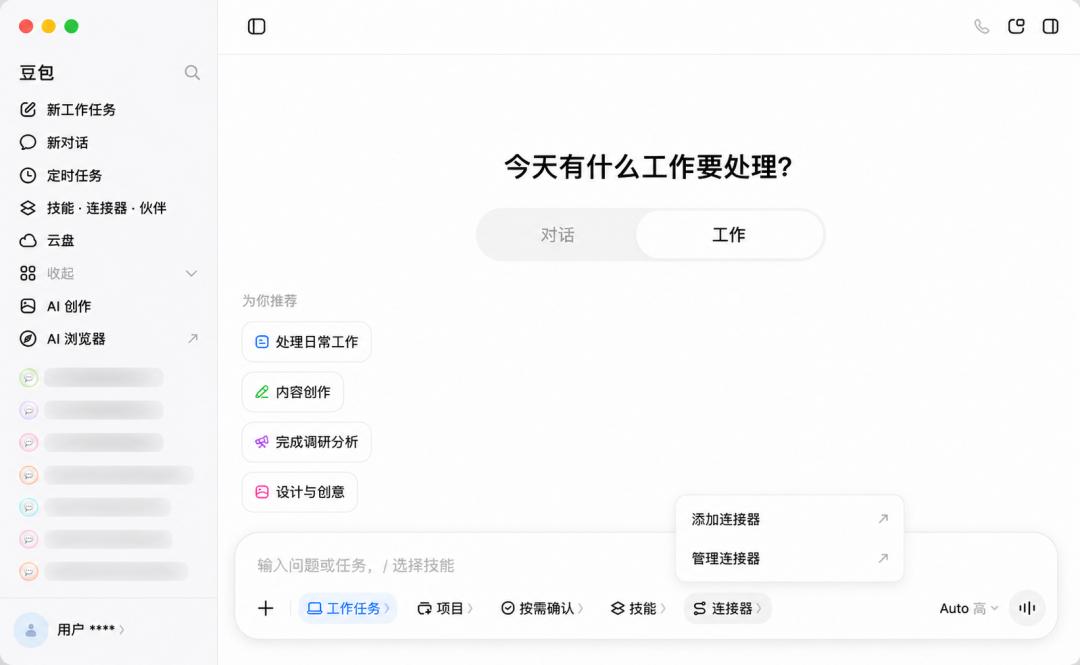
From working environment, to execution capability, and then to ecological connection. Doubao is rapidly building the infrastructure required by AI Agent.
Behind this is not only ByteDance's emphasis on the AI office track. More importantly, the competition logic of AI entry points has changed. It no longer asks "whose model is stronger", but answers "who can make the model enter the place where users work every day".
The rapid growth of Tencent WorkBuddy verifies this trend. It was officially launched in March 2026. According to data from Analysys, the monthly visits of WorkBuddy desktop reached 20.97 million in June, ranking first, higher than the sum of ByteDance TRAE and Alibaba QoderWork. Ma Huateng also called it "the most widely used efficiency AI agent service in China" in the financial report.
The core reason why WorkBuddy can achieve rapid growth is not only the model capability, but the enterprise ecosystem accumulated by Tencent for 20 years that it connects to.
From the very beginning, it is not an affiliated application of a certain model, but a multi-model aggregated workbench, built-in a variety of mainstream domestic models such as Hunyuan, GLM, MiniMax, Kimi, DeepSeek and so on.
When one model performs poorly on a specific task, users can switch to other models without waiting for the iteration of a single model. This design cleverly avoids the uncertainty of model capability in the early stage of the product.
At the same time, WorkBuddy is connected to Tencent's internal products such as Tencent Docs, Tencent Meeting, WeCom, and linked with third-party services such as QQ Mail and Official Account Assistant.
These connections do not need to be built from scratch, Tencent's existing ecosystem provides ready-made "sockets" for WorkBuddy. Coupled with high-intensity market investment — according to media reports, the offline investment in first-tier cities alone is close to 100 million yuan — WorkBuddy has established a first-mover advantage within half a year.
This is also the reason why Doubao must accelerate.
After being merged into Doubao, Feishu is being further componentized
Compared with Tencent, ByteDance entered the office field later. But what ByteDance really needs to make up for is not an office software, but a set of AI entry points that can be embedded into enterprise workflows.
This is also the core logic for Feishu to be merged into the Doubao system. At the end of July, ByteDance adjusted its business: the Feishu product team and the Doubao product team were integrated to form a new Doubao product team; the commercial team further cooperated with the Volcano Engine enterprise service system.
On the surface, this is an organizational adjustment. At a deeper level, this is ByteDance rearranging its enterprise assets in the AI era. Doubao has model capabilities and user entry points, Feishu has enterprise collaboration data, and Volcano Engine provides cloud and enterprise service capabilities.
After the three are connected, ByteDance has a complete link from model to application, and then to enterprise delivery.
The most critical link is Feishu. When AI enters the enterprise, what is missing is not a chat window, but a set of systems that understand how the enterprise operates.
In the past ten years, Feishu has been doing one thing, digitizing the operation process of a company. Instant messaging records organizational relationships — who collaborates with whom, who is responsible for what business; documents precipitate enterprise knowledge — systems, plans, experiences, processes, all stored in documents.
These things look like just office functions. But from the perspective of AI, they are actually the digital model of a company's operation.
The logic of traditional office software is that people use tools. The logic in the AI era has changed, users only need to express their goals, and the rest of the work is completed by the Agent.
When the logic switches, the value of office software also jumps — documents are no longer just writing tools, but entry points for AI to understand enterprise knowledge; meetings are no longer just communication tools, but entry points for AI to understand organizational decisions; project management is no longer just a task list, but entry points for AI to perform work.
All components accumulated by Feishu are beginning to change from employee tools to Agent capabilities. The model is responsible for thinking, and Feishu is responsible for providing context.
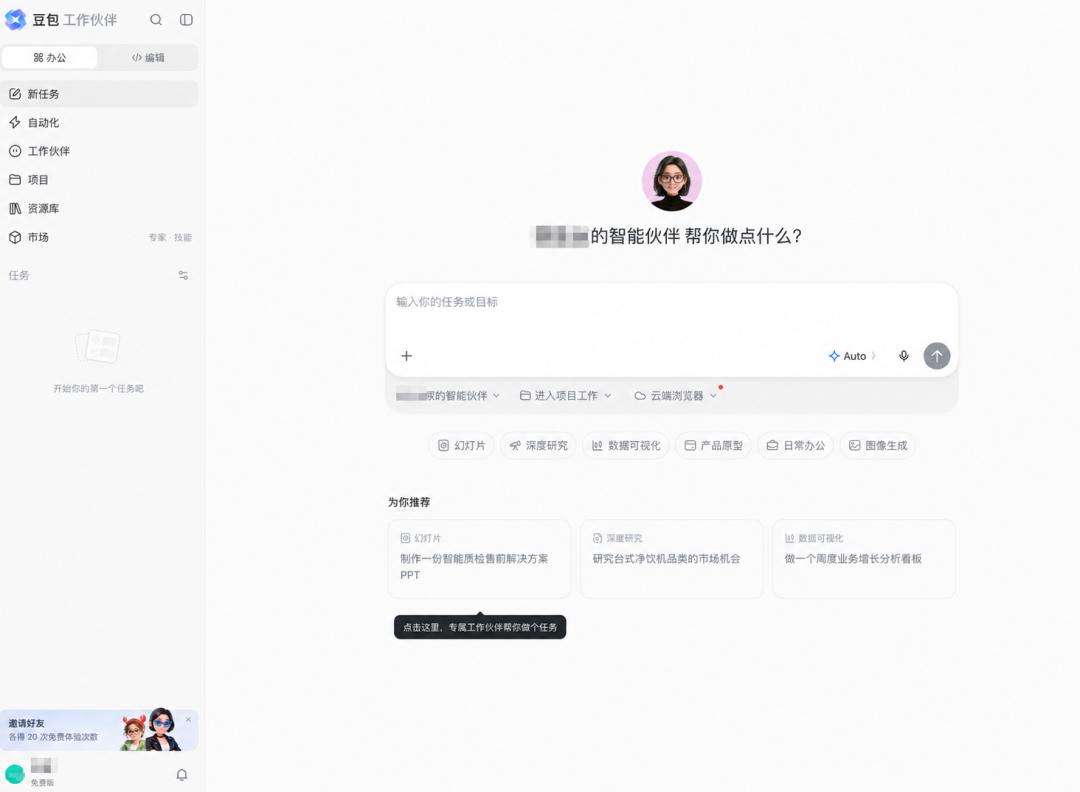
Documents become AI knowledge bases, meetings become AI decision-making databases, multidimensional spreadsheets become AI business databases, project management becomes AI execution systems, connectors become interfaces for AI to call the outside world, and the permission system becomes the action boundary of AI.
After these capabilities are disassembled, Feishu may no longer exist in the form of a complete App, but become a set of enterprise capabilities that Doubao can call.
This is "componentization", which does not simply connect Feishu functions to Doubao. Instead, it disassembles the ten years of accumulated enterprise collaboration capabilities into basic modules required in the AI era.
There are still two hurdles to cross
However, the integration of Feishu into the Doubao system does not mean that ByteDance has opened up the enterprise entry point. There are at least two hurdles to cross.
The Token consumption of Agent completing a complex task is far more than that of ordinary Q&A, which can be 10 to 90 times according to industry estimates. A simple web page data crawling plus table generation consumes Tokens equivalent to the amount of Q&A for a week at ordinary times.
Doubao currently provides the work task mode for free, but the computing power cost is real. The paid professional version launched in June has a standard package of 68 yuan and an advanced package of 500 yuan, which is positioned as "complex office scenarios".
However, if an AI task runs for half an hour and consumes several yuan worth of Tokens, while manual work only takes three minutes, it still needs to be verified whether enterprise users are willing to pay.
In addition, Doubao earns less than one million yuan per day, but its consumption reaches tens of millions of yuan. In this context, office products need to find a delicate balance between user scale growth and cost control — premature large-scale free access may lead to abuse of computing power resources, and premature charging may push users to WorkBuddy.
The other is the adaptation of organizational genes and the B-end market.
ByteDance's core competence lies in the rapid iteration of C-end products and traffic acquisition. But the enterprise service market follows another set of logic: in-depth customization, long-term service, and understanding of complex business processes.
Feishu has been working in the collaborative office field for ten years, and its user circle is still concentrated in Internet technology enterprises. According to data from iiMedia Research, the penetration rate of Feishu in manufacturing, retail, government and other fields is significantly lower than that of DingTalk and WeCom.
Doubao wants to leverage the B-end market with AI, and it faces the same problem. The technological process of a manufacturing enterprise and the data compliance requirements of a financial institution cannot be solved by a general AI assistant.
The ability to go deep into the industry and understand specific scenarios, this "heavy service" capability is a relatively weak part in ByteDance's organizational genes.
WorkBuddy and Qianwen Office also face these problems, but they are backed by Tencent and Alibaba's years of accumulation in the field of enterprise services. On Doubao's side, Feishu's sales team has just been merged into Volcano Engine, and the integration is still in the initial stage.
The office agent track is far from being finalized. For ByteDance, when its main competitors have completed product placement and resource integration, the gap of one quarter behind is not impossible to catch up.
However, if the hasty action rhythm cannot be quickly transformed into product advantages, it may instead amplify the friction cost in organizational integration.
In this far-from-finalized market, who runs more steadily may be more critical than who runs faster.
This article is from the WeChat Official Account "Keyan Society", published by 36Kr with authorization.