BBA is going all in; if it still fails to deliver satisfactory sales results, there is no point discussing its future.
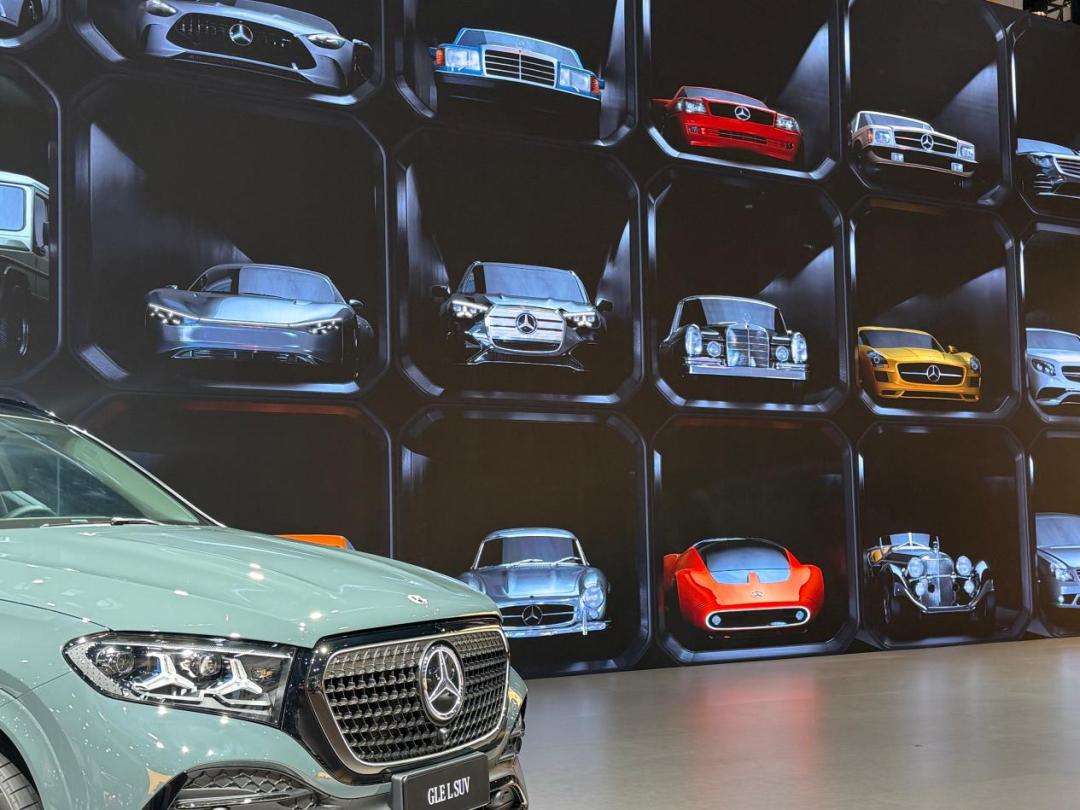
At the Chengdu Auto Show, Mercedes-Benz brought two highly anticipated models: one is the all-new Mercedes-Benz long-wheelbase GLE that has achieved domestic production for the first time, and this Chengdu Auto Show also marks its global debut; the other is the all-new Mercedes-Benz all-electric GLC launched in July. Mercedes-Benz has specially opened up an exclusive area for it in the exhibition hall, aiming to take advantage of the auto show to make deep inroads into Chengdu, the hot central-western market with extremely strong purchasing power for luxury cars.
Two new vehicles, two different development paths.
The all-new Mercedes-Benz long-wheelbase GLE reflects Mercedes-Benz's tangled transition away from fuel vehicles. Its appearance with a strong all-electric style, advanced intelligent assistance system and smart cockpit, as well as the still traditional fuel powertrain, are integrated in the same model. From the launch event theme "Demeanor Has Its Own Source", it is not difficult to see that up to now, the Mercedes-Benz GLE still shines with the residual glow of Mercedes-Benz's past glory.
The all-new Mercedes-Benz all-electric GLC is undoubtedly the culmination of Mercedes-Benz's all-electric transformation. As the most important key for Mercedes-Benz to open up the Chinese market after the all-electric CLA, it marks Mercedes-Benz's ambition to rewrite the current market landscape, and also marks the beginning of Mercedes-Benz's strong breakthrough in the all-electric future.
The past, present and future meet and intertwine under the lights of the Chengdu Auto Show. The same scene also appears at the booths of BMW and Audi.
After three generations of iteration, BBA has finally got rid of the label of "poor student in the electric era", and begun to compete head-on with Chinese independent car companies with equally matched product strength. However, while stumbling towards an unknown future, luxury brands still cannot forget their glorious past, chewing on the nostalgia, astonishment and unwillingness for the past glory, and frequently looking back.
01
The Unforgettable Glorious Past
It is actually a misinterpretation to simply attribute BBA's lag in electrification to the laziness or arrogance of "converting fuel vehicles to electric ones". Tracing the timeline, you will find that their enlightenment of electrification is even earlier than Tesla's.
As early as 1972, BMW proved the possibility of electric vehicles with the BMW 1602 Electric; in 2008, when the Tesla Roadster was just delivered, BMW's all-electric MINI E was already able to achieve a 200km cruising range and 3-hour fast charging.
In 2013, before the birth of Chinese EV brands Nio, Li Auto, Xpeng and Leapmotor, the BMW i3 and i8 had already been launched, and the first mass-produced all-electric vehicles of Audi and Mercedes-Benz were unveiled in 2018 and 2019 respectively. From the timeline, they are by no means latecomers.
However, an early start does not mean fast progress. Extreme joy begets sorrow, and BBA's lag in electrification transformation may be the inevitable result of its too solid basic market in the fuel vehicle era.
Fuel vehicles have always been the heavy ballast of BBA. Even today, the Mercedes-Benz E-Class, GLC, Audi A6L, Q5L, A3, BMW 3 Series, 5 Series, X3, X5 still can generate considerable sales. The stable "money-printing" models bring not only rich profits, but also a strong sense of security. This also made them, in the early stage of new energy transformation, not like independent brands, especially new EV brands, always immersed in a sense of crisis and anxiety, to bet on new energy with the determination to burn their bridges.
BBA's fuel vehicle base is too solid and thick, and this advantage in volume has alienated into strategic conservatism and optimism in the transition period. The conservatism is reflected in that they want to stabilize the volume of fuel vehicles and expand more markets by electrification; the optimism is reflected in their collective misjudgment of the electrification transformation process.
In 2019, when BBA's first batch of "fuel-to-electric" products were launched to the market one after another, they firmly believed that the full electrification of the Chinese market would take time, and with their own brand and technical heritage, they could make a smooth transition at their own pace.
At that time, BMW's annual sales of BEVs and PHEVs had reached 146,000 units, and this report card gave them great confidence. In the following year, BMW announced a high-profile ten-year plan — to put 7 million electrified vehicles on the global market by 2030. The realization path mainly relies on the transformation strategy of "all models can be electrified".
According to BBA's vision, "fuel-to-electric" products can support a sufficient transition period, during which they can gradually transfer the advantages accumulated from fuel vehicles to new energy models, so as to continue their leading position in the new energy era.
However, no one expected that Chinese independent brands would achieve curve overtaking of new energy models in a short period of time with such a radical and resolute attitude and such a rapid speed. As a result, we have seen the rapid popularization of all-electric exclusive platforms, high-level smart cockpits and autonomous driving technologies, the market iteration cycle has been shortened to two or three years, and in the blink of an eye, the fuel vehicle market has shrunk rapidly, until there is only one stubborn fuel vehicle left in the top ten of the best-selling list.
02
The Struggling Present
There is no time for surprise or aftertaste, BBA suddenly finds that in this world's largest single market, its solid fuel vehicle base is suffering a devastating blow, with both sales volume and price declining; while the electric vehicles that were expected to deliver strong results are labeled as "non-mainstream vehicles" by the market, and cannot fill the gap left by the rapid decline of the fuel vehicle market.
The situation is already very severe. Fortunately, under the background of century-old luxury brands, there is rapid market response capability and the determination to correct errors. After the setback in transformation, BBA's electrification transformation has accelerated significantly. By expanding local R&D teams for leading development and deeply binding the Chinese supply chain, the third-generation all-electric models launched by BBA do have the confidence to compete head-on with leading independent brands in terms of hard indicators of product strength.
Taking the cruising range and intelligence that all-electric car owners pay the most attention to as examples, before the Chengdu Auto Show, the new era BMW iX3 50L completed an extreme cruising range test with a total distance of over 1000 kilometers. Although vehicle speed control and energy consumption management were carried out during the test, this result is still shocking in a market where the actual cruising range is often only 60% to 80% of the nominal value. At present, there are only a handful of mass-produced all-electric vehicles with a real cruising range of over 1000 kilometers.
What is even more striking is that the starting price of the BMW iX3 is 269,900 yuan, which is 50,000 yuan lower than the 318,000 yuan guide price of its fuel version. At the BMW booth, the i3 and iX3 each occupy a large display space. Although each model has 3 existing cars for visitors to experience, under the crowd of enthusiastic media and consumers with Sichuan-accent Mandarin, you definitely need to queue up to get a chance to get in and experience the cars.
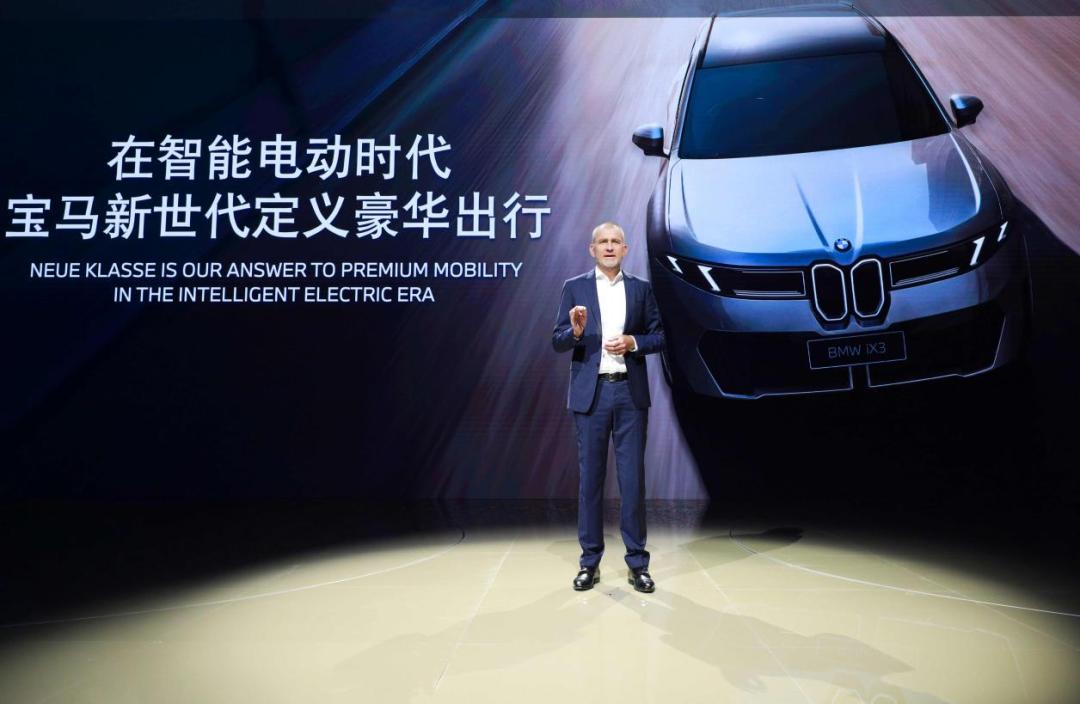
During the waiting period, almost everyone is repeating the same two sentences: "BMW's pricing is so aggressive" and "This car is truly a typical BMW product". Just like fuel vehicles, after sitting on the highly supportive main driver's seat, people can't help but put their hands on the steering wheel, eager to experience the driving pleasure of speeding. It has to be admitted that even for all-electric vehicles, BMW still has an irreplaceable unique charm, which has never been easily replicated by any independent brand.
It can also be seen from the pricing that even solving the cruising range problem of all-electric vehicles can only retain users through static experience, and BMW still makes compromises on prices.
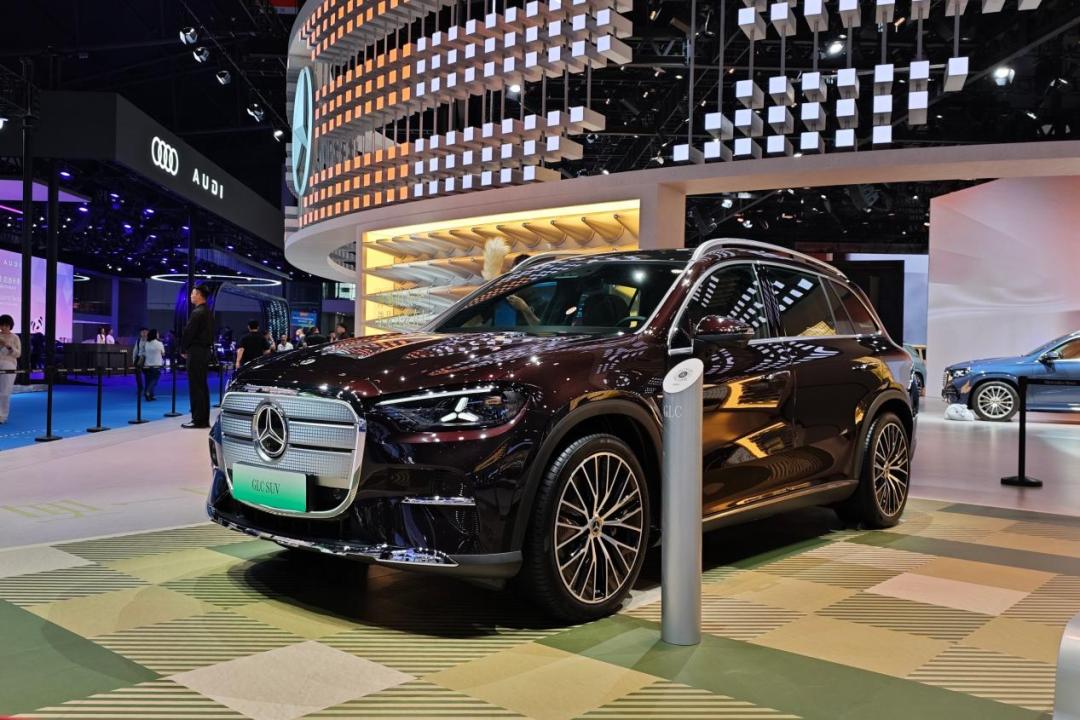
Mercedes-Benz has also begun to rethink its strategy. After the all-new all-electric CLA, Mercedes-Benz has shown more sincerity on the all-electric GLC. It is not only equipped with the only electric two-speed gearbox in its class, but also upgraded the infotainment system. With the in-depth participation of the local R&D team and cooperation with Momenta, it has made great breakthroughs in voice interaction and intelligent assisted driving.
This car also demonstrates Mercedes-Benz's determination. From the design language to interior design, and the application of the same chassis technology as the S-Class, Mercedes-Benz has almost brought out all its core technologies. In the separate corner for the all-electric GLC at the Mercedes-Benz booth, Mercedes-Benz uses a bright yellow color scheme to attract passers-by to stop.
Although the shortcomings in product strength have been filled, BBA's all-electric transformation still has many bottlenecks.
In terms of sales volume, the market response to Mercedes-Benz's two all-electric models is not enthusiastic. The unsatisfactory performance of the all-new Mercedes-Benz all-electric CLA can be attributed to its niche positioning, but the mid-size luxury SUV market where the all-electric GLC is located has always been BBA's most core profit hinterland in the past few decades, and it is also the battlefield that best tests product appeal. If this car still cannot achieve rising sales, it can only point to a more thorny problem: BBA's "user mind share" in the new energy era has already had problems.
This is also the aftereffect left by BBA's slow transformation in the early stage of new energy development and its previous fuel-to-electric models. Today, even if the new generation of products is completely upgraded, few young users are willing to include BBA in their new energy vehicle consideration list. As for the old users in the past, they either continue to stick to fuel vehicles, or turn to high-end independent brands. Once the cognition is solidified, it is far more difficult to reverse it than to catch up in technology.
In addition to user mind share, channels are also a problem. Considering cost and efficiency, BBA has not set up a separate sales network for new energy models, but sells them together with fuel vehicles. This leads to the inevitable internal competition between the fuel version and the all-electric version of the same model in the same showroom.
Taking the all-electric GLC as an example, in the first month of its launch, the orders for the fuel version of the GLC fluctuated significantly. The old and new products compete with each other under the same roof, which does not bring incremental growth, but shrinks the total market size. How to make fuel vehicles and electric vehicles complement each other instead of eroding each other while continuing to use the original product sequence is an organizational-level problem that BBA must face directly.
A more serious constraint is price. Recently, BBA has launched a new round of terminal price cuts, with many new energy models reduced by more than 100,000 yuan, and some high-end models even reduced by more than 200,000 yuan.
On the one hand, independent brands continue to break through the high-end market, constantly compressing the premium space of luxury brands, while the high-end positioning of BBA's new energy models is also widely questioned, and consumers no longer pay excess premium for the "BBA electric logo". On the other hand, the positioning and brand value of luxury brands limit the downward range of product prices, and they cannot exchange for sales through extreme price cuts like independent brands. This leads to great challenges to BBA's new energy price system, which can neither go up nor down.
03
Uncertain Future
Product strength has been improved, channels are being adjusted, and prices are still in the game. However, in the electrification era, BBA has not yet found an effective answer to what kind of identity it should use to face consumers again.
After the failure of the EQ series, Mercedes-Benz no longer uses an independent sequence, but follows the same path as BMW, returning to the classic naming system, allowing electrified models to directly inherit the brand assets accumulated by fuel vehicles for decades.
The advantage of this strategy is that it can quickly build user awareness and realize the continuous iteration of classic models, which is more easily accepted by the market than building a new brand system from scratch. The recognition of BBA's new energy vehicles is far lower than that of fuel vehicles, so letting the all-electric version inherit the brand assets and user reputation accumulated by fuel models has more advantages than creating a completely unfamiliar car series from zero. But as mentioned above, the other side of the coin is the unavoidable internal competition.
Audi is trying to take a broader but more risky path. On the one hand, the e-tron sequence realizes the electrified inheritance of old models, on the other hand, the newly launched "AUDI" letter logo brand is a new all-electric species independent of the four-ring logo.
In July, Audi had the highest sales volume of new energy vehicles among the three brands. Among them, the new car Audi E7X launched in May achieved sales of 3007 units, bringing vitality to the AUDI brand. However, the sales of several other new energy models under the brand are still not improving.
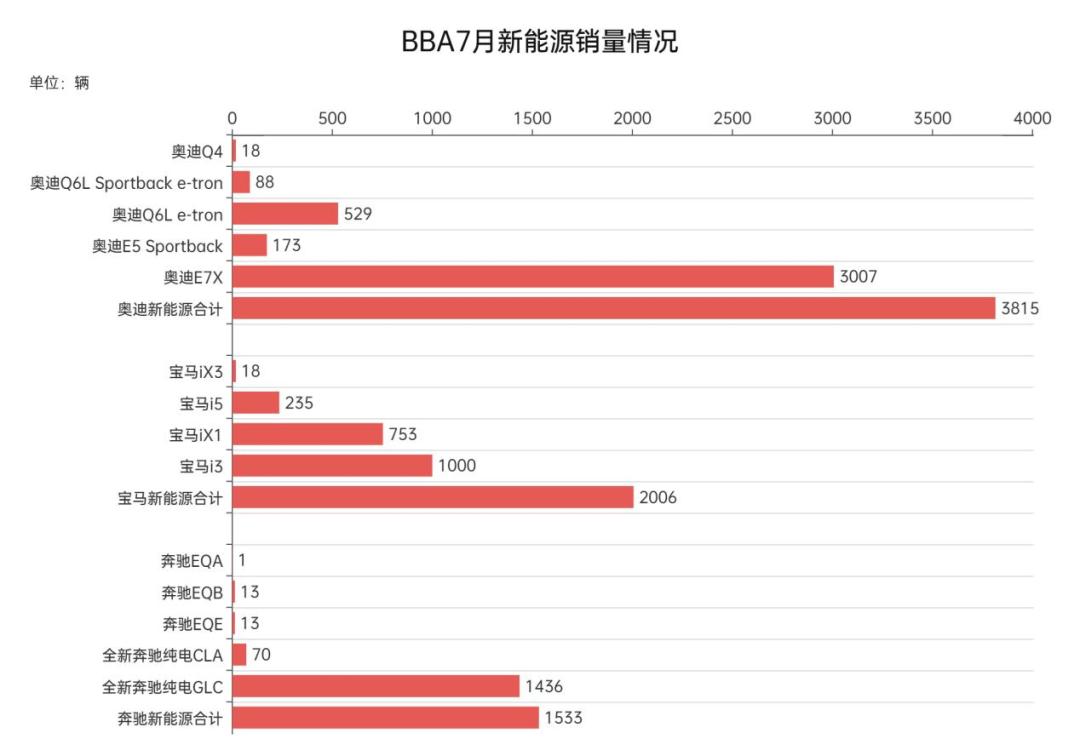
On the other hand, the sales volume of the all-new Mercedes-Benz all-electric GLC in the first month is close to 1500 units, which is barely acceptable, but there is still a big gap from real market breakthrough. BMW's new generation iX3 has achieved technological breakthroughs in battery standards and has started mass production, but it is still unknown whether the market is willing to pay for it.
Judging from the current situation, no matter returning to the traditional naming system or creating a completely new independent sequence, BBA is moving forward with great difficulty. Audi tried to take both paths, but both feet stepped into almost the same mud.
BBA has not yet found a suitable narrative logic in the electrification era. It can neither subvert without any burden like new EV brands, nor define standards with technology like Tesla, and is in a dilemma between inheritance and reform.
But the market and competitors will not stop and wait. The time and space left for BBA to try and make mistakes are still shrinking rapidly. The fuel vehicle base continues to shrink, while independent new energy brands are pressing forward step by step in the high-end market with increasingly fierce offensive.
The electrification transformation of luxury brands is currently going through throes. Whether those unforgettable past glories are heavy burdens on the way forward or inspiring spiritual sparks depends on the choices made now and in the future.
Over the past 100 years, BBA has experienced the impact of the oil crisis, the rise of Japanese luxury brands, and the devastation of the financial tsunami. Every time it was in great danger, but every time it relied on its profound engineering accumulation, keen market sense and decisive strategic adjustment to return to the peak.
From the Mercedes-Benz all-electric GLC to the Audi E7X, and then to the BMW iX3, BBA's all-electric counterattack is no longer weak, and BBA's fierce fangs can be clearly seen from its product strength and pricing system. The cold winter is tough, but it is not unfamiliar to BBA. It has gone through longer dark nights and held its ground in more bitter cold winds. As long as it survives this period, spring will come.
This article is from