Can Anthropic take on the 2-trillion-yuan gamble?
In June this year, SpaceX set a historical record with an IPO valuation of 1.77 trillion US dollars. In less than four months, this record is likely to be broken by Anthropic.
According to the Financial Times, Anthropic will go public as early as October, with a target valuation of up to 2 trillion US dollars. The company has secretly submitted its U.S. IPO application in June, and the specific timing and pricing have not been finally determined.
However, the controversy surrounding this star AI company suddenly heated up in the past week.
01
An ARR of 65 billion US dollars,
Why did it trigger a correction in global tech stocks?
On August 18, Bloomberg disclosed that Anthropic's ARR in July was 65 billion US dollars. The absolute growth rate is still impressive - up about 38% from 47 billion US dollars in May, and more than seven times higher than 9 billion US dollars at the end of 2025. The preliminary revenue in the second quarter exceeded 11.5 billion US dollars, a year-on-year increase of nearly 14 times, while achieving positive adjusted operating profit.
The problem lies in the expectation gap.
Two weeks ago, third-party tracking agencies such as Yipitdata and TickerTrends gave expectations of 700 billion to 800 billion US dollars. In the Anthropic research organized by institutions last week, experts gave a forecast of 78 billion US dollars. The actual figure of 65 billion US dollars is significantly lower than the most optimistic expectations of the buy side.
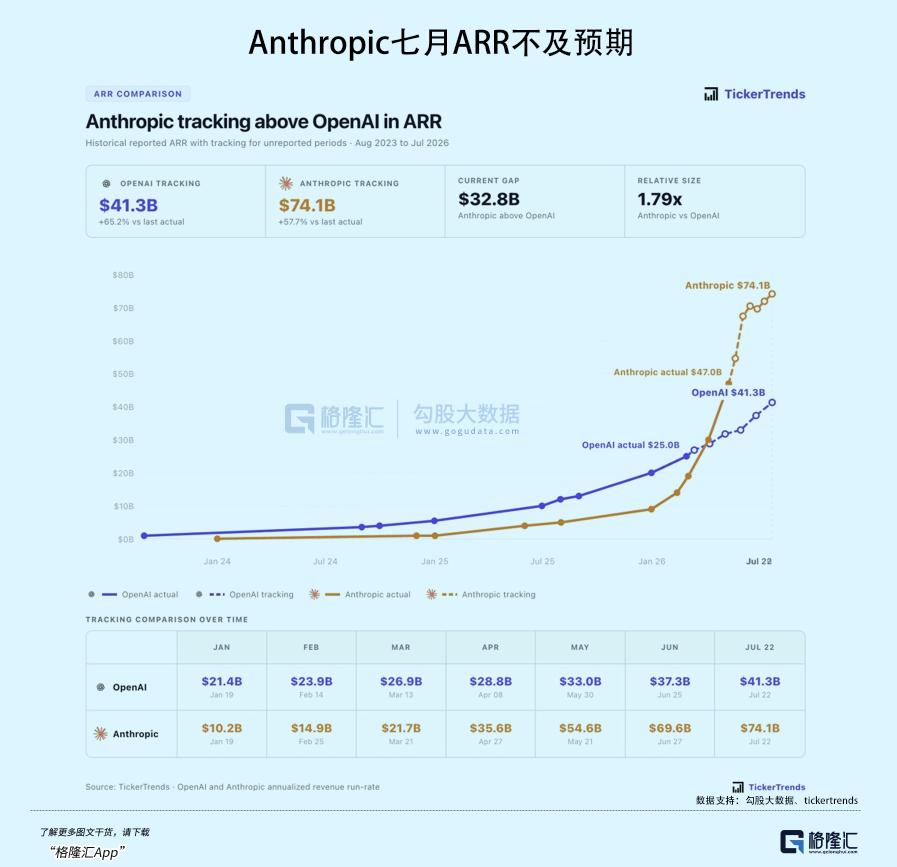
Why did this gap trigger a chain correction in global tech stocks? It knocked the AI hardware sector, which had barely rebounded, back to the ground. The Philadelphia Semiconductor Index plummeted by nearly 5% that day, and Western Digital and Micron fell by more than 7%.
Anthropic's ARR is the core anchor of the entire AI capital expenditure narrative at present. In the past two years, the total annual capital expenditure of the four giants Amazon, Microsoft, Alphabet and Meta has climbed from about 455.8 billion US dollars to nearly 750 billion US dollars. The commercial returns of these massive investments must eventually be verified through the revenue of model vendors. As the first pure large model company about to go public, Anthropic's revenue growth rate is the key metric to test whether this 750 billion US dollars of Capex is reasonable.
The signal of a slowdown from the leading player is far more worrying than the performance fluctuation of a single company. The market is concerned that if the fastest-growing Anthropic has already started to slow down, will other players also hit the brakes in the near future? If the revenue growth rate on the model side falls short of expectations and the downstream payment capacity is in doubt, the long-term sustainability of the continuously surging computing power capital expenditure upstream will be called into question. The entire AI industry chain has moved from the one-sided optimistic narrative of "hardware first" to a stage where both the demand side and the supply side need to be verified.
OpenAI's data exacerbated this concern. The quarterly data disclosed by The Wall Street Journal sent a shockwave across Silicon Valley and Wall Street at the same time: OpenAI's revenue in Q2 this year was only 6.7 billion US dollars, a quarter-on-quarter increase of only 18% from 5.7 billion US dollars in the first quarter, while operating losses expanded from 9.3 billion US dollars to 12.3 billion US dollars. For every 1 dollar earned, more than 1.8 dollars are burned, moving further away from profitability. Although OpenAI's overall ARR has exceeded 400 billion US dollars in August, the overall ARR in Q3 increased by 35% quarter-on-quarter and enterprise ARR increased by 50%, the 18% quarterly growth rate in the second quarter has made the market re-examine the pace of AI commercialization.
One day later, TickerTrends released more detailed tracking data: as of August 10, the tracked ARR of Claude Code was 15.12 billion US dollars, from which it is inferred that Anthropic's total ARR is about 69.04 billion US dollars, up 6.2% from the end of July. In the same period, the tracked ARR of OpenAI Codex was 8.83 billion US dollars, with a monthly growth rate of 20.8%. The growth rate of Claude Code, which has a larger scale, has slowed to around 5%, while Codex, which has a smaller scale, is catching up at four times the speed.
On the night this set of data was released, overseas tech stocks continued to decline, the Nasdaq Index fell another 1.33%, and the Philadelphia Semiconductor Index continued to drop. On August 20, A-shares followed with a sharp correction, and the STAR 50 Index and the ChiNext Index fell by more than 5% in a single day. The ARR data of one AI company linked the global market within three days.
02
Claude Code,
How did it become the "igniter"
Back at the end of 2025, Anthropic and OpenAI had ARR of about 90 billion US dollars and 200 billion US dollars respectively, with a gap of more than double. Then the situation reversed: Anthropic overtook around March this year, its ARR rose to 470 billion US dollars in May, and exceeded 650 billion US dollars at the end of July, while OpenAI's ARR was about 400 billion US dollars in the same period. It completed the counterattack in one quarter relying on Claude Code.
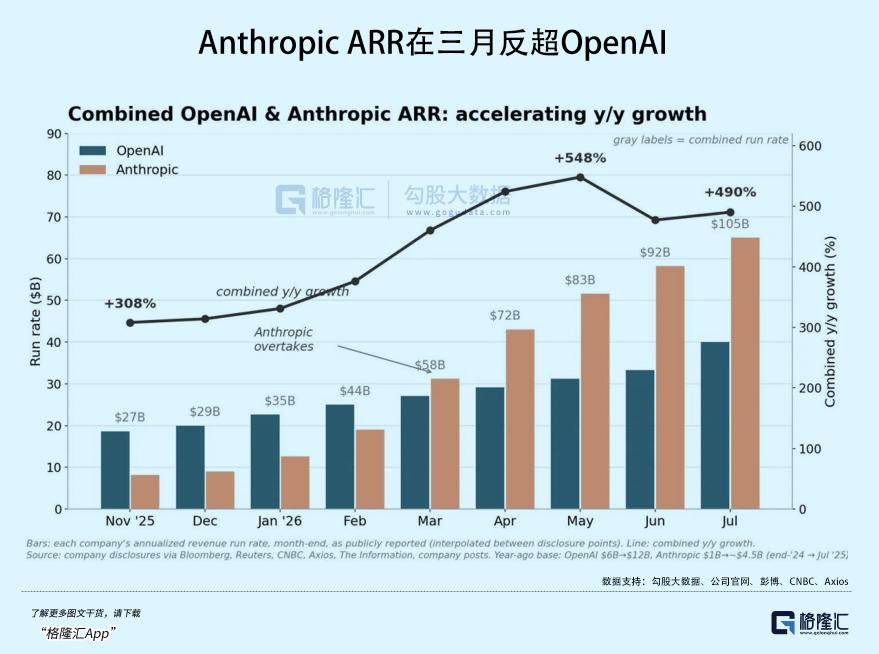
The high-frequency invocation of programming scenarios and deep tool chain binding naturally upgraded personal subscriptions to enterprise contracts and API calls. Claude Code's ARR exceeded 500 million US dollars three months after its launch, reached 1 billion US dollars in about half a year, and exceeded 2.5 billion US dollars by the beginning of 2026. It took only about seven months to grow from 2.5 billion to 15.1 billion US dollars.
More importantly, it pressed the start button for the entire Agent industry - it proved with real revenue that the largest payment scenario for AI is to directly complete work for people. Cursor, Windsurf, and Replit all enhanced their autonomous programming capabilities, Microsoft upgraded GitHub Copilot, Google launched Jules, and OpenAI re-centered Codex in its product lineup. The domestic market also followed up simultaneously, Zhipu, MiniMax, Kimi, DeepSeek enhanced their coding capabilities, and Kimi Work, Alibaba Wukong, Tencent WorkBuddy were launched intensively.
A verified scenario is being replicated by everyone. The story of Claude Code is already exciting enough, but what the capital market cares about is never how wonderful the "story" is, but how far the "figures" can continue to grow.
03
Is 2 trillion US dollars worth it?
The logic of the bulls is very clear.
Anthropic internally expects its ARR to reach 1.9 trillion to 2 trillion US dollars by 2028. Based on this, Wall Street gives a target valuation of up to 2 trillion US dollars, corresponding to about 10 times the forward revenue. Calculated by the direct annualization of 11.5 billion US dollars in the second quarter to 46 billion US dollars, the current valuation corresponds to about 43 times the revenue; calculated by the latest annualized revenue of 65 billion US dollars, the multiple drops to about 31 times. The market has already paid in advance for a considerable part of the growth that has not yet occurred.
For the bears, what they worry about is several other things.
The first is ROI. In 2026, the total capital expenditure of the four major cloud vendors has approached 750 billion US dollars. And in 2027, the market's consensus expectation is 1.1 trillion to 1.4 trillion US dollars - no matter which figure is taken, it will be about 1.6 to 1.9 times that of 2026. The commercial verification of these massive investments will eventually return to the revenue growth rate of Anthropic and OpenAI. If the revenue growth rate on the model side continues to slow down, how long can the upstream Capex, which is heading for 1.4 trillion US dollars, be sustained?
The second is that the revenue structure is too concentrated, with APIs accounting for about 80%. Once enterprises cut their AI budgets, the fluctuations will be sharply amplified. Price wars are also approaching - Chinese open source models continue to reduce costs, and the price of Claude Opus 5 released by Anthropic on July 25 has been lowered.
The bulls and the bears hold their own opinions, but who is right and who is wrong will eventually be verified by the public market.
There are only 2 to 3 revenue update windows left before the earliest possible October listing schedule. Anthropic needs to prove that the recent slowdown is only a short-term fluctuation, not an inflection point. Before that, the market will keep a close eye on every figure.
Risk Warning: Investment involves risks, and prudence is required when making decisions. The above analysis is only for industry research and market strategy reference, and does not constitute specific investment advice.
Disclaimer: The copyright of this article belongs to the Investment Research Team of Beijing Gelonghui Investment Consulting Co., Ltd. (Duan Yuehan: A0160625050003). This report is produced based on the principles of independence, objectivity, impartiality and prudence. All information is sourced from public materials and collected, abstracted and edited legally, reasonably and appropriately.
Stock market investment carries risks, and caution is required when entering the market. No investment advice in this article shall be taken as the basis for your investment transactions. You must make your own investment decisions independently and bear the risks yourself. Any entity or individual who, without the permission of this company, unauthorizedly publishes, copies, disseminates or publishes and reposts this article on the Internet shall be regarded as infringement, and this company will pursue the infringement liability in accordance with the law.
This article is from the WeChat official account "Gelonghui Finance Hotspot" (ID: glh_finance), author: Gelonghui Editor, and is authorized for release by 36Kr.