What determines how much money you can earn in your lifetime?
Many people assume that managing personal finances is a math problem. If you learn to read K-lines, understand valuation models, and master asset allocation theories, wealth will naturally come your way. But reality has proven otherwise time and again: an MBA from Harvard can go bankrupt, while a cleaner can donate 6 million dollars. The secret to financial success does not lie in your mind, but in your behaviors.
Today, we will break down the book The Psychology of Money for you. Its author is Morgan Housel, an American financial writer. This book has been translated into more than 50 languages and listed as a "must-read for everyone" by countless investment giants. It does not cover formulas or charts, but uses 20 concise chapters to unpack one question: Why do smart people also make foolish decisions with money? Why is the highest form of wealth not luxury mansions or sports cars, but the state of "being able to do anything you want when you wake up every day"?
Now, let's open this book The Psychology of Money together.
Why do smart people also make foolish decisions with money?
In 2014, a 92-year-old man passed away in Vermont, USA. When his obituary was published, the whole town was shocked. His name was Ronald Read. For 25 years before his death, he worked as a car mechanic at a gas station, and then worked as a cleaner in a department store for another 17 years. No one expected that the will of this cleaner showed his net worth reached 8 million dollars, 6 million of which was donated to hospitals and libraries.
He did not win the lottery, nor did he inherit a fortune. He just invested every penny he saved from his meager salary in blue-chip stocks continuously, and held them for decades. Compound interest did the rest for him.
Almost in the same period, Richard Fuscone, a Harvard MBA and former senior executive of Merrill Lynch, declared bankruptcy during the 2008 financial crisis. He once owned a luxury mansion in New York State with 11 bathrooms, and the monthly maintenance cost was as high as 90,000 dollars. However, his highly leveraged investment portfolio vanished instantly when the market crashed, and he could not even afford his own bankruptcy lawyer fees.
The contrast between these two lives exactly reveals the core proposition of The Psychology of Money: Whether you have a good relationship with money has almost nothing to do with how smart you are, but largely depends on how you act. Ronald Read was patient, while Richard Fuscone was greedy. This single behavioral difference largely offset all gaps in education background, social status and income between the two.
Financial success is not a hard science, but a soft skill: what you do matters more than what you know.
The logic sounds simple, but it is extremely difficult to put into practice. Housel points out the crux of the problem with a surprising chapter title: "No One's Crazy". Everyone's perception of money is shaped by their own unique life experiences. In Housel's words, your personal experience of dealing with money may only account for a tiny fraction of the entire history of money in the world (in his metaphor, roughly 0.00000001%), but it constitutes 80% of your perception of "how the world works".
More importantly, the U.S. 401(k) retirement plan was not born until 1978, and the index fund was invented in the 1970s. In other words, the entire human race is using less than 50 years of experience to try to navigate a brand new monetary world. We are not crazy, we are just collectively inexperienced.
But behavior is only the foundation. Housel takes his thinking a step further: luck and risk are also unavoidable variables.

Bill Gates' talent is beyond doubt, but the Lakeside School he attended was one of the only secondary schools in the United States that had a computer terminal at that time. Housel estimates that this probability is about one in a million. At the same time, Gates' close high school friend Kent Evans was also obsessed with computers, but he died in a mountaineering accident before graduation - the probability of this accident happening is exactly one in a million. The two sides of the same story are exactly the two sides of luck and risk.
Therefore, when we see extreme success or failure, never attribute it 100% to personal effort - Read's success is also inseparable from luck: he lived to be 92 years old, was born in the United States, and caught up with the longest bull market in the history of U.S. stocks. This is not nihilism, but humility in good times and tolerance for yourself and others in adversity.
If ignoring luck leads to arrogance, then the inability to answer "is this enough?" leads to destruction. Rajat Gupta, the former global CEO of McKinsey, had a net worth of over 100 million dollars, but was imprisoned for insider trading. Bernie Madoff could have lived a rich life legally if he stopped his fraud at a certain point - but he could not stop.
The most difficult financial skill to master is to stop your goals from shifting.
Modern capitalism is good at two things: creating wealth, and breeding envy. The ceiling of social comparison is so high that no one can reach it, which is a war that can never be won - the only way to win is not to participate. "Being content" does not mean persuading you to give up pursuit, but reminding you: there is no reason to exchange what you already have and really need for what you do not have and do not need.
Another psychological mechanism that makes smart people stumble over money is "pessimism". Why is pessimism so tempting? Historian Deirdre McCloskey once said: "For reasons I can never understand, people just love to hear that the world is going to end."
There are three reasons behind this. First, money is everywhere, and bad news affects everyone, so it can best capture everyone's attention. Second, when pessimists deduce trends, they often ignore the self-repairing ability of the market - extremely good and extremely bad situations rarely last for too long. Third, growth happens too slowly to be noticed, while collapse happens too fast to be ignored: it only takes six months for the stock market to plummet by 40%, which is enough to trigger a congressional investigation; but a 140% increase takes six years to complete, and almost no one pays attention to it.
However, in the past 170 years, the United States has experienced 9 major wars, 4 presidential assassinations, and 33 economic recessions. U.S. stocks have fallen by more than 10% from their highs at least 102 times - but during the same period, the per capita living standard has increased by 20 times.
True financial optimism is believing that the probability of good outcomes is on your side, even if there will be countless setbacks along the way.
The last psychological trap is about "narrative". Daniel Kahneman once said: When we make plans, we only focus on what we can do and want to do, ignoring other people's plans and capabilities; when explaining the past, we overemphasize skills and underestimate luck; we only focus on the known and ignore the unknown - the result is overconfidence in our own judgments. The more you want to believe that something is true, the easier it is to believe the story that overestimates its probability of happening.
What can ordinary people rely on to stay in the game all the time?
If the first section talks about "why you lose", this section will answer "what makes you win".
The story of Ronald Read has actually let us glimpse the power of compound interest. But Housel found a more extreme sample - Warren Buffett: of his 84.5 billion dollars net worth, 81.5 billion was earned after he turned 65.
This is not a number about investment skills, but a number about time. Buffett started investing at the age of 10, and continued for 80 full years. If he started at 30 and retired at 60, almost no one would know his name today.
His secret is not to get the highest rate of return, but to continuously get a "good" rate of return for the longest time. The counterintuitive part of compound interest is exactly this: you can hardly see any change in the first year, it starts to show some progress in the tenth year, and by the fiftieth year, you will find that it has created something incredible. It's like planting an oak tree - you can hardly see any change in one year, there are obvious changes in ten years, and it becomes a miracle in fifty years. The human brain is inherently not good at understanding exponential growth: we are used to linear thinking, but compound interest operates exponentially. This is exactly why so many people give up prematurely.
But time alone is not enough, you also have to stay in the game all the time.
Getting rich and preserving wealth are two completely different skills. Getting rich requires optimism, adventure, and the courage to stand out; while preserving wealth requires humility, fear, and even paranoia - you need to be clear that at least part of the money you earned depends on luck, and past success cannot be replicated infinitely. Almost all the people who collapsed during the 2008 financial crisis were people who knew how to make money but did not know how to preserve it.
A good investment does not lie in making a brilliant decision once, but in not making mistakes for a long time - not being wiped out, not being forced to exit.
Related to this is the "tail effect". Buffett has bought 400 to 500 stocks in his life, but the vast majority of his wealth comes from only 10 of them. Charlie Munger put it more bluntly: "If you take away our 15 most successful decisions, our performance will become mediocre." In business and investment, it is often a very small number of events that determine the vast majority of results. This means that you can still make a lot of money even if you do things wrong half the time.
It will bring about a complete change in mentality: accepting a large number of small failures is completely normal. You don't have to be right every time, what you need is - when that decisive opportunity comes, you are present and you still have chips in your hand.

To stay in the game for a long time, you need two preparations: one is to "defend" without making mistakes, and the other is to continuously "save" money - that is, saving. For ordinary people, the latter is even more controllable.
Then, how can ordinary people ensure that they are always present? Housel's answer is: take saving as an end in itself.
Getting rich has little to do with your income or investment return, but is closely related to your savings rate - without a high savings rate, it is impossible for you to accumulate wealth. And the secret of saving does not lie in the income side, but in the desire side: how much you can spend less depends on how much you care about other people's opinions. Housel wrote: "After exceeding a certain income level, your 'needs' are everything below your desire line." Therefore, the most powerful way to increase savings is not to increase income, but to increase humility.
Saving does not require a specific reason. It is of course good to save for retirement, but it is equally important to save for things that you cannot foresee or even imagine.
Saving is an end in itself, because it can give you the scarcest resource in the world: the right to choose.
This flexibility is exactly the essence of what Housel calls "reasonable is better than rational". Purely from a mathematical point of view, when the interest rate is low, you should not pay off the mortgage in advance, but invest the money in the stock market to get a higher return. But Housel himself chose to pay off the house payment in one lump sum. He admitted: "This is the worst financial decision I have ever made, and it is also the best money decision I have ever made." The sense of control and peace of mind brought by owning a house far exceeds the extra benefit brought by the mathematically optimal solution - there is no one-size-fits-all formula for personal finance, the key is to figure out "what your own goals are".
The investment portfolio that allows you to sleep well is the best investment portfolio.
Benjamin Graham, the father of value investing, once said: "The purpose of the margin of safety is to make prediction unnecessary." You don't know what will happen in the future, so you don't need to make accurate predictions at all - you just need to leave enough redundancy so that even if your prediction is wrong, it won't be fatal. Housel's own approach is: first assume that the future investment return will be one third lower than the historical average, and then plan savings according to this more conservative assumption. This is not pessimism, but leaving room for yourself.
Debt will amplify ordinary risks to a level enough to destroy you. Putting all your assets on the only source of income without any savings as a buffer is equivalent to betting that "nothing will go wrong". But the truth is - everything will go wrong, it's just a matter of time.
Are you showing off to others, or living for yourself?
In 1981, psychologist Angus Campbell published The Sense of Well-Being in America. After a large number of studies, he found that the most reliable predictor of happiness is not income, region, or education level, but an extremely simple thing: a strong sense of control over your own life.
The highest form of wealth is being able to say every morning when you wake up: Today, I can do anything I want. Be with the people I like, go to the places I want to go, and stay as long as I want.
The highest intrinsic value of money is the control it gives you over your own time. It is more valuable than salary, more valuable than the size of the house, and more valuable than job titles - this is the highest dividend that money can pay.
But most people use money in the completely opposite direction - showing off. Housel uses the "luxury car paradox" to expose this collective illusion: you drive past in a Ferrari, thinking "these people must think I'm cool"; but the real inner thought of passersby is "if I also have a car like this, others must think I'm cool". They don't care at all who the driver is.
When you buy luxury goods, you hope that others will respect you and envy you. But when others look at your things, they just take them as the benchmark of their own desire. No matter how loud the engine of the Ferrari is, it can't get real respect. If you really desire respect and admiration, humility, kindness and empathy are far more effective than horsepower.
Housel further distinguishes between "being rich" and "being wealthy" - this is one of the sharpest insights in the whole book. "Being rich" is visible - luxury cars, famous watches, big houses, these are the results after you spend your money. "Being wealthy" is invisible - it's the money you didn't spend: the BMW you didn't buy, the famous watch you didn't wear, the income you saved and didn't consume. Real wealth is hidden, it's that you refuse to buy something today, so that you can have more choices and flexibility in the future. The world is full of people who look plain but are actually wealthy, and people who look rich but are actually in a precarious financial situation. You think you can tell the difference, but you can't.
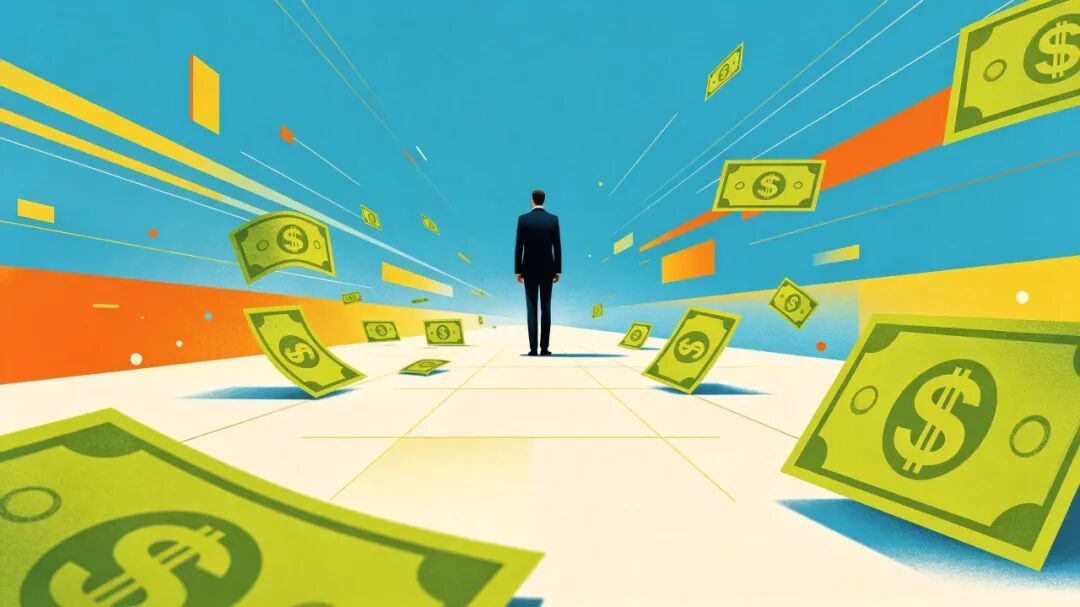
In other words: spending money is to show that you are rich, but becoming wealthy requires you to refrain from spending - the two are completely opposite directions. Many people spend their entire lives using "spending money" to imitate "being wealthy", and as a result, they get farther and farther away from being wealthy.
Taking this logic one step further is: figure out what game you are playing. Housel reminds us to be careful of the financial hints given by people who are playing a completely different game from you. You can see how much money others spend - cars, houses, clothes, vacations - but you can't see their goals, anxieties and desires. A young lawyer