Exclusive Interview with Funloom AI: Text-based Interactive Story Games Are the Foundation of Interactive Film Games and RPG Games
Over the past year, "generating a game with one sentence" has increasingly become the most common product vision in the AI gaming track. Coding, art creation and music production can all be delegated to AI models, and the threshold for game development seems to have been lowered to a very low level.
However, a problem soon emerged: even if people with no game development experience do not need to write code, they still cannot necessarily create a fun game.
Tong Wu, founder of Funloom AI, also ran into this pitfall.
The team initially tried to build game tools through the Vibe Coding approach, hoping that users could describe an idea and the AI would generate a game directly. But actual tests showed that ordinary users are simply unable to express a vague idea in their mind into a complete game design document.
Later, Tong Wu noticed on Xiaohongshu that a large number of young people with no game development experience were putting their self-written prompts into DeepSeek to play text simulators, and some users even sold complete sets of such prompts directly.
Therefore, Funloom took AI text-based games as its initial entry point.
Funloom launched in March and now has 50,000 users, most of whom are young people under 25, with the majority being male. The first hit on the platform is *Chongzhen Simulator* created by Tong Wu himself: players take on the role of Chongzhen, appoint and dismiss officials, collect taxes and wage wars, and the AI continues to generate plots based on each choice made by the player.
This attempt confirmed one thing for Tong Wu: although ordinary users cannot write a professional game design document, they are very good at "playing" games and "pointing out flaws". If they think the character setting is wrong, the numerical values are unreasonable, or the plot is boring, they can make adjustments during the gameplay.

Tong Wu, Founder of Funloom AI
This also became the subsequent product roadmap of Funloom: first use text-based games with the lowest cost to let users gradually test and refine their vague ideas, then convert the confirmed characters, rules and plots into interactive film games, and finally generate full RPG games.
In addition to *Chongzhen Simulator*, a series of niche theme games on the platform with World War II, Three Kingdoms, Coser Simulator and Idol Simulator themes are also very popular. In Tong Wu's view, without AI, these games would probably not even pass the project approval stage. Now, a playable text game can be generated at a cost of only a few dollars to meet users' segmented needs.
Not long ago, Funloom completed its Pre-A round of financing, and the company is currently valued at 200 million yuan. It is still a startup team with only more than 20 members, most of whom are in product and R&D positions. They want to polish the product first before carrying out subsequent operation and commercialization.
# This article has interviewed relevant parties, who is the 260th interviewee of "Entertainment Capital Theory" in 2026
The following is the conversation between Entertainment Capital Theory and Tong Wu:
Vibe Coding does not allow unclear ideas, but text-based games only require you to output your thoughts
Entertainment Capital Theory: Why did Funloom AI decide to start with AI text-based games?
Tong Wu: We used to be a game company and later transformed to engage in AI-related businesses. At the beginning, we tried the Vibe Coding route, which was to help UGC users create games directly.
But soon we found that Vibe Coding has a fatal flaw. For UGC users, they can only express fragmented ideas, and it is very difficult for them to form a systematic design document. This leads to low-quality prompts and poor output content. We also conducted a series of tests and found that both user experience and user retention were extremely unsatisfactory.
The idea of making text-based games came to me by accident when I was browsing Xiaohongshu and saw some users writing prompt instructions, putting them into DeepSeek to play, and even selling those prompts.
When I saw this, I had two initial thoughts.
First of all, this thing itself has consumer value. Some people are selling such prompts, and I found that the sales volume is quite considerable. A small content creator with 10,000 followers can easily earn 70,000 to 80,000 yuan a year from this. They usually sell them in bundles: for example, a creator who has made more than 50 prompts sells the whole package for 19.9 yuan, covering different themes such as love reality show simulator, idol simulator and various other simulators.
The second thought is that we can also develop such a product ourselves.
To make a game with Vibe Coding, you have to finish writing the code before you can play the game. But for text-based games, even if you express your ideas very casually, it can still simulate the game system. It is just like writing a novel, simulating all the content you experience in the game.
Moreover, I observed that the vast majority of text-based game players are female, with non-engineering backgrounds, who know nothing about computers or game design. They just want to express what they want to play, with their own ideas and demands.
My original intention was very simple: I wanted to use this to solve the problems of game planning and design, which is also the attempt we made later to create *Chongzhen Simulator*.

*Chongzhen Simulator* created by Tong Wu
Entertainment Capital Theory: But if DeepSeek itself can simulate text-based games, where is the value of Funloom?
Tong Wu: Let me first talk about the problems you will encounter when playing games on DeepSeek.
First of all, the plot directly deduced by DeepSeek is very chaotic. For example, one second you are chatting with a male character and tell him "I want to go to the toilet", and the next second the whole plot may revolve around the toilet. Its consistency is very fragmented, it has no concept of a complete system, just like a dream: wherever your thoughts go, the whole dream will go off track.
Another example: after playing a dating game for half an hour, it forgets what you said half an hour ago, which is a context-related problem. In addition, large language models do not understand numbers. For example, in a game with numerical values where you go to work to earn money, you clearly set that you can earn 10,000 yuan a month, but it may update the number to 10,000 yuan this month, and then change it to 8,000 or 9,000 yuan next month.
There is also a core problem: text game players also have demands for visual presentation, and they do not want pure text content. But you will never get such an interactive interface by chatting directly on DeepSeek.
Funloom AI solves the problems of system fragmentation, short context window, broken character consistency and unreasonable numerical values. At the same time, it comes with a built-in UI interface with both images and text, as well as clickable buttons.

Kuran StudioAI Visual Novel Workshop
Entertainment Capital Theory: What is the difference between Funloom and other AI text game tools like Tavern?
Tong Wu: My framework is actually built on the basis of Tavern. But Tavern has a problem: it is an open-source framework. Although the open-source community is very active, with a large number of people updating plugins and developing new functions, no one maintains the plugins uniformly, leading to extremely poor compatibility. It is just like a pile of scattered parts, with no one assembling them into a complete product.
We are a commercial organization, so we will maintain the entire system and do a better job in ease of use than Tavern. To use a metaphor of building a house: they provide you with a plot of land, and you need to build the house and decorate it by yourself. We are equivalent to selling you a commercial apartment, and you only need to decorate it on your own.
For ordinary consumers, they come here to consume content, so you should let them jump to their favorite parts as quickly as possible. For most game players, they prefer to consume content directly. The less operation they need to do, the better.
Entertainment Capital Theory: Is Funloom a creation tool or a platform for ordinary players to consume content?
Tong Wu: Players always account for the vast majority on this kind of platform. We do not have any B2B business, we are purely C-oriented.
Here, the boundary between creators and players is more blurred. You do not need to have professional knowledge to make games. The first version you make may not be consistent with your original idea, but that's okay, you can start playing it directly. During the gameplay, if you are not satisfied with any part, you can immediately return to the editing page to add more information.
It allows you to fill in the details while playing, instead of forcing you to think everything through first, write a 10,000-word detailed design document for an idol simulator, and then submit it to generate the game. You simply cannot think everything through in the first place, but Vibe Coding does not allow such unclear ideas.
Our editor is more like a form, which splits the entire system into specific forms. For example, if you think the personality of a character is not what you expected, you can find the "character personality" section precisely to modify it. The default character may be set as a "tsundere and black-bellied" character, and if you do not want this setting, you can just change those few words.
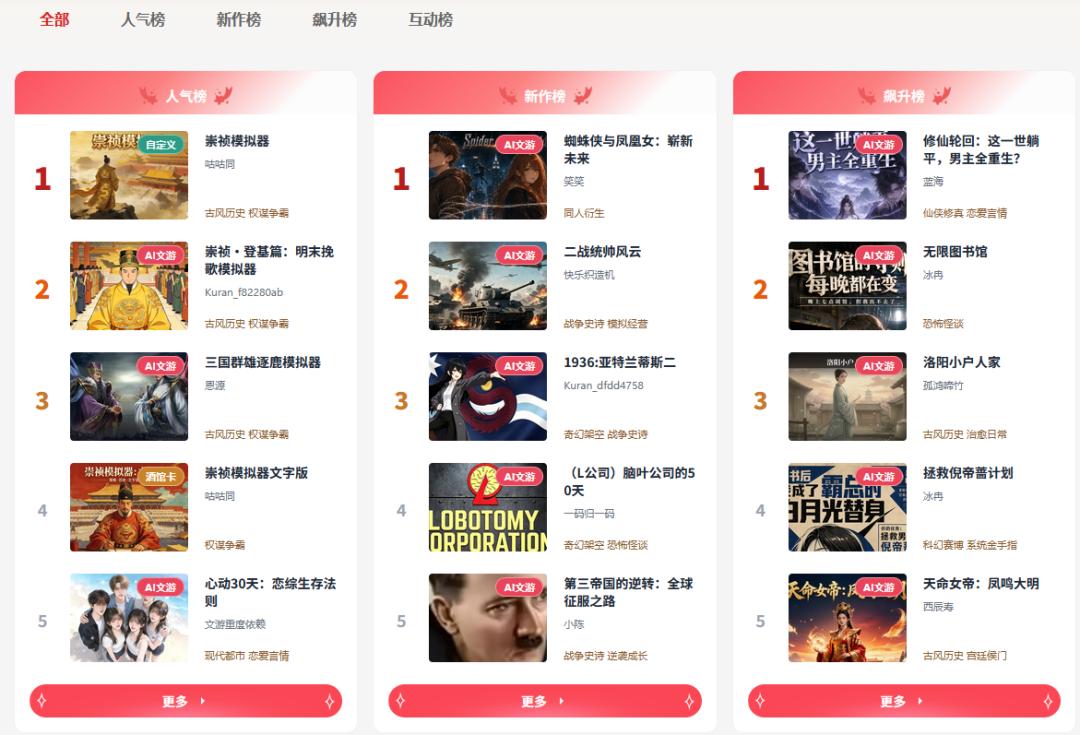
Popular games on Funloom
Text-based games provide the planning foundation, interactive film games are the intermediate state, and RPG is the ultimate goal
Entertainment Capital Theory: Now that text-based games can already operate smoothly, why do you continue to develop interactive film games and RPGs?
Tong Wu: Because my ultimate goal is to make RPGs, and interactive film games are an intermediate state.
When we first tried the Vibe Coding route, we hoped to create games of the same quality as those you can find on mobile app stores. I never intended to make only text-based games, we have been aiming at RPGs from the very beginning.
We just encountered a problem before that UGC users cannot make RPGs, so we need to provide them with a transitional solution. They need to use text-based games to simulate the game first, polish the design document in the text game, and then they can generate a complete RPG.
Interactive film games are also closely connected with text-based games. You can export the game history record directly, and it becomes a script. But as a cultural work, the core of making it profitable does not lie in the execution process. A work can make money not because of how much cost you put into it, but because the story is good enough.
The core value of Funloom now lies in the design side.
As for the execution side, it is essentially the business of large base model manufacturers like ByteDance. For startups, we have no competitive advantage in this field, and we cannot compete with them.
The design side is the embodiment of expert knowledge. We first help users solve the problem of script quality. Whether the final game can sell for 1 million yuan or 10 million yuan depends on how well the design is done.
Entertainment Capital Theory: You mentioned before that the cost of making an AI text game now is only a few dollars, but interactive film games involve a large amount of video generation, won't the cost rise sharply?
Tong Wu: In fact, generating an interactive film game with AI now is not that expensive even though it costs more than text games. For example, if you use Seedance and can reduce the rate of re-generating unsatisfactory clips, assuming the cost is 1 dollar per second, making a 60-minute interactive film game will cost 3600 dollars. The final decision lies in whether the return on investment is satisfactory.
Our model supports publishing all works on Funloom, whether they are text games, RPGs or film games, and Funloom will help promote them. For film games, we also allow creators to publish their works on other platforms such as Steam. We will ask for the operation right of the work, but we do not require exclusive operation right for film games for the time being, so you can also publish them elsewhere.
Before publishing, you can first use the text game version to verify the market response. It is a bit like writing a novel first: if the novel becomes popular, then adapt it into a film game, and the quality of this film game will be guaranteed to a large extent.
When PGC teams make film games, they may need to generate ten minutes of content to cut out one minute of usable clips. But with the pre-confirmed design document, we can generate the required content more accurately.
Entertainment Capital Theory: Why can a complete text design document reduce the rate of re-generating AI video clips?
Tong Wu: Although AI generation has a certain degree of uncontrollability, it is essentially another form of code. In my opinion, the reason why many people need to regenerate AI output many times now is that there is no set of prompt specifications that clearly tell you which keywords to use to ensure which output result you get.
But we are building such a mapping system. You do not need to write prompts by yourself. You just need to finish the script, and we have our own set of specifications to map your script into a complete interactive film game.
Entertainment Capital Theory: You said before that without AI, games like *Chongzhen Simulator* would never exist. Why?
Tong Wu: In the past, making such a game manually would cost at least 100,000 yuan. But the game with its current quality level is impossible to earn back that 100,000 yuan cost.
The reason why it "cannot exist" is a commercial problem. Most creators in the content industry work for companies. Very few people do part-time or independent game development. So it is almost impossible for someone to invest such a high cost in making such a niche work purely out of passion without expecting returns.

The future will be 1% PGC and 99% UGC
Entertainment Capital Theory: In your vision, will AI games eventually become a scenario where everyone makes games for themselves, or will there still be hit games played by a large number of people?
Tong Wu: Both scenarios will exist. The future will be 1% top PGC and 9