How can troubled real estate enterprises get out of difficulties and achieve rebirth through bankruptcy reorganization?
In the in-depth adjustment cycle of the real estate industry, bankruptcy restructuring is a critical approach for market-oriented risk clearance. At present, benchmark real estate enterprises that have completed restructuring and successfully removed their delisting risk warnings have emerged, such as Jinke Co., Ltd. and Xinhualian. Leveraging their diverse resources and strong endogenous capabilities, these enterprises have demonstrated the value of restructuring, and with the synergy of local governments and courts, they have completed risk clearance and bankruptcy restructuring. There are also many enterprises in the process of restructuring, such as China Fortune Land Development, Caisin Development and Dima Co., Ltd., which are facing different dilemmas, and there are still many uncertainties on their restructuring paths.
Successfully Restructured Enterprises Complete Debt Clearance and Business Restructuring Relying on Differentiated Asset Endowments
1. Jinke Co., Ltd.: Resolve Hundred-Billion-Level Stock Liabilities with Multiple Settlement Tools
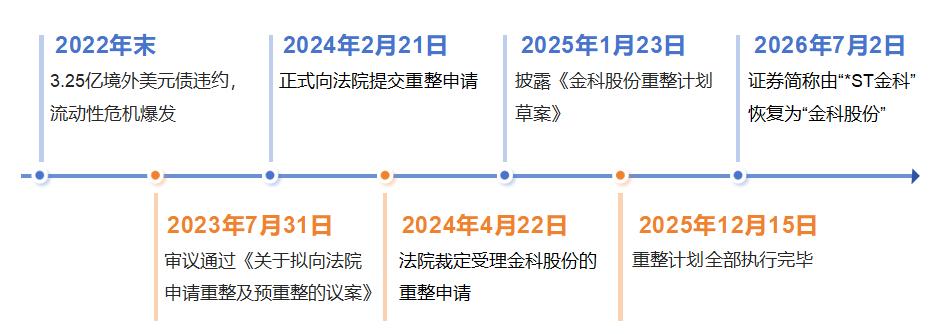
The restructuring of Jinke Co., Ltd. is the largest restructuring case of listed real estate enterprises in China in terms of disposed debt volume so far. The crisis originated from the default of its US dollar bonds in 2022. After consecutive years of operating losses, the enterprise's net worth turned negative, and it was deeply trapped in the dilemma of insolvency. Jinke Co., Ltd. reviewed and passed the proposal of applying for restructuring and pre-restructuring on July 31, 2023, and formally submitted a restructuring application to the court on February 21, 2024; on April 22 of the same year, the court ruled to accept the restructuring application. Subsequently, the company disclosed the "Draft Restructuring Plan of Jinke Co., Ltd." on January 23, 2025, and all the execution of the restructuring plan was completed by December 15, 2025. Finally, on July 2, 2026, its securities abbreviation was officially restored from "*ST Jinke" to "Jinke Co., Ltd.", marking the official conclusion of the restructuring and "delisting risk warning removal" process.
Figure: Timeline of Jinke Co., Ltd. Restructuring
After the local intermediate people's court formally accepted the restructuring application and the enterprise was marked with the delisting risk warning, the administrator publicly selected restructuring investors from the market, and finally finalized the capital contribution camp composed of central SOE asset management companies, provincial local state-owned capital funds, and industrial investors with real estate industry resources. The Pinqi Consortium is the selected investor for Jinke Co., Ltd. and Chongqing Jinke. The industrial investors of Jinke Co., Ltd. include the Pinqi Consortium, Sichuan Development Securities Fund and China Great Wall Asset Management; the financial investors include Sichuan Development Securities Fund, China Great Wall Asset Management, Great Wall Capital, Chongqing International Trust and other investment institutions and other natural persons.
The restructuring investors of Jinke Co., Ltd. acquired 3 billion shares of the company after capital reserve transfer at a consideration of 2.628 billion yuan. Among them, industrial investors acquired a total of 1.2 billion transferred shares of Jinke Co., Ltd. at a unit price of 0.63 yuan per share, with a total investment of 756 million yuan; financial investors acquired a total of 1.8 billion transferred shares at a unit price of 1.04 yuan per share, with a total investment of 1.872 billion yuan. The 2.628 billion yuan restructuring investment is used to pay off creditor's rights, cover bankruptcy expenses, supplement the liquidity of the listed company, fund the special fund for ensuring project delivery and housing handover, and make restructuring investment in Chongqing Jinke, etc. In addition, the Pinqi Consortium promises to provide no less than 750 million yuan in loans by itself or a designated entity, to supplement the working capital of Jinke Co., Ltd. and support the investment in new projects.
The restructuring of Jinke Co., Ltd. adopts differentiated disposal for five categories of creditor's rights: employee creditor's rights are fully settled in cash 6 months after the investors contribute 1.8 billion yuan; tax creditor's rights are paid 341 million yuan in the same period, and the remaining balance is paid off monthly within 3 years with late surcharge added for overdue payment; secured creditor's rights with property can be paid off preferentially through physical asset offset, auction or trust share, and the excess part is converted into ordinary creditor's rights; for ordinary creditor's rights, the amount within 50,000 yuan per household is settled in cash, and the excess part is offset with transferred shares and trust shares, with a comprehensive initial settlement rate of 22.36% for million-level creditor's rights; subordinated creditor's rights are not settled. After creditors are paid off according to the plan, Jinke will no longer be liable for the remaining debts.
After Jinke's restructuring, the Pinqi Consortium holds 9.34% of the shares and becomes the largest shareholder. In terms of business, it transforms into a technology-driven comprehensive real estate operator, sets up four collaborative sectors of "investment management, development services, operation management, and special assets", and takes the asset-light path of "phasing out old businesses, exploring new businesses, and strengthening industrial chains"; it strictly controls new heavy-asset development, focuses on high-end agency construction in first-tier cities, commercial office and industrial park operation, revitalizes distressed assets relying on resources such as Great Wall Asset Management, and links with Alibaba Assets to digitally dispose of stock assets; it uses AI, BIM and big data to empower design, construction and investment promotion, and sets up real estate-related funds to broaden financing channels; it also deploys photovoltaic new energy simultaneously to improve the diversified profit system.
2. Xinhualian: Focus on Core Operating Assets to Reduce Burdens and Achieve Profitability Turnaround
Xinhualian is a listed company mainly driven by the dual engines of "cultural tourism + real estate", which faced delisting risk due to severe debt crisis and insolvency. On May 5, 2023, the stock abbreviation of Xinhualian was changed to "*ST Xinhualian". Then it applied to the court for bankruptcy restructuring and launched the pre-restructuring procedure on May 11, and the court formally decided to launch pre-restructuring and appointed a temporary administrator on May 18. After nearly half a year of pre-restructuring, the court ruled to accept the restructuring case and appointed an administrator on November 14, 2023. The draft restructuring plan was passed by voting on December 14 of the same year, and the court ruled to confirm that the execution of the restructuring plan was completed and terminated the restructuring procedure on December 29. At this point, Xinhualian completed bankruptcy restructuring, and on May 21, 2024, its stock abbreviation was restored from "*ST Xinhualian" to "Xinhualian", completing the removal of delisting risk warning.
In this restructuring, the restructuring investment entities selected by the administrator include Huarun Yingxin Assets, China Merchants Ping An Asset Management, China Foreign Economic and Trade Trust, Xiangjiang Assets and Shenzhen Deyuan Investment. The five restructuring investors subscribe for transferred shares in cash, providing a total of 1.928 billion yuan of funds to Xinhualian Cultural Tourism. Among them, Huarun Yingxin Assets contributed a total of 1.296 billion yuan, with a unit transfer price of 1.08 yuan per share, and acquired 1.2 billion shares of the company. After the successful restructuring, Huarun Yingxin Assets holds 29.41% of the shares and becomes the largest shareholder of the company. The remaining five restructuring investors contributed a total of 632 million yuan, with a unit transfer price of 1.2 yuan per share, and acquired a total of 526.7 million shares of the company.
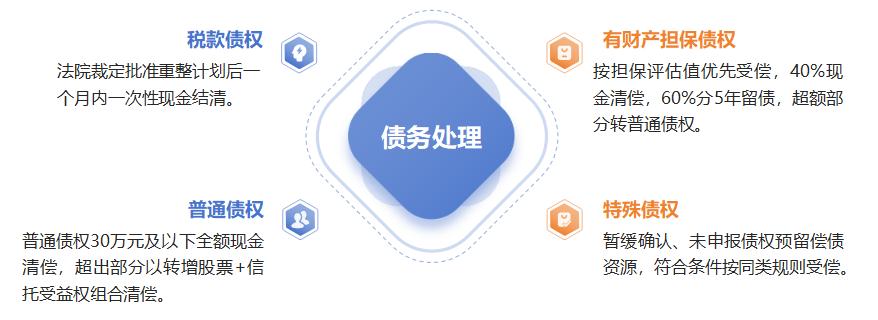
After the full implementation of the restructuring plan, the overall liability scale and interest-bearing liability scale of the enterprise have decreased significantly. There are no employee creditor's rights in this restructuring; tax creditor's rights are settled in one-time cash within one month after the court approves the restructuring plan; secured creditor's rights with property are paid off preferentially within the assessed value of the secured assets, 40% is paid in cash within one month, 60% is retained for debts to repay principal and interest in installments over five years, and the excess part is disposed of as ordinary creditor's rights; among ordinary creditor's rights, the creditor's rights of wholly retained subsidiaries are deferred for settlement, and the rest are fully settled in cash for the amount of 300,000 yuan and below. For the part exceeding 300,000 yuan, 82.9% is offset by transferred shares and 17.1% is settled by trust beneficial rights, and the subordinated creditor's rights of deferred interest are not settled; reserved debt repayment resources are corresponding to the suspended confirmed and unreported creditor's rights, which will be paid off according to the same rules after meeting the conditions.
Figure: Debt Disposal of Xinhualian Restructuring
After completing the delisting risk warning removal and getting out of the predicament, Xinhualian Cultural Tourism actively divests inefficient non-core assets, takes cultural tourism asset operation as its core main business, deeply cultivates passenger flow operation and commercial format upgrading of mature ancient town cultural tourism projects, steadily digests the inventory of stock real estate projects, no longer blindly expands new projects outward, and relies on the stable cash flow of the cultural tourism sector to maintain enterprise operation. At the same time, with the resource empowerment of restructuring investors, it optimizes governance to reduce costs and increase efficiency, restores financing functions, and builds advantageous projects in the cultural tourism industry.
Enterprises Under Restructuring: Different Dilemmas Lead to Diversified Restructuring Paths of Distressed Entities
1. China Fortune Land Development: Multiple Difficulties Exist in Restructuring
The restructuring process of China Fortune Land Development began on November 17, 2025, when creditors applied to the court for restructuring of the company and launched the pre-restructuring procedure, and the court decided to accept it on the same day; on March 2, 2026, the temporary administrator publicly recruited intended restructuring investors; on May 6 of the same year, China Fortune Land Development was given a delisting risk warning by the Shanghai Stock Exchange, and its securities abbreviation was changed to "*ST Huaxing"; on June 10, the restructuring investor was finally determined to be the consortium composed of Hangzhou Chengfeng Erlai Digital Technology Co., Ltd. and Nanyang Mulan Garden Real Estate Co., Ltd.
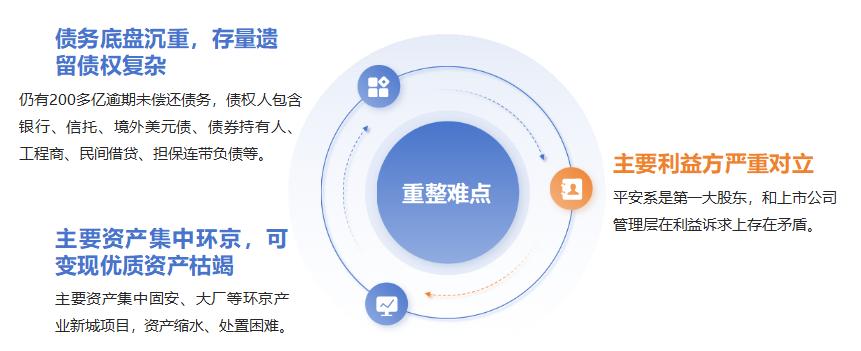
There are currently multiple difficulties in the restructuring of China Fortune Land Development. First of all, the debt base is heavy, and the remaining stock creditor's rights are complex. China Fortune Land Development still has more than 20 billion yuan of overdue unpaid debts, and the creditor's rights structure is very messy, including banks, trusts, overseas US dollar bonds, bond holders, engineering contractors, private lending, joint and several secured debts, etc. Secondly, the main assets are concentrated in the industrial new city projects around Beijing such as Gu'an and Dachang, with shrinking assets, difficult disposal, and depleted realizable high-quality assets. In addition, the main stakeholders are severely opposed: the Ping An system is the largest shareholder, and there are conflicts of interest with the management of the listed company.
Figure: Difficulties in China Fortune Land Development Restructuring
2. Caisin Development: Related Debts Raise the Threshold for Restructuring Implementation
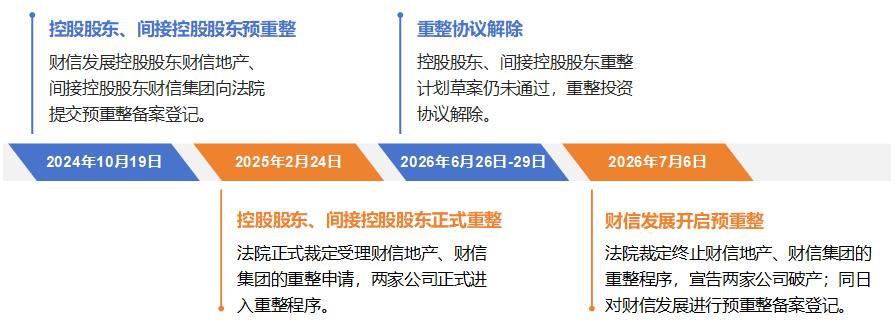
The predicament of Caisin Development stems from the failure of risk disposal at the controlling shareholder Caisin Group level. During the merger and restructuring of multiple entities of the group, fatal shortcomings such as chaotic related transactions, large amount of transaction funds lacking real business support, and absence of internal risk control mechanism were exposed. On October 19, 2024, Caisin Real Estate, the controlling shareholder of Caisin Development, and Caisin Group, the indirect controlling shareholder, submitted pre-restructuring filing registration to the court. Then on February 24, 2025, the court ruled to formally accept the restructuring application and enter the restructuring procedure. However, as the draft restructuring plan had not been passed by the end of June 2026 and the restructuring investment agreement was terminated, the court ruled to terminate the restructuring procedures of the two companies and declared them bankrupt on July 6, 2026. The risk was transmitted to the listed entity along the equity, and the listed company immediately entered the pre-restructuring filing process.
Figure: Timeline of Caisin Development Restructuring
There is major uncertainty in the restructuring prospect of Caisin Development. First, the court has not formally accepted the restructuring application, and only completed the pre-restructuring filing registration at present, so it is unclear whether it can enter the formal restructuring procedure in the follow-up. Second, all the shares held by Caisin Real Estate, the controlling shareholder, have been pledged and frozen, and there may be buyers inconsistent with the pre-restructuring investors in the subsequent judicial auction, which will disrupt the plan of maintaining the listing status. Third, even if the net worth turns positive, it is still difficult to meet the delisting red line through its own operation, which requires relying on investors to assist in acquiring third-party assets, with complex operation and tight time.
3. Dima Co., Ltd.: The Debt Default of the Major Shareholder Drags Down the Listed Company
The risks of Dima Co., Ltd. show a pattern of double-layer pressure on the parent company and the listing platform. On May 6, 2024, Dima Co., Ltd. publicly announced that the "21 Dima 01" bond had a substantial default, and the company's securities abbreviation was changed to *ST Dima accordingly. On June 19 of the same year, the major shareholder Dongyin Holdings took the lead in launching judicial restructuring. On June 24, the stock of Dima Co., Ltd. was suspended and entered the delisting-related process. Until November 11, 2025, Dima Co., Ltd. submitted an application for pre-restructuring filing registration to the court. On May 6, 2026, the voting of the draft restructuring plan failed to pass, and there are still great uncertain risks in this restructuring.
Dima Co., Ltd. encountered a severe financial crisis under the downward cycle of the industry, coupled with the debt default of the major shareholder, which led to the collapse of the company's revenue, consecutive huge losses, insolvency, delisting, and a large number of judicial seizures, forming a vicious circle. As a self-rescue path, restructuring faces multiple stuck points, and it is difficult to reverse the declining operating trend in the short term. Even if the state-owned capital bailout is implemented and the restructuring is successful, a long process of asset divestment and debt restructuring is needed to achieve business transformation.
Diverse Resources, Endogenous Capabilities, Restructuring Value and Government-Court Synergy Jointly Determine the Success or Failure of Distressed Real Estate Enterprise Restructuring
The core internal conditions for the successful restructuring of distressed real estate enterprises cover three dimensions: resources, capabilities and restructuring value. At the resource level, it is necessary to build a collaborative capital contribution structure of central SOE AMCs, local state-owned assets, industrial and financial investors, fully implement restructuring investment funds and supporting working capital, classify creditor's rights clearly, build a layered settlement plan through cash, transferred shares and trust beneficial rights, and fully pay off small-amount creditor's rights in cash to reduce voting resistance. In terms of endogenous capabilities, it is necessary to have asset-light hematopoietic businesses such as agency construction, asset management and operation, the stock assets can generate stable cash flow, complete control right restructuring through equity transfer, and carry out pre-restructuring work in advance. At the level of restructuring value, it is necessary to hold stable cash flow