24 Hours in the City | Why Is This Major Northern City Betting Big on a Corridor?
According to Qingdao Daily, the Symposium on Integrated Development of Qingdao Science and Innovation Corridor was held on August 18.
At the symposium, the Office of the Leading Group for the Promotion of the Qingdao Science and Innovation Corridor briefed on the work progress. Experts, scholars, entrepreneurs, responsible representatives of relevant institutions stationed in Qingdao and district and municipal authorities delivered speeches focusing on industry-university-research cooperation, construction of science and innovation platforms, and the landing of industrialization projects.
Key leaders of the Qingdao Municipal Party Committee pointed out that building the science and innovation corridor is a major deployment for Qingdao to seize the opportunity of the in-depth advancement of the new round of scientific and technological revolution and industrial transformation, and to strengthen the city's future development advantages. For the next step, we will focus on the key tasks of integrated development, further integrate resource elements, strengthen scientific and technological leadership, and accelerate the building of an important source of scientific and technological innovation with national influence, a demonstration zone for the in-depth integration of scientific and technological innovation and industrial innovation, a leading zone for modern marine economic development, and a pilot zone for the construction of a modern industrial system.
The global innovation landscape is undergoing accelerated restructuring, and science and innovation corridors are becoming innovation sources for regions to cultivate new productive forces and a strong engine for economic transformation and upgrading.
Take the Yangtze River Delta G60 Science and Innovation Corridor as an example. It takes the G60 Expressway as the axis, gathers nearly 1/7 of the country's high-tech enterprises and more than 20% of the STAR Market listed enterprises, and is a pilot corridor for scientific and technological and institutional innovation.
The Guangzhou-Shenzhen-Hong Kong-Macao Science and Technology Innovation Corridor brings together 9 national large scientific devices and numerous top laboratories, and has built a full-chain innovation ecosystem covering "source innovation - application transformation - large-scale manufacturing".
For Qingdao, a city with strong traditional manufacturing industry, it is facing challenges such as insufficient industrial structure support and insufficient support for emerging industries. On the other hand, for a long time, the distribution of innovation resources in Qingdao is relatively scattered, and the connection between industry, university and research is not close enough.
It is against this background that the construction of the Qingdao Science and Innovation Corridor was launched in November 2025. Its core purpose is to integrate the city's advantageous resources, break through development bottlenecks, promote the transformation of innovation elements from "scattered agglomeration" to "in-depth fusion", and then systematically reconstruct the industrial ecosystem.
As a leading project laid out by Qingdao in the first year of the 15th Five-Year Plan period, the Qingdao Science and Innovation Corridor takes the Binhai Avenue as the main axis, stretches for 53 kilometers, connects 190 square kilometers of industrial space, and gathers leading enterprises such as Haier, Hisense, Goer, and TGOOD.
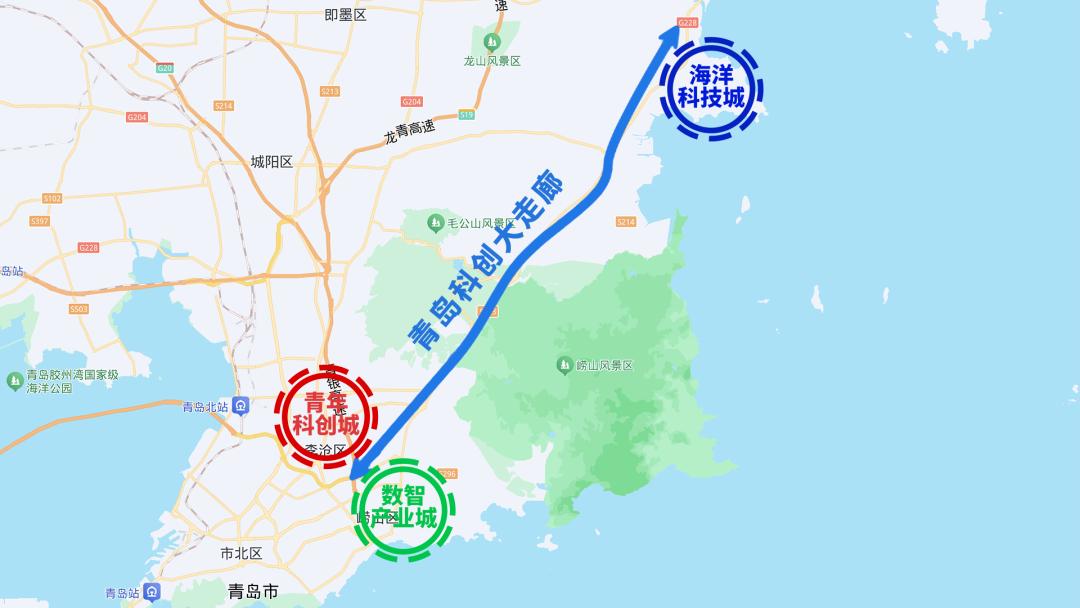
Image source: Qingdao Release
From the perspective of spatial layout, the corridor has formed a development pattern of "one corridor connecting, three cities driving, and multiple circles interacting". The "three cities" refer respectively to the Digital Intelligent Industrial City located in Laoshan District, the Youth Science and Innovation City located in Licang District, and the Marine Science and Technology City located in Qingdao Blue Valley.
In Qingdao's vision, the three major sectors support and coordinate with each other, targeting at cutting-edge tracks such as marine artificial intelligence large models, synthetic biology, quantum information, and low-altitude economy, to jointly build the "new backbone" that represents Qingdao's future industrial competitiveness.
Among them, the ocean is the most distinct feature of the Qingdao Science and Innovation Corridor.
As a "national key strategic weapon" in the marine field, Laoshan Laboratory is like the "top brain" and "powerful heart" of the Qingdao Science and Innovation Corridor. As a key node of the marine power strategy, Qingdao ranks first in the country in the number of marine academicians, and its total marine economy steadily ranks top three among coastal cities in China. This "foundation" is a hard core endowment that other cities cannot easily replicate.
The innovation of marine science and technology and the development of marine industries require the two-wheel drive of digital technology and high-end talents.
In the eyes of the outside world, this corridor not only relies on Qingdao's marine endowment for differentiated competition, but also actively connects with global cutting-edge developments, sending a strong signal of breaking path dependence and reshaping industrial genes.
However, cross-regional integration is never a "physical superposition", but a "chemical reaction". The key to the construction of the Qingdao Science and Innovation Corridor still lies in whether it can truly break boundaries, activate elements, and achieve continuous evolution.
This article is from the WeChat Official Account "City Evolution Theory", author: Liu Yanmei, published with authorization from 36Kr.