The medical data trading sector is experiencing explosive growth, and exchanges are flocking to carve out their own market territories.
The fourth year after data was promoted to a production factor, medical data transactions have finally seen initial progress.
Investigation of the listed medical data products on major domestic data exchanges in Shanghai, Beijing, Guizhou and other regions shows that the number of data providers is rising year by year, the tradable categories are becoming more and more diverse, and the total transaction volume and transaction amount have multiplied accordingly.
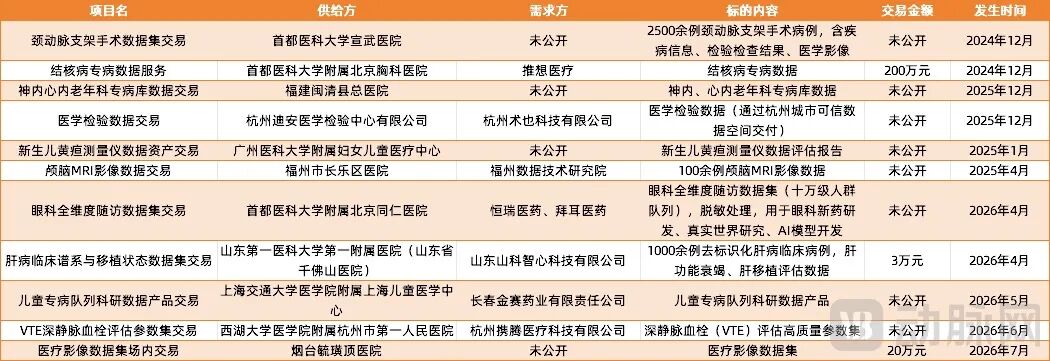
Part of publicly disclosed medical data transaction projects
Behind the data, it is essentially the wide recognition of general AI capabilities and the large-scale implementation of medical vertical AI applications that have contributed to the natural and rapid growth of medical data transactions.
In addition, local big data bureaus and their subordinate institutions are also participating on a large scale. They actively seek cooperation with enterprises, develop new data businesses, and further accelerate the entry of both supply and demand sides into the market.
In the past year, the Beijing Data Pilot Zone has cooperated with One Sunny to jointly build a high-quality medical imaging database; the Hangzhou Data Exchange and Hangzhou Data Element Innovation Center have signed a strategic cooperation in coordination with Deshi Technology; the Shaanxi Silk Road Data Trading Center has joined hands with Yangtze River Pharmaceutical, Digital Xi'an Technology Operation (Group) Co., Ltd. and other parties to build a medical data integration innovation research platform;
A new type of co-constructed data supply and demand ecosystem has begun to take shape.
However, the ownership of medical data remains unresolved, and the existing supply and demand volume of the exchanges is far from meeting the scale requirements for the rapid circulation of data.
To seize the global AI trend in time and quickly enter the era of hundreds of billions of medical data circulation, exchanges, supply and demand enterprises, regulatory agencies and all relevant parties need to work together to make the medical data trading market operate efficiently.
01 Exchanges: Take the initiative to launch the resource scramble
High-quality medical data never lacks demanders.
Ideally, AI nurtured by high-quality data can replicate the capabilities of top doctors, eliminating the supply gap of doctors in the medical system; it can shorten the average drug development time from 10 years to 4 years, making more drugs accessible and affordable for patients.
In practice, however, the demand in the medical field is extremely scattered. Pharmaceutical companies need R&D data, medical device companies need training data, and insurance companies need actuarial data. The data product of one institution can often only meet a very narrow demand scenario.
As a result, the matching of supply and demand is far more difficult than in other industries.
At present, the main dilemma of exchanges is the insufficient number of suppliers. Out of consideration for data security, many medical institutions are unwilling to take the risk of data transactions, and a large amount of high-quality data is left idle and cannot enter the trading market.
To solve this problem, a variety of exploration paths have emerged in different provinces and cities.
The first is the in-depth service model of exchanges.
Taking the Shanghai Data Exchange as an example, to obtain top clinical data as soon as possible, the exchange intervenes in the whole process from data right confirmation, compliance assessment to product listing, and provides one-on-one dedicated services for key tertiary hospitals. At present, it has obtained the listing of imaging and special disease data products from institutions such as Huashan Hospital and Ruijin Hospital.
In addition to supporting on-site transactions, Shanghai has also built a trusted data space for specific diseases.
This model can not only ensure the storage, management and circulation of data to realize efficient data utilization, but also provide all-round support for the operation of the data space from multiple aspects such as technical support and security guarantee. It can also provide three components including data connector construction, data space operation service platform and data space portal, offering users a convenient interactive interface to access and use resources in the data space.
The well-performed Helicobacter pylori data space adopts a systematic construction architecture to ensure that data is available but not visible, and solves the problems of data privacy and compliance through technical means.
The other is the government-led data trusted space model.
Under this model, data does not leave the local area, and data service transactions are completed in the trusted space built by the government. The supply and demand sides do not need to exchange raw data directly, and pharmaceutical and medical device enterprises can only take away the calculation results.
In July 2024, the Guangzhou Municipal Health Commission jointly with Guangzhou Digital Technology Group launched the construction of a trusted data space for the health industry in Guangzhou, and promoted hospital-enterprise cooperation in accordance with the principle of "raw data does not leave the domain, data is available but not visible".
Up to now, more than 40 hospitals have settled in, completing more than 10 million medical data transactions.
The first transaction was completed by the Women and Children's Hospital Affiliated to Guangzhou Medical University — a neonatal jaundice instrument company hoped to obtain equipment test and evaluation reports in the trusted space. The hospital cooperated with the space operator to output results through technologies such as data sandboxes, and the raw data always remained in the space.
In addition, other differentiated explorations have emerged across different regions.
Fujian currently adopts a government-led model of public data authorization operation plus scenario incubation. Medical data is regarded as public resources, and the exchange uniformly accepts the authorization, playing the dual roles of data customs and incubator.
It not only supervises data exports, but also actively designs scenario products to attract enterprises to participate in data processing. The advantages of this model lie in authoritative data sources, high standardization, and easy rapid scale-up.
However, the high involvement of the exchange may interfere with the supplier's design of data sets to a certain extent, and filter out part of the data that meets market demand.
Xi'an currently focuses on regional specialist advantages and traditional Chinese medicine characteristics, and takes the special-disease-driven industry-university-research integration path.
The exchange acts as a technical broker, facilitating in-depth cooperation between hospitals and pharmaceutical companies through agreement transfer, joint laboratories and other methods, so that data can directly serve scientific research.
Recently, the Xi'an Big Data Bureau has reached a cooperation with Yangtze River Pharmaceutical. The two sides focus on the R&D of classic traditional Chinese medicine prescriptions and the application of real-world data, with the exchange providing a compliance framework and matchmaking support to explore data-driven new drug development of traditional Chinese medicine.
This cooperation focuses on real-world data research of orthopedic special diseases. Local leading hospitals provide desensitized diagnosis and treatment data, and Yangtze River Pharmaceutical uses these data to carry out secondary development and efficacy evaluation of traditional Chinese medicine varieties.
The differentiation of operation methods is an inevitable trend in the development of exchanges. Although there are differences in geographical distribution, due to the scarcity of high-quality assets, there is still strong competition among exchanges.
Therefore, current exchanges not only need to provide safe and reliable functions for data display and circulation, but also output sufficiently attractive value-added services to assist in data processing and actively match the two parties of the transaction.
As for the ownership issue, the current consensus of the whole industry is to put it aside temporarily, and discuss it as soon as possible after the medical data transaction initially forms a scale.
02 Supply-side enterprises: Dilemmas and opportunities behind high gross margins
For medical institutions that hold data, data transactions are becoming a brand-new means of increasing revenue, and the active involvement of exchanges and local governments has further amplified this opportunity.
One Sunny is a direct example. Relying on the regional advantages of Beijing's pilot policy, One Sunny has taken the lead in completing several anonymized and assessed data transactions in accordance with policy and scenario guidelines, achieving solid results and considerable returns in the data trading field.
This is because the company has a medical AI matrix, and the data traded comes from the data it cleaned by itself during the training of models. The cost has long been diluted in the R&D link, so the data products can generate considerable marginal profits.
According to the "2026 White Paper on the Development of the Global Intelligent Medical Imaging Ecosystem Industry in the AGI Era" by Frost & Sullivan: One Sunny has formed a relatively systematic medical imaging data service capability, with a total of more than 28.53 million imaging data cases, an average daily increase of about 20,000 cases, compatible with 12 full-modality imaging types, covering more than 300 diseases and more than 500 disease subtypes, and the data flywheel has taken initial shape.
In addition, after a single data set product is constructed, multiple repeated transactions can be realized, and each additional transaction in the future can dilute the construction cost of medical data products.
However, the case of One Sunny cannot be easily replicated by other enterprises.
On the one hand, the cost of current data sets is very high.
If you sell the data sets left over from the enterprise's past training, the gross profit margin can exceed 90%, but if you build a data set product from scratch, from data collection, data governance, to law firm assessment, asset confirmation, and platform transaction, the whole process requires the supplier to pay a cost of at least 100,000 yuan.
On the other hand, due to the extremely scattered demand in the medical field, it is difficult to form a "hit demand", resulting in few large-scale full-time data supply teams in the market, and the weakness of the supply side is restricting the development of exchanges.
The path adopted by One Sunny can usually only be used for reference by medical institutions.
Such institutions package their existing data sets into tradable assets and list them on the exchange for secondary sales, and these assets make up the vast majority of the products listed on current exchanges.
It should be noted that as a supplier, blindly expanding data production capacity on a large scale has certain risks.
The current mainstream method is to communicate on the exchange, and copy transaction data through external hard drives off the exchange, which has the risk of data leakage. Switching to a trusted data space can solve certain problems and achieve more controllable delivery of data assets.
However, in terms of cost, the construction of each trusted data space requires the deployment of a certain scale of computing power for encrypted computing. During non-transaction hours, a large amount of computing power will be idle, resulting in obvious waste of resources.
To eliminate this idle computing power, we can only wait for the data transaction volume to rise to a high level, so that the computing power can be reused frequently and the average cost can be gradually reduced.
03 After scaling up, re-evaluate the medical AI value chain
Although various problems hinder the rapid progress of medical data asset transactions, the trend is irreversible.
In the past, when AI enterprises carried out application R&D based on clinical data, they were often limited by the data of only a few cooperative hospitals, and the trained models were prone to regional deviations, making it difficult to be generalized.
When medical data transactions are truly scaled up, enterprises are expected to get rid of their dependence on individual hospitals, integrate data from multiple regions and multiple sources at the beginning of R&D, and develop intelligent models with stronger robustness.
This will also make the commercial sales of AI products more independent, and fundamentally avoid intellectual property disputes with hospitals.
It is also of great significance to medical institutions.
Over the past decades, they have repeatedly discussed the governance value of medical big data, and built many big data centers for this purpose, but it has always been a huge cost.
Now that data transactions have made initial progress, governance is finally expected to transform from a cost center to a revenue engine, opening up a brand-new space for revenue growth.
After all, medical data assets have a highly flexible value space. Once they can accelerate the R&D of pharmaceutical and medical device products and improve the operational efficiency of hospitals, the derivative value that will explode will far exceed the direct revenue generated by the transaction process itself.
Like all industries, the real realization of the business model of medical and health data needs to go through an explosive investment period, cross the peak and valley, and then obtain the benefits brought by the decreasing marginal cost.
At present, large-scale investment in data assets has not yet arrived, but positive signals have emerged.
Perhaps in less than three years, this market with hundreds of billions of potential will truly rise.
Its significance is far more than adding a new transaction category. A new way to reshape the value creation logic of intelligent medical treatment will emerge accordingly, driving the iteration and upgrading of the entire digital medical industry.
This article is from the WeChat official account "vcbeat" (ID: vcbeat), author: Zhao Hongwei, published with authorization from 36Kr.