The Wuxi-based optical "Little Giant" enterprise is sprinting for IPO, with a net profit of 170 million yuan, and its business relies heavily on the major customer Innolight.
On August 21, Wuxi Xinjuhong Intelligent Technology Co., Ltd. (hereinafter referred to as Xinjuhong) is about to usher in its listing review meeting at the Beijing Stock Exchange.
From 2023 to 2025, Xinjuhong's operating performance grew rapidly, but the company's customer concentration increased year by year, the proportion of revenue from the top five customers remained above 80%, and its revenue mainly relied on two major clients, Innolight and Eoptolink. Its performance is highly tied to the procurement of leading customers, and its overall risk resistance capacity is weak.
There were two periods of equity holding on behalf of others in Xinjuhong's history. For some of the reserved equity for employee incentives, the accounting treatment and actual disposal path were not fully disclosed. It was only confirmed that the holding arrangement was cleared based on the decline of Wu Jie's shareholding ratio in the industrial and commercial registration, which resulted in disclosure defects.
In December 2021, Xinjuhong implemented internal capital increase, raising its registered capital to 15 million yuan, with a capital increase price of 1 yuan per registered capital. The company accordingly confirmed that all equity held on behalf of others under Wu Jie's name was lifted. This internal capital increase formed a huge price difference with the entry price of 46.67 yuan per registered capital for external investors 9 months later.
Over 80% of revenue comes from the top five customers, with operations deeply tied to two major optical module giants
Xinjuhong is mainly engaged in the R&D, production and sales of precision optical components.
The company's main products include optical module chip bases, optical fiber lens arrays, high-density optical fiber connectors, lidar windows, vehicle-mounted lens windows, etc., and it continues to expand various precision optical components and robot parts products around downstream application fields.
In terms of performance, from 2023 to 2025, Xinjuhong's operating revenue was 200 million yuan, 465 million yuan and 812 million yuan respectively. The non-recurring net profit attributable to shareholders was 17.722 million yuan, 86.757 million yuan and 171 million yuan respectively. The operating data grew rapidly with outstanding growth potential.
From the perspective of customer structure, the problem of customer concentration of Xinjuhong has intensified year by year. From 2023 to 2025, the proportion of revenue contributed by Xinjuhong's top five customers accounted for 80.14%, 82.30% and 83.33% respectively, and the concentration continued to rise.
Among them, the two major customers Innolight and Eoptolink constitute the core revenue source of Xinjuhong. The sales proportion of Innolight dropped from 49.35% to 31.65%, and it is still the core major customer of Xinjuhong. The sales proportion of Eoptolink rose sharply from 15.57% to 39.32%, making it the largest customer of Xinjuhong.
The highly concentrated customer structure leads to the fact that Xinjuhong's operating performance is deeply tied to the procurement needs of leading customers, and its risk resistance capacity is weak.
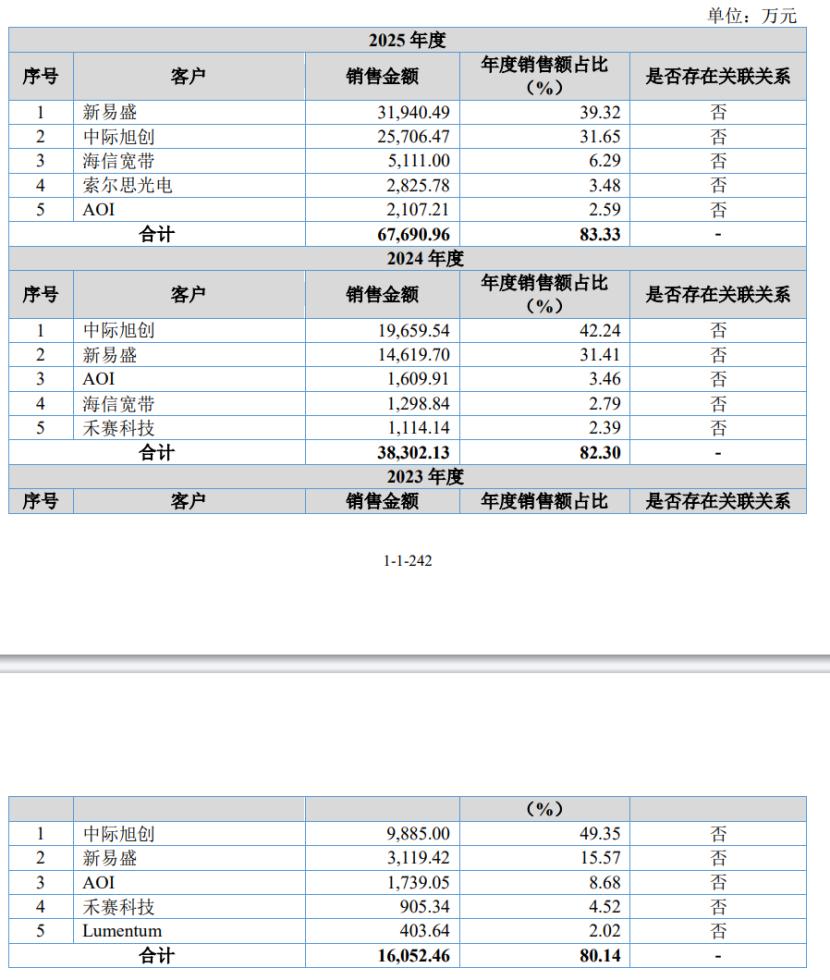
In the first round of inquiry letter, the Beijing Stock Exchange required Xinjuhong to combine the development trend of downstream industries, industry barriers, domestic and overseas sales layout, international economic and trade environment and the status of on-hand orders to demonstrate in detail whether Xinjuhong has the risk of performance decline and whether relevant risk disclosure is sufficient.
During the reporting period, the procurement scale of Innolight and Eoptolink to Xinjuhong continued to grow. However, there are no binding commercial agreements such as long-term volume lock-in and priority supply between Xinjuhong and the above main customers. All cooperations adopt the mode of framework agreement plus order-by-order arrangement. The order scale is determined by the actual current demand of customers and price comparison results, and the cooperation lacks rigid guarantee at the contract level.
In the second round of inquiry letter, the Beijing Stock Exchange required Xinjuhong to analyze whether the cooperation between the issuer and its main customers is stable and sustainable in combination with the sales situation of the issuer to main customers and the status of on-hand orders after the reporting period, the revenue of corresponding products for customers and the demand of end customers.
Two historical equity holding arrangements on behalf of others account for 25%, with missing details of reserved employee incentive disposal
Xinjuhong Co., Ltd. had two periods of equity holding on behalf of others in its history, namely the holding arrangement by relatives in the early stage of entrepreneurship, and the arrangement that Wu Jie held the equity related to equity incentive on behalf of others.
In February 2015, limited by personal energy and to facilitate the handling of industrial and commercial and bank related procedures, the actual controllers Sun Liangliang and Liu Ling transferred part of their equity to their relatives at 0 yuan for holding on behalf of others. Among them, Sun Liangliang transferred 51% of the equity to Cheng Xiaoyan, and Liu Ling transferred 49% of the equity to Sun Tiantian. Sun Tiantian is Sun Liangliang's younger brother, and Cheng Xiaoyan is Sun Tiantian's spouse.
Subsequently, the holding arrangement by relatives was gradually cleared: in February 2017, Cheng Xiaoyan transferred the 51% equity held on behalf of others back to Liu Ling and withdrew from the holding relationship; in June 2018, Sun Tiantian transferred 4% of the equity held on behalf of others to Wu Jie; in March 2021, Sun Tiantian returned the remaining 45% equity held on behalf of others to Sun Liangliang.
So far, all the equity holding arrangements between Sun Liangliang, Liu Ling, Sun Tiantian and Cheng Xiaoyan have been lifted, and all relevant parties confirm that there are no equity disputes or potential disputes.
The second holding arrangement refers to that Wu Jie held the equity related to equity incentive on behalf of others. At this stage, Xinjuhong had a limited operating scale, single business structure, and was at a low profit level on the whole.
In order to introduce business partner Liu Xiaoxiang, who served as a consultant of Xinjuhong to promote the preparation of the precision structural parts division, and reserve incentive rights for subsequent talent introduction.
On June 25, 2018, Liu Ling and Sun Tiantian signed equity transfer agreements with Wu Jie respectively, transferring a total of 40% of Xinjuhong's equity to Wu Jie at 0 yuan. Among the 40% equity, 15% of the actual rights and interests belong to Liu Xiaoxiang, which is registered under the name of his spouse Wu Jie for family property arrangement; the remaining 25% is the reserved employee incentive right of Xinjuhong, which is also held by Wu Jie on behalf of others, thus forming this holding relationship.
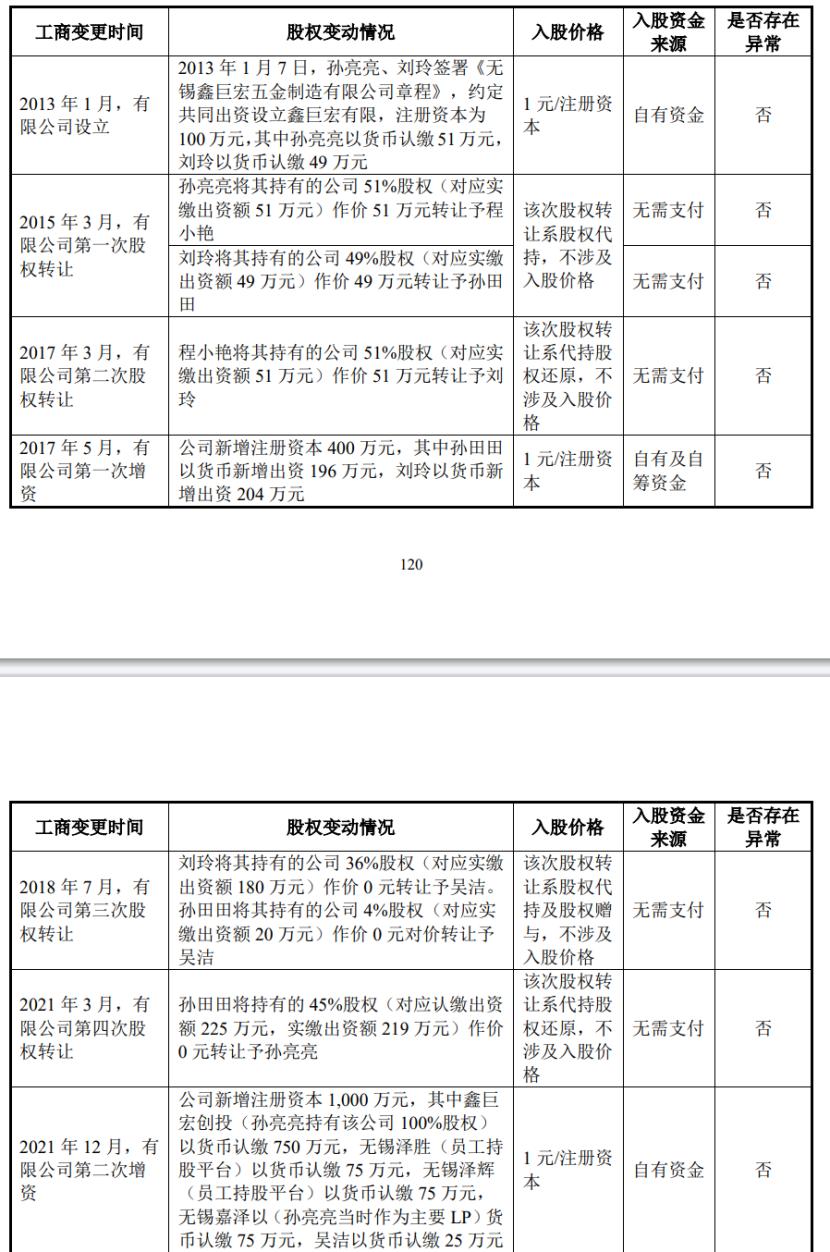
For the 15% equity belonging to Liu Xiaoxiang, Xinjuhong calculated and accrued share-based payment expenses of 859,500 yuan based on the net asset of 1.146 yuan per registered capital at the end of 2018. Since the service period was not agreed, the expense was included in the management expenses at one time in the current period of equity transfer.
However, for the 25% reserved employee incentive equity, Xinjuhong's application documents did not fully analyze the accounting treatment of this part of rights and interests in the grant and subsequent disposal links. Relevant capital increase documents also did not make agreements on the lifting of the 25% incentive rights and interests.
Xinjuhong only claimed that all the holding arrangements were cleared based on the decline of Wu Jie's shareholding ratio at the industrial and commercial registration level, and did not fully explain the actual disposal path of this part of reserved rights and interests, which laid a hidden danger for regulatory inquiries.
In response to the historical equity holding issue, the Beijing Stock Exchange issued an inquiry, requiring Xinjuhong to explain whether Xinjuhong and its subsidiaries have or had equity holding on behalf of others, entrusted shareholding, trust shareholding, voting right entrustment, special agreement on usufruct in history or at present, whether there are circumstances of evading relevant laws and regulations and regulatory requirements through equity holding on behalf of others, shareholding or enjoying interests in Xinjuhong by entities prohibited from shareholding by laws, regulations or regulatory provisions, shareholding or enjoying interests in Xinjuhong by intermediary institutions and their relevant personnel or relatives and stakeholders of relevant personnel, concealing related party relationships or conducting interest transfer and bribery through equity holding on behalf of others.
The reply only stated that the 25% reserved employee incentive equity held on behalf of others was lifted through capital increase dilution, and did not make a closed-loop demonstration on how the rights and interests originally planned for employee incentives were finally disposed of and why the employee incentive was not actually implemented.
The core concern of the regulator is whether the historically planned incentive rights will be used for disguised interest compensation through oral or private arrangements.
Significant disparity in equity transaction prices, with obvious price differences among different investors
However, the reply only explained that the 25% reserved employee incentive equity held on behalf of others was lifted through capital increase dilution, and did not make a special closed-loop demonstration on how the rights and interests originally planned for employee incentives were finally disposed of and why the employee incentive was not actually implemented. The core concern of the regulator is whether the historically planned incentive rights will be used for disguised interest compensation through oral or private arrangements.
With the development of business, Xinjuhong has the practical demand to expand its registered capital, and at the same time needs to complete the clearance of remaining holding arrangements, build an employee shareholding platform to prepare for the introduction of external investors. On December 29, 2021, Xinjuhong Co., Ltd. held a shareholders' meeting, reviewed and approved the capital increase plan. Xinjuhong's registered capital increased from 5 million yuan to 15 million yuan, with an additional 10 million yuan of registered capital, and the capital increase price was 1 yuan per registered capital. This capital increase was subscribed by five parties: Xinjuhong Venture Capital, Wuxi Zesheng, Wuxi Zehui, Wuxi Jiazhe, and Wu Jie. After the capital increase, Wu Jie's shareholding ratio in industrial and commercial registration dropped from 40% to 15%. Xinjuhong accordingly confirmed that all the equity held on behalf of others under Wu Jie's name was lifted through this capital increase, and shareholder interviews confirmed that all parties had no equity disputes.
This capital increase is for Xinjuhong's internal holding arrangement clearance, with a price of only 1 yuan per registered capital; only 9 months later, Ningbo Houpu and Wu Qiang, as external financial investors, completed their equity participation in Xinjuhong, with a capital increase price of 46.67 yuan per registered capital. There was a huge gap of dozens of times between the two rounds of transaction prices. The transaction attributes of the two are completely different: the former is Xinjuhong's internal equity sorting, while the latter is market-oriented external financing for Xinjuhong. However, in a similar time window, the huge price difference has aroused public attention.
Even for external financial investors, different institutions have different equity participation prices for Xinjuhong. Before the formal investment, Ningbo Houpu and Wu Qiang first provided interest-free loans to Xinjuhong to lock in the investment share, and finally the equity participation price for Xinjuhong was 46.67 yuan per registered capital. The market-oriented institution Wuxi Xinrun, which entered the market later, had a capital increase price of 52.85 yuan per registered capital for Xinjuhong.
As external financial investment entities, there is an obvious difference in the price of the two parties' equity participation in Xinjuhong.
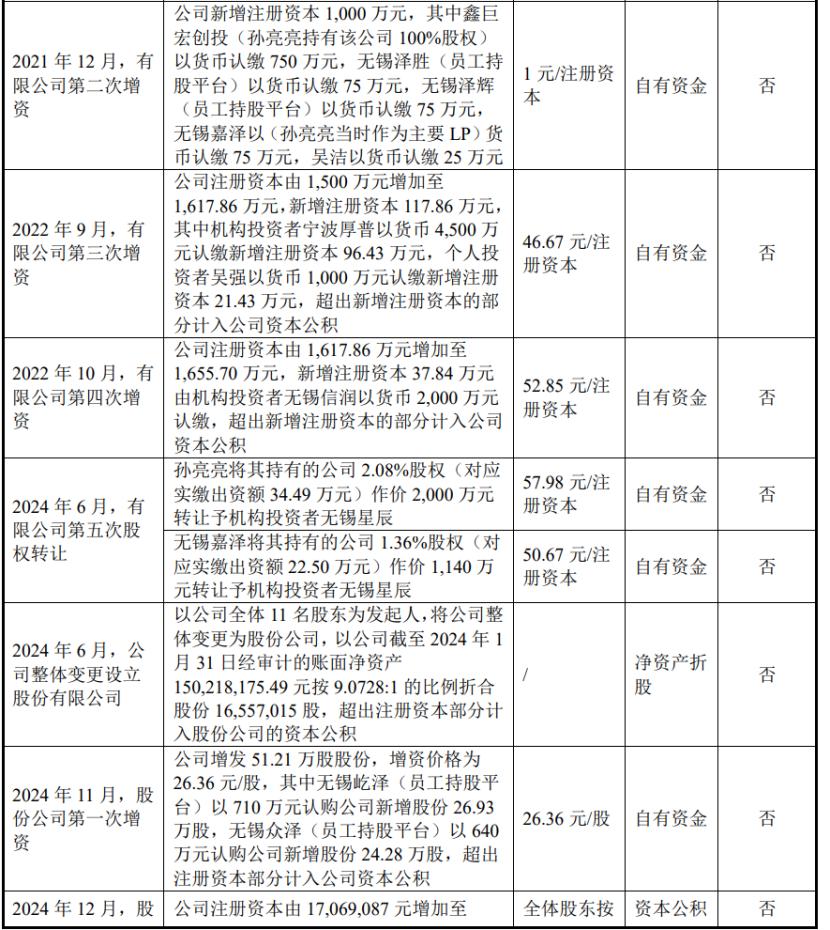
The Beijing Stock Exchange required further explanation of the rationality of the price difference between Ningbo Houpu, Wu Qiang and Wuxi Xinrun's equity participation in Xinjuhong.
Xinjuhong explained that due to the long optimization cycle of Xinjuhong's internal equity structure, the actual equity participation time of Ningbo Houpu and Wu Qiang was later than the agreement stipulated in the early stage; when the two institutions participated in the equity, there was no major change in Xinjuhong's operating performance; in the first half of 2022, Xinjuhong's automotive optical business developed well, with increasing orders and realizing mass supply to leading customers. The investment agreement of Ningbo Houpu and Wu Qiang was signed 10 months earlier than that of Wuxi Xinrun, so the equity participation price was slightly lower.
Wuxi Jiazhe is an investment platform established by acquaintances of the actual controller, and most of its underlying partners have private relationships with the actual controller. Although the corresponding price for Wuxi Jiazhe to participate in this capital increase of Xinjuhong is the same as that of Ningbo Houpu and Wu Qiang, the actual cost for the underlying partners to transfer the partnership shares is lower, and the investment agreement of Wuxi Jiazhe does not set gambling clauses related to listing and performance. Compared with the market-oriented external investment in Xinjuhong in the same period, this acquaintance-backed investment platform has differences from pure market-oriented institutions in terms of actual equity participation cost and investment agreement terms.
Transactions before and after the shareholding system reform further amplified the divergence of Xinjuhong's equity prices. In September 2024, Xinjuhong implemented equity incentives through two employee shareholding platforms, Wuxi Yize and Wuxi Zhongze, with a total additional issuance of 512,100 shares, and the capital increase price was 26.36 yuan per share. Among them, Wuxi YIZE invested 7.1 million yuan to subscribe for 269,300 shares, and Wuxi Zhongze invested 6.4 million yuan to subscribe for 242,800 shares. The premium part was included in the capital reserve, and Xinjuhong's registered capital was changed to 17.0691 million yuan.
By March 2025, there was a transaction of old equity transfer of Xinjuhong in the market, and the transaction price dropped to 18.33 yuan per share. In just two or three years, Xinjuhong's equity transaction price dropped from the highest 52.85 yuan to around 18 yuan. The transaction types during this period are complex, including multiple scenarios such as market-oriented financing for Xinjuhong, investment in Xinjuhong by acquaintance-backed platforms, employee equity incentives of Xinjuhong, and discount exit of old shareholders of Xinjuhong.