Next year, a large number of enterprises will only recruit AI talents.
The differentiation of corporate talent demands is intensifying.
On one track, positions in front-end development, testing, operations, marketing and design are being cut. On the other track, FDE (Frontier Deployment Engineers), Agent development specialists, AI evaluation and security professionals, and full-stack engineers are being snapped up frantically.
This is not a partial adjustment of a single company, but a restructuring of talent demands across the entire internet industry. A clear signal of this restructuring comes from Maimai, a recruitment platform — its talent pool is being divided into two categories: AI talents and non-AI talents.
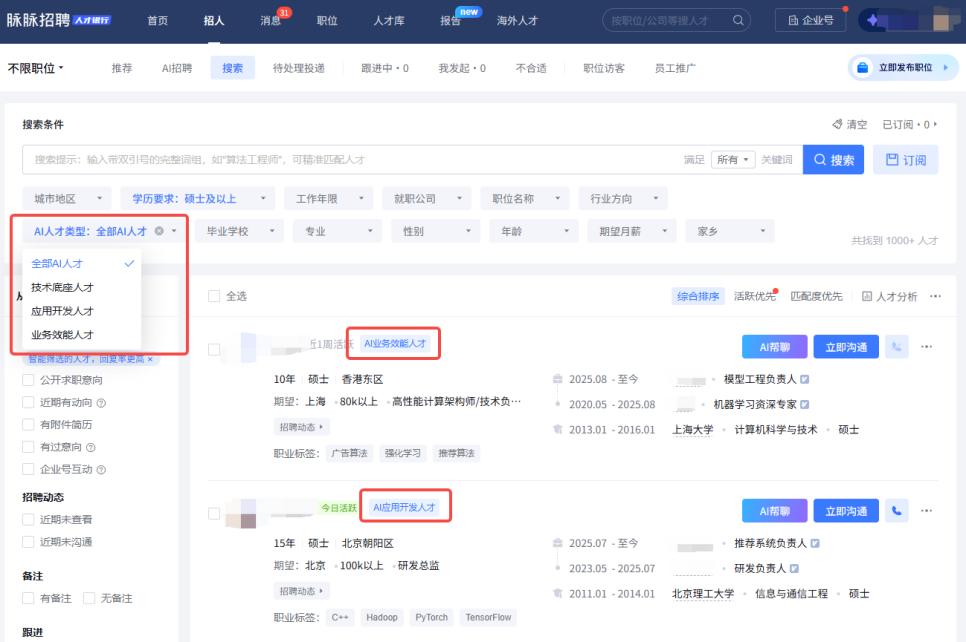
In the widely circulated screenshot of Maimai's backend, an "AI Talent Tag" prominently appears next to the filter menu and candidate avatars.
01 Talent Scramble Starts Earlier, the Logic of Recruiting Has Changed
In previous years, the internet industry's autumn campus recruitment was concentrated in the "Golden September and Silver October", which was a long-standing industry convention. Since last year, this timeline has been continuously moved forward.
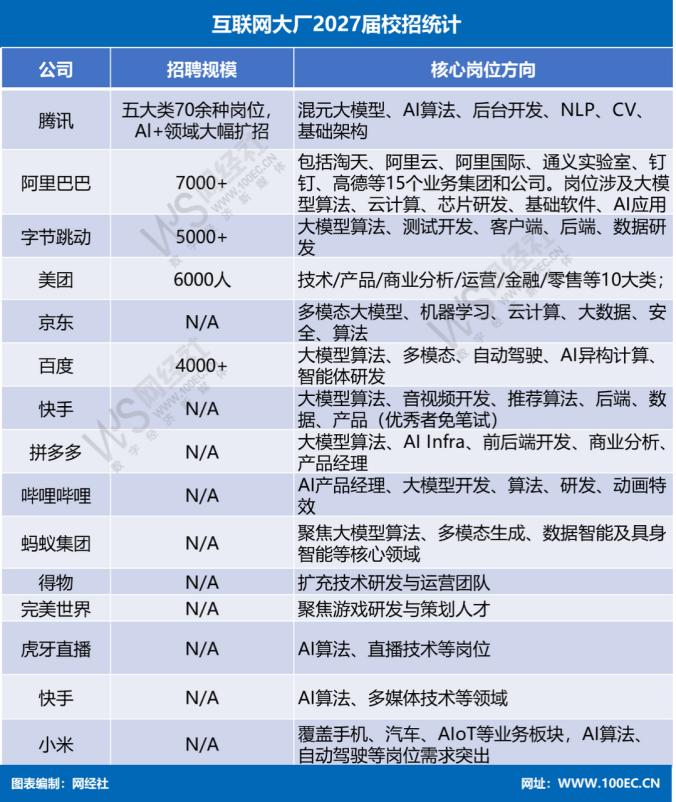
Baidu launched its campus recruitment in July, Alibaba and ByteDance opened their 2027 graduate recruitment channels this week, and DeepSeek launched large-scale recruitment as early as June. Some top AI positions are advertised with "no upper limit on compensation", ByteDance even opened a separate early-bird application channel for AI product managers, through which candidates can get a direct offer in as fast as two days.
Why are companies scrambling to recruit so early? It takes AI talents one or two years to become core business backbones, so locking them in advance is the only way to build a talent moat.
But the logic of this year's talent scramble is completely different from last year's.
In previous years, the scramble for AI talents was essentially a race to recruit the top batch of algorithm engineers — master's and doctoral graduates from top universities such as Tsinghua, Peking University, Fudan and Shanghai Jiao Tong University, first authors of papers published in top academic conferences, and people who are more familiar with TensorFlow/PyTorch than their own home frameworks. This group of people is extremely small in number, big tech companies poach each other's employees, with annual salaries starting at millions of yuan.
But this year, another group of professionals are the ones being snapped up frantically.
Alibaba's current recruitment covers eight job categories including algorithms, R&D, chips, and product management; ByteDance's campus recruitment has a 20% increase in demand for AI product positions; Meituan's campus recruitment targets core positions in technology, product, operations and other fields.
02 The AI Employment Scissors Gap: Some Are Fiercely Pursued, Others Are Laid Off
What enterprises are most lacking now are people who can put AI into practical use — professionals who understand business scenarios, can adjust Agents, build Workflows, and connect RAG to real systems to generate practical results. These people do not necessarily have papers published in top conferences, but they can integrate models into enterprises to create tools that even non-technical workers can use, or use Coding Agents to cut the operation process by half within two weeks, or reduce customer service costs by one third, and use an AI tool to triple the graphic output speed of designers.
As the platform with the highest density of AI talents, Maimai was the first to capture this structural change. Lin Fan, CEO of Maimai, once disclosed a set of data:
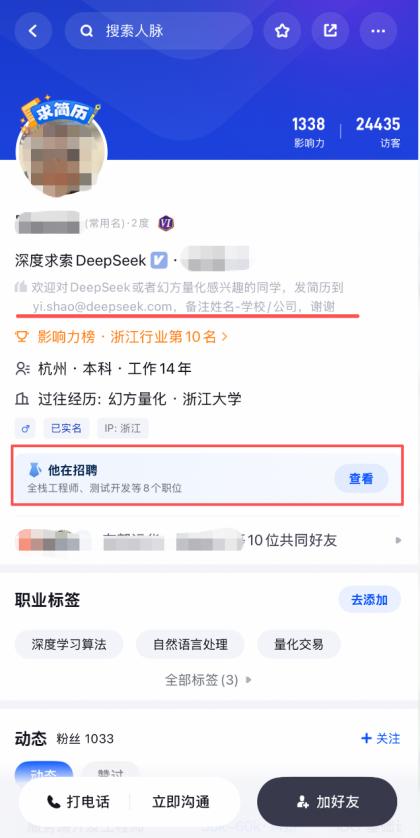
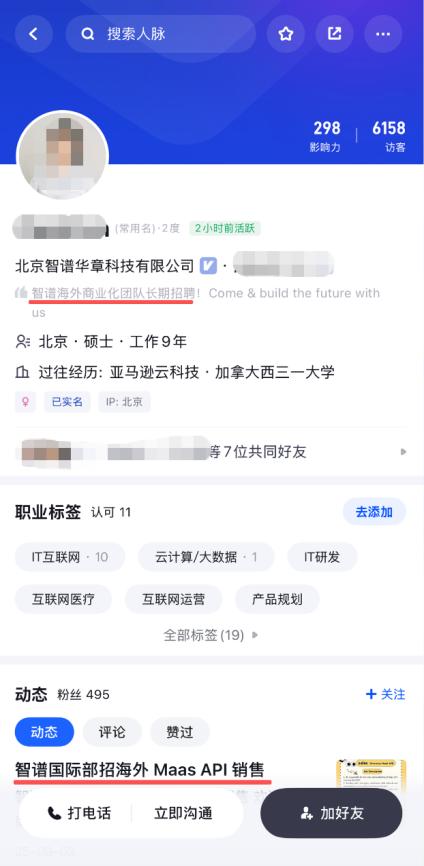
80% of AI talents are active on Maimai, and a large number of HR and headhunters have long been "waiting in ambush" for AI talents on the platform. Executives of companies such as DeepSeek and Zhipu AI will recruit talents in person, with "Seeking Resumes" written on their avatar pendants, and "Hiring Long-term" and their email addresses in their personal signatures.
This time, Maimai's separate labeling of AI talents shows that front-line recruitment service providers have also realized that the logic of enterprises scrambling for talents has changed.
While some talents are being frantically pursued, others are being laid off.
Major domestic internet companies have never stopped optimizing their headcount in the past two years, you can search for "Big Tech + Layoffs" on Maimai and Xiaohongshu by yourself.
The overseas situation is equally severe: according to statistics from Morgan Stanley, last year, the unemployment rate in the U.S. white-collar service industry increased by 15% due to the impact of AI.
The technology and internet industry is even worse: Meta laid off 8,000 people, Amazon 30,000 people, and Microsoft 8,500 people. 40% of the layoffs in the United States in May 2026 were attributed to artificial intelligence.
This is the "AI employment scissors gap" — the job structure is being restructured. The economy is undergoing K-shaped differentiation, and the job market is facing the same fate. Next year, technology enterprises may really only recruit AI talents.
03 Industry Demand Shifts to Landing Applications
How exactly do large tech companies advance their vigorous AI implementation? They are moving forward on two tracks.
External Talent Acquisition
What they are scrambling for are talents for "technical base" and "high-level application development" — talents with background from C9 universities (or at least 985/211 universities), with published papers, practical experience and proven results. This group of talents requires long-term training, and that is exactly who big companies lock in in advance through campus recruitment.
Internal Transformation
There are two types of transformation: first, original R&D engineers receive AI training and transform into application development specialists; second, a large number of non-technical staff directly use Coding Agents to transform business processes, and prove their value through efficiency improvement results.
The full-staff AI transformation at Alibaba and Tencent has long been launched. A person in charge of Meituan's campus recruitment revealed that a new "AI Competency Assessment Module" was added in 2026, which is required for technology, product and operation positions. 70.12% of enterprises in the e-commerce industry have launched or are evaluating salary adjustments linked to AI efficiency.
Industry demand has shifted from "basic algorithm R&D" to "landing application". A recruitment executive said frankly:
The most scarce resources are interdisciplinary talents who can understand business and convert AI capabilities into industrial value.
04 Breakthrough Directions for Ordinary People
So, what is the way out for ordinary people like us?
To find where the opportunities are, we can look at what kind of people enterprises are recruiting. Take a reference from how Maimai, the recruitment platform that has the most interactions with technology and internet companies, divides its AI talent tags:
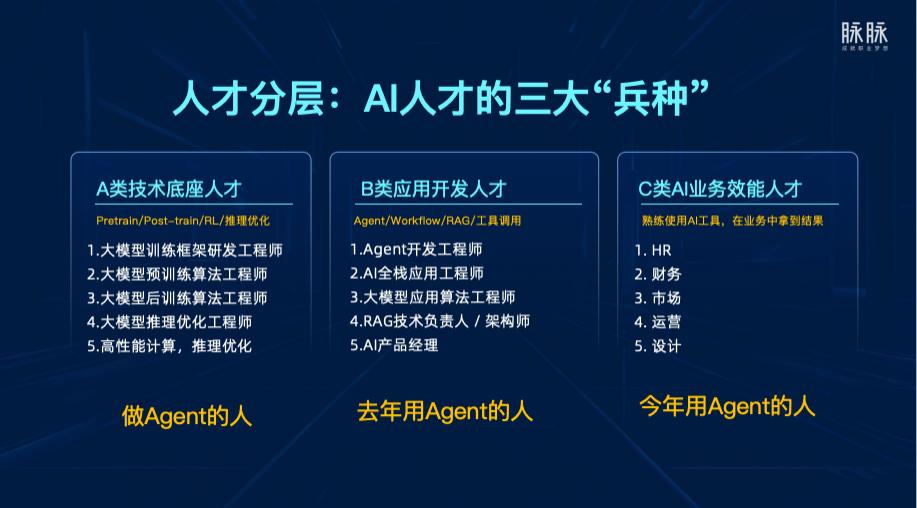
For the vast majority of white-collar workers, the first two categories have too high thresholds, and AI business efficiency talents are the only breakthrough direction.
It is useless to list a bunch of tools like Doubao and DeepSeek on your resume, what matters is what results you have achieved with AI — X% increase in work output, X days shortened project cycle, how much traffic your works have gained, and what practical problems you have solved.
It is useless to write a bunch of tool names on your resume, you have to write down the results.
Lin Fan, CEO of Maimai, once put forward a radical viewpoint:
Truly mastering the use of Coding Agent means making it automatically run tasks for more than 1 hour. You can check which level you are at.
It is not enough to get the results, you have to make them seen. Update your results and works to your resume or Maimai homepage, so that the algorithm can label you as an "AI talent", and HR and headhunters can find you.
OpenAI only took 8 months to increase its internal AI penetration rate from 10% to 99.8%. Domestic technology companies are following up intensively.
With Agents accelerating their penetration, technology companies may really stop recruiting non-AI talents next year.
But this is precisely an opportunity — under the new rules, the window for overtaking on a curve has not closed yet.
Don't wait until the tag is attached to you, only to find that you have been assigned to the "non-AI" category.
This article is from the WeChat Official Account "Shi Tianhao Observation" (ID: shitianhao01), the author is Qinfen de Haozi, and 36Kr publishes this article with authorization.