Zhu Xiaohu's 5 Years, Xu Xin's 28 Years
Alice stood at the fork in the road and asked the Cheshire Cat which direction she should go. The cat said: It depends on where you want to go.
01 One Company, Two Choices
When the topic shifted from embodied intelligence to Xu Xin's core investment methodology, the word "great" appeared 9 times in about 35 minutes — returning after riding the market waves, Sister Xu still insists on investing in great companies.
This observation comes from Li Xiang's podcast show "High Energy". Sitting in front of the microphone with Xu Xin was also Zhu Yang, the founder of the embodied intelligence company Starsea Graphics, and the fourth founder that Xu Xin "signed the TS immediately after meeting" after Liu Qiangdong, Zhao Peng and Yang Zhilin.
Xu Xin has not appeared in the public eye for a long time. Her last relatively intensive public expression took place from 2020 to 2022. At that time, a number of consumer and internet projects behind her were cashing out. Since the 2022 Nanjing University Alumni Association, Xu Xin and her Capital Today behind her seem to have entered a "dormant period". In 2024, the market even spread the news that Capital Today disbanded its primary market team, forcing Xu Xin to personally issue a statement to refute the rumor.
But so far this year, in addition to Li Xiang's podcast, Xu Xin also appeared at the Greater China Private Investment Summit not long ago. For an investor who does not contact the media frequently in the first place, does this frequency mean that Xu Xin's investment answers for the AI era are ready to be told publicly?
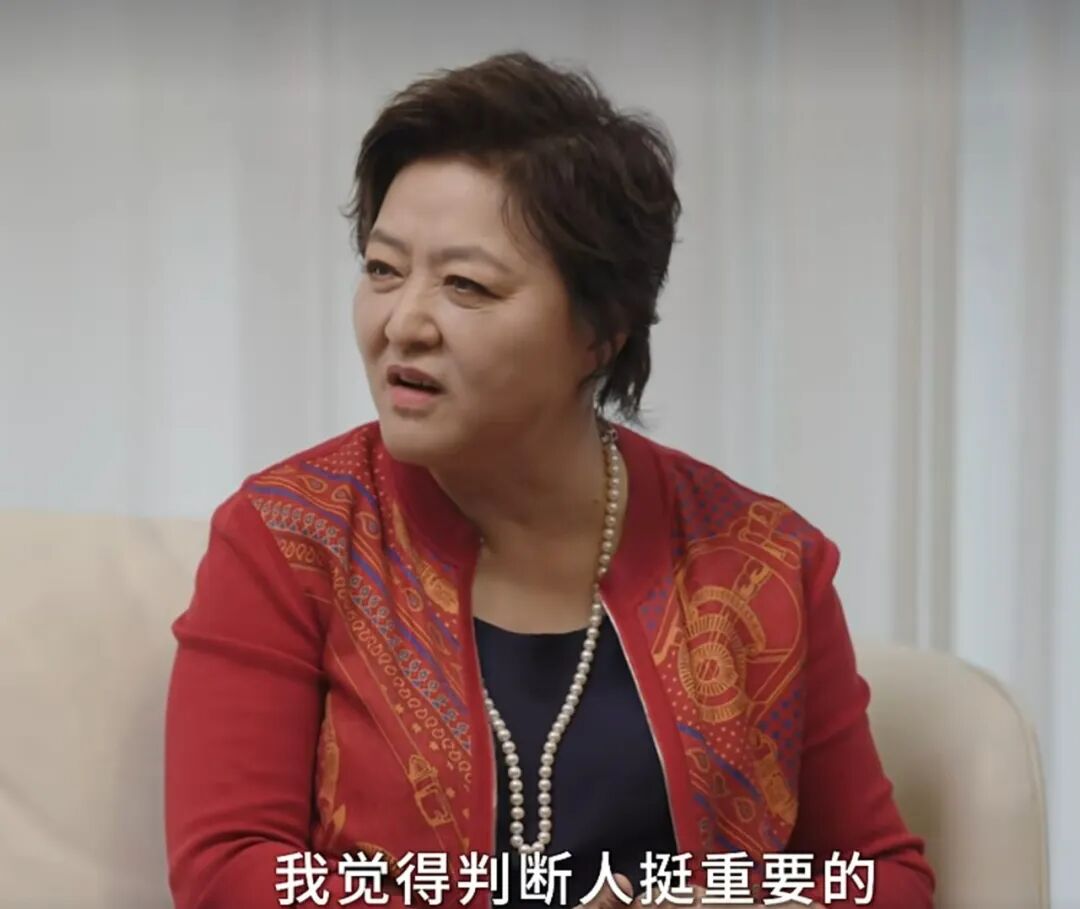
Caption: Li Xiang in conversation with Xu Xin
At least in the conversation, she has connected AI, embodied intelligence and her own investment methods into a set of self-consistent logic.
She deduced from the progress of foundation models how AI will rewrite organizational forms and employment standards; when it comes to embodied intelligence, she first distinguished rule-based robots from general-purpose robots, then judged a company along the lines of data closed-loop, cost reduction and large-scale implementation. She values Gao Jiyang, and also values Starsea Graphics's strategic choice of doing data, brain and hardware at the same time.
This is in sharp contrast to her tentative and observant attitude towards AI when she was interviewed by Caixin many years ago. At that time, she still believed that AI would still be the domain of super platforms, "because the core of AI is data and scenarios, which are concentrated in the hands of super platforms".
It is not difficult to see that in the days when she did not speak out, Xu Xin has been developing in silence.
However, judging from this statement, the new variables of the AI era have finally been put back into the familiar coordinate system by her: she still emphasizes that she must look at every "tree" in the track before she can see the "forest"; she still studies the winner pattern to find rules from historical winners; for early-stage projects lacking data, her calibration system is still "people", and once she finds a home run, she will invest heavily, increase her position, and hold it for ten or eight years —
New technologies have updated her knowledge base, but not rewritten her methodology.
In the years when Xu Xin disappeared from the public eye, Zhu Xiaohu took over the microphone of the venture capital circle.
From foundation models to AI applications, from Manus to embodied intelligence, wherever the trend goes, his judgments follow. When foundation models were at their hottest, he firmly refused to invest; when he saw AI applications with a 20% month-on-month revenue growth, he immediately placed bets; when Manus became a hit, while others discussed how far it was from the general Agent, he did the math first: it costs at least a few dollars to complete a task, and it is possible to break even only if he charges 10 dollars; when the valuation of embodied intelligence rose all the way, he began to exit.
Buy or not, enter or exit, it is not difficult to sum up: calculate the numbers. Customer acquisition cost, sales cycle, retention rate, growth rate and so on, these immediate economic accounts are far more exciting to him than the vast star map of AGI.
It is not hard to see that Zhu Xiaohu has not changed either. He is still using the old method to calculate accounts. But when this ruler falls into the AI era, it screens out different results from Xu Xin's.
Starsea Graphics is a ready example. GSR Ventures entered the shareholder list when Starsea Graphics was founded, and proposed to exit half a year later; the next year, Xu Xin made a move, and then kept increasing her position. She was still inquiring about whether there were old shares to buy when recording the podcast.
One in and one out, the investment philosophies of the two investors are also placed in front of the public.
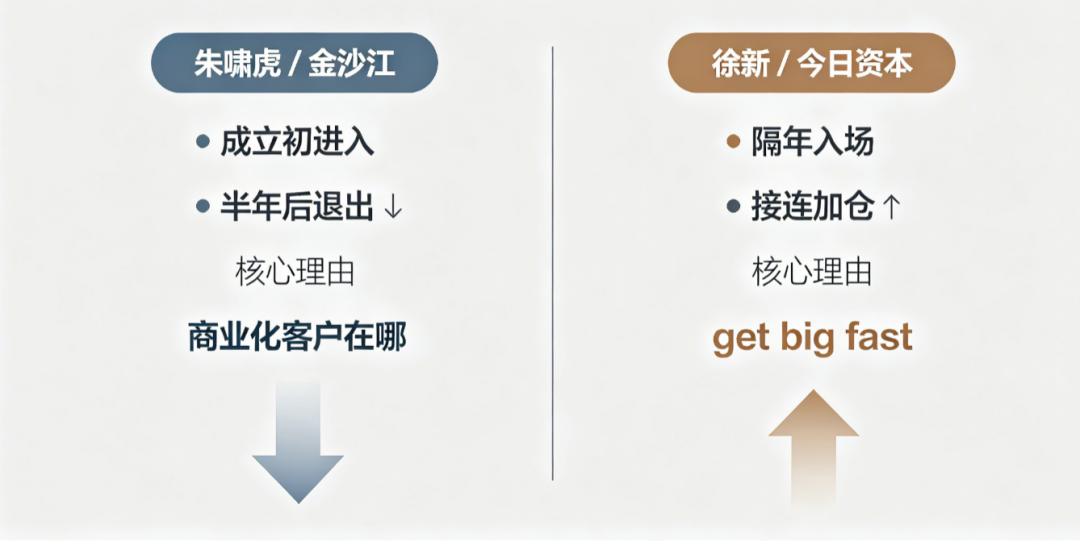
Regarding embodied intelligence, Zhu Xiaohu's questioning is very direct: "Where are the possible customers for commercialization?" He has asked several CEOs one after another, and the answers he got have never convinced him. "Either universities or peers, today there is a new customer — central SOEs buy them back for front desk display, none of these are commercialization in our sense.".
The two entered the market one year apart, but the commercialization problem left by Zhu Xiaohu was still not solved when Xu Xin entered the market. In fact, until June this year, in the media group interview after the Starsea Graphics Developer Conference, Gao Jiyang confessed that the productivity market has not really opened: "No company is currently operating effectively in productivity scenarios."
But Xu Xin still placed a heavy bet. She believes: "When the industry crosses the chasm and enters a skyrocketing period, there are usually three to five players. If you are the fastest runner among these three to five people, and you can 'get big fast', the market share you get is eternal, this moat is very deep, and you must find such an enterprise at this time."
The reason why Zhu Xiaohu left the market happened to be the reason why Xu Xin entered the market. No one has changed, but AI has pulled them in different directions.
The two were not so different in the past.
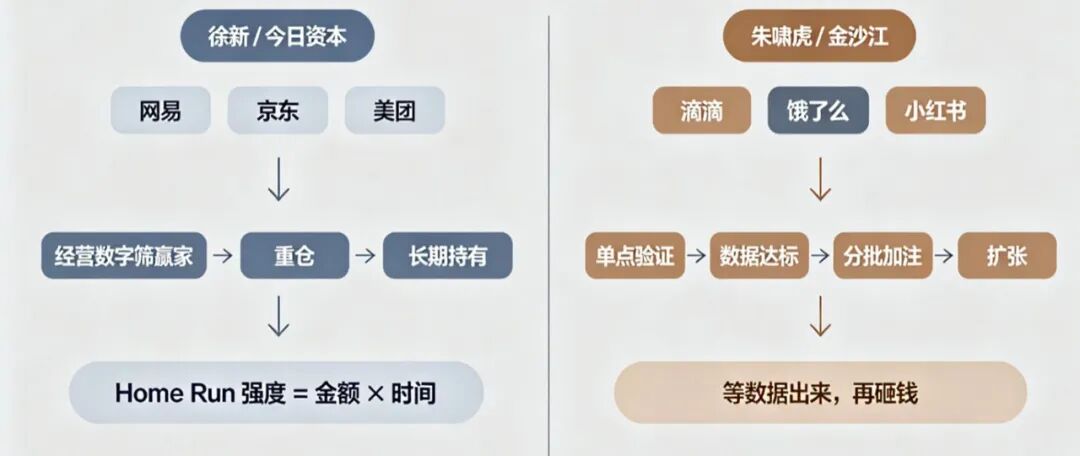
They entered the investment industry in the most turbulent years of consumer internet, and almost at the same time became the beneficiaries of that era. Xu Xin invested in NetEase, JD.com and Meituan, while Zhu Xiaohu invested in Didi, Ele.me and Xiaohongshu. When capital, users and market share promote each other, they all believe that capital can help strong players run faster.
After the emergence of AI, the same set of experience began to give two answers. This divergence is certainly related to personality, and also related to the prices they paid in the old days. People will sum up their own success, but it is difficult to get rid of the conditioned reflex left by failure.
For investors, what is more troublesome than Alice is that the end point of AI has not yet appeared, and they can only use the experience gained from the last road to decide where to go next.
02 What Victory Taught Them
There is a simple way to judge whether Xu Xin has changed: put her public interviews in recent years together, and you will find that time suddenly loses its scale.
Over the years, the forums have changed, the interviewers have changed, but Liu Qiangdong only asked for 2 million US dollars, she gave 10 million US dollars. When JD.com was in the most difficult time, Capital Today provided five bridge loans one after another; Ding Lei and Zong Qinghou's unique business acumen made her realize that entrepreneurs must have "killer instinct" — to see things that others cannot see; and after missing ByteDance, the story of her starting to study the winner pattern will always return on time.
Listening only to these old repertoires, it is hard to tell which year Xu Xin on the stage is in.
The service life of her speech content is longer than that of many funds. After listening too much, it feels a bit like reheating cold rice. But the repeated appearance of these stories also illustrates a fact: the industry has changed round after round, but the set of methods Xu Xin uses to understand them has rarely undergone fundamental changes. The understanding that new projects bring to her is usually only adding a piece of testimony to the old methods.
This time, the testimonies are Moonshot AI and Starsea Graphics.
In Xu Xin's investment stories, the opening is usually the operating figures of the invested company: JD.com does not invest a cent in advertising, and can still grow 10% every month; excluding the impact of new store openings and M&A expansion, old stores of Yifeng Pharmacy have grown 8% year-on-year for 12 consecutive years without change; before investing in the merged Meituan, what Xu Xin saw was its embryonic form of a super platform that had already emerged: hundreds of millions of users, an average of 8 to 10 uses per year, and the ability to continuously extend to new businesses.
When the story comes to the second half, the protagonist will become her own position and holding time: she has held JD.com for 12 years; in order to invest in Meituan, she put 55% of the capital of the second phase fund into it; in order not to be urged by the fund term to sell good companies, she set up another fund with a term of up to 28 years.
These figures eventually fall on the "Home Run" that Xu Xin has repeatedly emphasized. Finding a great company is only the starting point. How much money you invest and how long you hold it will also change the weight of this investment in the whole fund:
"There are two key points of Home Run, one is the probability and frequency of you investing in great companies, and the second is actually the intensity. It completely depends on two things, the first is whether the amount is large enough, and the second is whether the time you hold is long enough."
Frequency is given by the times and luck, and what investors can control is intensity. In the consumer internet era, operating data first screened out winners, then investors placed heavy bets, provided the capital needed for the company's expansion, and turned the company's subsequent growth into fund returns through long-term holdings.
The order Zhu Xiaohu is used to is different.
As one of GSR Ventures' most successful investment cases, Xiaohongshu is often used by Zhu Xiaohu to explain his investment logic. Mao Wenchao and Qu Fang first launched shopping guides for Hong Kong and Japan, the product was only two rough PDFs, but the download feedback was very good. The team later made it into a shopping sharing community, but Xiaohongshu still had no answer about how to make money at that time.
When GSR Ventures was preparing to invest in Series A, the legal documents were ready, and another fund that was supposed to contribute together temporarily exited, so GSR Ventures took over all the vacant shares. After that, Xiaohongshu moved from shopping community to e-commerce and advertising, and its business model changed several times.
Zhu Xiaohu later summed up this investment and said: "We don't care much about what stories are told, because stories change very fast most of the time, and it's okay to have no revenue. Then we look at the numbers, look at your customer acquisition cost and customer retention rate."
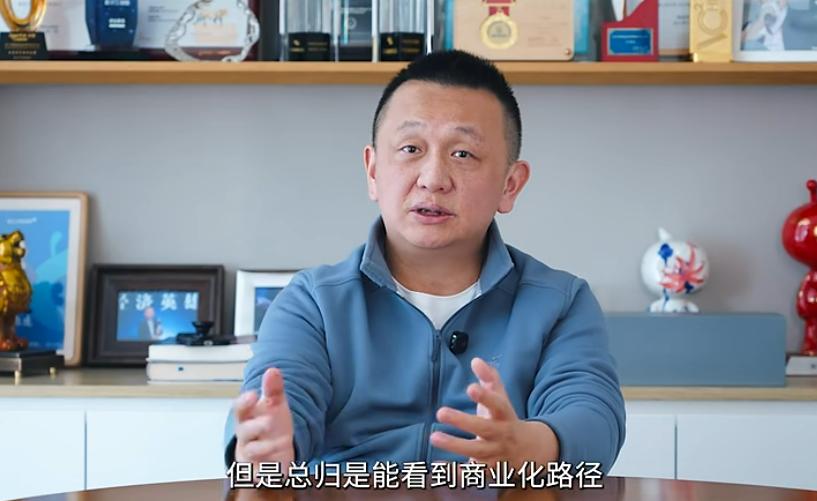
As long as effective user feedback can be left, even if the business model is not finalized, there is a chance to get on Zhu Xiaohu's poker table, but the money for the next round usually has to wait until the data of this round comes out.
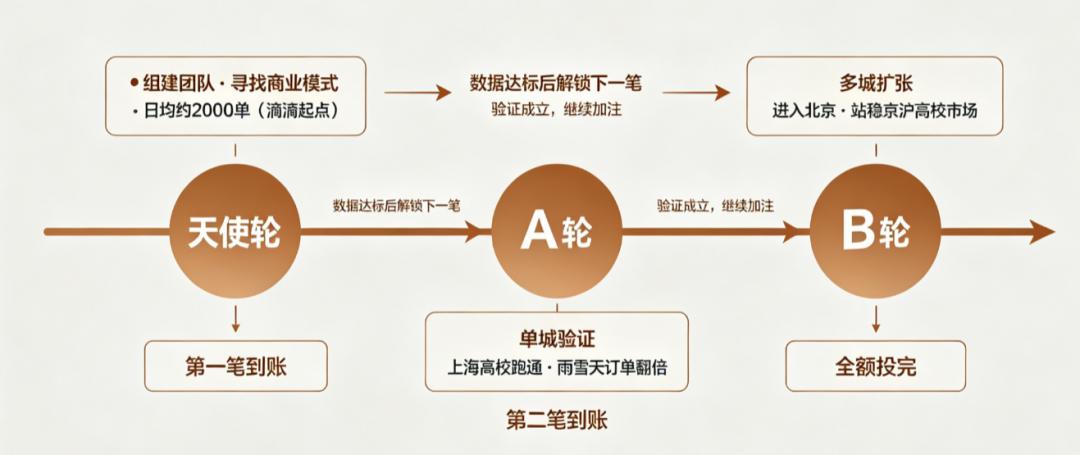
In 2016, Zhu Xiaohu broke down the financing rhythm of startups in great detail: the angel round is used to form the team and find the business model; Series A first completes verification in one city or even one region; Series B then expands to more cities.
GSR Ventures originally promised 1 million US dollars to Ele.me, and the money was not paid in one time. The first sum helped Ele.me enter other universities in Shanghai from Minhang Campus; the data after expansion was still valid, and the second sum was used to develop universities in Beijing.
When the 1 million US dollars was all invested, Ele.me had already gained a firm foothold in the university markets in Beijing and Shanghai. Zhu Xiaohu later said that the Ele.me project alone earned back the entire GSR Ventures fund at that time.
Didi also went through similar verification. When GSR Ventures invested, Didi had about 2,000 orders per day, and Cheng Wei estimated that when the order volume reached 20,000 per day, there would be a chance to make a profit. In the winter of 2012, it snowed three times in a row in Beijing. Zhu Xiaohu recalled that every time it snowed, Didi's user volume would multiply several times. At that time, there was no large-scale subsidy, and the demand for taxis in rainy and snowy weather had already appeared in the numbers.
But Zhu Xiaohu later gave two opposite answers about how the money should be spent.
When reviewing Baixing in 2017, he believed that Wang Jianshuo was too cautious in expansion. Although Baixing brought more than 100 million US dollars in returns to GSR Ventures, it was eventually left behind by 58.com. The lesson he learned from this is: "You still have to spend money when it's time to spend, especially when the market is good."
In the same interview, he also mentioned a project that was preparing to expand nationwide. The team's repurchase still relied on subsidies, and once the coupons were stopped, users would no longer come back. When the rear-end investors advocated rapid nationwide expansion, Zhu Xiaohu pressed the pause button.
The dividing line between these two judgments is the performance after the subsidy is stopped — if users still come back, the money can continue to be invested, otherwise, it is time to stop the loss in time.
The advantage of consumer internet is that this answer doesn't take long to wait.
When that wave started, the necessary technical infrastructure had been almost laid out. Smartphones, mobile payment and location-based services became popular one after another. After a product was launched, downloads, retention rates and orders appeared quickly. Zhu Xiaohu said in 2016 that after investing in internet projects, you can basically know whether it works in six months.
Xu Xin used operating figures to identify winners and then placed heavy bets; Zhu Xiaohu waited for single-point verification before expanding. The two may enter the market one after another, but as long as the demand is proved, the next step is to pour money and expand the model that has been run through. The reason why they did not diverge too far in the consumer internet era is right here.
Of course, both of them have times when they misjudge.