Has Baidu AI taken up the banner of leadership?
On August 18, Baidu released its Q2 2026 financial results after the Hong Kong stock market closed as scheduled.
This earnings report has drawn widespread attention. This is the first quarter after Baidu's AI business revenue accounted for more than half of its general business revenue, marking the official shift of the company's narrative from a search enterprise to an AI-focused entity. Three months later, the market is eager to know whether the new growth pillar of AI has propped up Baidu's overall performance.
Financial data shows that in the second quarter of 2026, Baidu's total revenue reached 31.3 billion yuan (RMB, the same applies below if not marked otherwise); Baidu's general business revenue was 25.2 billion yuan, of which AI business revenue accounted for 50%, exceeding 50% for two consecutive quarters. On the user side, the monthly active users of its App hit 644 million, which has basically stabilized its basic market.
The market has also given its response. Overnight, Baidu's US-listed shares (BIDU.US) plummeted 12.73% to close at $90.87, hitting the lowest level in nearly a year since August 2025, and its cumulative decline for the year has expanded to 30.45%.
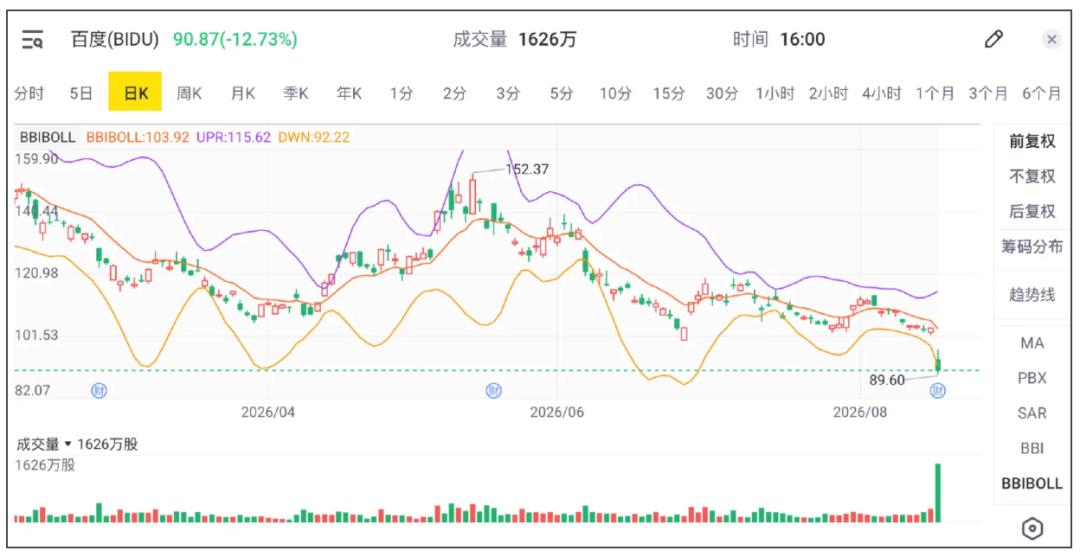
Figure: Baidu's stock price trend Source: Tiger Securities, Screenshot from Tingtong Tech
Several major financial institutions lowered Baidu's target price after the earnings report: Jef Group cut it from HK$170 to HK$163, Deutsche Bank lowered it from HK$186 to HK$162, both maintaining the "Buy" rating.
During the earnings call, Baidu's co-founder and CEO Robin Li said, "We are confident in accelerating the iteration of artificial intelligence, and making Ernie Bot return to the first echelon of foundational large models." This statement not only shows his determination, but also acknowledges that the company has fallen behind its peers.
This also means that the transformation is underway, while the growing pains are still continuing. Next, whether Baidu can maintain its "original advantages" in the AI sector amid the fierce competition among numerous players depends on its subsequent performance.
01 Revenue Meets Expectations, While Profit Continues to Decline
First, let's look at the core financial data.
In the second quarter of 2026, Baidu Group achieved total revenue of 31.3 billion yuan. This figure is slightly higher than the lower limit of the previously predicted range of 31.195 billion yuan to 31.6 billion yuan by some institutions, but there is still a gap compared with the market expectation of 31.95 billion yuan, down 2% quarter-on-quarter and 4% year-on-year.
What really makes the market frown is the profit side.
In this quarter, Baidu's Non-GAAP operating profit was 3.8 billion yuan; Non-GAAP diluted earnings per ADS was 7.22 yuan, compared with 13.58 yuan in the same period of last year, down 47% year-on-year.
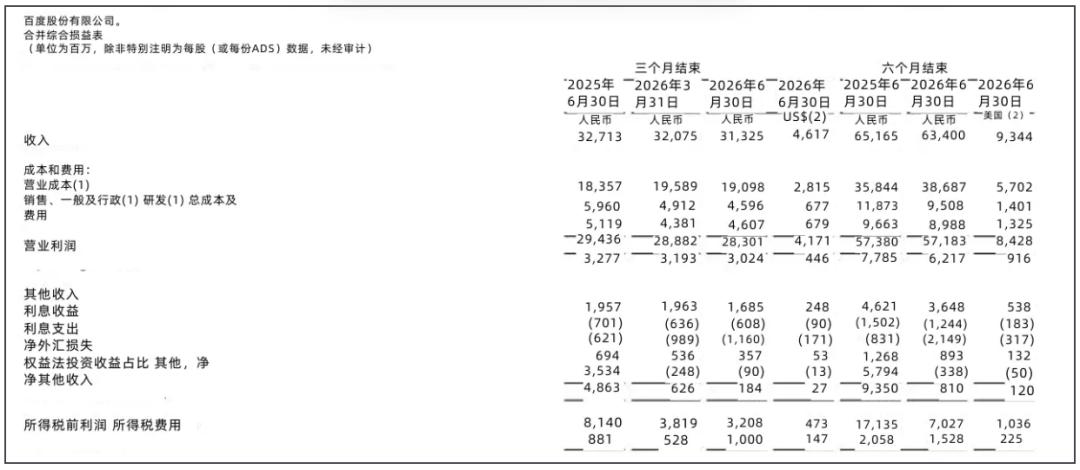
Figure: Baidu's revenue and other performance data Source: Baidu Earnings Report, Screenshot from Tingtong Tech
The most noteworthy indicator is net profit. In this quarter, the net profit attributable to Baidu was 2.319 billion yuan, plummeting 68% year-on-year. Many analyses believe that behind the profit decline is the structural growing pain that Baidu is experiencing.
On the one hand, the shrinking of traditional advertising business is compressing the overall profit margin.
In Q2 2026, Baidu's traditional online marketing and other business revenue was about 13.1 billion yuan, down 19% year-on-year. This decline exceeded the expectations of many institutions.
Against the backdrop of sluggish macro consumption, advertisers are generally cutting their budgets, and their requirements for conversion rate are becoming increasingly strict.
However, what makes the market more worried is that AI-native search is reshaping users' search habits, and the impact of this change on the number of traditional ad impressions may be long-term and irreversible.
On the other hand, Baidu's new businesses are eating into its profits.
Baidu's large model training, computing power infrastructure construction, and Kunlun chip R&D all require substantial capital investment. In Q2, Baidu's R&D expenditure reached 4.607 billion yuan, up 5% quarter-on-quarter. Previously, in Q1 2026, this R&D expenditure of Baidu was 4.384 billion yuan.
With the old business losing revenue and the new business burning cash, Baidu's profit margin is naturally squeezed from both sides.
However, there are also highlights in the earnings report.
For example, the basic user base remains stable. In Q2, the monthly active users of Baidu App reached 640 million. That means the large-scale user group is still there, but how to convert them into revenue more efficiently is a key issue for Baidu to solve.
In addition, Baidu has sufficient cash flow. Data shows that as of the end of this quarter, Baidu held total cash and investments of 283.1 billion yuan, with abundant liquidity. This huge cash reserve is also its ammunition to continue to increase investment in the AI competition.
02 AI Starts to Generate Revenue, It Still Takes Time to Become the Core Growth Driver
At a time when profits continue to decline, the market is more concerned about whether Baidu can burn out a truly profitable future even with sufficient cash flow?
This requires a detailed look at the performance of Baidu's new businesses.
In Q2, Baidu's general business revenue was 25.2 billion yuan, of which AI business revenue accounted for 50%, exceeding 50% for two consecutive quarters. This also means that the proportion of AI in Baidu's revenue map is steadily consolidating.
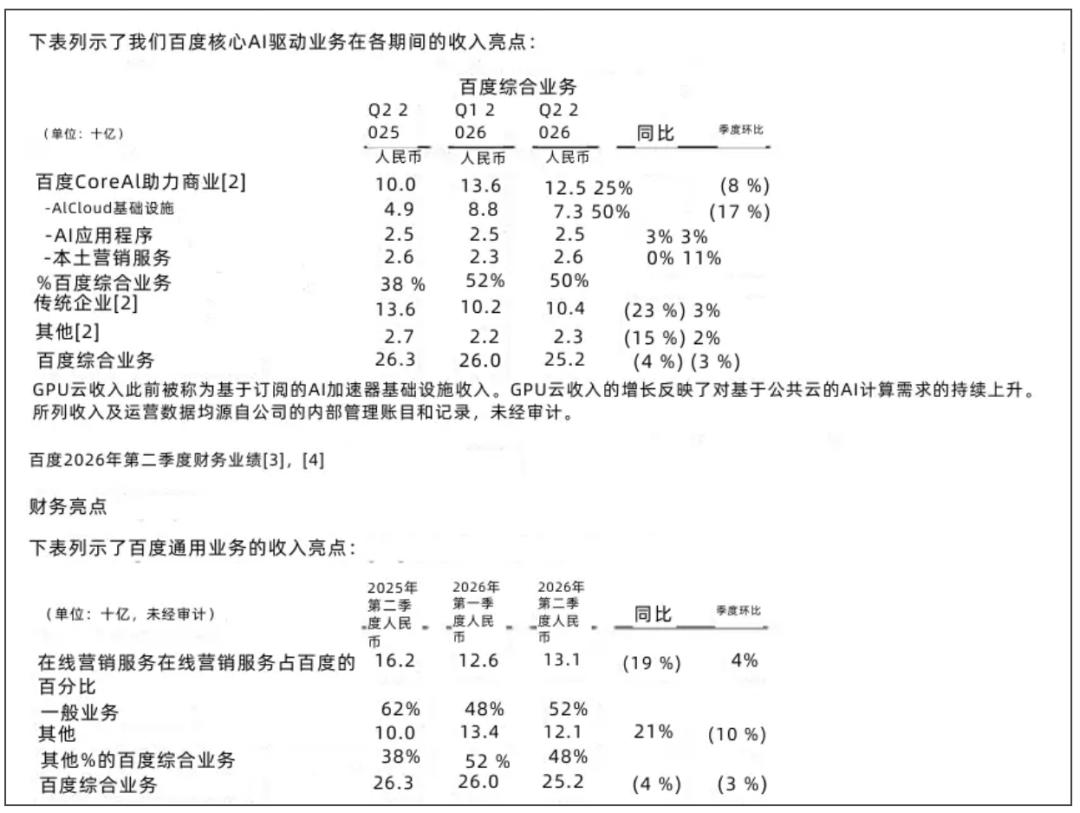
Figure: Baidu's revenue and performance by business segment Source: Baidu Earnings Report, Screenshot from Tingtong Tech
Baidu's AI business focuses on the "full stack", with self-developed Kunlun chips, Ernie large models, and PaddlePaddle deep learning framework, forming a closed loop from chips to models to applications. Therefore, compared with other peers that rely more on external procurement for computing power, Baidu has different cost and business structures.
Part of Baidu's new business comes from smart cloud and GPU computing power services.
The earnings report shows that in Q2, Baidu's AI cloud infrastructure revenue was 7.3 billion yuan, up 50% year-on-year; GPU cloud revenue increased 283% year-on-year, with the growth rate further accelerating from 184% in the previous quarter.
This indicates that with the continuous explosion of demand for large model training and inference, enterprises' demand for paying for AI infrastructure is growing strongly, and Baidu continues to benefit from its full-stack capabilities of self-developed Kunlun chips and Ernie large models.
The other part is AI-native applications and marketing services.
Data shows that in this quarter, Baidu's AI application revenue was 2.5 billion yuan, up 3% year-on-year; AI-native marketing service revenue reached 2.6 billion yuan.
The background here is that in August this year, Baidu completed a new round of integration of its AI office product line, forming an AI office product matrix represented by Baidu Buddy, Kuku AI, Miaoda and other products. According to the AI Office Agent Ranking, the month-on-month growth rate of Baidu Buddy's MAU in July reached 1063.79%; Kuku AI Office's MAU exceeded 25 million.
However, the growth rates of these two businesses are significantly lower than that of cloud infrastructure, reflecting that C-end users' willingness to pay for large models is still relatively low, and the commercial monetization of AI search is still in the exploratory stage.
The third part is Baidu's long-standing autonomous driving business.
Data shows that in Q2, Baidu's Apollo Go, in cooperation with Freenow under Lyft, launched public road tests in London, entering the mature European market for the first time. However, Baidu's autonomous driving business is still far from contributing large-scale revenue, and the significance of overseas expansion is more symbolic than short-term financial.
Overall, Baidu's AI business has shown its posture of becoming the core growth pillar, with the proportion of revenue exceeding 50% for consecutive quarters and the GPU cloud achieving triple-digit growth, all of which are solid achievements.
But Baidu is not without problems.
For example, the revenue growth rate of AI applications is only 3%, indicating that the commercial implementation of AI in the C-end market is still moving forward slowly; although the growth rate of AI cloud infrastructure is amazing, the price war in the B-end cloud service market is also intensifying, which shows that all leading manufacturers are accelerating model iteration and price reduction.
In addition, from the perspective of the industry, although compared with several other large manufacturers, Baidu is slightly more "restrained" in the competition of capital investment in the AI track, the cost of this arms race is appearing on everyone's profit statement.
Profit is under pressure and cash burning never stops, which is also Baidu's problem, but Baidu "cannot stop".
03 The Transition of Old and New Growth Drivers Is Still in the Pain Period
On the one hand, the traditional advertising business is declining, on the other hand, the growth rate of AI business is not enough to offset the loss of revenue of the old business, so Baidu is caught in the contradiction of "growth rate gap".
That is to say, Baidu's transformation, the handover between the old and new growth drivers, is still in the transition period.
Robin Li said frankly in the earnings statement, "Although the online marketing business is still facing pressure, the growth momentum of core new AI businesses further confirms Baidu's transformation from an internet-centric company to an AI-first company."
This statement also objectively acknowledges that the pressure on the old business exists objectively, but the direction and effectiveness of the transformation are being verified by data.
However, Baidu's management further put forward its own judgment.
Haijian He, Baidu's Chief Financial Officer, said in the earnings presentation, "Looking ahead, we will unswervingly continue to invest in AI as the core driving force for Baidu's long-term growth."
Robin Li emphasized in the earnings statement, "As AI business becomes the core development direction of Baidu, we are consolidating the foundation for the next stage of AI-driven growth."
But the market's patience is limited.
On August 19, Baidu's Hong Kong stock opened more than 12% lower, hitting a new low since September 2025, with a cumulative decline of more than 32% for the year. Overnight, Baidu's US-listed shares also plummeted 12.73% to close at $90.87, hitting the lowest level in nearly a year since August 2025, and its cumulative decline for the year has expanded to 30.45%.
Morgan Stanley said that with the increase in AI investment in the second half of the year, it lowered Baidu's core revenue forecast for 2026 and 2027 by 3%, and cut its target price from $140 to $130. Bocom International maintained the "Buy" rating, but lowered the target price.
Looking back, Baidu's Q2 results can be summed up with several key words: revenue meets the line, profit continues to decline, AI is growing, and the old business is shrinking.
The revenue of 31.3 billion yuan shows that Baidu's basic market has not collapsed; but the sharp decline in profit also reminds the market that transformation has its cost.
From the data point of view, Baidu is indeed moving towards the AI direction, whether it is the direction of capital expenditure, the adjustment of organizational structure, or the shift of business focus, all of which show Baidu's determination to transform.
But what investors want to see is not just an AI story, but a real "moment of verification". The market is still waiting for Baidu's next earnings report to give the answer.
This article is from WeChat Official Account "Tingtong Tech", Author: Tingtong Tech Studio, authorized by 36Kr for release.