The "Chinese version of SpaceX" that recorded an annual loss of 1.7 billion yuan has finally retrieved its rocket.
On the morning of August 19, Landspace witnessed a historic moment for China's commercial aerospace industry.
At 7:35 a.m., the Zhuque-3 Y2 carrier rocket pierced through the sky from the Dongfeng Commercial Aerospace Innovation Test Zone.
About 137 seconds later, the first and second stages separated successfully: the second stage rocket continued its ascent and sent the "Honghu-03 Satellite" into the predetermined orbit;
The first stage rocket turned back to return, going through a series of high-difficulty maneuvers including reentry deceleration, aerodynamic gliding, landing ignition and landing leg deployment, and finally landed at the Minqin Landing Site in Gansu Province along the pre-planned trajectory.
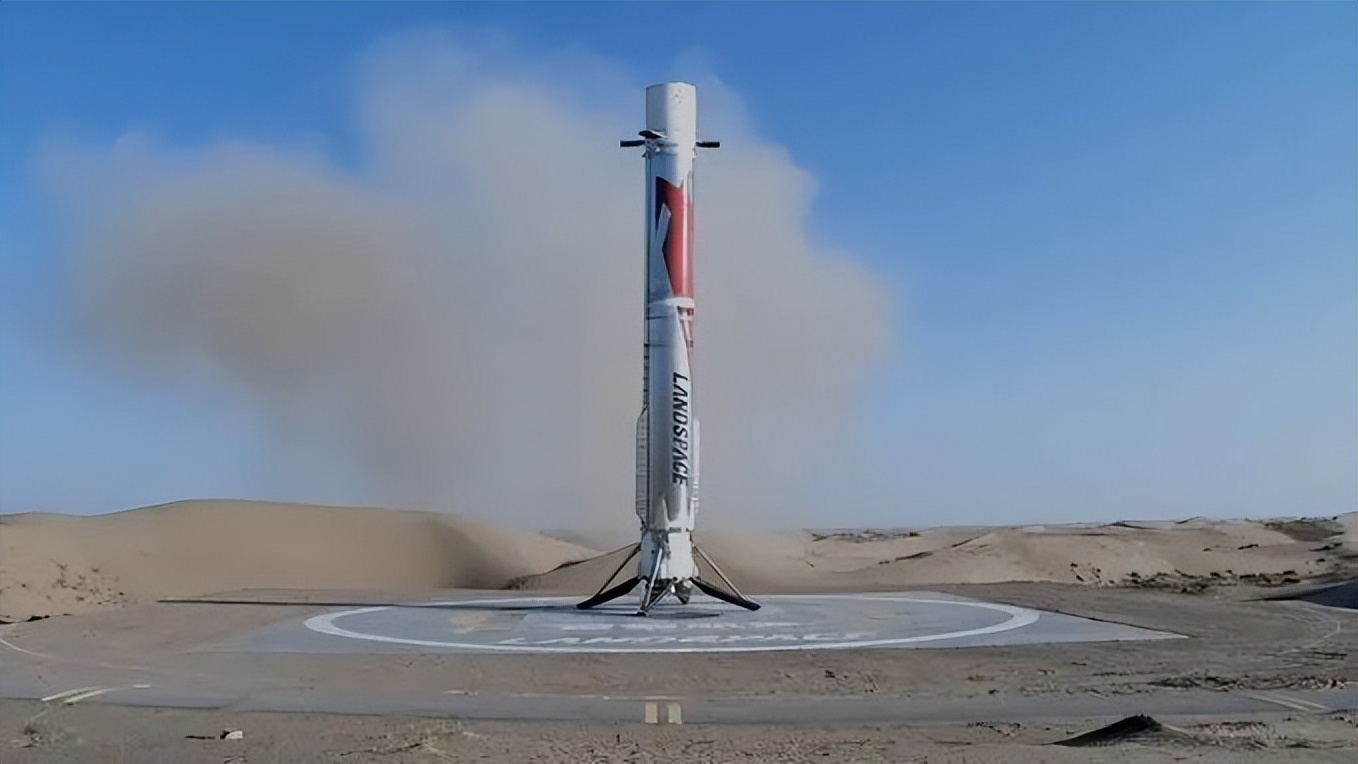
This marks China's first successful land recovery of the first stage of an orbital carrier rocket, as well as the first first-stage recovery completed via landing leg deployment. Landspace has thus become the first private rocket enterprise in China to achieve this breakthrough.
Landspace has waited no more than eight months for this victory.
Last December, Zhuque-3 Y1 was extremely close to success, but unfortunately failed just seconds before touching the ground. Eight months later, Landspace has finally closed this last critical gap. China's commercial aerospace sector now has its first orbital rocket capable of returning upright from space.
However, before the cheers inside the launch site faded, the capital market outside had already returned to rationality.
On the launch day, commercial aerospace-related ETFs opened sharply higher before fluctuating downward. While this was partly driven by the overall pressure on the broader market, the more critical reason may lie in overdrawn expectations: since August, the cumulative increase of satellite-related ETFs has once exceeded 18%.
Technical personnel have completed the final step of technical verification, while investors have already begun to carefully calculate the next economic account:
How high of a threshold has this landing of Zhuque-3 helped China's commercial aerospace cross?
For Landspace, which is still mired in an annual loss of 1.7 billion yuan, how far is it from achieving real profitability through "reusability"?
And the unavoidable question: Which stage of SpaceX's development has China's commercial aerospace actually caught up to?
Click the business card below to follow Jinjiao Finance, we will analyze more social hotspots for you and break down the logic behind economic events.
How Valuable is Zhuque-3?
Strictly speaking, Zhuque-3 is not the first rocket in China to achieve "orbit insertion + recovery".
Just over a month ago on July 10, the Long March 10B took the lead in breaking through this barrier. After completing the orbital insertion mission, the first stage of the Long March 10B returned vertically and was successfully captured by the offshore recovery platform via a net system.
Zhuque-3, however, has taken a different technical route.
Instead of setting up a huge net at sea, it is equipped with four landing legs at the bottom of the rocket body. Through grid fins, engine reverse thrust and autonomous control, the dozens-of-meters-tall first-stage rocket flies to the land landing site on its own, then lands upright just like SpaceX's Falcon 9.
Neither of the two solutions is absolutely superior to the other:
Net-based recovery saves the weight of landing legs, which can maximize launch efficiency, but relies on offshore platforms with extremely high construction and maintenance costs;
While leg-based recovery sacrifices part of the launch capacity and requires extremely high control accuracy, its ground recovery system is simpler, and post-flight maintenance of recovered rockets does not need to handle complex ground capture devices, which is more conducive to shortening the turnaround cycle.
For Landspace, the core breakthrough of Zhuque-3 Y2 is that it has fully realized the full closed-loop of the "launch-orbit insertion-return-landing" process. This success is by no means a simple repetition of the Y1 mission.
After the Y1 failure, the Landspace team traced back all the data and launched a two-to-three-month "technical root cause resolution" process. The investigation strictly followed two principles: "presumption of guilt" (treating every doubt as a potential fault source) and "no single piece of evidence can stand" (ruling out any suspicion requires confirmation from multiple objective pieces of evidence).
As Dong Kai, the deputy chief designer, said in an interview with LatePost, a single rocket costs a lot of money, "If we let the real fault cause go unnoticed, all the money spent on it will be wasted."
Based on the real flight data of Y1, Y2 has made adjustments that fully reflect commercial engineering thinking: reducing the maximum number of engines that can be ignited during the return phase from 5 to 3.
The original 5-engine design was intended to address concerns about insufficient braking capacity of the rocket during the aerodynamic deceleration phase, providing redundancy with more engines. However, the real flight data of Y1 shows that 3 engines are already sufficient. Since there is no need to ignite 5 engines at the same time, the extra two engines could otherwise become new sources of failure.
"Do not add entities unless necessary." Dong Kai used an old saying in aerospace engineering to summarize this trade-off in the interview. What commercial aerospace ultimately needs is not a rocket that barely flies back with a large number of design redundancies, but an engineering system that is simple enough, easy to verify, and capable of repeated operation.
This "extreme cost-effectiveness" mindset is also reflected in material selection.
Different from Falcon 9's "liquid oxygen kerosene + aluminum-lithium alloy" combination, Zhuque-3 adopts "liquid oxygen methane + stainless steel". Methane burns cleanly and is less prone to carbon deposition; stainless steel is high-temperature resistant, with a mature supply chain and extremely low cost — this combination is actually closer to SpaceX's later Starship on the roadmap.
According to disclosures from LatePost, Landspace does not use expensive "special aerospace-grade steel", but ordinary industrial stainless steel that costs only tens of thousands of yuan per ton. To solve the deformation problem of dozens-of-meters-thin-wall steel bodies during the welding process, the team even specially established the Tianma Laboratory to develop laser welding processes.
Of course, choosing a newer technical route does not mean directly owning a mature commercial product. The most stringent challenge in the aerospace industry has never been to make a rocket land successfully once, but to make the same system fly stably ten times, dozens of times.
The Target of 10 Launches Per Year
When Landspace was founded in June 2015, China's commercial aerospace industry had just opened its door to social capital, while SpaceX had not even completed the first successful recovery of Falcon 9.
An early investor once recalled that the industry at that time "had nothing but opportunities".
There was no mature private engine supply chain, and test stands, rocket factories and launch capabilities all needed to be built from scratch. Founder Zhang Changwu realized very early that core subsystems cannot be bought with money. Since 2017, Landspace has taken the lead in embarking on an asset-heavy route of self-developed components and self-built infrastructure.
However, when it officially decided to develop "reusable rockets", Landspace was in a difficult situation.
At that time, the first flight of Zhuque-2 failed. To save resources for manufacturing the next rocket, Landspace suspended part of its infrastructure expansion, but fully retained the reusable rocket project.
According to Dong Kai's recollection, when he first estimated to Zhang Changwu that manufacturing the test rocket would cost 50 million yuan, Zhang Changwu responded: "Can such a big thing be done with only 50 million yuan? No problem, we will fully support it."
But today, the cost of this "big undertaking" is far beyond that level.
According to Landspace's prospectus, the company's revenue in 2025 was only 52.0963 million yuan, while the net loss attributable to shareholders reached as high as 1.711 billion yuan; among which R&D expenses reached 922 million yuan, and the cumulative R&D investment in the past three years has exceeded 2.3 billion yuan. By the end of 2025, the undistributed profit in the company's consolidated statements was -5.955 billion yuan.
With an annual revenue of more than 50 million yuan and an annual loss of 1.7 billion yuan, Landspace has obviously not yet established a viable business model.
Currently, Landspace is working to get listed on the Sci-Tech Innovation Board, planning to raise 7.5 billion yuan (of which 2.77 billion yuan will be used to expand the production capacity of reusable rockets, and 4.73 billion yuan will continue to be invested in R&D). If the capital market is willing to invest several billion more yuan, it is obviously betting not on its current tens of millions of yuan in revenue, but on the commercial potential of Zhuque-3 to achieve stable and high-frequency reusability in the future.
This is also why today's success has attracted such widespread attention. If China wants to deploy tens of thousands of low-orbit satellites in the future, continuing to follow the traditional "manufacture one, launch one, discard one" model will eventually hit the ceiling in terms of launch capacity and cost.
But "being able to land" does not equal "reuse is cheap". After rocket recovery, inspection, maintenance and consumable replacement are extremely cumbersome. If the maintenance cycle is too long and the cost is too high, the cost saved by recovery will be quickly eroded by maintenance expenses.
In response to this point, Landspace's engineering philosophy is very clear: "Although the number of rockets we produce is small, we still manufacture them as industrial products, not luxury goods."
According to the current production pace, it takes dozens of days for Landspace to manufacture a new stainless steel rocket. This means that the maintenance speed of recovered rockets must be faster than manufacturing new ones. Dong Kai said bluntly: "If it takes four or five months to adjust before the rocket can be reused, it is better to just manufacture a new one."
Therefore, the first thing to do after Zhuque-3 lands is to fully disassemble it, to check the remaining lifespan of each component that has experienced space flight.
What Landspace really needs to build is an efficient maintenance system that is "inspectable, testable and repairable": after the rocket returns, it can complete inspections quickly, replace a small number of components, be refueled with propellant, and then be sent back to the launch pad.
The first operational target Dong Kai set for Zhuque-3 is to cross the threshold of "10 launches per year", and in the long run, he hopes to increase this number to 30 to 50 launches per year.
Landspace has already given its first affirmative answer to whether Zhuque-3 "can return".
But what the market is waiting for next is a set of more tedious but critical data:
How soon can this rocket be re-launched? How many times can the first stage be reused? What is the cost of a single maintenance session? How much can the unit launch cost be reduced after reusability is realized?
These figures will ultimately determine whether the billions of yuan Landspace has lost so far are a continuously expanding bleeding wound, or an upfront ticket to a large-scale space transportation system.
Which Stage of SpaceX's Development Has Landspace Caught Up To?
After the successful recovery of Zhuque-3, public opinion tends to go to two extremes:
Some people think that China finally has its own "Falcon 9"; others argue that SpaceX has completed dozens of reflights while we have only landed a rocket once, so it is too early to talk about catching up.
A more objective evaluation may be that Zhuque-3 has caught up to the key milestone SpaceX reached ten years ago, but there is still a vast gap between it and the engineering and commercial ecosystem that SpaceX has built today.
The technical route determines the starting point, and engineering maturity determines the end point. The "liquid oxygen methane + stainless steel + vertical land recovery" architecture chosen by Zhuque-3 is more similar to SpaceX's Starship in underlying logic, but in the chain of "converting technology into reliability", Landspace has only taken its very first step.
In an interview with LatePost, Dong Kai once divided the technical maturity level of Zhuque-3 using a 1-to-9 scale.
According to his judgment, successful recovery only means progressing from level 6 to level 7; sending the recovered rocket back to space counts as reaching level 8; and achieving highly reliable, large-scale continuous launches is the highest level, level 9.
He also used a metaphor from xianxia novels: if Falcon 9 is already at the "Deity Transformation" stage, Zhuque-3 is at most at the "Golden Core" stage; only after completing reflight can it be called reaching the "Nascent Soul" stage.
This metaphor, though playful, reveals the cruel gap between the two sides.
SpaceX completed the first successful recovery of Falcon 9 in December 2015. In the following ten years, it has turned this once globally sensational technological breakthrough into a routine operation at the launch site. As of July 2026, the maximum number of flights for a single Falcon 9 first stage has reached 36.
This is the path of progress that Landspace and even China's entire commercial aerospace sector must go through: one recovery is a sensational news story; completing reflight is the first step to verify reusability; dozens of high-frequency reflights with controllable costs are what makes a business capable of transforming the entire industry.
The deeper gap lies in that what is hardest to replicate about SpaceX is no longer any single rocket, but the closed-loop positive feedback formed by "rocket reusability + large-scale manufacturing + Starlink constellation deployment".
Lower-cost launch capacity supports the rapid deployment of Starlink, and the huge constellation continuously generates launch demand and cash flow, which in turn feeds back to rocket iteration. It can not only make a rocket fly dozens of times, but also has a steady stream of satellite orders to support its operations.
For China's commercial aerospace sector, although the demand for low-orbit satellite internet is strong, how to convert this potential demand into stable commercial orders and match corresponding rocket production capacity and launch pads is the real tough battle.
Without a high-frequency launch assembly line, recovery technology cannot truly dilute costs.
However, Landspace does not blindly claim to "overtake on a curve".
Dong Kai once said frankly that what touched him the most was that after Falcon 1 failed three times in a row, SpaceX still dared to bet all its assets to organize the fourth launch — "It can be done this way, they dare to do it this way". This has left a crucial psychological anchor point for latecomers: aerospace development can tolerate failures and continue to move forward.
As he often says when facing doubts: "No matter how difficult our situation is, it cannot be more difficult than Musk's situation back then."
On August 19, Zhuque-3 has taken this statement a big step forward. China's private aerospace industry has proven with facts for the first time that the first stage of an orbital rocket can truly return to land completely.
What Landspace needs to do next is to send it back to the launch pad, and keep flying it again, again, ten times and more.
For a company that still loses 1.7 billion yuan a year, the real success may not be having the footage of rocket landing making headlines over and over again.
It is that one day, such footage will no longer be seen as a rare event.
This article is from the WeChat public account "Jinjiao Finance", author: Jinjiao Finance, published with authorization from 36Kr.