From 999 to 2699, can Zhang Bo and Sharge AI glasses stage a comeback?
In December 2024, when Zhang Bo released Sharge's first AI glasses, he deliberately rode the wave of Lei Jun's popularity, claiming that the 999-yuan Pai Pai Glasses A1 was "a price that even Lei Jun cannot achieve".
This is not a lie. In June 2025, the first Xiaomi AI glasses were released, with the standard version priced at 1999 yuan.
However, the subsequent fiasco of the Pai Pai Glasses A1 brought Zhang Bo and Sharge back to square one. The product was discontinued, full refunds were issued, public apologies were made, and the brand missed the golden market window for AI glasses.
In 2025, almost all major players in the AI glasses market entered the track, and the second half of the year in particular saw a peak of new product launches. According to statistics from Yiou, 76 new products emerged in the Chinese market throughout the year, a year-on-year increase of 40%.
IDC predicts that China's smart glasses shipment is expected to reach 4.508 million to 4.915 million units this year, representing a year-on-year increase of 77.7%.
Thus Zhang Bo made a comeback with the Sharge loomos L1, which has a launch price of 2699 yuan.
In less than two years, the price has nearly tripled. The pricing logic has changed, and Zhang Bo no longer rides on anyone's popularity. Instead, he explained frankly why the launch price has risen: "If the product is not good enough, no matter how low the price is, it is useless."
The question is, can the former dragon-slayer just put down his sword and make everything right?
The 999-yuan Lesson
In December 2024, at the Shenzhen Futian Convention and Exhibition Center, Zhang Bo declared that he would build "a sharp maverick in a world of slick mediocrity". The 999-yuan Sharge A1 had 50,000 units in the first limited batch that sold out that very night, and Zhang Bo's expectation was an annual shipment of 500,000 units and annual revenue of 600 million yuan.
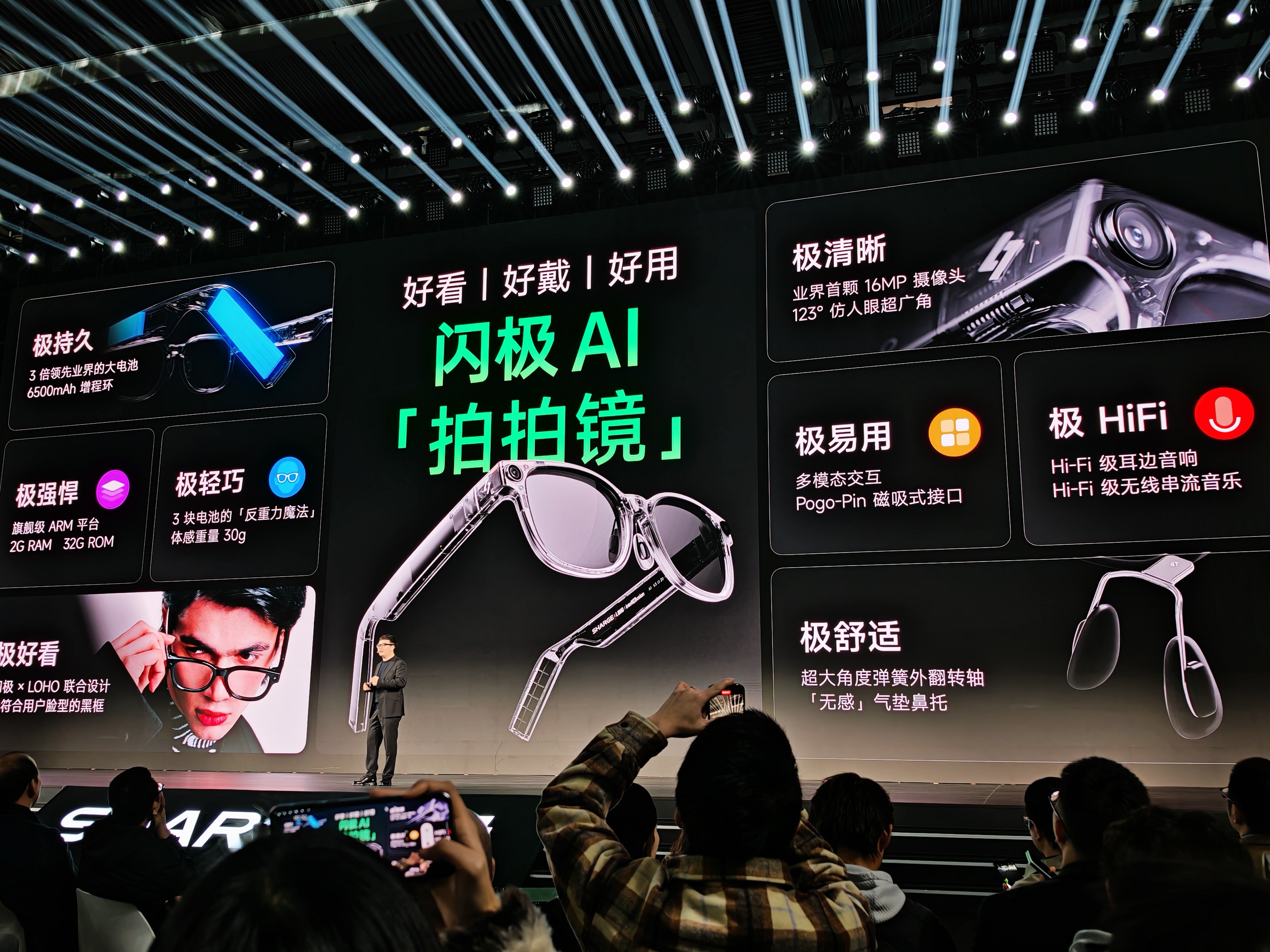
At that time in the AI glasses track, the second generation of Ray-Ban Stories co-developed by Meta and Ray-Ban had just been released with good public praise, but there was no real hit product in the Chinese market.
Sharge cut the price directly below the industry bottom line at 999 yuan, which was equivalent to throwing a bomb into the market. Media outlets rushed to report on it, distributors chased to place orders, and Zhang Bo was surrounded by people asking when they could get the goods wherever he went.
However, things did not go as expected, and the product was far below acceptable quality standards.
Bluetooth connection failures, intermittent call audio, blurry photos, and almost no night shooting performance. Some users received two new devices within one month, one could not power on, and the other could not be charged.
On social media, there were more and more complaint posts from A1 users. At first, everyone thought it was an occasional quality control problem, but later it turned out not to be the case, almost every user was complaining about similar issues.
Sharge's customer service team was once overwhelmed, with hundreds of complaints pouring in every day, and they did not know how to solve many problems themselves, because the underlying hardware was already limited by its design.
Why did this happen? Later reviews found that the root cause lay in the chip.
The A1 uses the Unisoc W517, which was originally designed for smart watches. It does have low power consumption and small size, and Sharge claimed at the launch conference that its AI and ISP performance was outstanding, but in actual development, it was found that the chip platform was far from meeting expectations in terms of Bluetooth stability and camera performance.
Worse still, the hardware ceiling caused by the wrong chip selection could not be fixed no matter how many software OTA updates were released.
Sharge's technical team tried to optimize the Bluetooth protocol stack and improve the ISP algorithm through firmware updates, but after each update, the improvement was very limited. Users' dissatisfaction was further intensified because "after waiting for a month for the update, the problems remained the same".
According to reports from multiple media outlets, Sharge was not in a stable internal state during that period. Many senior core personnel including Pan Xin, Sharge's AI partner, and Zhou Wancheng, CTO, resigned one after another; a large number of middle and senior management including R&D director, project director, brand director, HR director, head of the design department, and almost all employees of the domestic marketing brand department left after April 2025.
Zhang Bo later said that during that period, he read user feedback every night, and the more he read, the more he could not fall asleep.
At the end of 2025, Zhang Bo made a decision that almost no one in the hardware circle dared to make: discontinue the A1 and issue full refunds to all users.
This decision came at a high cost. Tens of thousands of units of refunds, plus a market gap of almost one year. For a startup, not launching new products or making any public announcements for a year basically means disappearing from the market.
Many distributors withdrew at this time, media no longer reported on Sharge, and rumors spread in the industry that Sharge was about to go bankrupt. But on the other hand, if this had not happened, Sharge's reputation would have been completely destroyed.
As a result, some users' evaluations changed from "what a piece of junk" to "at least they have a good attitude". Some users posted in the community that although the A1 was really poor, the fact that they dared to issue full refunds was better than those brands that launched new products and ignored old users.
Zhang Bo himself admitted that he had indeed underestimated the engineering difficulty of AI glasses. But a good attitude is just a good attitude. The fact that users are willing to give Sharge a second chance does not mean they are willing to pay 2699 yuan for the new product.
What Sharge needs to prove is never "we are sincere", but "we can make a good product this time".
Can the Phoenix Rise From the Ashes
Sharge did not idle away the past year. According to Zhang Bo, the team spent tens of millions of yuan to reconstruct the underlying system, adopted a dual-chip solution, and the achievement is the loomos L1 and the Phoenix Architecture 1.0.
The core logic of this architecture is very simple, that is, to make a pair of qualified glasses first.
It sounds very simple, but the vast majority of AI glasses manufacturers have bypassed this very issue.
Most of the AI glasses on the market still look like electronic toys worn on the face: thick temples, prominent raised camera modules, and all made of black plastic.
Many teams making AI glasses come from the consumer electronics or internet industries, and their inertial thinking is to make smart devices with screens, not to make glasses.
Therefore, some products desperately promote their AI computing power, voice interaction, and ecosystem interconnection during promotion, but never mention the most basic question: Is this thing comfortable to wear on the face? Would you like to wear it out to meet people?
Many people are willing to spend two or three thousand yuan on a pair of Ray-Ban glasses because they are comfortable to wear and look decent, but many people are unwilling to spend the same amount of money on something that looks like an electronic device worn on their face. This truth sounds simple, but in the AI glasses industry, there are very few brands that have actually achieved this.
Zhang Bo figured this out when reviewing the A1: "The first problem AI glasses need to solve is whether users can wear them stably all day long. If this problem is not solved, no matter how cheap it is, it is useless."
Therefore, Sharge did several things for the loomos L1:
In terms of materials, engineering plastic was abandoned and replaced with aerospace-grade titanium alloy and natural acetate fiber. Titanium alloy is light, and acetate fiber feels like traditional high-end glasses, without the strong digital product texture.
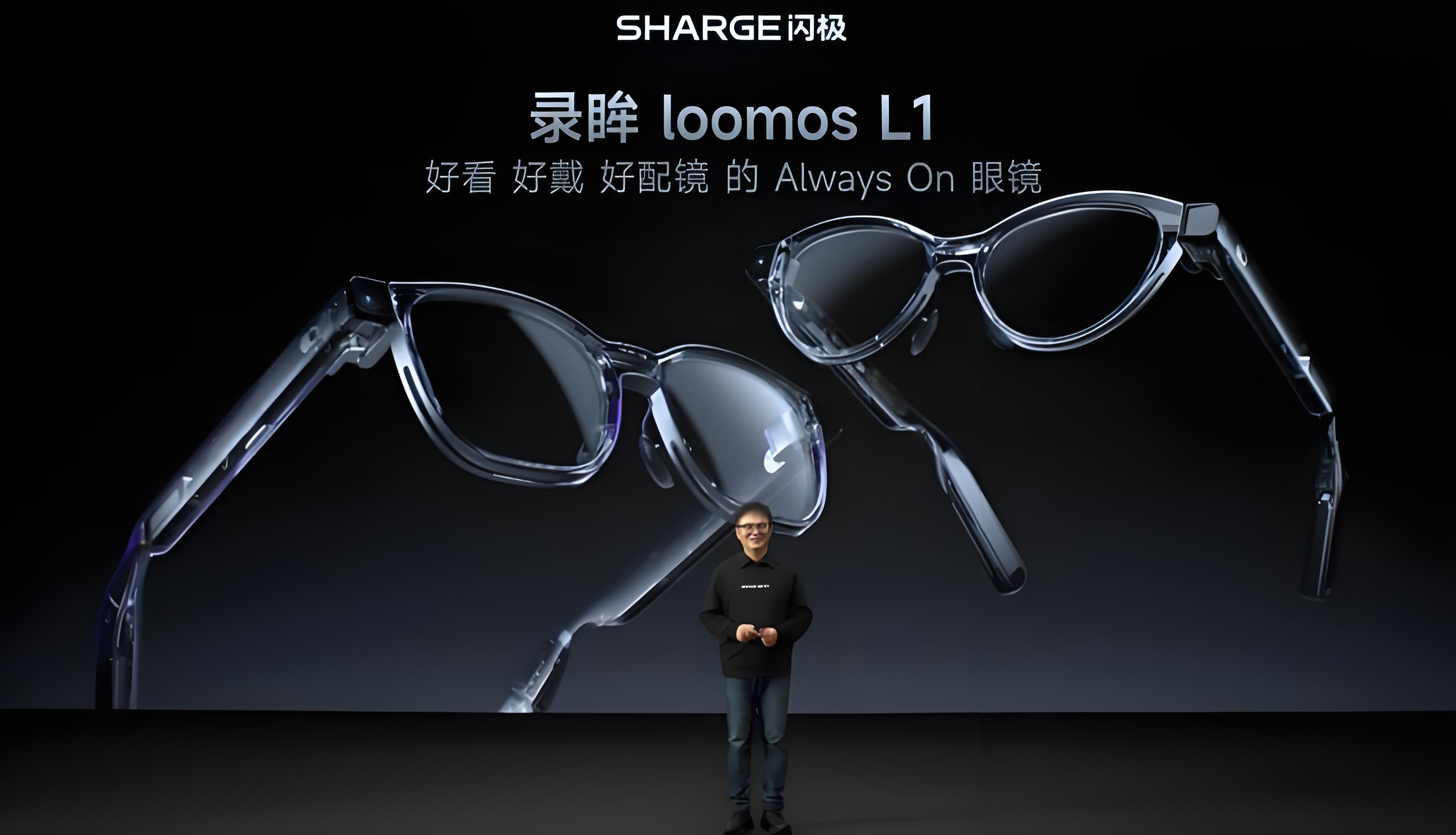
This change is actually very significant. If you pick up any pair of optical glasses priced over 1000 yuan in an optical shop, the frame material is most likely titanium alloy or acetate fiber.
Using these two materials means that Sharge's supply chain has to switch from the logic of consumer electronics to the logic of traditional glasses, with different suppliers, different process standards, and different cost structures.
When Zhang Bo mentioned this at the launch conference, he said something to the effect of "it took us a very long time to find a factory that was willing to take this order".
In terms of structure, the camera, battery and motherboard are all moved to the temples, making the frame itself lighter. The lightest weight of the whole device is 43 grams, the front frame weighs only 19 grams when worn, and the pressure on the bridge of the nose is half that of similar products.
The reason why traditional AI glasses are uncomfortable to wear is largely due to their forward center of gravity. A lot of parts are hung in front of the frame, and the whole weight presses on the bridge of the nose.
Sharge moved the center of gravity backward. Although the temples are slightly heavier, the load-bearing capacity of the ears and the side of the head is much stronger than that of the bridge of the nose, so the actual wearing experience is much more comfortable.
In terms of styles, there are 4 frame shapes, 5 colors, and large and small sizes to choose from, instead of only the single masculine style in the previous generation.
This is to solve a very specific problem. The proportion of female users of the previous generation A1 was very low. It is not that women do not need AI glasses, but that the style is not suitable for them at all.
The frame is too wide, the nose pads are too high, and it looks like a child wearing an adult's clothes. Therefore, the loomos L1 specially added a cat-eye frame shape, and the frame sizes are also graded.
In terms of configuration, it uses two chips: Qualcomm W5100 and BES2700 from Beken.
Sharge said that under the AI memory mode, the power consumption of the W5100 is 38% lower than the mainstream AR1 solution in the industry. For imaging, it uses the Sony IMX681 sensor with 12 million pixels, 111-degree ultra-wide angle, and F2.2 aperture.
The battery life is supported by a 258mAh swappable battery that can be replaced in 5 seconds, and the charging case can recharge the battery 3 to 4 times. The core AI feature is active memory, which does not require wake-up every time, and it can automatically record, organize diaries and to-do items.
In terms of privacy, a magnetic lens cover is added to physically cover the camera when it is not in use. The design of this lens cover is interesting, it is not added because of technical problems, but because of user feedback.
During the A1 period, many users complained that they were stared at by others when wearing the glasses outside, and others did not know whether the glasses were taking photos of them. After adding the physical cover, at least when passers-by see that the cover is closed, they know that the camera is not working.
On paper, the product parameters are really very competitive.
But the problem is that the last product with equally impressive paper parameters became the most disastrous failure in Sharge's history.
The biggest difference between this time and the last time is that Sharge has discarded the "low price" card.
When the price was 999 yuan, users would more or less think "what else can you expect at this price", and tolerate small flaws. But at 2699 yuan, users' mentality is completely different, they will change from "I can understand this" to "why can't you make it work properly".
Sharge has put itself in a situation with no retreat, the product must be fully qualified, otherwise it will not even get the tolerance that users give to cheap products.
Epilogue
Sharge's current situation is actually very awkward.
The good news is that there are still people who are willing to trust it one more time. Pre-orders exceeded 25,000 units within 24 hours after the launch conference, which is not a bad number for a brand that has experienced a major product failure.
This time Zhang Bo no longer shouted about annual sales of 500,000 units, but focused more on the quality of the product itself. From radical to pragmatic, this in itself is a kind of growth.
But the bad side is also obvious. The scar left in users' minds still exists. The question of "is Sharge really capable" cannot be erased by just a wonderful launch conference. The full refund incident did help it win back some goodwill, but there is still a gap between "having a good attitude" and "being truly reliable", which can only be filled by a solid product delivery.
Coupled with the price of 2699 yuan, users have almost zero tolerance for flaws. If the actual experience of the loomos L1 is as bad as the A1, Sharge will not get a second chance to issue full refunds.
The market's patience is limited, especially when competition in this category has reached a white-hot stage.
This article is from the WeChat official account "Decoding NewSight", written by Yuan Xile, and published with authorization from 36Kr.