Is Hangzhou not panicking as the proportion of the manufacturing sector falls below 25%?
Hangzhou is entering a critical period of a new round of industrial restructuring.
On August 19, Unitree Robotics will be listed on the Sci-Tech Innovation Board of the Shanghai Stock Exchange, becoming the "first stock of humanoid robots" in the A-share market. The first enterprise of the "Six Little Dragons" has achieved listing, which is regarded as another milestone for Hangzhou to step out of the "e-commerce era".
A few days ago, Hangzhou further deepened its "traditional strength" in the service industry — at the high-profile municipal service industry conference, a clear goal was put forward: by 2030, the added value of the service industry will exceed 2 trillion yuan, and the proportion of producer services will exceed 60%.
Manufacturing on one side and services on the other have brought up the long-discussed "unbalanced development" problem of Hangzhou's manufacturing industry.
In recent years, Hangzhou has continuously increased its efforts in manufacturing and proposed to "rebuild a new Hangzhou industrial system"; but from the data perspective, the proportion of the added value of industrial enterprises above designated size in Hangzhou has been declining, accounting for only 20.1% of GDP last year.
The flip side of the coin is the continuous growth of the service industry. In the first half of this year, the added value of Hangzhou's service industry reached 904.5 billion yuan, a year-on-year increase of 5.4%, the highest growth rate in two years; the proportion of the service industry in GDP exceeded 75% for the first time, reaching 75.3%, second only to Beijing, Shanghai and Guangzhou.
This "one rise and one fall" has brought an old problem back to the surface — the further the service industry develops, will the "foundation" of the manufacturing industry become thinner? Under the requirement of maintaining a reasonable proportion of the manufacturing industry, what kind of reference can Hangzhou provide for cities that expect to bet on the next "Little Dragon" enterprise?
"25%"
25% was once regarded as a "red line" for the proportion of urban manufacturing industry.
The most representative city Shanghai, in the "Three-Year Action Plan for Promoting High-Quality Development of Manufacturing in Shanghai (2023-2025)" issued in 2023, clearly drew the red line: by 2025, the proportion of industrial added value in Shanghai's regional GDP will reach more than 25%. This is also the second time Shanghai has emphasized this goal after seven years.
Authoritative confirmation comes from a report by the World Bank research team: for megacities like Shanghai, the proportion of manufacturing industry should be between 25% and 30%. Consistent with this, many cities have also set their own "red lines". For example, Shenzhen, a major industrial city, although its manufacturing proportion is still significantly higher than 30%, has still set a red line in advance that the proportion of industrial land in the whole city shall not be less than 30%.
Although Hangzhou did not clearly define such a red line at that time, under the overall national requirement of "keeping the proportion of manufacturing basically stable", Hangzhou also made the same deployment in the outline of the 14th Five-Year Plan, and proposed to thoroughly implement the "New Manufacturing Plan" and promote the "New Factory Plan".
However, this has not prevented the proportion of the service industry in many cities from rising all the way. Today, several years later, the manufacturing "red line" of more and more cities is loosening.
According to the data of the first half of this year, since most cities have not released specific manufacturing data, if only referring to the ratio of the added value of the service industry to GDP, 4 out of the trillion-yuan GDP cities have exceeded 75%. In particular, Shanghai's indicator is as high as 79.4%, an increase of 4.2 percentage points compared with 2023, second only to Beijing.
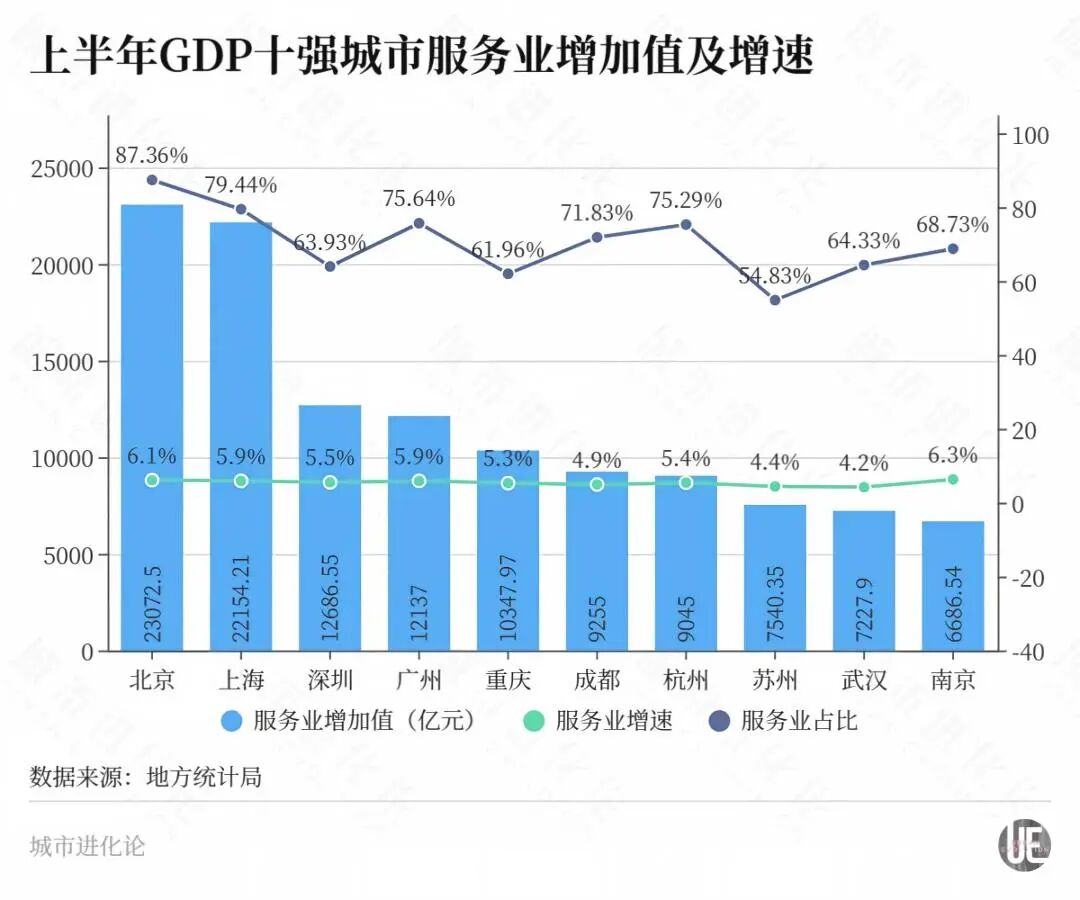
Hangzhou is one of them.
A set of data repeatedly mentioned by local media is that after the proportion of Hangzhou's service industry added value exceeded 70% in 2023, it rose all the way, increasing by 5 percentage points in 3 years, further exceeding 75% in the first half of this year, and the gap with Guangzhou narrowed to 0.3 percentage points.
In fact, Hangzhou has not relaxed its efforts to develop the manufacturing industry. In the past few years, under the goal of building a "global advanced manufacturing base", Hangzhou has reshaped its industrial geography, built the East City Intelligent Manufacturing Corridor, and promoted the mutual promotion between the corridor and the West City Science and Innovation Corridor. On the other hand, it has reconstructed the industrial structure and built the "296X" advanced manufacturing cluster, aiming to break the "obvious deficiencies" of the manufacturing industry in total volume, growth rate, investment, industrial level and enterprise attraction capacity.
But at the same time, the service industry is still taken as the key development direction by Hangzhou. From the policy perspective alone, since 2022, Hangzhou has held high-profile conferences on the high-quality development of modern service industry for three consecutive years, with a view to further promoting the upgrading of the service industry's capacity.
At the service industry conference held this year, Liu Fei, Secretary of the Hangzhou Municipal Party Committee, further pointed out that the service industry is the "main driving industry" for Hangzhou to promote economic and social development, which is related to industrial development, economic circulation and people's livelihood employment. It is necessary to "take the expansion and quality improvement of the service industry as a major task, continuously achieve new results, and continue to be at the forefront of the country".
"Dual 70%"
Why does Hangzhou continue to promote the increase of the proportion of the service industry under the requirement of stabilizing the proportion of industry? One reason is that Hangzhou experienced the debate between manufacturing and service industry very early.
There is a consensus that 2000 was the starting point for Hangzhou to promote the strategy of "prospering the city through industry" in the new era. After that, Hangzhou's total industrial output value grew at a speed of crossing a 100-billion-yuan level almost every year, reaching 800 billion yuan by 2007.
The 2008 financial crisis became a turning point for Hangzhou's development. In the following years, Hangzhou's GDP growth rate once dropped to the bottom among sub-provincial cities. Problems such as lack of land resources and high prices of production factors made it difficult for the manufacturing industry to maintain the original development model. Also in 2008, Hangzhou officially proposed the development strategy of "priority to the service industry", and achieved the iconic transformation of the industrial structure of "three-secondary-primary" in the next year, which became a new starting point for Hangzhou to develop the service industry.
The starting point of the transformation to the service industry is the electronic information industry that Hangzhou later takes pride in. For example, Liu Ting, former deputy director of the Zhejiang Provincial Development and Reform Commission, once pointed out that from the strategy of "prospering the city through industry" to the "No.1 Project" of information economy, Hangzhou's economy has achieved a strategic leap from being led by industrialization to informatization, and from being dominated by industrial economy to information economy, which has become the major background for the leading development of Hangzhou's new economy.
Up to now, more than ten years of accumulation in the service industry has in turn become the key for Hangzhou to promote manufacturing.
Last year, Hangzhou's "Six Little Dragons" became a hit, which was regarded as a milestone mark of Hangzhou's transition from the "e-commerce era" to the "AI era". But if you take a closer look at the "Six Little Dragons", stripping off the shell of "hardcore manufacturing", it is exactly the core support of Hangzhou's service industry represented by the digital economy.
Among them, Game Science and DeepSeek, which became popular earlier, are backed by the advantages of Hangzhou's software and information service industry — in 2025, the revenue of the information service industry above designated size alone exceeded 1.3 trillion yuan; even Unitree Robotics, which focuses more on hardware development, has expanded its business in many cities across the country in the past year and accessed the industrial chains of major manufacturing cities such as Chongqing, but Hangzhou, as its R&D center, still focuses on the advantages in digital economy, scientific and technological innovation, and the integration of digital and real economy.
As the article published on the WeChat official account of Hangzhou Investment Promotion Bureau pointed out, this is actually injecting Hangzhou's innovation genes into the national industrial chain and innovation chain, so that such a city "is truly worthy of the title of 'national strategic force'". To achieve this goal, Hangzhou's service industry can not only be the "worldly life atmosphere" of consumer services, but more importantly, it should act as the producer services that serve as the "accelerator" of the manufacturing industry.
Looking at the composition of "Hangzhou's service industry", the keyword is exactly "producer services" — a set of data repeatedly cited by local Hangzhou media shows that as early as 2024, the ratio of producer services to the added value of the service industry in Hangzhou reached 63.2%, exceeding Shanghai and second only to Beijing.
In the 5.3% growth rate of Hangzhou's service industry last year, the revenue of information transmission, software and information technology services maintained double-digit growth for 11 consecutive months, with an annual growth of 13.4%.
Compared with the international "two 70%" indicators that are often used to observe the level of urban economic development, the proportion of Hangzhou's service industry has "exceeded the line", and the next step is to fill the gap of producer services.
"Unbalanced Development"?
In this sense, for Hangzhou, a more fundamental question is whether it is necessary to maintain the proportion of the manufacturing industry unchanged?
Last year, at a conference on producer services in Hangzhou, Huang Qifan, former mayor of Chongqing, put forward an "Apple Question":
Apple does not build factories, has no production lines, and does not engage in manufacturing. Why does it take away most of the profits of the product? The reason is that it firmly grasps all links of producer services, including R&D, logistics distribution, market access, inspection and testing, digital empowerment, financial settlement, sales and after-sales services, etc. These are the foundation of the industrial chain and the giver of the core value of the industrial chain.
In other words, to increase the added value of the manufacturing industry, it must extend to links such as R&D and design, industrial software, supply chain management, brand services, and financial services. It is these producer services that ultimately determine the profit of the manufacturing industry and the added value of the industry, and determine the gold content of modern manufacturing.
Furthermore, some insiders summed up the development path of Hangzhou's "Six Little Dragons" as a "soft driving hard" development model with Hangzhou's characteristics. Compared with the advantages of Beijing, Shanghai and Shenzhen in computing power infrastructure and talent density, Hangzhou's artificial intelligence industry, based on the advantages of digital economy and service industry, is expected to explore a characteristic path of promoting innovation through application and gathering resources through ecology.
It is difficult to fully reflect the quality of the development of the local manufacturing industry only through the change of numbers.
Liu Ting once recalled in an interview that a few years ago, Hangzhou's economic growth rate once ranked at the bottom of the province. The local government was anxious and wondered whether to reintroduce heavy chemical industry and raise the proportion of manufacturing. After the debate, there was a sober judgment: the root cause of Hangzhou's problem is not that there is not enough industry, but that the producer services are not strong enough. It is not cost-effective to sacrifice invisible competitiveness for visible numbers.
One reason is that different from the "explicit" manufacturing industry, the manufacturing growth driven by producer services is relatively "invisible", and many places have realized this problem. According to media reports, in order to make this part of manufacturing data visible, Jiangsu has changed the assessment method of the manufacturing industry, instead of assessing the proportion of the secondary industry in isolation, it takes the combined proportion of the manufacturing industry and producer services in GDP as the assessment standard, "the former is the 'skeleton', the latter is the 'muscle', and looking at either one alone will be distorted".
From the national perspective, policies are also changing.
In the outline of the 15th Five-Year Plan, the expression of "keeping the proportion of manufacturing basically stable" has been replaced by "reasonable proportion". Xiao Rongmei, deputy director of the Policy and Economics Research Institute of the China Academy of Information and Communications Technology, and others once wrote that this means "after fully considering various internal and external risk shocks, and taking into account the development stage and industrial structure, the proportion of manufacturing is allowed to fluctuate within a certain reasonable range", "not only pursuing the expansion of manufacturing scale, but also striving to achieve systematic improvement of quality".
Under the new round of adjustment, how should we re-examine the judgment of Hangzhou's "unbalanced development" in the service industry? Where is the "reasonable proportion" of Hangzhou's manufacturing industry? Hangzhou has made its own judgment. According to the "Three-Year Action Plan for Accelerating the Development of Manufacturing Industry in Hangzhou (2025-2027)", by 2027, the total added value of industrial enterprises above designated size will reach 530 billion yuan, with an average annual growth of more than 6%, and the proportion of industrial added value in GDP will be more than 22%.
This article is from the WeChat official account "City Evolution", author: Yang Qifei, published with authorization from 36Kr.