Xiaomi lost 5.7 billion yuan in half a year, burning massive capital to expand its presence in the automotive and AI sectors, and the Pengcheng series has not affected its existing vehicle models.
Automobile revenue increased by 15.9% year-on-year, Lu Weibing: We have already contacted distributors in multiple countries.
Lu Weibing: The user group of the Pengcheng model has very little overlap with existing models, and overseas distributors have shown extremely high attention to Xiaomi Auto.
Che Dong Xi August 18 news, just now, Lu Weibing, Partner and President of Xiaomi Group, and Steven Lam, Vice President and Chief Financial Officer of Xiaomi Group, responded to questions related to the business and financial performance of Xiaomi Group in the second quarter of 2026 during a conference call.
In the smart electric vehicle business section, Lu Weibing and Steven Lam mainly answered 5 related questions.
1. The user group of the Pengcheng model has very little overlap with existing models.
2. Xiaomi Pengcheng N90 Max and Pengcheng N70 Max have not been finally priced yet, and their impact on gross profit margin is still unclear.
3. This year we have visited multiple countries for inspections, and overseas automotive distributor partners have extremely high attention to Xiaomi Auto and are very eager to sell Xiaomi Auto products.
4. It is difficult to give a specific sales ratio for range-extended models and pure electric models at present.
5. The fluctuation of average selling price per vehicle is caused by changes in product mix.
Combined with the financial report, in the second quarter of 2026, Xiaomi Group's total revenue reached 108.9 billion yuan, and the adjusted net profit was 6.2 billion yuan. The revenue of Xiaomi Group's innovative business segment including smart electric vehicles and AI was 24.9 billion yuan, of which the revenue of smart electric vehicles was 23.9 billion yuan, a year-on-year increase of 15.9%.
In terms of losses, in the second quarter of 2026, the operating loss of Xiaomi Group's innovative business segment including smart electric vehicles and AI was 2.6 billion yuan, expanding by about 766.67% year-on-year.
In terms of gross profit margin, in the second quarter of 2026, the gross profit margin of Xiaomi Group's innovative business segment including smart electric vehicles and AI was 19.2%, down 7.2 percentage points year-on-year and 0.9 percentage points quarter-on-quarter.
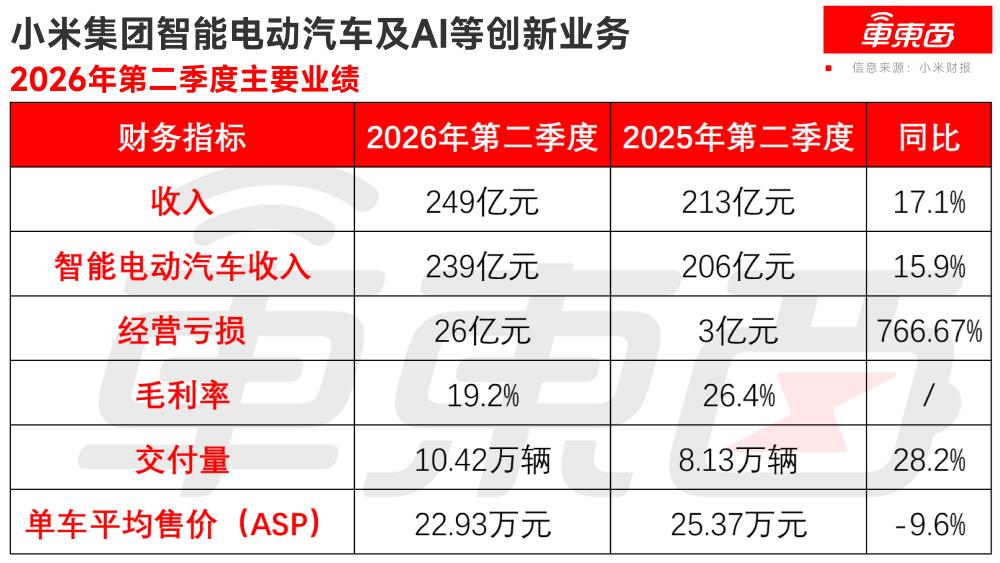
Financial performance of Xiaomi Group's innovative business segment including smart electric vehicles and AI
In terms of sales volume, Xiaomi Auto delivered 104,200 units in the second quarter of 2026, a year-on-year increase of 28.2%.
01. The Pengcheng user group has little overlap with existing models, and overseas distributors pay high attention to Xiaomi Auto
At the financial report meeting, Lu Weibing and Steven Lam mainly answered 5 questions related to the automotive business.
1. Judging from the current small reservation situation, what are the characteristics and changes of the user profile of Xiaomi's Pengcheng model? Compared with range-extended SUVs of competitors, what aspects do these early reservation owners particularly favor?
Lu Weibing: When we were planning the Pengcheng series, we were very clear that it must be positioned differently from our existing SU7 and YU7 products, and the users are also different, otherwise there will be a huge internal user cannibalization.
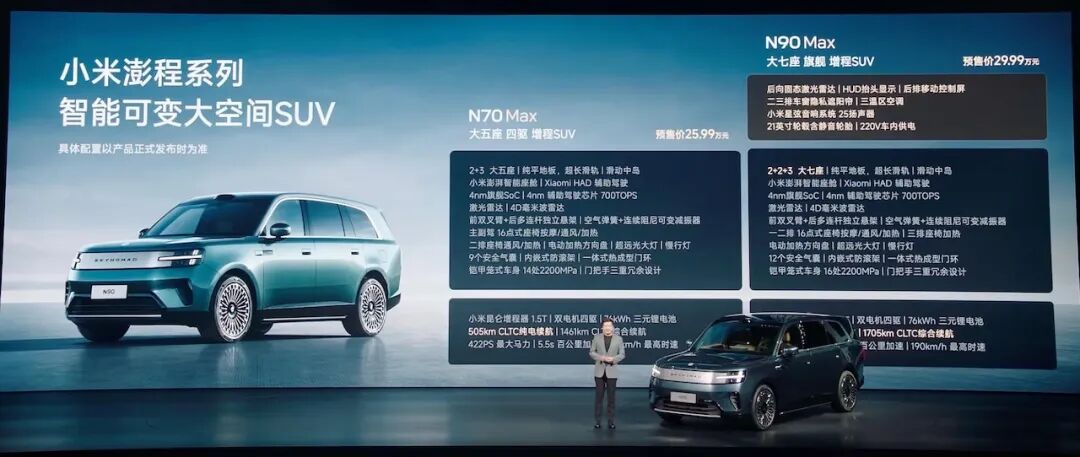
Pre-sale price of Xiaomi Pengcheng series models
At present, this goal has been basically achieved very well. The user group of the Pengcheng model has very little overlap with the users of the SU7, and also very little overlap with the YU7 which is also an SUV. We estimate that the overlap degree may only be about 10% to 20%.
I think the reason why the Pengcheng series has very little overlap with SU7 and YU7 is that their positioning is different. SU7 and YU7 are positioned as cars for drivers, and we emphasize their driving experience very much, while the Pengcheng series is designed for space.
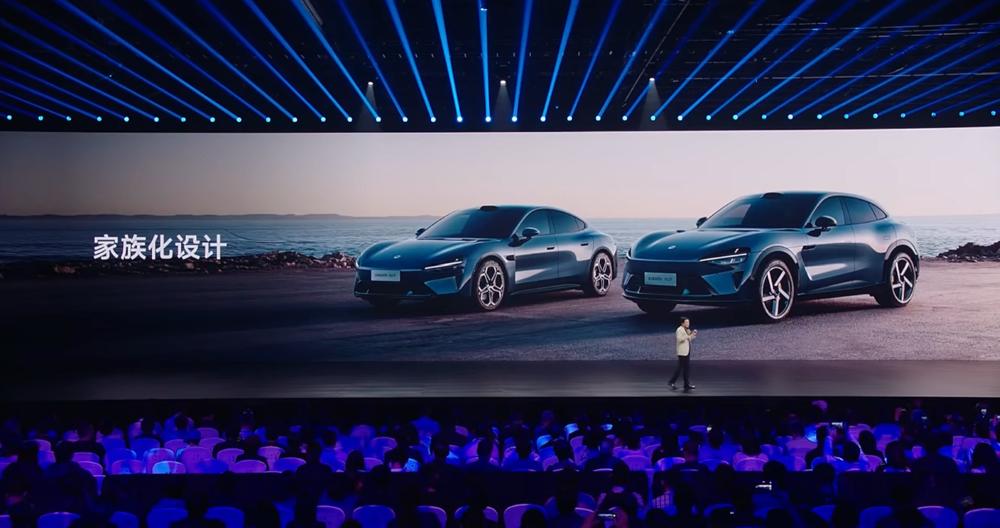
Xiaomi YU7 and Xiaomi SU7
While being designed for space, we are different from traditional SUVs. We have created a versatile space that can expand to a huge number of scenarios.
After the pre-sale of the Xiaomi Pengcheng series was launched, we received a large number of small reservation orders, and we also conducted analysis on the users.
The first characteristic is that the scenarios of family car purchase or multi-person riding are much more than those of SU7 and YU7. SU7 and YU7 are mostly used for individual driving or two-person driving, which is completely different, leading to the average age of users being several years older than that of SU7 and YU7 users.
And I think everyone pays extremely high attention to the versatile space of our Pengcheng series. Although users have not been able to experience the actual car yet, they have thought of a lot of scenarios, even many scenarios that we did not expect when designing the car.
The Pengcheng series will be officially released in September, and we are relatively optimistic about its order expectations.
2. The gross profit margin of the automotive business in the second quarter fluctuated both year-on-year and quarter-on-quarter. What are the specific reasons? Will the Pengcheng model affect the gross profit margin in the future?
Steven Lam: On a year-on-year basis, our gross profit margin data in Q2 last year was relatively ideal for SU7 Ultra, so our gross profit margin in Q2 last year was relatively high. The delivery volume of SU7 Ultra in this quarter is still much lower than that of the same period last year.
On a quarter-on-quarter basis, we delivered more of the new generation SU7, which is a product we released in March. The delivery ratio of SU7 and YU7 in the second quarter is different from that in the first quarter.
Mr. Lei (Lei Jun, Founder, Chairman and CEO of Xiaomi Group) also said at the press conference that the cost of our new generation SU7 has increased a lot, so when the delivery proportion of the new generation SU7 is relatively high, the gross profit margin will decline to a certain extent quarter-on-quarter.
The third reason is that our large model business revenue has just started, which has a certain negative impact on the gross profit margin of our entire segment.
As for Xiaomi Pengcheng N90 Max and Pengcheng N70 Max, we have not made the final pricing yet, so I think the impact on the gross profit margin can only be seen after the final pricing is determined.
3. Are there any preparations for the layout of the automotive business in overseas markets? For example, in terms of overseas venues?
Lu Weibing: We have always said that we will go overseas in the second half of 2027. This year we have visited many countries. After the visits, we found that overseas automotive distributor partners have extremely high attention to us, are very eager to sell our products, and try every means to become Xiaomi's dealers in the future. Their enthusiasm is very high.
The reason for their high enthusiasm is that I think everyone has a very important judgment. The first judgment is that the overseas expansion of China's smart electric vehicles will become the mainstream in the future. This trend is unstoppable and a definite trend.
The second is that among so many Chinese brands going overseas, which distributors will choose to cooperate with? This is a very important judgment criterion. I think first of all, Xiaomi's positioning in the full ecosystem of people, cars and homes is unique in the world, and secondly, Xiaomi is one of the few Chinese brands that can build a high-end brand.
The third point is that distributors see that Xiaomi is a technology company making cars, not a traditional car manufacturer.
I think almost all the dealers we have contacted in various countries are top dealers. Basically, at least 7 or 8 of the top 10 top dealers in a country will take the initiative to contact us.
After our board meeting in Hong Kong, we will go to Europe to visit many more countries to conduct market research and customer inspections in this regard.
4. What proportion of Xiaomi Auto's sales will range-extended models account for?
Lu Weibing: It is difficult to disclose the specific proportion at present. SU7 and YU7 are built on the Modena platform, and the Pengcheng series is built on the Kunlun platform. For these two platforms, our goal is definitely to advance side by side in the future.
5. The unit price of Xiaomi electric vehicles declined in the second quarter, but the cost may continue to increase. What is the prospect of gross profit margin or profit margin?
Steven Lam: The fluctuation of ASP (Average Selling Price per vehicle) is actually based on our product mix. More YU7 was delivered in the first quarter, and more SU7 was delivered in the second quarter. As you know, the price of SU7 is lower than that of YU7, which will cause some fluctuations in ASP.
In the second quarter of last year, our SU7 Ultra delivery proportion was much higher than that of this year, and the ASP of SU7 Ultra is much higher than the average. So I think ASP is a result for us, not a goal. ASP has little to do with gross profit margin. A low ASP does not mean that our gross profit margin is low.
02. The business segment's revenue in the second quarter increased by 17.1% year-on-year, with a loss of 2.6 billion yuan
In the first half of 2026, the competition in the automotive industry was extremely fierce. What is the actual financial performance of Xiaomi's automotive business?
According to the second quarter 2026 performance announcement released by Xiaomi Group, the revenue of Xiaomi Group's innovative business including smart electric vehicles and AI in the second quarter of 2026 was 24.9 billion yuan, a year-on-year increase of 17.1% from 21.3 billion yuan in the same period of last year; accounting for 22.9% of Xiaomi Group's total revenue in the second quarter of 2026, an increase of 4.6 percentage points compared with the same period of last year.
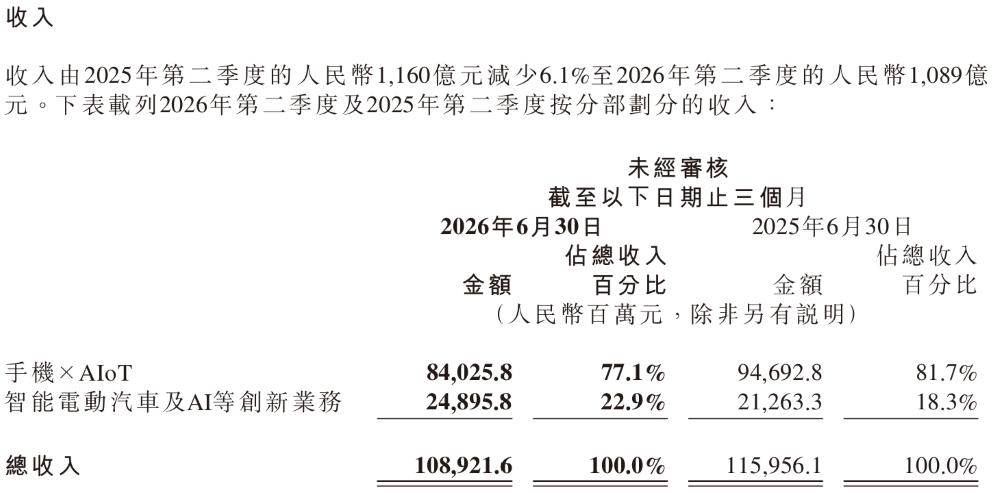
Proportion of revenue of each business of Xiaomi Group in the second quarter of 2026
Among them, the revenue of smart electric vehicles was 23.9 billion yuan, a year-on-year increase of 15.9% from 20.6 billion yuan in the second quarter of 2025. Xiaomi stated that this was mainly due to the increase in automobile delivery volume, partially offset by the decline in automobile ASP (Average Selling Price per vehicle).
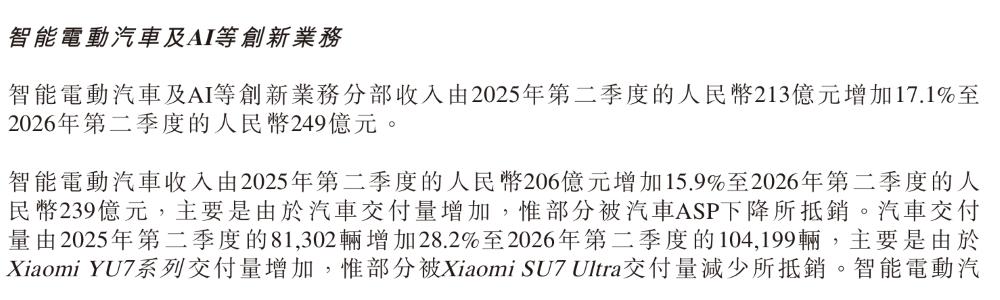
Smart electric vehicle revenue of Xiaomi in the second quarter of 2026
In terms of operating loss, the operating loss of Xiaomi Group's innovative business segment including smart electric vehicles and AI in the second quarter of 2026 was 2.6 billion yuan, expanding by about 766.67% compared with 300 million yuan in the second quarter of 2025.

Operating loss of Xiaomi Group's innovative business segment including smart electric vehicles and AI in the second quarter of 2026
In the first quarter of 2026, the operating loss of Xiaomi Group's innovative business segment including smart electric vehicles and AI was 3.1 billion yuan. After calculation, the operating loss of this segment in the first half of 2026 can be obtained as 5.7 billion yuan.
In terms of gross profit margin, in the second quarter of 2026, the gross profit margin of Xiaomi Group's innovative business including smart electric vehicles and AI was 19.2%, down 7.2 percentage points from 26.4% in the second quarter of 2025, and down 0.9 percentage points from 20.1% in the first quarter of 2026. Xiaomi explained that this was mainly due to the decline in the delivery proportion of Xiaomi SU7 Ultra, the rise in prices of core components and the increase in costs related to AI business.
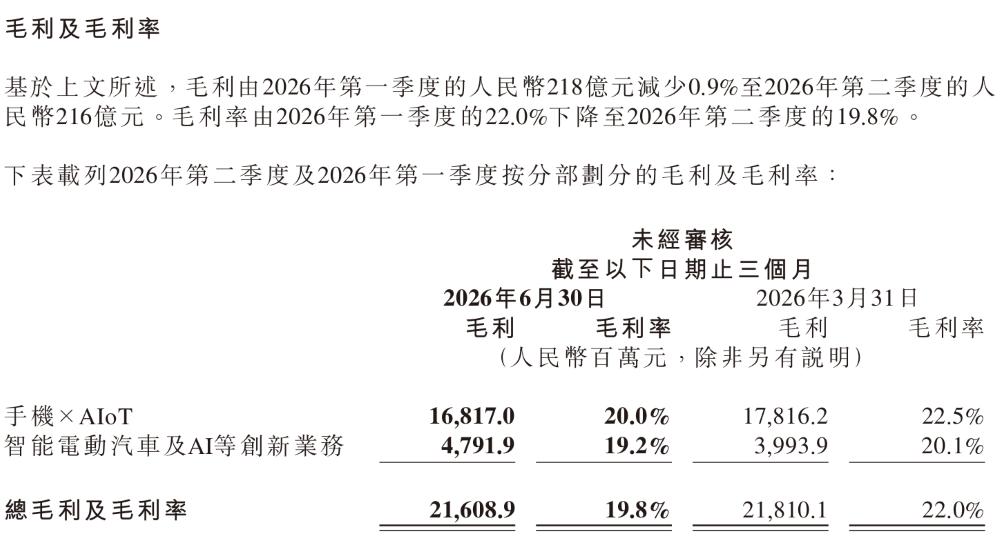
Gross profit and gross profit margin of each business of Xiaomi Group in the second quarter of 2026
In terms of Average Selling Price per vehicle (ASP), the ASP of Xiaomi's smart electric vehicles in the second quarter of 2026 was 229,300 yuan per vehicle, a decrease of 9.6% from 253,700 yuan per vehicle in the second quarter of 2025. Xiaomi explained that this was mainly due to the decline in the delivery proportion of Xiaomi SU7 Ultra.
