Earning 130 million yuan a day: AI servers are selling like hotcakes
Recently, a company has been making extremely high profits. Foxconn Industrial Internet released its financial report. Driven by the skyrocketing demand for AI servers, the company earned 23.7 billion yuan in net profit in the first half of the year, averaging 131 million yuan in net profit per day.
This already sounds incredibly impressive. But look at another figure: its net profit margin is only 4.26%.
What does that mean? It means that for every 100 yuan of products sold, only 4.26 yuan ends up in its pocket.
So despite Foxconn Industrial Internet earning over 100 million yuan a day, what it makes is actually "hard-earned money": it engages in ODM (design, production, assembly) for AI servers.
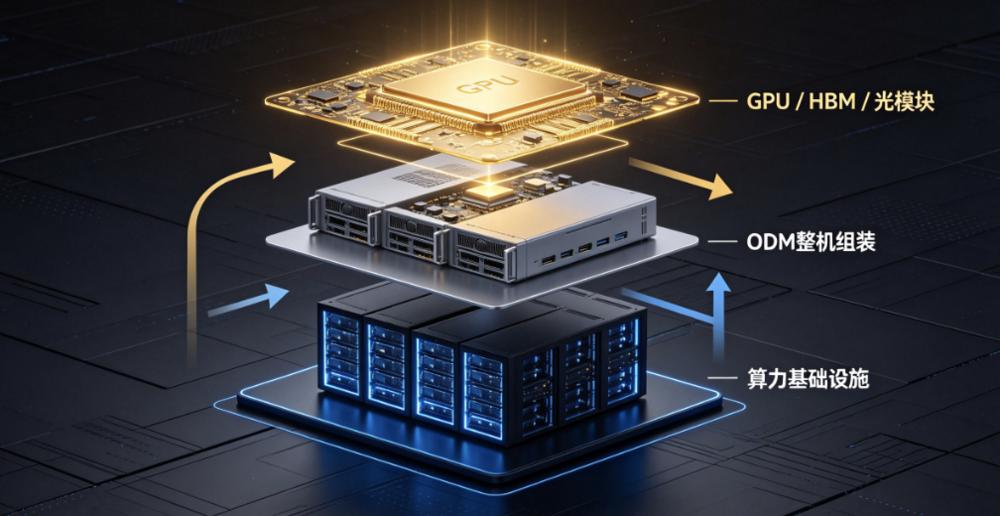
JIAN Jingjing, Partner and Head of the AI Team at MIR, told Pencil News: "For ODM manufacturers like Foxconn Industrial Internet, the gross profit margin at this stage is indeed not high. They earn processing service fees, the hard-earned money from complete machine assembly. The segments with really high profits are upstream components: GPUs, HBM high-speed memory, high-speed networks, liquid cooling heat dissipation and temperature control, and power distribution systems for computer rooms."
In other words, in the AI server industrial chain, the truly lucrative profits are hidden in the upstream. GPUs, HBM high-speed memory, high-speed networks, liquid cooling heat dissipation, and computer room power distribution — these seemingly inconspicuous components may be far more profitable than complete machine assembly.
On the surface, the more popular AI servers sell, the people who actually hide behind and count the money are not the complete machine assemblers, but the sellers of key components.
- 01 - Soaring revenue, razor-thin profit
Let's start with the figures — why do we say Foxconn Industrial Internet makes hard-earned money?
In the first half of 2026, Foxconn Industrial Internet posted revenue of 557.861 billion yuan, a year-on-year increase of 54.64%.
Among this figure, revenue from AI servers rose 2.3 times year on year, and shipment volume of GPU AI cabinets increased 3.2 times year on year. Revenue in the second quarter alone reached 306.783 billion yuan, hitting a new all-time high. Driven by the rapid volume growth of high-gross-margin AI server cabinets, the company's gross profit margin reached 7.15% in the first half of the year, up 0.55 percentage points from the same period last year.
Revenue rose by 54%, and profit rose by 96% — almost doubling. It looks extremely impressive, but the gross profit margin is only 7.15%, and the net profit margin is only 4.26%.
Why does Foxconn Industrial Internet have such high revenue but such thin profit?
JIAN Jingjing's view is: "ODM manufacturers like Foxconn Industrial Internet earn processing service fees, the hard-earned money from complete machine assembly."
To put it another way: they sell a lot, but the selling price is very low.
The business logic of Foxconn Industrial Internet is very simple: assembling AI servers for cloud vendors. For one AI server, more than 55% of the cost goes to the GPU. What Foxconn Industrial Internet earns is the service fee for assembly, testing, transportation and after-sales support, with a gross profit margin of only 7%. For a server priced at 1 million yuan, the gross profit is only 70,000 yuan, and after deducting all kinds of expenses, the net profit is only around 40,000 yuan.
While NVIDIA sells one B200 chip with a manufacturing cost of about 6,400 US dollars, the terminal selling price ranges from 30,000 to 40,000 US dollars. The gross profit of one single chip exceeds 20,000 US dollars. The net profit that Foxconn Industrial Internet earns from assembling a complete AI server may not even reach a fraction of the profit of one GPU chip.
This is exactly what JIAN Jingjing said: "One NVIDIA H100 chip sells for tens of thousands of US dollars, how many percentage points of profit can Foxconn Industrial Internet earn from assembling one AI server? This is the reality of profit distribution in the industrial chain."
- 02 - Upstream players take the lion's share, midstream players get the crumbs
JIAN Jingjing's judgment is very straightforward: "The segments with really high profits are upstream components: GPUs, HBM high-speed memory, high-speed networks (optical modules + switches), liquid cooling heat dissipation and temperature control, and power distribution systems for computer rooms.
The profit margins of these segments are not at the same level as that of complete machine assembly at all."
Take GPU as an example — NVIDIA's full-year revenue for fiscal year 2026 reached 215.9 billion US dollars, 193.7 billion of which came from the data center business. Its gross profit margin hit 71.1%, and peaked at 75% in a single quarter. The manufacturing cost of one B200 chip is 6,400 US dollars, and it is sold at 30,000 to 40,000 US dollars. The profit of one single chip is higher than the profit of assembling one complete server. The CUDA platform is the operating system of the AI era, developers cannot do without it, and cloud vendors have no alternative options.
Take wafer foundry as an example — TSMC's gross profit margin in Q1 2026 reached 66.2%, exceeding market expectations. Its 4nm and 3nm production lines are fully loaded throughout the year, and its advanced packaging capacity has already been pre-sold to 2027. No matter who makes profit or suffers loss, all chips have to be manufactured by TSMC.
Take HBM high-speed memory as an example — SK Hynix's revenue in the first half of 2026 reached 131.9 trillion won, up 230.8% year on year. Its net profit hit 134.15 trillion won, up 788% year on year. Its gross profit margin is 81.63%, even higher than that of NVIDIA. Its products are in short supply, and all the orders it signs are long-term orders worth tens of billions of US dollars. NVIDIA itself is also its customer, contributing about 29% of SK Hynix's total revenue.
Take high-speed networks (optical modules + switches) as an example — Innolight's revenue in Q1 2026 reached 19.496 billion yuan, up 192% year on year. Its net profit hit 5.735 billion yuan, up 262% year on year. The profit it earned in one single quarter exceeded half of its total profit in 2025. For the more upstream optical chips, the gross profit margin has exceeded 80%.
Take liquid cooling heat dissipation & temperature control and computer room power distribution systems as an example — The power consumption per single rack in AI data centers has soared from the traditional 8-15kW to 132kW for NVL72. Liquid cooling and power distribution have changed from "optional accessories" to "rigid demands". Vertiv's backlog of orders in Q1 2026 reached 15 billion US dollars, doubling year on year. For domestic manufacturers, Envicool posted revenue of 6.068 billion yuan in 2025, up 36% year on year, and its revenue in Q1 2026 reached 1.175 billion yuan, up 26.03% year on year.
While server OEM is indeed the segment with the thinnest profit. Foxconn Industrial Internet has a gross profit margin of 7.15% and a net profit margin of 4.26%. More than 55% of the cost of one AI server is spent on GPUs, and OEMs have no pricing power.
- 03 - Is computing power investment a good business?
High profit in upstream segments is one thing, the more critical question is: how long can this high prosperity last? The answer ultimately depends on whether the demand for computing power will continue to grow. JIAN Jingjing's judgment is: "The intelligent computing market is not a bubble, and the self-built private domain computing power of governments and enterprises will see explosive growth."
In the past, the main buyers of computing power were large internet companies and cloud vendors. Now, there is a clear change: more and more traditional enterprises are starting to build their own computing centers.
JIAN Jingjing shared one case: A component enterprise with an annual output value of about 5 billion yuan invested more than 10 million yuan in the first half of 2026 to build private domain computing power. It adopted NVIDIA servers as hardware, added a liquid cooling system for cooling, and got algorithm support from Alibaba and ByteDance.
These computing power resources are not used for "showcase", but directly integrated into the core business of the enterprise.
For example, this company is building a national integrated management system covering production, supply chain and sales. Previously, if the boss heard that a certain customer was developing new products for overseas markets, he had to inquire layer by layer. Now AI can directly push the information to the corresponding salesperson, the salesperson will go to the site for verification immediately, and then feed back the results.
This shows that AI is evolving from a "novelty tool" to a real productivity tool that penetrates into production, supply chain and sales segments. Out of considerations for data security and compliance, many enterprises are more willing to build their own private domain computing power.
As demand grows, capital expenditure is also rising. In Q1 2026, the total capital expenditure of the four major North American cloud vendors reached 131.63 billion US dollars, up 70.3% year on year; the figure further rose to about 163.9 billion US dollars in Q2, up 86% year on year. The full-year capital expenditure guidance has been revised up to about 745 billion US dollars.
Domestically, relevant parties are also increasing investment, and the construction of the computing power network during the "15th Five-Year Plan" period will add 4 trillion yuan of direct investment. JIAN Jingjing concluded that there are two driving forces behind this round of computing power expansion: policy promotion and real market demand.
But the return on many current computing power projects is not very high. The reason is very straightforward: the commercialization of AI is not yet fully mature. "Once algorithm models achieve gradual breakthroughs, the demand for AIDC will see explosive growth."
In other words, the problem now is not that there is no demand for computing power, but that the construction of computing power is running ahead of commercialization.
- 04 - Who else can make profits in the future?
The general direction of the industrial chain will not change in the short term, but JIAN Jingjing judges that with technological breakthroughs, new profit-making opportunities will emerge.
The overall structure of the AIDC industrial chain is fixed: servers + networks + infrastructure. The high-profit components at this stage are still undergoing continuous technical upgrading as computing power improves. In the short term, the categories of core components with high profits will not change significantly.
But opportunities lie in the details. Especially in the power sector — once the 800V DC + SST solution becomes the mainstream, a number of new high-profit components will emerge. Eaton has cooperated with NVIDIA to launch a power supply solution for AI factories, taking solid-state transformers as the core component of the 800V high-voltage DC power supply architecture, which is specially designed for NVIDIA NVL72 racks. Relevant technologies are still in the verification stage and have not yet entered large-scale commercial use — but once they achieve breakthroughs, the profit space will be considerable.
The actual implementation of AI applications in China has been more mature than that in the United States. Although the US AI market is larger in scale, China has more in-depth AI applications in manufacturing, finance, healthcare, education and other fields. Relying on the advantages of low cost and application focus, China's large models have accounted for two-thirds of the global call share.
The profit logic of the AI industrial chain can be summed up in one sentence: whoever holds scarce resources can earn more profits. When shovels are in short supply, the people who sell shovels make the most money; when shovels are sufficient, the people who use shovels start to make money. When the algorithm models are mature and the demand for computing power truly explodes, the profit distribution at that time will be the beginning of the next round of game. Before that, the pattern where upstream players take the lion's share and midstream players get the crumbs will last for a period of time.
The fact is — shovels are still in short supply right now.
JIAN Jingjing's conclusion is very clear: "The short-term return on computing power investment is not optimistic, but if you do not invest, you will fall behind. This is not a bubble, it is an infrastructure race in the next ten years."
The content of this article is for reference only, and does not constitute any investment advice.
This article comes from the WeChat official account "Pencil News" (ID: pencilnews), author: Song Ge, editor: Wang Fang, published by 36Kr with authorization.