US stock: A vastly undervalued, little-known potential AI stock that industry giants are scrambling to partner with
There is a US-listed company whose share price was only $13 at the close last Wednesday, with a market capitalization of merely $3 billion.
Yet this seemingly obscure small company has recently been involved in the data center projects of both Anthropic and Meta at the same time — it is a participant behind Anthropic's 470-megawatt super order and Meta's 366-megawatt data center power project.
Meanwhile, its backlog of unfulfilled orders has surged directly from $170 million to $1.7 billion, a full 10-fold increase.
It is the first unusual point that Anthropic did not turn to those established industry giants but chose to hand such a large project to this small company.
With $1.7 billion in orders in hand, the market only values the company at $3 billion — that is the second unusual point.
Are these two "mismatches" caused by the market's unspoken concerns, or is the market yet to truly understand this company?
Today we will thoroughly explain three core questions:
First, what exactly is its core competitiveness? Is its technology irreplaceable, or does it just fill the most critical gap that AI data centers are most lacking right now?
Second, how much of the $1.7 billion in orders is inflated, and how much of it can eventually be truly converted into revenue and profits?
Third, is this explosive growth a one-off event, or has the expansion of AI data centers just opened a long-term track for it?
Finally, US Stock Investment Network will answer the question that most people care about:
Now that its share price is below $20, is it worth buying? Is it just a small-cap stock that has already been hyped up, or a dark horse that truly has the potential to rise 5 times or even 10 times in value?
What kind of company is EROC exactly?
This company is ERock, with the US stock ticker EROC, which was just listed in June this year.
What it does can be clearly explained in one sentence:
The AI data center has been built, and GPUs have been purchased, but the grid power is not yet connected. What should you do? EROC will deliver power to you first.
This is its core business.
When many people hear "data centers are short of power", their first reaction is to think of energy companies such as GEV, CAT, CMI, BE and FLNC, but the businesses they are engaged in are not exactly the same.
GEV focuses on large power generation equipment, CAT and CMI mainly sell engines and generators, BE manufactures fuel cells, and FLNC is mainly engaged in energy storage.
But EROC is targeting a more urgent problem:
The data center needs to be put into operation right now, but the public grid may take another one or two years to be ready. How to solve this?
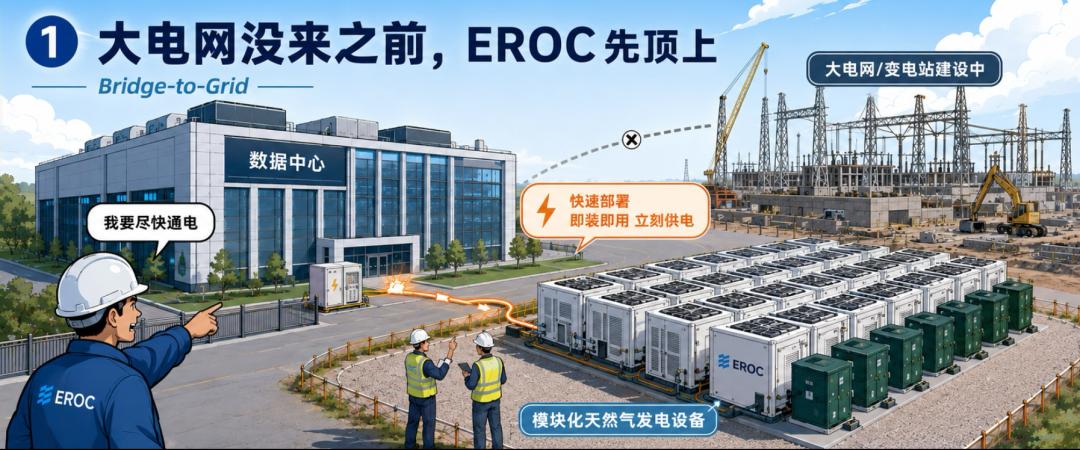
EROC's answer is Bridge-to-Grid.
Simply put, it means: before the main grid is available, we will provide you with power supply as a temporary substitute.
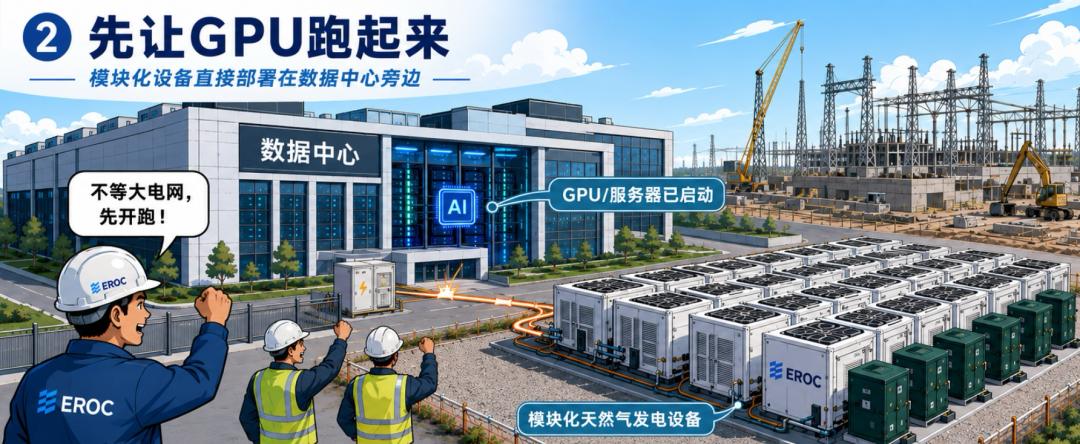
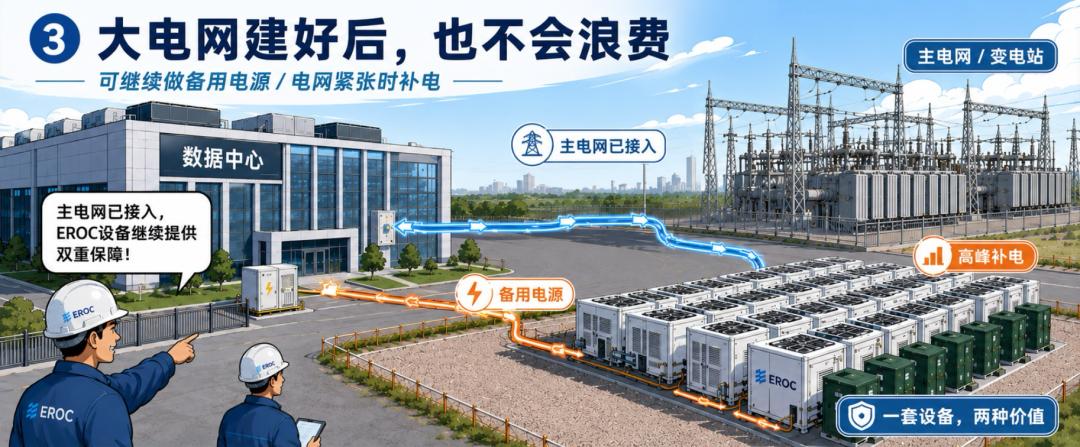
It will deploy modular natural gas power generation equipment directly next to the data center to get the GPUs running first. When the grid and substations are completed in the future, these equipment will not be wasted, and can continue to be used as backup power supplies, or provide supplementary power when the grid is under strain.
Therefore, EROC does not simply sell several generators.
It can provide full services from design, approval, natural gas access, to equipment installation, commissioning, and post-operation maintenance.
The US Stock Investment Network believes that you can understand it this way:
Customers only put forward one requirement — I need to get power as soon as possible. EROC will handle all the rest for you.
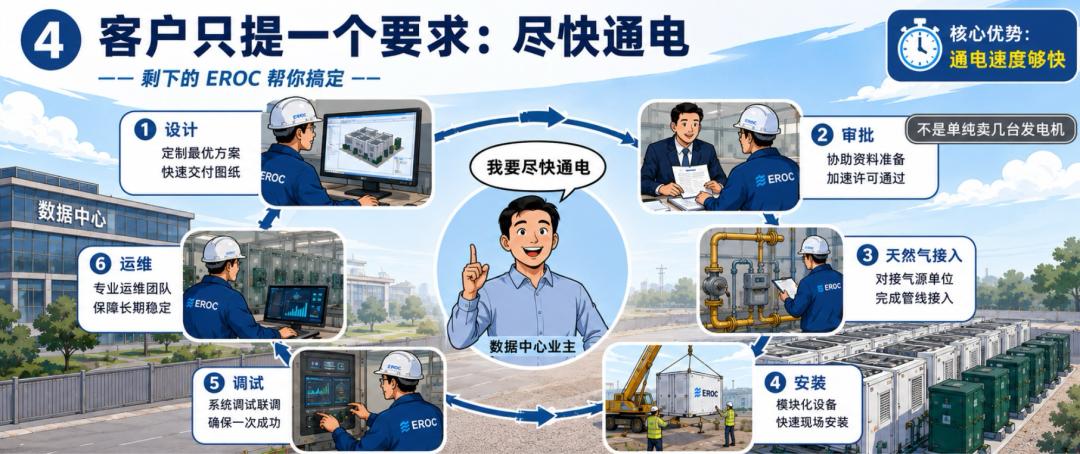
This is also why its core advantage is not "the cheapest electricity", but the extremely fast speed of power supply.
For AI companies like Anthropic and Meta, this point is very critical. Because a data center may be equipped with GPUs worth billions of dollars. If the operation is delayed for half a year due to waiting for the grid, the real loss is not the small amount of electricity bill, but the fact that these GPUs cannot generate revenue for half a year. So essentially, what they buy from EROC is not electricity. It is time.
Meta's 366-megawatt data center project follows this model: the grid is not fully ready yet, EROC first provides transitional power to allow the data center to operate in advance. After the official grid is connected, this set of equipment can continue to be used as backup or dispatchable power supply.
Now Anthropic has placed another 470-megawatt order with it, and its production schedule has been arranged as far as 2028.
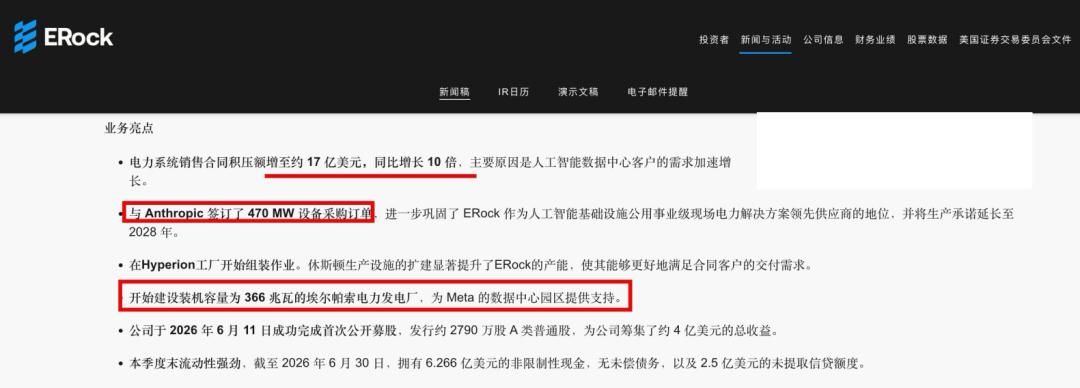
These two projects at least prove one thing:
EROC's model of "power supply first, grid connection later" has been truly adopted by large AI clients.
Therefore, when looking at EROC, do not regard it as an ordinary power generation equipment company.
What it is really betting on is a very realistic trend:
In the past, data centers competed for who could get GPUs first.
Now that GPUs are available, the new bottleneck has become —
Who can deliver power the fastest.
What EROC is seizing right now is exactly this position.
It does not have any black technology that others can never replicate, but it has proven one thing through the two large projects of Meta and Anthropic:
It has the ability to successfully deliver large-scale projects in the field of "delivering power in the fastest way".
This is the most notable value of EROC.
The next stage of competition lies in delivery capacity
As explained earlier, EROC's biggest selling point is "speed" — when customers are in urgent need of power, it can deliver power faster than other players.
But the problem also arises:
You have obtained the orders, but can you deliver them on schedule?
This is the most critical hurdle for EROC right now.
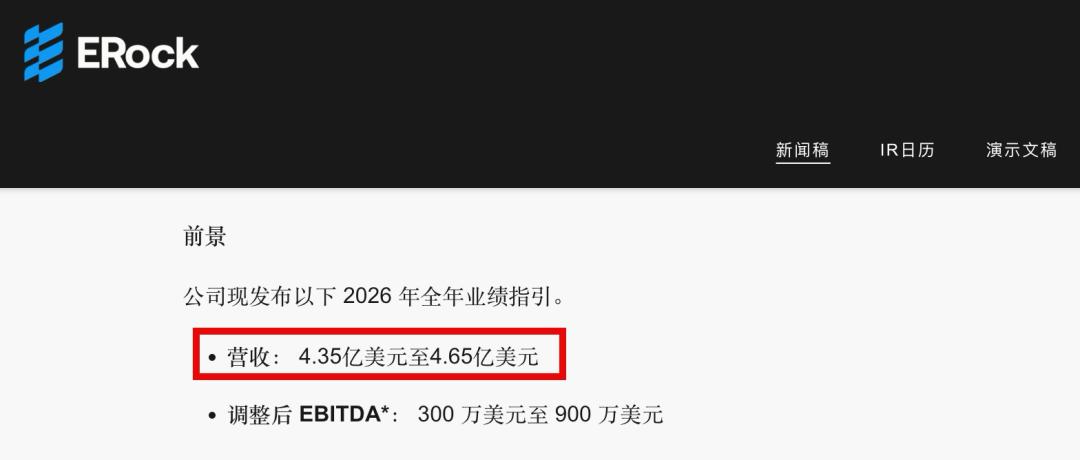
The company's revenue target for this year is $435 million to $465 million, of which approximately $360 million to $390 million originally comes from the already signed backlog. Therefore, there is no need to worry too much about whether it can continue to win new orders this year, it already has more than enough orders, and the most important thing now is to deliver the orders in hand.
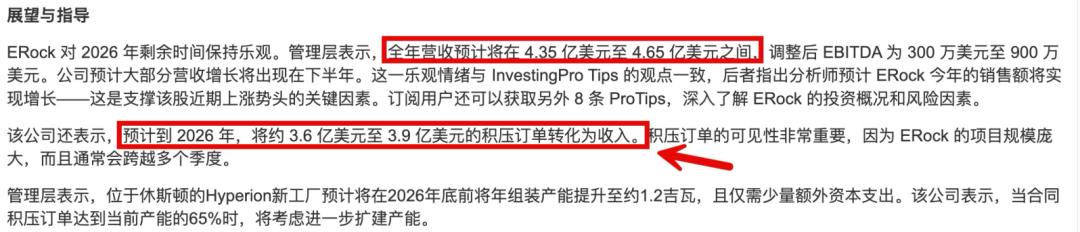
To be honest, the pressure is really huge.
The total revenue in the first half of the year was about $71.6 million. To achieve the full-year target, the revenue in the second half of the year needs to reach at least about $360 million, which is 5 times that of the first half.
Therefore, what comes next is not a "slight speed increase", but a real ramp-up of production capacity. That is why the newly put into operation Hyperion factory is very important.
The company plans to increase its annual assembly capacity to about 1.2 GW, which is 1200 megawatts, by the end of this year. You may not have a clear idea of this figure. Let me put it another way: the two large projects of Anthropic's 470 megawatts and Meta's 366 megawatts add up to only 836 megawatts.
What is the level of 1200 megawatts? It is enough to deliver all the orders of these two large clients at the same time, with one third of the capacity remaining.
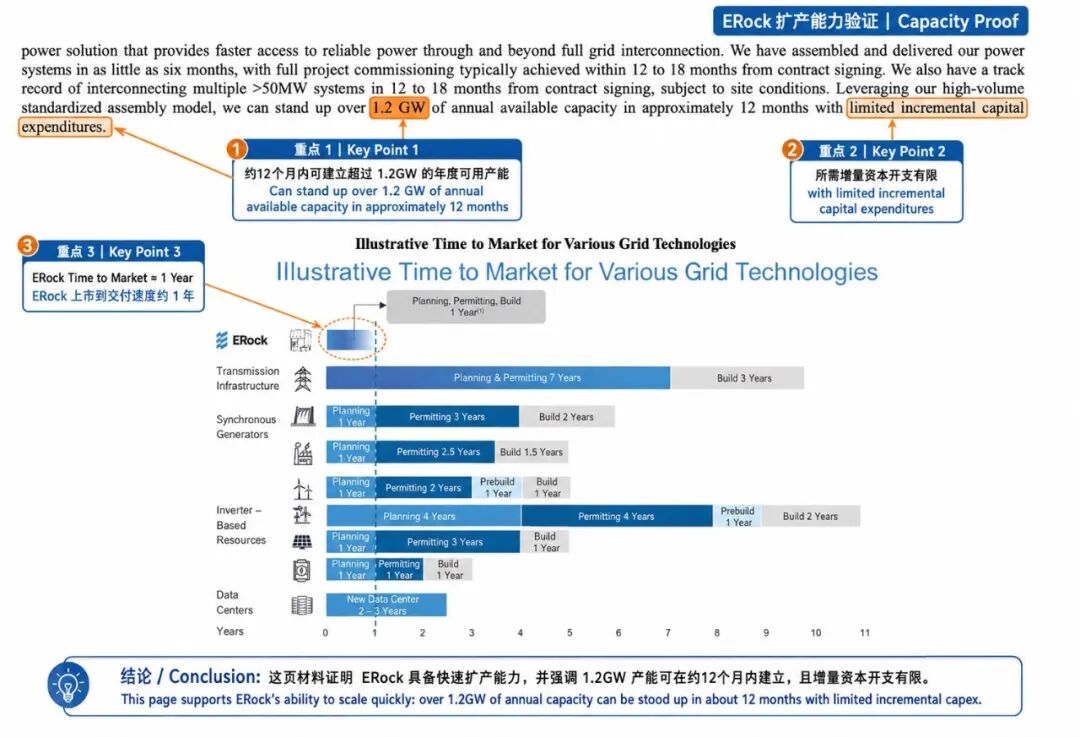
Moreover, the management stated that if demand continues to grow, adding another 1200 megawatts of production capacity only requires an additional investment of $15 million.
Why does it cost so little? Because EROC does not manufacture engines by itself, it purchases engines from other suppliers and assembles its own systems. Fast capacity expansion and low capital expenditure are the most practical advantages of this model.
Speaking of which, there is another point that many people have not noticed — after the equipment is sold, the business does not end.
It earns a sum of money first from selling equipment and providing installation services; after the equipment is put into operation, EROC can continue to collect operation, maintenance and service fees. In the second quarter, the annualized recurring service revenue of this part has reached $23.6 million.

Therefore, you can understand EROC's revenue as two layers:
In the early stage, it expands revenue scale by selling equipment, and in the later stage, it stabilizes revenue through operation and maintenance services.
But obviously, it is still in the stage of "scaling up its business", so the risk is also very direct.
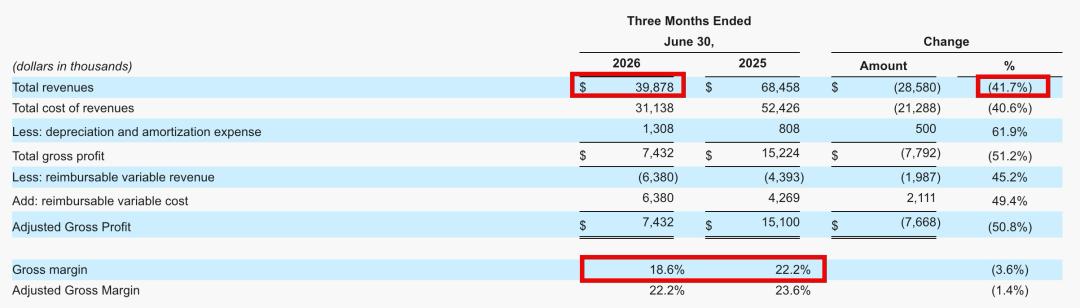
Although its revenue in the second quarter increased quarter-on-quarter, it decreased by 42% year-on-year. You may feel worried when you see this figure — don't panic, the large year-on-year decline is mainly due to a one-time large order in the second quarter of last year which created a very high base, not a downward trend in its core business.
However, its adjusted EBITDA lost $14 million, and its gross margin also dropped from 22.2% in the same period of last year to 18.6%, which are real tangible pressures.
So to sum up, the $1.7 billion backlog of orders looks really impressive, but it cannot be directly equivalent to $1.7 billion in real revenue.
Then what should we focus on? Just keep an eye on the performance in the next few quarters — whether the delivery speed can be significantly accelerated, whether the revenue can explode as planned, and whether the gross margin can pick up again after the scale expands.
If all three points are achieved, the $1.7 billion in orders will truly start to be "valuable".
How much is EROC worth? Three scenarios
We have clearly explained its business model, order quality and delivery capacity, and now we come to the question that everyone cares most about: its share price is around $17 right now, is it worth buying?
For companies like EROC that are still in the high-speed expansion stage and have not fully released their profits, using P/E ratio for valuation does not make much sense, because the most important thing for it now is not "how much money it earns this year", but how large its revenue can reach in the future, and whether its profit margin can increase synchronously as the business scale expands.
Therefore, I prefer to use three scenarios to estimate its approximate value in the future.
Worst-case scenario
The worst case does not mean that the power shortage in the AI sector suddenly disappears, or the demand from Anthropic and Meta vanishes overnight. It means that although EROC's revenue continues to grow, the quality of growth is very poor.
For example, by 2027, the company's revenue can only reach $600 million to $800 million, its gross margin stays at a dozen percent for a long time, and its EBITDA cannot turn positive for a long time. In that case, the market will finally find that although this company has caught the boom of AI data centers, it is essentially still an equipment and engineering company