In August, gold prices have suddenly surged sharply. Is it still a good time to enter the market? The latest analysis and judgment
Fund Managers' Research and Judgment: The "long bull" logic of gold is solid, and multiple main lines of non-ferrous metals rise in resonance
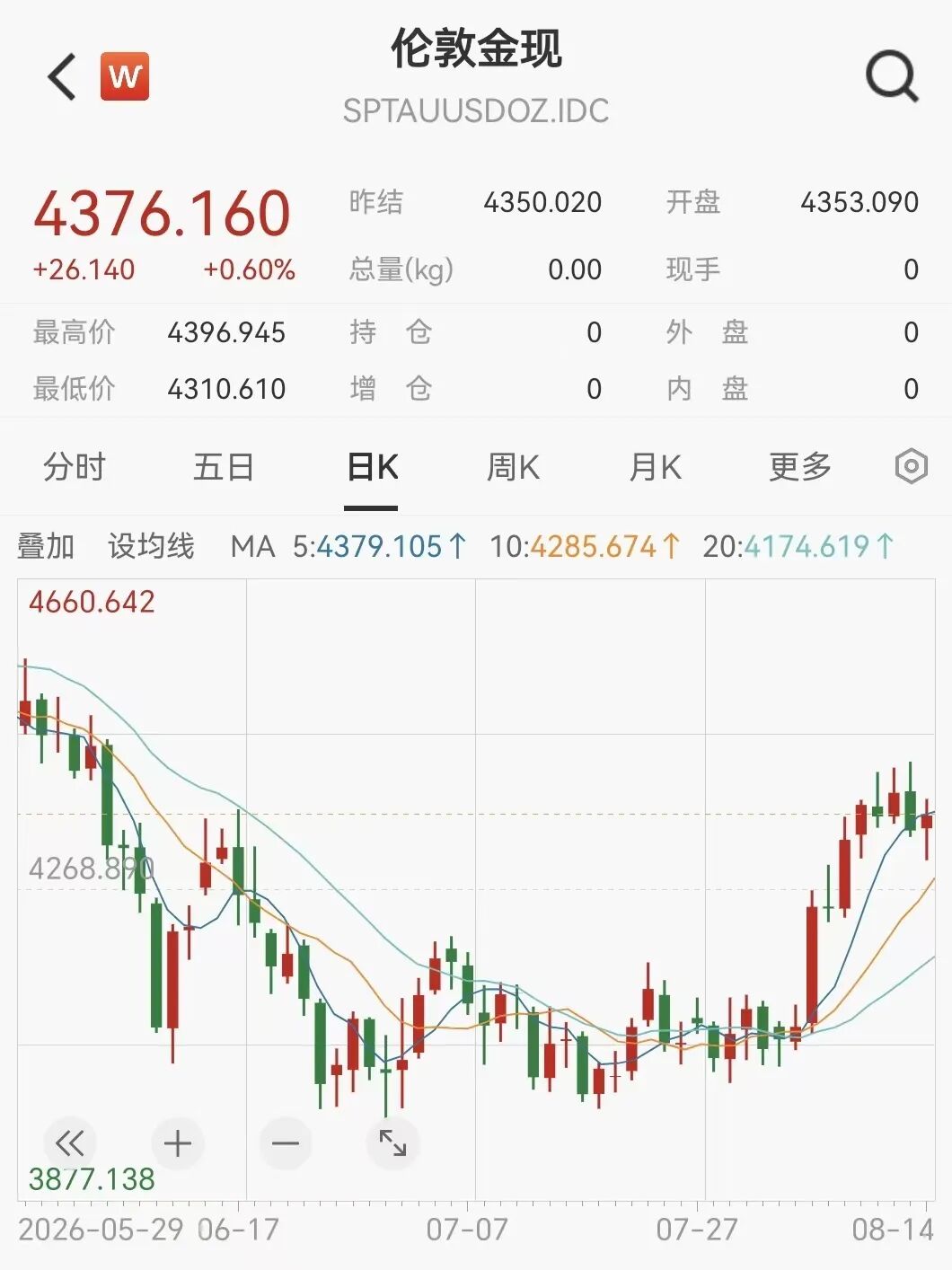
After months of adjustment, gold has returned to the vision of global investors. The international gold price has risen by 10% cumulatively since the end of June. Since August, the trend has been more aggressive, recording the largest weekly increase of the year in the first week, successively breaking through the two thresholds of $4,200/oz and $4,300/oz, and once surging to $4,400/oz. At the same time, the copper futures price in non-ferrous varieties recently hit a record high.
What are the main driving factors behind this round of gold price rebound? Will the gold price restart its upward trend? How sustainable will the market trend be next? What is the medium and long-term allocation value? What other non-ferrous varieties are worthy of attention?
To this end, reporters from China Fund News interviewed Yang Kaining, Gold ETF fund manager of Southern Fund; Wang Lele, Gold ETF fund manager of Fullgoal Fund; Ai Xiaojun, Gold ETF fund manager of Guotai Fund; Chen Ziyang, fund manager of Great Wall Resource Selection; Tang Chen, fund manager of Ping An Global Gold Fund; Liang Pusen, Gold ETF fund manager of Qianhai Kaiyuan.

Yang Kaining, Gold ETF fund manager of Southern Fund

Wang Lele, Gold ETF fund manager of Fullgoal Fund

Ai Xiaojun, Gold ETF fund manager of Guotai Fund

Chen Ziyang, fund manager of Great Wall Resource Selection

Tang Chen, fund manager of Ping An Global Gold Fund

Liang Pusen, Gold ETF fund manager of Qianhai Kaiyuan
The above fund managers generally believe that the resonance of multiple driving factors has promoted this round of gold price rebound, and the core logic of the "long bull" in the medium and long term remains solid, but there is still short-term uncertainty, and the current stage is more appropriately defined as a secondary recovery period after high-level rebalancing.
Resonance of Multiple Driving Factors
China Fund News: The international gold price started to rebound at the end of June, with a cumulative increase of more than 10%. What are the main factors driving the gold price rebound?
Wang Lele: Since the beginning of this year, the international gold price first rose rapidly and then retreated significantly. At the end of June, the international gold price fell back to around $4,000 per ounce, entering the stage of "de-foaming" and re-pricing. This round of rebound is mainly driven by the clearance of previous positions, marginal easing of interest rate hike expectations, and continuous gold purchases by central banks.
First of all, the clearance of previous positions is the direct starting point of this round of rebound. The leveraged positions accumulated in the early stage have been digested, and signs of replenishment appeared in early August. With the concentrated release of selling pressure, the marginal selling pressure gradually weakened, the sensitivity of gold prices to new negative factors decreased, and minor positive factors may trigger a rapid recovery.
Secondly, the market's pricing of further interest rate hikes has marginally eased. On July 29, the Federal Reserve maintained the target range of the federal funds rate at 3.50% to 3.75%; the US Consumer Price Index (CPI) released afterwards rose by 0.1% month-on-month in July. The moderate inflation data cooled the market's expectations of interest rate hikes, the upward slope of the US dollar and long-term interest rates slowed down accordingly, the pressure on the opportunity cost of gold to continue to deteriorate was reduced, and the previously suppressed allocation demand also returned.
In addition, after the sharp price fluctuations in the first half of the year, the continuous increase of gold holdings by central banks also supported the gold price.
Yang Kaining: There are two main reasons for driving the gold price rebound. First, the Fed's tightening expectations have cooled down, and the number of non-farm jobs decreased by 23,000 in July. The weakening employment data restricts the Fed's policy space to maintain high interest rates. Second, central banks continue to buy gold. The People's Bank of China increased its gold holdings by about 20 tons in July, marking 21 consecutive months of increase; the Bank of Korea also restarted gold-related allocation.
Ai Xiaojun: The main catalyst for this round of gold price rise is the shift in expectations of US monetary policy. The US labor market data has rarely weakened, and non-farm employment unexpectedly recorded negative growth in July, sharply reducing the probability of the Fed raising interest rates in September; the US dollar is under pressure, and US Treasury yields have fallen from high levels, giving strong boost to gold prices. At the same time, the phased progress of the US-Iran negotiations on the Strait of Hormuz has led to a sharp drop in oil prices, easing concerns about energy inflation and opening up space for further cooling of interest rate hike expectations.
Chen Ziyang: The most direct catalyst for the rise in gold prices is the "surprise" of US employment data. The Fed's interest rate hike expectations have cooled down, pushing gold prices higher. In addition, the situation in the Middle East has released signs of easing, and concerns about energy inflation have cooled down, opening up space for gold's valuation recovery.
Tang Chen: The recent round of gold price rebound is the result of the resonance of three layers of driving forces.
First, central bank gold purchases have established the central price. Global central banks continue to buy gold, and net gold purchases in the second quarter increased by 62% year-on-year. The People's Bank of China has increased its gold holdings for 21 consecutive months, providing solid bottom support for gold prices.
Second, ETF and private allocation funds take over. The gold price has fully priced in the interest rate hike expectations in the previous decline. As the US ADP and non-farm employment data in July were significantly lower than expected, the market's expectations for the Fed to raise interest rates in September fell sharply, and the US dollar and US Treasury yields came under pressure. In this context, global gold ETFs reversed their previous consecutive outflows in July, achieving a net inflow of about $3 billion.
Third, speculative positions amplify the market trend. Private sector de-risking allocations such as high-net-worth households buying physical gold and investors' demand for call options, coupled with the rapid entry of futures and options positions, jointly amplified the slope of this round of rebound.
Liang Pusen: Since the end of June, multiple constraints suppressing gold prices have seen marginal improvements, jointly driving the international gold price to start this round of rebound.
On the macro level, after Wash took office as Chairman of the Federal Reserve, the Fed's policy framework has been significantly adjusted, making it clear that price stability is the primary policy goal. After the US-Iran negotiations reached a deadlock, oil prices fluctuated at high levels. Compared with other financial assets, gold prices have more fully priced in the Fed's expectation of raising interest rates multiple times within the year. However, the ADP and non-farm employment data in July weakened and the historical data was significantly revised down, the market's pricing for the Fed's interest rate hikes cooled rapidly, and the upward pressure on real interest rates eased, laying a macro foundation for gold price recovery.
At the capital level, the gold market continued to face the pressure of capital outflow before, and this trend has reversed recently, and capital replenishment has become an important driving force for the rise of gold prices.
In addition, the rigid demand for global central bank gold purchases continues to provide bottom support. China's central bank purchased 640,000 ounces of gold in July, the largest monthly increase since the restart of the gold purchase cycle in November 2024, achieving 21 consecutive months of increase; on August 3, the Bank of Korea restarted gold purchases after 13 years.
Expected to Restart Medium and Long-term Upward Trend, Short-term Still Faces Uncertainties
China Fund News: After several months of previous adjustments, is the gold price expected to restart its upward trend? How sustainable will the market trend be next?
Yang Kaining: Gold prices have the conditions to restart their upward trend, but in the short term, it is more likely to be trend recovery rather than unilateral rise. The weakening of the US dollar, cooling of interest rate hike expectations, and rising central bank gold purchases are all favorable to gold prices. If US employment continues to slow down and inflation does not rebound excessively in the follow-up, the market trend is expected to continue.
Wang Lele: The gold price is expected to maintain a generally strong pattern, but it is more likely to show high-level fluctuations after the price center rises, rather than immediately entering a new round of linear main rise. The core contradiction at the current stage is not that gold lacks long-term logic, but that the long-term logic coexists with high short-term opportunity costs. This means that the operation of gold prices may shift from trend-led to event-driven and range-bound fluctuations.
The driving forces for gold mainly come from three aspects: first, continuous increase in holdings by central banks to improve the stability of long-term demand; second, geopolitics, finance, sovereign credit and policy uncertainties, which raise the hedging demand of portfolios; third, after the gold price falls sharply, part of the allocation funds rebalance. The above factors help gold prices maintain resilience, but in an environment where opportunity costs are still high, the market trend may fluctuate repeatedly.
Chen Ziyang: The US economy shows certain signs of cooling, and the probability of gold stabilizing is relatively high. However, whether it can rise further still needs to observe the evolution of subsequent US economic data.
Tang Chen: After this round of adjustment, the international gold price is expected to restart its medium and long-term upward trend, but the profit-taking selling pressure after the sharp rise in the short term cannot be ignored. In addition, the current inflation data is still relatively high, the US-Iran conflict has not been completely resolved, and the market has not completely got rid of interest rate hike concerns. It still needs continuous verification of subsequent data such as non-farm payrolls and CPI.
Liang Pusen: The medium and long-term logic for gold prices to restart their upward trend includes: the profit-taking of previously accumulated profit positions, the momentum selling pressure has been fully cleared, the sentiment has been significantly released, and the siphon effect of AI investment on gold funds has marginally weakened.
From a medium and long-term perspective, under the background of global geopolitics and order reconstruction, gold, as a traditional hard currency without credit risk, its allocation value of risk aversion and anti-inflation will continue to be valued. However, it should be noted that the upward process will still be accompanied by large-level fluctuations. Whether the rebound can turn into a reversal still requires continuous verification of macro data and capital conditions.
The Core Logic of the "Long Bull" Remains Solid, and the Current Period May Be a Secondary Recovery Period
China Fund News: From a medium and long-term perspective, what is the allocation value of gold? What stage is it currently in?
Ai Xiaojun: After half a year of adjustment, the bottom of the gold price may have been found, and it is currently in the stage of testing upward momentum. If the gold price can successfully stand at $4,365, the future market center is expected to move up to the range of $4,365-$4,800.
From a medium and long-term perspective, the core logic of gold's "long bull" remains solid. On the one hand, under the background of global currency over-issuance and monetization of fiscal deficits, the US dollar credit system continues to be under pressure; on the other hand, frequent global geopolitical conflicts promote the diversified transformation of national asset reserves, and the safe-haven property and reserve value of gold continue to highlight. The continuous advancement of the global "de-dollarization" trend also allows gold to reshape its status as a "pricing anchor", and the long-term upward support for gold prices is stable.
Wang Lele: The medium and long-term allocation value of gold mainly comes from three structural main lines.
First, the monetary and reserve properties are further strengthened. Central bank gold purchases are still an important structural factor supporting gold prices.
Second, the trend of global reserve diversification and sovereign credit constraints have enhanced the strategic value of gold. Gold is a non-sovereign credit asset, and its allocation status often increases when geopolitical risks rise and global financial pressures increase.
Third, under the high volatility environment, the portfolio hedging value of gold rises. The current macro environment is characterized by high debt, high uncertainty, divergent policy communication and repeated geopolitical risks. In such an environment, even if gold does not continue to rise unilaterally, it can still play a role in tail risk hedging.
On the whole, the medium and long-term allocation logic of gold still exists, but the return distribution may shift from the previous unilateral rise to reallocation within the range.
<