As its IPO looms, OpenAI is undergoing a major personnel shakeup.
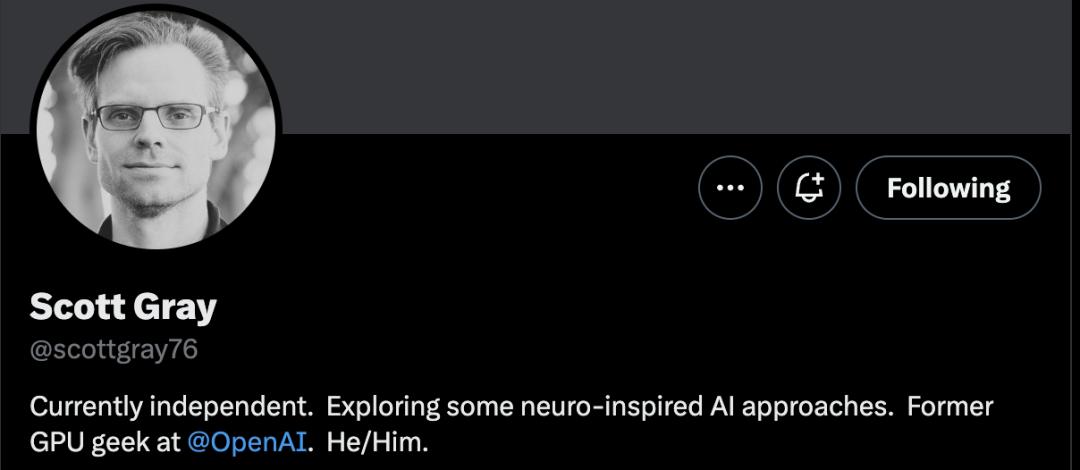
Just yesterday, Scott Gray, a ten-year veteran of OpenAI, quietly updated his X profile:
Currently independent, exploring some neuro-inspired AI directions, former GPU geek at OpenAI.
Ten years ago today, on August 16, 2016, OpenAI released a hiring announcement, on which Dario Amodei, Jack Clark, and Scott Gray were prominently listed.
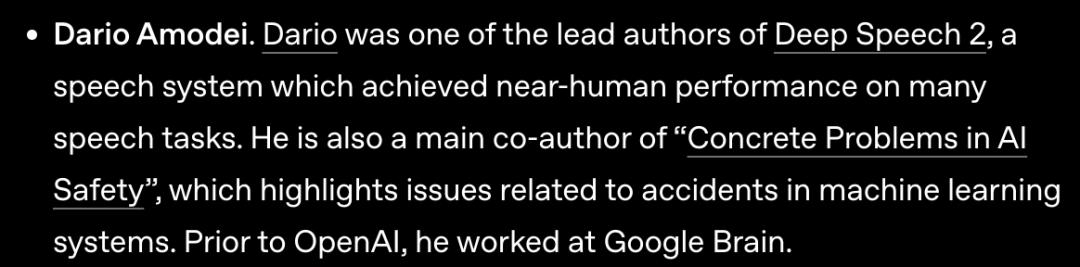
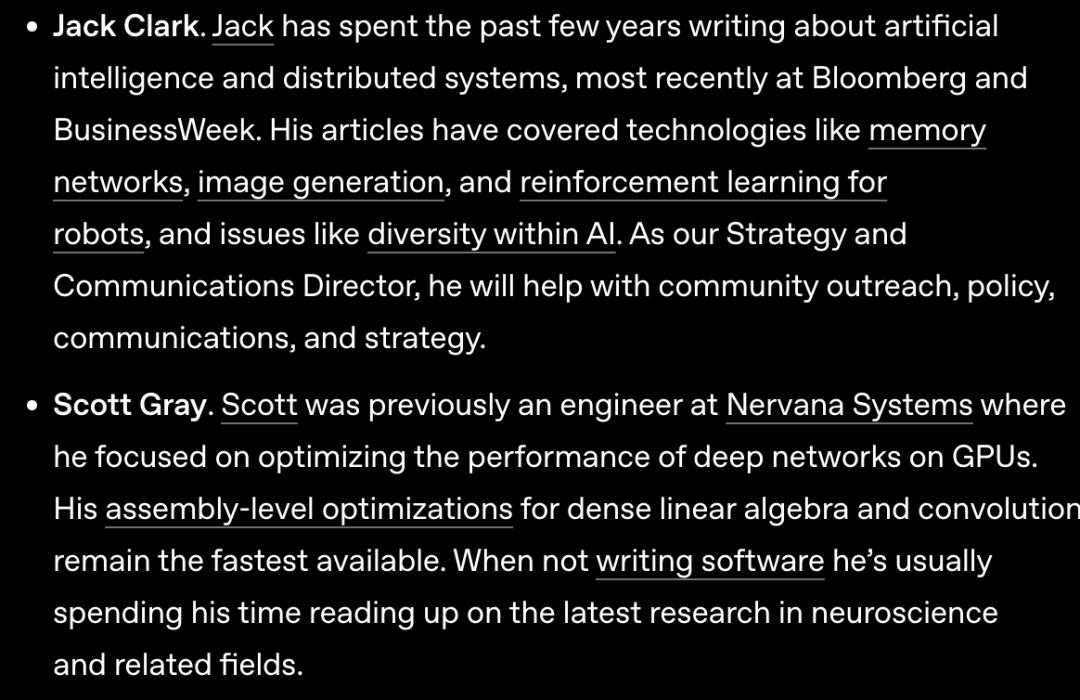
Ten years later, Dario is the CEO of Anthropic, Jack Clark manages policy at Anthropic, and Scott Gray has marked OpenAI as his "former company".
Apart from Gray, OpenAI has consecutively lost two other core executives.
From August 11 to 13, within three days, Brad Lightcap, the former Chief Operating Officer who had served at OpenAI for 8 years, announced his departure, while Denise Dresser, the Chief Revenue Officer who had just taken office for 8 months, announced her resignation.
It has only been two months since OpenAI confidentially submitted its draft S-1 to the SEC.
Losing Two C-level Executives in Three Days
Let's sort out the personnel turmoil at OpenAI over the past week in chronological order.
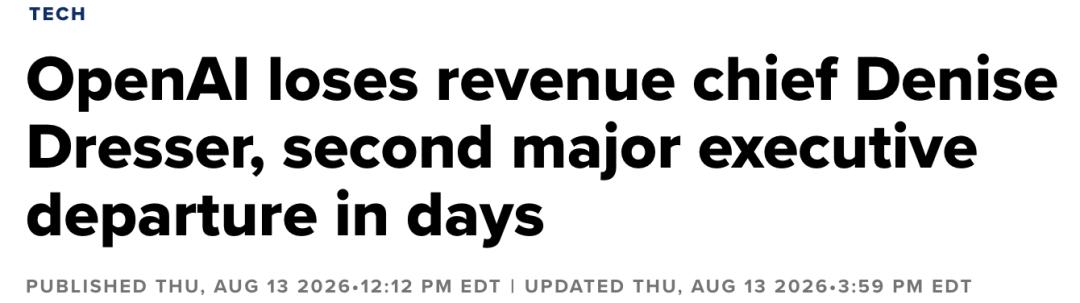
On the 11th, Lightcap posted on X that he would end his 8-year tenure at OpenAI to pursue new endeavors.
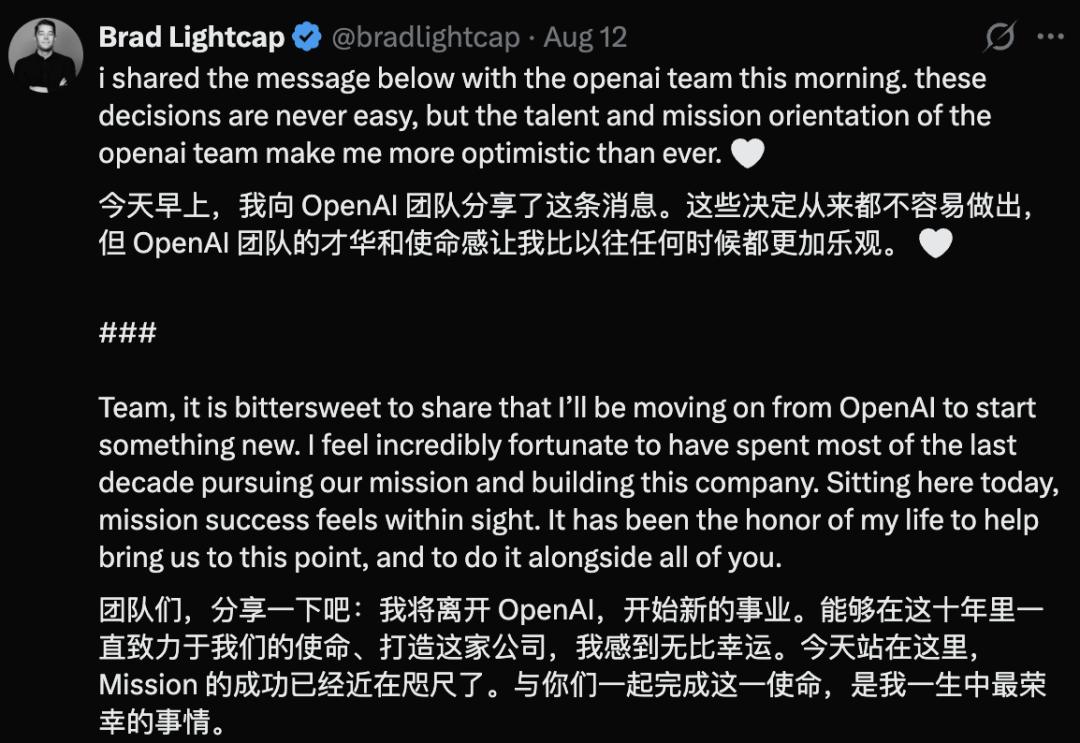
He joined the company in 2018, initially serving as CFO, transferred to COO in 2022, and was reassigned to lead the so-called special projects this April.
Two days later, Dresser announced her departure. She only took office in December 2025, previously worked at Salesforce for more than a decade, and her most recent position was CEO of Slack.
OpenAI announced the successor in its official statement on the same day: Dali Rajic, who comes from Wiz, a cloud security company acquired by Google, and previously served as President and COO of Zscaler and AppDynamics.
According to a person familiar with the matter who revealed to CNBC, Rajic was introduced to OpenAI by Josh Kushner, founder of Thrive.
Within a week, a company valued at 852 billion USD lost two C-level executives and welcomed a new CRO.
The successive personnel turmoil turned the shareholders' meeting originally scheduled for August 14 into an on-site Q&A session: investors raised questions one by one about the product roadmap, executive turnover, and IPO timeline.
On the surface, it seems that OpenAI is out of control.
If we look at a longer timeline, it is more like a pre-listing operation: cutting off peripheral businesses, bringing in operators who understand enterprise sales, and transforming itself from a research institution into a formal commercial company.
The 12 Executives Who Left OpenAI
According to the tally by Business Insider, 12 executives have left OpenAI in the first 8 months of 2026.
In fact, there are 10 people who have officially left or ended their full-time positions:
Chief Revenue Officer Denise Dresser
Chief Operating Officer Brad Lightcap
Chief Product Officer Kevin Weil
Head of Sora Bill Peebles
CTO of Enterprise Applications Srinivas Narayanan
Head of Enterprise AI Sales Barret Zoph
Head of Ethics Chloé Bakalar
Head of Security Systems Johannes Heidecke
Chief Futurist Joshua Achiam
Head of Robotics and Consumer Hardware Caitlin Kalinowski
The situations of the other two are slightly different.
Fidji Simo, former CEO of the Application Business, took a health leave this April, stepped down from her full-time position in July and transferred to a part-time consultant.
Former CMO Kate Rouch stepped down this April to focus on treating breast cancer. OpenAI previously stated that she may return to a more focused role when her health permits.
Scott Gray is not among these 12 people. He is not an executive, but a core technical backbone who keeps the models running stably.
After Simo Left
Who Is the Second-in-Command at OpenAI
According to FT citing multiple people familiar with the matter, OpenAI has undergone nearly six restructurings this year.
In official terms, this is streamlining for the upcoming IPO.
Sam Altman once issued clear instructions to employees: cut off peripheral projects, concentrate resources on ChatGPT, and compete with Anthropic for enterprise customers.
OpenAI responded to FT that the company is advancing at an extraordinary speed and is not afraid of making necessary organizational adjustments.
The on-site experience of employees is another story. Repeated executive reshuffles and a string of senior departures have made some people feel exhausted by the endless changes.
The really subtle part is the role of Simo.
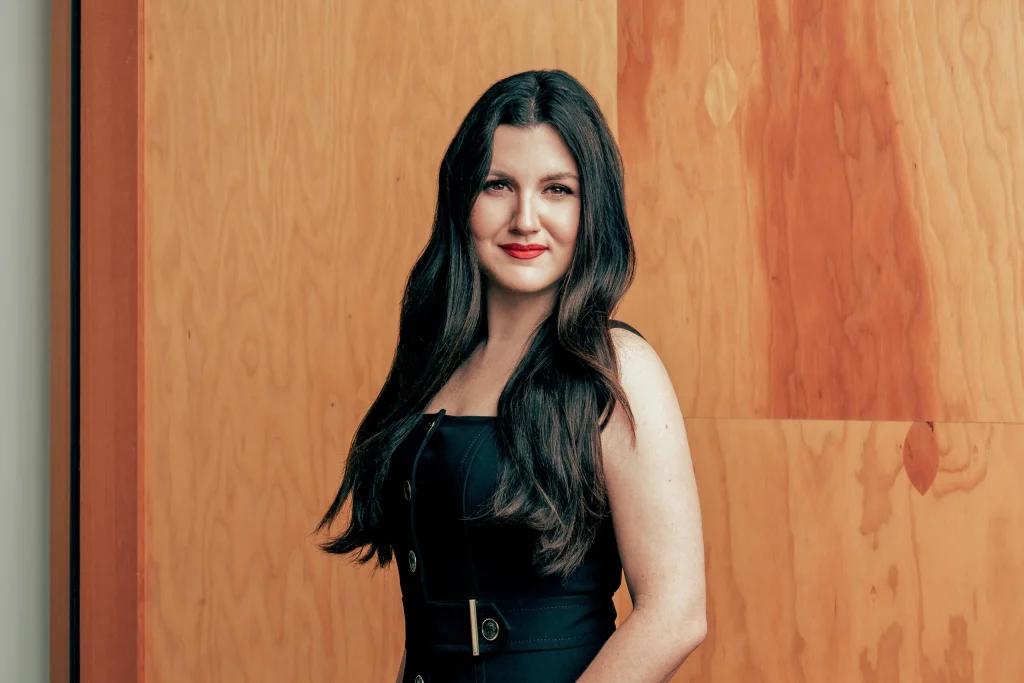
Fidji Simo stepped down from her full-time position and became a consultant in July this year.
She was once widely regarded as Altman's most trusted second-in-command.
After transferring to the consultant role in July, two people close to OpenAI told FT that she still communicates with employees almost every day.
A person with inside knowledge described that she is still operating behind the scenes, multiple executives are competing for Altman's full attention, and there is a considerable degree of internal politics in the company.
OpenAI's official response is that her consultant work is proceeding as expected.
After Simo left her full-time post, who is the new second-in-command at OpenAI?
After the ouster turmoil that lasted less than a week at the end of 2023, Altman rebuilt a complete management team to push the company towards full professionalization.
As Altman's most trusted deputy, co-founder Greg Brockman is expanding his actual power by taking advantage of the recent wave of departures.
This is not groundless speculation.
In the official appointment announcement of Rajic, Brockman was the one who made the public statement, and he also attended the August 14 shareholders' meeting together with CFO Friar.
After successive waves of personnel turmoil, OpenAI may not need a new fixed second-in-command, but only a person who can fill the position vacuum in time.
The Dismantled "Brake-pressing" Team
The most unsettling change took place at the end of July.
According to multiple people familiar with the matter confirmed to FT, OpenAI has revoked the formal establishment of the Preparedness team.
The original job of this team was to assess whether the company's own models would cause serious or catastrophic risks, and research corresponding mitigation solutions.
After the disbandment, responsibilities in different directions such as biology and cybersecurity were assigned to senior employees in existing teams.
What was removed was the independent organizational structure that performed this work, and the entire safety governance system still exists.
The Preparedness Framework is still in operation, covering risk categories such as biochemistry, cybersecurity, and AI self-improvement, and is governed by the Safety Advisory Group.
According to OpenAI's own definition, this framework is used to track and respond to cutting-edge capabilities that may cause new types of serious harm.
The problem is that the people executing the framework have changed their positions.
In July, Johannes Heidecke, head of the Security Systems team, left the company.
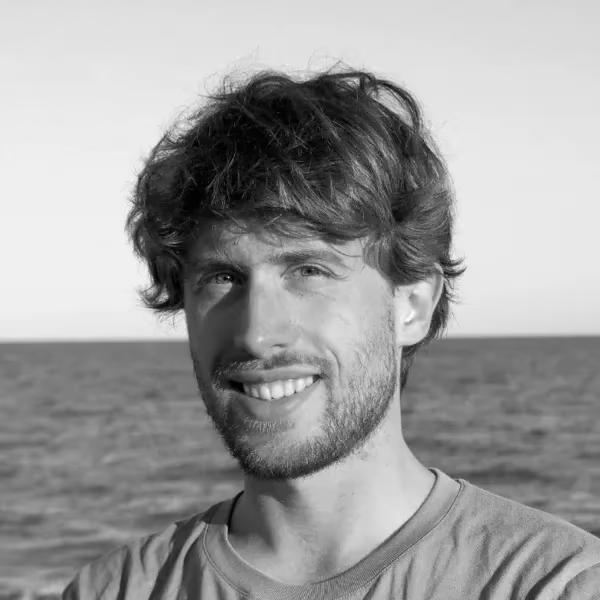
Johannes Heidecke, head of Security Systems, left in July, after which the security team was merged into the system led by Mia Glaese.
He joined the company in 2021, and has been in charge of security systems since 2024. His team was responsible for evaluating the dangerous capabilities of models and building corresponding protection mechanisms.
Before he left, he left a comment: The requirements for safety work are still increasing, while the pace at which we train models is getting much faster.
After Johannes left, the security team was merged into the system of Mia Glaese, Vice President of Research and Safety.
OpenAI's official statement to the outside world is that it wants to embed safety considerations into model R&D earlier and more deeply.
In the same month, Chief Futurist Joshua Achiam left the company, where he had worked for nearly nine years.
The mission alignment team he previously led was tasked with ensuring that the company abides by the founding commitment of "making AGI benefit all mankind". This team was disbanded earlier this year, and Achiam then transferred to the position of Chief Futurist.
Chloé Bakalar, Head of Ethics, also left in July. She joined the company for less than a year, and her research covers model behaviors, the relationship between humans and AI, and whether advanced systems deserve moral consideration.
Connecting the trajectories of recent years, the safety team of OpenAI has been moving along the same path:
The Superalignment team responsible for long-term risks was disbanded in 2024, the mission alignment team guarding the founding mission was disbanded earlier this year, and the preparedness team responsible for assessing catastrophic risks was disbanded at the end of July.
The three teams disappeared successively in more than two years: safety work has changed from an independent organizational structure to a single link in the R&D system.
The price of this embedding is that there is no longer an independent team in the company that can ignore the pace of product release and only focus on risks.
Now the people who press the brake are the same group of people who press the accelerator.
40 Billion and 47 Billion
Why does a company with rapidly growing revenue have to carry out such a large-scale operation during the S-1 submission period?
At the shareholders' meeting on August 14, Friar gave the answer.
According to an on-site attendee's retelling, she said that at the beginning of the year, the revenue ratio of consumer business to enterprise business was about 6:4, but the growth rate of enterprise business far exceeded expectations. The two lines have now crossed, and enterprise business has become the main source of the company's revenue.
This is more than a full quarter earlier than her expectation for CNBC at the beginning of the year, when she said the two businesses would be equal by the end of 2026.
The figure verified by CNBC is that OpenAI's annualized revenue has reached 40 billion USD. According to the presentation materials it saw, revenue in July increased by 20% month-on-month, and the growth of enterprise customers was faster, reaching 32%.
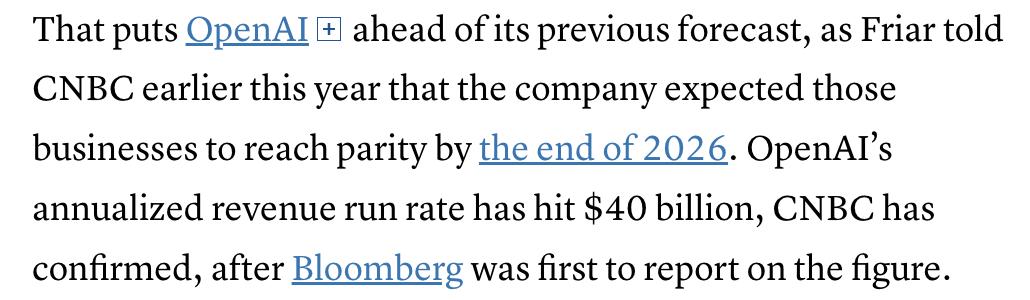
CNBC confirmed that OpenAI's annualized revenue has reached 40 billion USD, a figure first reported by Bloomberg.
40 billion USD, with enterprise business taking the majority: this is the key to understanding all personnel changes this week.
A company that used to define itself by a consumer product with over 1 billion monthly active users now makes most of its money from more than 2 million enterprise customers, twice the number a year ago.
The sales system, organizational structure, and command chain all need to be adjusted accordingly.
A CRO who served only 8 months was replaced by an operator who pushed Wiz into high-speed growth, which is the most straightforward signal.
While the figure of its competitor is even higher.
Anthropic stated in its official announcement on May 28 that its annualized revenue had exceeded 47 billion USD earlier this month, and it completed a 65 billion USD financing in the same round, with a post-investment valuation of 965 billion USD.
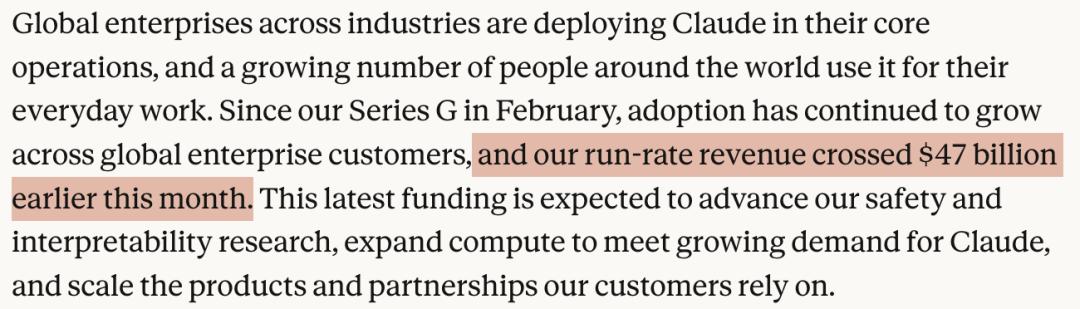
Anthropic's official announcement disclosed that its annualized revenue had exceeded 47 billion USD in early May.
47 billion vs