The Eve of Going Public | SHEIN's 11-Year Financing Story and a Rarely Mentioned Ratchet
This article is approximately 4,600 words, with an estimated reading time of 10 minutes
Author | PENG Xiaoqiu
Editor's Note: The Pre-IPO Night column focuses on the critical moment when enterprises sprint to the capital market. Every prospectus hides the ambition, business cycles and hidden worries of an enterprise before going public. This is the 10th issue — SHEIN.
Many companies go public because they are short of capital. SHEIN is the exact opposite.
From 2023 to 2025, the net cash flow from operating activities of this company reached 17.57 billion, 14.05 billion and 28.38 billion US dollars respectively, generating a total of 6 billion US dollars in cash in three years. As of the end of March 2026, its cash resources on hand even reached 148.31 billion US dollars.
What does this mean? SHEIN raised capital from Series A to Series D+ in the past 11 years. According to our calculation based on the prospectus, the total equity financing actually received is about 3.84 billion US dollars, plus 169 million RMB from Series B. In other words, the cash generated by SHEIN itself in the last three years is 1.55 times of the total financing amount in the past 11 years.
It is even a typical "doing business with other people's money" model: consumers make advance payments, the net income turnover days have long been maintained at -12 to -13 days, and the inventory turnover days in 2025 were only 36 days.
Normally, such a company would not be in a hurry to raise money in the capital market. But after going through SHEIN's prospectus, another figure stands out: 172.94 billion US dollars.
This is the amount of convertible redeemable preferred shares on SHEIN's books as of March 31, 2026.
More critically, there is a running clock behind this sum: the cash return rate for Pre-D, D and D+ round investors has jumped from 8% to 12% on March 5, 2026; if the IPO is withdrawn, rejected, or no reapplication is submitted within 12 months after the IPO expires, the suspended redemption right will be reactivated.
Thus, a seemingly counterintuitive question arises: Why does a company that generated 6 billion US dollars in cash in three years and has 14.8 billion US dollars in cash on its books have to go public?
The answer is probably not "financing". To understand why SHEIN is standing at the gate of the Hong Kong Stock Exchange today, we need to turn the clock back 11 years, starting from its first $5 million financing.

The Starting Point and the First $5 Million Financing
On May 12, 2014, Shein International Holdings Limited was registered in the Cayman Islands with a legal share capital of $50,000.
On June 30 of the same year, the company completed a share split, and then issued shares to the BVI companies of the four founders at par value (US$0.0001 per share):
Xu Yangtian's BVI company: a total of 49.6792 million shares
Ren Xiaoqing's BVI company: 13 million shares
Gu Xiaoqing's BVI company: 13 million shares
Miao Miao's BVI company: 13 million shares
Calculated at par value, the consideration for Xu Yangtian's share is about 4,968 US dollars.
It should be noted that subscribing for founder shares at par value is a standard practice, and this figure does not represent the market value of the company at that time. But it does mark a starting line. Eleven years later, the company's operating profit in 2025 was 1.707 billion US dollars.
Eight months after its Cayman registration, on February 17, 2015, the Series A funds arrived. The company issued 9.4339 million ordinary shares to a specific investor at approximately US$0.5 per share, for a total consideration of 5 million US dollars. These shares were later exchanged and consolidated into 5.39 million Series A preferred shares, with a pre-money valuation of 53 million US dollars. Now the valuation is 64 billion US dollars, with a floating profit of more than 1,200 times.
In this year, SHEIN launched its own mobile App.
Throughout the prospectus, we found several very interesting points:
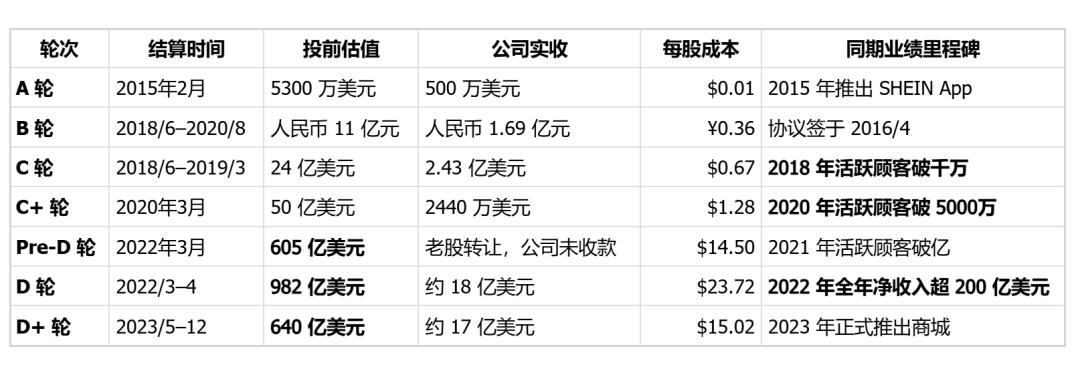
Cost per share has taken into account the impact of restructuring and 1:50 share split (Source / HardKr sorting)
First, the Series B funds took four years to fully receive. The agreement was signed on April 28, 2016, and 169 million RMB was received, but the shares were issued gradually from June 28, 2018 to August 17, 2020.
Second, in the year of Series C, the number of active customers just exceeded 10 million. Dividing the pre-money valuation of 2.4 billion US dollars by the 10-million-level customer base, the corresponding valuation per customer is no higher than 240 US dollars. By the Series C+ round, the number of customers exceeded 50 million, the pre-money valuation was 5 billion US dollars, and the valuation per customer dropped to no higher than 100 US dollars. The business scale grew faster than the valuation, which were the two healthiest years.
Third, everything got out of control in 2022. From the pre-money valuation of 5 billion US dollars for Series C+ to 60.5 billion US dollars for Pre-D, and then to 98.2 billion US dollars for Series D, only two years passed in between. According to the 41.1% net income growth rate in 2023 disclosed in the prospectus, the net income in 2022 was about 22.75 billion US dollars, and the pre-money valuation of 98.2 billion US dollars for Series D corresponds to a price-to-sales ratio of about 4.3 times.
Finally, the valuation was cut in half within a year. The Series D+ round was settled in May 2023, with a pre-money valuation of 64 billion US dollars — 35% lower than that of the Series D round. Corresponding to the net income of 32.103 billion US dollars in 2023, the price-to-sales ratio is about 2.0 times.
It is not uncommon in the global primary market in 2022–2023 for a company's valuation to be cut by one third within a year. If we superimpose the performance curve and the valuation curve, we also find that: revenue increased by 84%, while the valuation anchor was cut by 35%.
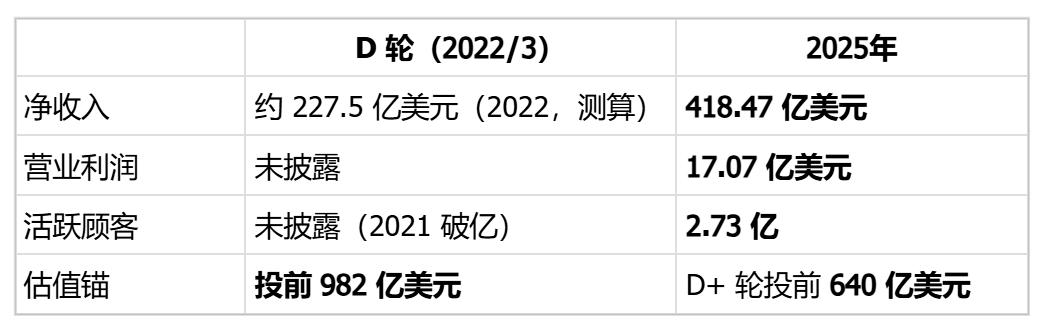
(Source / HardKr sorting)
In these three years, SHEIN increased the total number of orders from 715 million to 1.078 billion, increased the number of active customers from 186 million to 273 million, kept the inventory turnover days at 36 days, and expanded the number of contract manufacturers from 5,800 to 7,500. The business itself is growing.
But in the same period, the revenue growth rate dropped from 41.1% to 8.0%, and only 1.1% in the first quarter of 2026; the US revenue decreased by 3.5% in absolute terms in 2025, and the year-on-year decline reached -14.3% in the first quarter of 2026.
The market has already voted on the downward revision of valuation back in 2023. The pricing of 64 billion US dollars in the Series D+ round is, in a sense, closer to the current reality than the 98.2 billion US dollars in the Series D round.

Who invested how much at what price
Although the prospectus does not directly give the capital contribution of each institution, the capitalization table discloses the exact number of preferred shares held by each shareholder in each round, and the financing term sheet gives the cost per share of each round. Combining the two tables for calculation, every sum of money can be restored.
Series C financing is 243 million US dollars, with 0.67 US dollars per share.
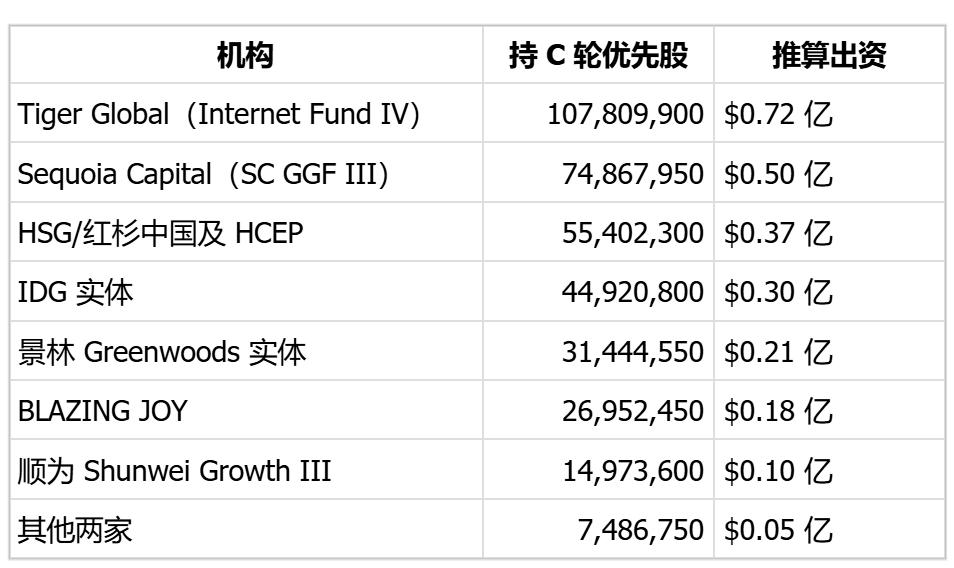
(Source / HardKr sorting)
Series B financing is 169 million RMB, with 0.36 RMB per share. IDG is estimated to have contributed about 95 million RMB, and Greenwoods Asset Management contributed about 49 million RMB.
Series D financing is about 1.835 billion US dollars, with 23.72 US dollars per share. Among them, Boyu Capital alone invested about 700 million US dollars at a pre-money valuation of 98.2 billion US dollars. Accounting for 38% of the Series D round, it is the largest single investment in the whole round.
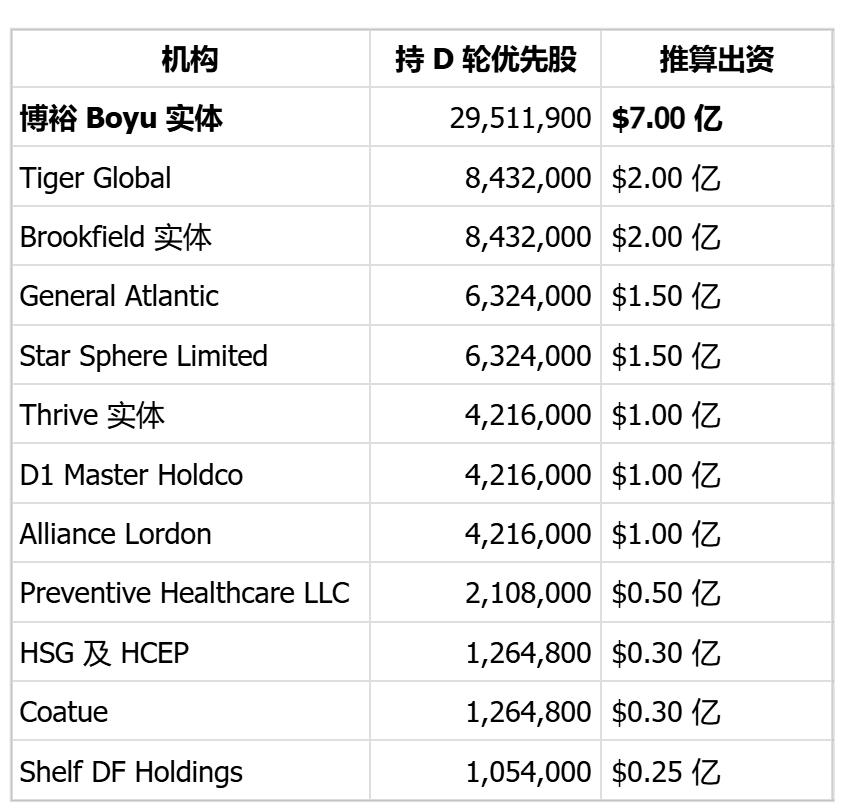
(Source / HardKr sorting)
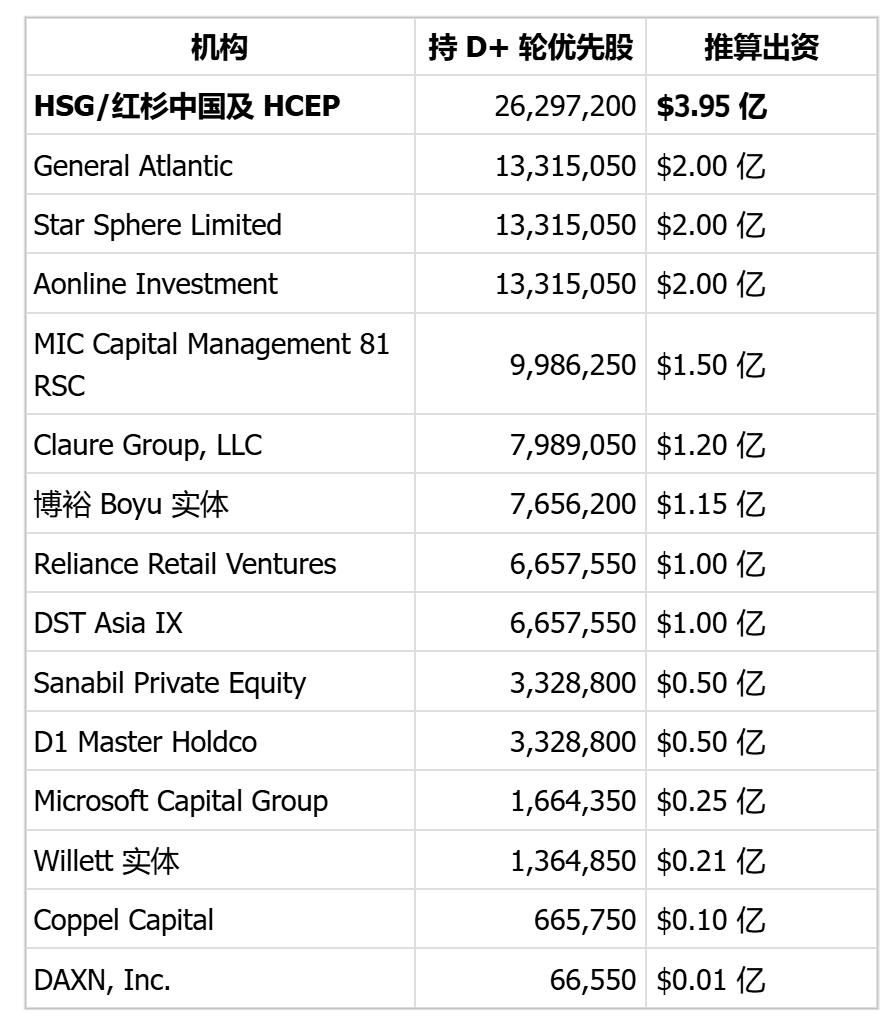
Series D+ is about 1.737 billion US dollars, with 15.02 US dollars per share. So in that price-cutting round, who is adding positions?
(Source / HardKr sorting)
Looking through the seven rounds of financing, several sets of data are particularly eye-catching:
IDG: about 95 million RMB in Series B + 30 million US dollars in Series C, with a total equivalent of about 44 million US dollars, holding 7.88% of shares;
Greenwoods: about 49 million RMB in Series B + 21 million US dollars in Series C, holding 4.28% of shares;
Boyu Capital: 700 million in Series D + 115 million in Series D+, with a total of about 815 million US dollars, holding 0.95% of shares.
Boyu Capital paid more than ten times as much as IDG, but got less than one eighth of IDG's shares. IDG entered at a valuation of 1.1 billion RMB, while Boyu Capital entered at a valuation of 98.2 billion US dollars.
There is another institution worth mentioning separately: HSG and HCEP is the only institution that participated in all six rounds of Series A, C, C+, Pre-D, D and D+, and it is the largest contributor (395 million US dollars) in the Series D+ price-cutting round. In another part of the shareholder register, Sequoia Capital is listed separately — the two entities after Sequoia's split in 2023 stand side by side on SHEIN's shareholder register. HSG currently holds 5.8% of the shares.
In fact, there is an easily overlooked date overlap in the financing term sheet. In one day, some people cashed out and some people entered the market.
That is March 4, 2022, when the Pre-D round was settled. At that time, several existing shareholders sold 413,900 ordinary shares to Pre-D round investors at a price of about 724.9 US dollars per share, for a total consideration of 300 million US dollars. The prospectus clearly states that these shares were later re-designated as Pre-D round preferred shares. Therefore, the Group did not raise any proceeds from this investment. That is to say, none of this 300 million US dollars entered the company, all went to the pockets of the sellers.
On the same day, the Series D round began to settle. The company issued new shares to Series D investors at a price of about 1186.0 US dollars per share, raising about 1.8 billion US dollars.
On the same day, for the same company, some people cashed out at a valuation of 60.5 billion US dollars, while new capital entered the market at a valuation of 98.2 billion US dollars. There is a 37.7 billion US dollar valuation gap between them, with less than a month apart.
Who took over the Pre-D old shares? According to position calculation, HSG and HCEP took