On the Eve of Listing | The "Father of BOE" Embarks on His Second Startup to Pursue a Hong Kong IPO, Losing a Total of 4.9 Billion Yuan in Three Years
This article is about 5,200 words, with an estimated reading time of 11 minutes
Author | PENG Xiaoqiu
Editor's Note: The "Eve of Listing" column focuses on the critical moment when enterprises sprint to the capital market. Every prospectus hides the ambitions, cycles and hidden worries of an enterprise before going public. This is the 9th issue -- Eswin Computing.
69-year-old WANG Dongsheng has taken his second-time startup Beijing Eswin Computing to launch an IPO on the Hong Kong Stock Exchange.
WANG Dongsheng is known as the "Father of BOE". He founded BOE in 1993 and served as Chairman and CEO since its establishment until May 2016. He then continued to serve as Chairman with the term expiring in June 2019.
In June 2019, WANG Dongsheng left his position and founded Beijing Eswin Computing in September the same year. For this IPO, CITIC Securities (Hong Kong) and CITIC Construction Investment (International) were appointed as joint sponsors.
Interestingly, on one hand, Eswin Computing has accumulated a total net loss of 4.9 billion yuan in three years; on the other hand, it has raised a total of 92.76 billion yuan through four rounds of financing. At the end of 2025, cash on the books was only 188 million yuan.
If we summarize Eswin Computing in one sentence, it is a founder who has reshaped the pattern of China's display industry, leading a team with BOE background and 92.76 billion yuan of state-backed capital, to bet on the RISC-V architecture replacing x86/ARM.
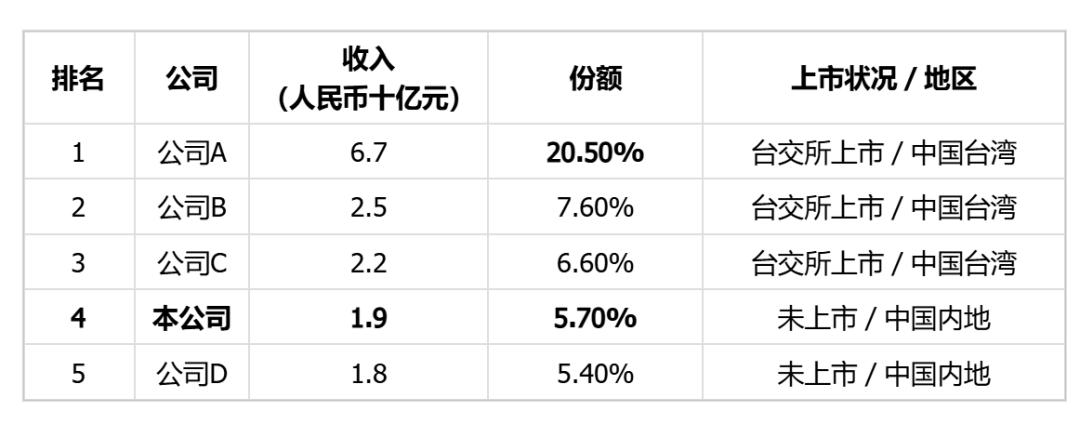
In terms of revenue in 2025, Eswin Computing is China's largest domestic provider of human-computer interaction chip products for smart terminals, and the third largest domestic provider of RISC-V main control chip products in China.
(Source / Arranged by HardKr)
But across the whole market, Eswin Computing ranks fourth with a share of 5.7%, which is only a little over a quarter of the first-place player. It ranks first only when the qualifier "domestic" is added. The ranking of RISC-V main control chips better illustrates the situation: Eswin Computing ranks fifth among all RISC-V main control chip providers in China with a share of 1.2% (sales revenue of 454 million yuan). The top four are Dutch company E (7.7%), Swiss company F (6.2%), A-share listed company G (4.4%) and company H (3.0%) respectively. The top five players in the industry only account for 22.5% in total, indicating an extremely fragmented market.
Similarly, with the qualifier "domestic" added, the 1.2% share makes it the third largest domestic RISC-V main control chip provider in China.

Gross profit of 453 million yuan a year, cannot cover 604 million yuan of administrative expenses
In terms of performance, Eswin Computing recorded revenues of 17.52 billion yuan, 20.25 billion yuan and 24.31 billion yuan respectively from 2023 to 2025, with a two-year compound growth rate of 17.8%; revenue in Q1 2026 was 494 million yuan, a year-on-year increase of 18.4%. This is a stable but not explosive growth curve.
Losses are the main theme. The loss for the corresponding periods was 18.37 billion yuan, 15.47 billion yuan and 15.16 billion yuan respectively, with another loss of 375 million yuan in Q1 2026. In other words, the total loss in the three years from 2023 to 2025 was 4.9 billion yuan, adding the Q1 figure the total reached 52.76 billion yuan.
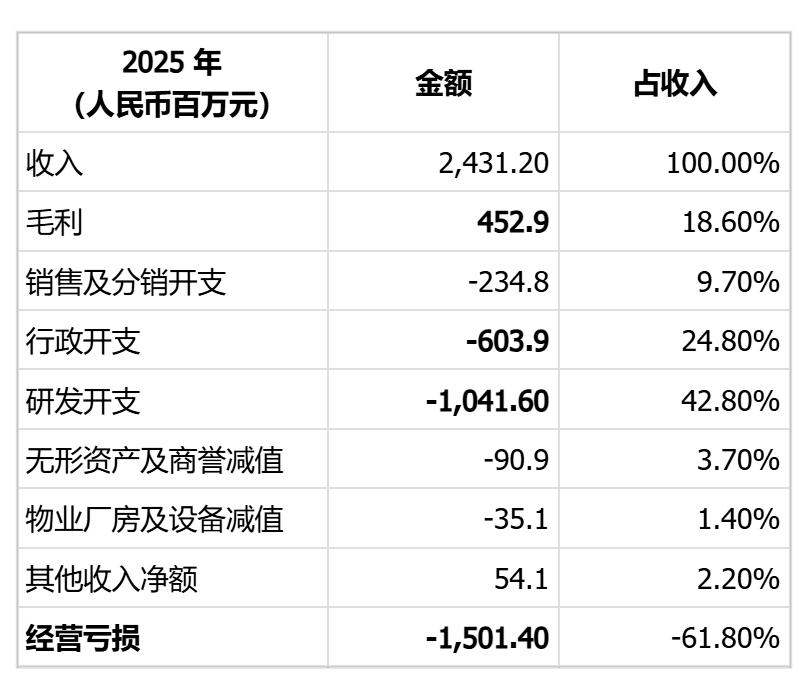
Why is it so hard to narrow the loss? HardKr found clues in the 2025 profit and loss statement:
(Source / Arranged by HardKr)
The 453 million yuan gross profit Eswin Computing earned from selling chips in a whole year cannot even cover the 604 million yuan of administrative expenses, let alone the 1.042 billion yuan of R&D expenses. This is not a problem that can be dismissed as "scale effect not yet released", but there is an order of magnitude gap between the gross profit margin on the revenue side and the absolute magnitude of expenses on the cost side.
The adjusted net losses disclosed by the company for the last three years were 17.05 billion yuan, 14.40 billion yuan and 11.61 billion yuan respectively. This caliber adds back two items: equity-settled share-based payment expenses (322 million yuan in 2025) and listing-related expenses.
Even on the adjusted basis, Eswin Computing's loss ratio in 2025 was still 47.7%. This is far from "approaching break-even". The company itself clearly stated in the prospectus that it expects to record a net loss in 2026.
HardKr also found from the trajectory of cash and cash equivalents that Eswin Computing had only 188 million yuan left on its books at the end of 2025, with a monthly burn rate as high as 96.8 million yuan.
End of 2023: 808 million yuan
End of 2024: 1.588 billion yuan
End of 2025: 188 million yuan, an evaporation of 1.4 billion yuan in one year
End of March 2026: 1.306 billion yuan
End of May 2026: 846 million yuan (unaudited)
In the section on the sufficiency of working capital in the prospectus, Eswin Computing presented its burn rate: assuming the average monthly cash consumption rate in the future is 96.8 million yuan, calculated based on the average of the last 15 months up to March 31, 2026.
If we make a static calculation based on the balance at the end of 2025, the 188 million yuan cash at the end of 2025 divided by 96.8 million yuan per month is only enough for less than two months.
The reason why cash returned to 1.306 billion yuan in the first quarter of 2026 is not from operations. Its bank loans surged from 190 million yuan at the end of 2025 to 606 million yuan at the end of March 2026, and further to 612 million yuan at the end of May;
At the same time, it liquidated all 400 million yuan of wealth management products. Therefore, the net inflow from financing activities in the last quarter was 632 million yuan.
Moreover, Eswin Computing also held 963 million yuan of wealth management products and 981 million yuan of bank time deposits at the end of 2023. By the end of 2024, both items had returned to zero -- they converted wealth management products and time deposits into cash to support daily operations. These three years are a ledger of gradually liquidating all assets.
Looking at the cash flow from operating activities, Eswin Computing recorded -1.251 billion yuan, -781 million yuan and -1.171 billion yuan in the last three years, and finally turned positive to +171 million yuan in the first quarter of 2026.
The reason for the positive turn is reflected in the accounts receivable. Its trade receivables dropped from 1.112 billion yuan at the end of 2025 to 753 million yuan at the end of March 2026, as the "settlement process of several large receivables" was completed before February 28, 2026. That is to say, this positive turn mainly came from one-time repayment, not the inflection point of operational self-sufficiency. Because by the end of May, receivables rose back to 864 million yuan.
Net assets also shrank simultaneously, from 5.069 billion yuan at the end of 2023 to 3.627 billion yuan in 2024, then to 2.686 billion yuan at the end of 2025, and 2.395 billion yuan at the end of March 2026. This is equivalent to an evaporation of 2.675 billion yuan in more than two years.
The asset-liability ratio rose from 0.2 to 0.4, the current ratio dropped from 4.6 to 2.5, and the quick ratio dropped from 4.2 to 1.9.
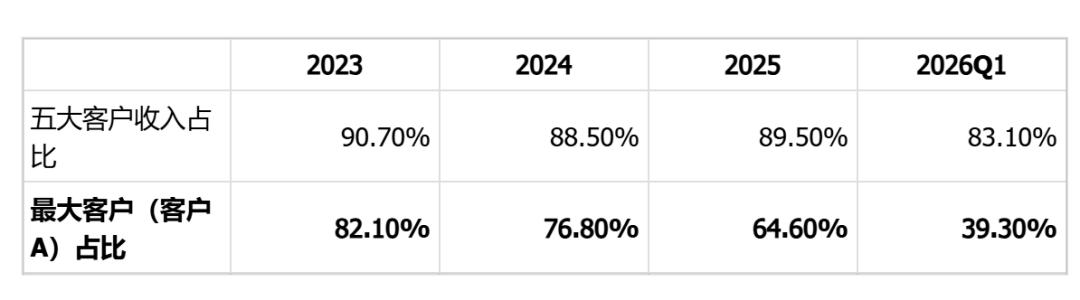
Behind the performance is that Eswin Computing is highly dependent on large customers. One single customer contributes 80% of its revenue, and this customer is very likely to be BOE.
(Source / Arranged by HardKr)
In 2023, 82.1% of Eswin Computing's revenue came from one single customer. This ratio dropped to 64.6% over three years, and further to 39.3% in Q1 2026. The degree of dependence is indeed declining, but the base remains large.
Who is Customer A? The prospectus does not name it, but gives a description: Customer A is a leading IoT supplier registered in China, providing smart interactive products and professional services, and listed on the Shenzhen Stock Exchange.
In the section of director resumes, when introducing WANG Dongsheng, the prospectus describes BOE as follows: BOE Technology Group Co., Ltd. (a leading IoT supplier registered in China, providing smart interactive products and professional services, listed on the Shenzhen Stock Exchange with the stock code 000725.sz)
In the same document, the two descriptions are identical word for word. Coupled with three supporting evidences: first, Eswin Computing's main products, human-computer interaction chips (TCON, touch controllers), are exactly the essential components for display panel manufacturers; second, by geographical division, 83.6% of the revenue was recorded in Hong Kong, China in 2023 -- a typical settlement path for overseas procurement entities; third, in the shareholder register, Beijing Core Dynamic Energy, which holds 5.78% of the shares, its largest limited partner is exactly BOE (holding about 37.3% of partnership interests).

Inventory write-down eats up a quarter, goodwill from two acquisitions is fully written off
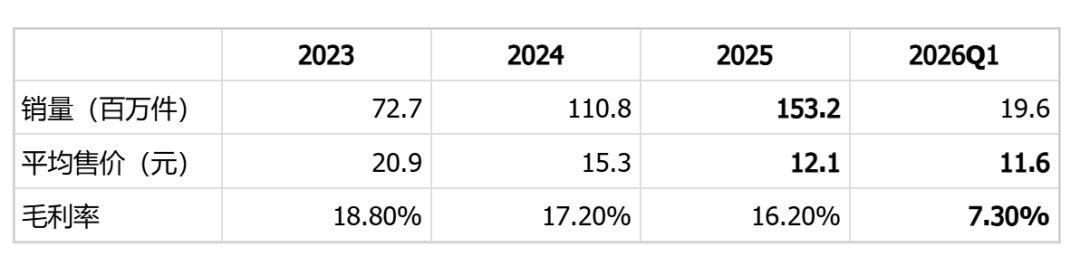
In the revenue structure, Eswin Computing repeatedly mentions a term in the prospectus -- exchanging volume at the expense of price. The cost of this strategy is that the unit price halved in three years, and the gross profit margin of the core business fell to 7.3%.
Take the human-computer interaction chip products that accounted for 76.3% of revenue in 2025 as an example. Over three years, sales volume increased by 1.1 times, the unit price dropped by 42%, and the gross profit margin fell from 18.8% to 16.2%.
(Source / Arranged by HardKr)
Revenue only increased by 9.7% in 2025 (from 1.69 billion yuan to 1.856 billion yuan). And in the first quarter of 2026, the gross profit margin of this core business collapsed to 7.3%. The prospectus explained that this was affected by demand fluctuations, industry supply shortages and temporary supplier interruptions.
In Eswin Computing's overall gross profit margin, it was 15.4% in 2023, rose to 17.7% in 2024, and further increased to 18.6% in 2025. It seems to have improved, but the figure was 14.8% in the first quarter of 2026, compared with 8.1% in the same period of 2025 -- a chip design company with a gross profit margin of less than 20%, while bearing an R&D expense ratio of 42.8%, this scissors difference is the entire source of losses.
The only profitable part in the product line is the small-scale segment. High gross margin multimedia (52.1%) and licensing services (62.7%) only account for 7.9% of revenue in total; interconnect chips recorded gross losses for three consecutive years, with a gross loss rate of 50.2% in 2025, due to inventory write-down of early-version products and low-price clearance sales.
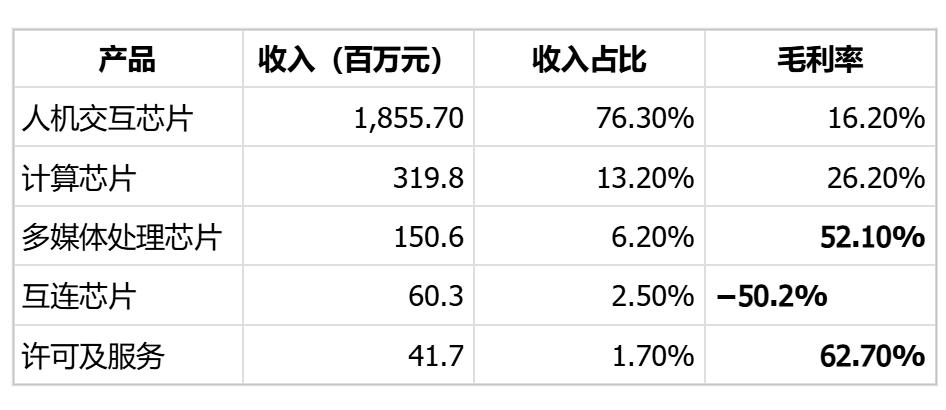
(Source / Arranged by HardKr)
A major structural reversal occurred in the first quarter of 2026: the proportion of human-computer interaction revenue dropped from 79.5% to 46.0%, and computing chips jumped from 10.7% to 45.1% (223 million yuan), with the average selling price rising from 28.0 yuan to 180.9 yuan.
The prospectus explained that this came from several smart computing center projects, where the company provided "systematic computing infrastructure" with products equipped