The five burgeoning GPU startups have secured total financing of over 30 billion yuan. Who will become the "Chinese version of NVIDIA"?
Around 8 p.m., Huang Xin, who had just got home from work, turned on his computer immediately. He is obsessed with an open-world game, where the relaxation and freedom in the virtual world are a comfort that reality can hardly offer, but the outdated hardware greatly undermines his experience.
Unable to put up with the poor performance, he decisively replaced his mainframe recently, and the scenes on the monitor suddenly became vivid. On the screen, Huang Xin can see the edges of leaves curling in the wind, the water splashes from raindrops hitting the leaf surface refracting the sky light, and the grass and leaves no longer rigidly pass through the model when the character pushes through the bushes to move forward.
This highly immersive visual experience comes from the GPU chip in the mainframe, which realizes "perfect integration of picture and scenario" through technologies such as super-resolution reconstruction, frame generation, and ray tracing optimization. This is only a tiny part of GPU's practical applications in real scenarios, yet it represents a major leap forward in technology.
Apart from the personal C-end market, the commercial GPU competition in global data centers is also in full swing, with the battlefield extending from the technical field to the financial capital sector. In the booming AI era, domestic GPUs are advancing against the wind and accelerating onto the global capital stage. They are heading deep into the industry.
1
The "Five Young GPU Players" have different technical paths, institutions say: the 5-year compound growth rate is nearly 30%
GPU, also known as graphics processing unit, as the name suggests, initially undertook the task of graphics rendering. With the continuous evolution of software and hardware technologies, as the core microprocessor in the field of computing acceleration, the application boundaries of GPUs have been expanding, and they have become the key computing power foundation in the fields of high-performance computing and artificial intelligence.
Guojin Securities once pointed out in a research report that from the perspective of the ecosystem, the GPU software stack usually consists of upper-layer algorithm libraries, middle-layer interfaces and drivers, and bottom-layer compilers and hardware architectures. "The main difficulties in the industry focus on the hardware architecture design and the long-term construction of general-purpose computing software systems."
At present, the global GPU market is highly concentrated, with NVIDIA and AMD occupying dominant positions. The domestic market has formed a diversified competition pattern, where Moore Threads, Biren Technology, Iluvatar CoreX, Mthreads, and Enflame Technology are the leading players, each with different technical paths.
Information shows that Moore Threads focuses on full-featured GPUs, and its adopted MUSA architecture does not make division or trade-offs between "graphics" and "computing". One single chip can simultaneously support five capabilities: AI intelligent computing, graphics rendering, scientific computing, physical simulation, and ultra-high-definition video processing; Mthreads, Biren Technology, and Iluvatar CoreX bet on general-purpose GPUs. Among them, Mthreads starts from the intelligent computing reasoning end, takes data center training and inference as the core, and then complements its graphics rendering product line (which is still under research and development); Biren Technology and Iluvatar CoreX follow the pure AI training and reasoning route, pushing the computing power to the extreme, with almost no graphics rendering capability.
Different technical paths also mean they target different markets. However, in the view of Wu Quan, chief expert of Huaxin Jintong (Beijing) Semiconductor Research Co., Ltd., the core paths of GPU companies actually reach the same end despite their different routes, "there is no essential difference".
He further explained that no matter it is reasoning, training, graphics, or different choices on the architecture (isomorphism, heterogeneity, reconfigurability), the improvement of GPU performance requires better connection and optimization of the whole chain including upper-layer algorithm libraries and bottom-layer hardware architectures. And a mature GPU needs to be able to form an ecosystem, which is essentially to combine all the above routes together.
Wu Quan compares this process to "integration". He made an analogy, saying that at present, domestic GPU enterprises are actually running on the same mountain ring road, but everyone chooses different starting points. No matter how tortuous the journey is, they have to finish the whole road. "Some start from point A, some start from point B, but when they reach a certain stage, they all have to come back to make up for the missing parts and fill in the uncovered sections."
In recent years, as the export control of high-performance chips such as GPUs in some countries has been continuously escalated, the market's demand for substitution of domestic computing chips has continued to rise. Factors such as the increasing complexity of AI models, the expansion of reasoning workloads, domestic substitution, and the gradual maturity of the software ecosystem have become the driving forces for industry growth.
According to Frost & Sullivan's forecast, the revenue of China's general-purpose GPU market will grow from 154.6 billion yuan in 2024 to 715.3 billion yuan in 2029, with a compound annual growth rate of about 29.5% from 2025 to 2029; the localization rate will increase simultaneously, rising from 2% to 3.6% between 2022 and 2024, and is expected to reach 31% by 2029.
2
Domestic GPUs are going public intensively, realizing collective capitalization under the "domestic substitution" trend
Faced with opportunities, all GPU enterprises want to ride the wind. They need more capital to invest in R&D to achieve technical iteration; they also need to stand on a broader platform to enter the vision of more industrial parties.
A few days ago, Moore Threads, a leading domestic GPU enterprise, revealed its plan for listing on the Hong Kong Stock Exchange, saying that the company will fully consider the interests of existing shareholders and the conditions of domestic and overseas capital markets, and select the appropriate timing and issuance window to complete the issuance and listing within the validity period of the shareholders' meeting resolution or other periods agreed to be extended by the shareholders.
According to the announcement, Moore Threads has hired Ernst & Young as the audit agency for this Hong Kong stock issuance and listing. It has only been 8 months since it landed on the Sci-Tech Innovation Board of the Shanghai Stock Exchange. At the end of June 2025, Moore Threads' Sci-Tech Innovation Board IPO was accepted, with a planned fundraising of 8 billion yuan for chip project R&D. After two rounds of inquiries, the company passed the listing committee meeting in September, and was officially listed on December 5 with the aura of "the first domestic GPU stock".
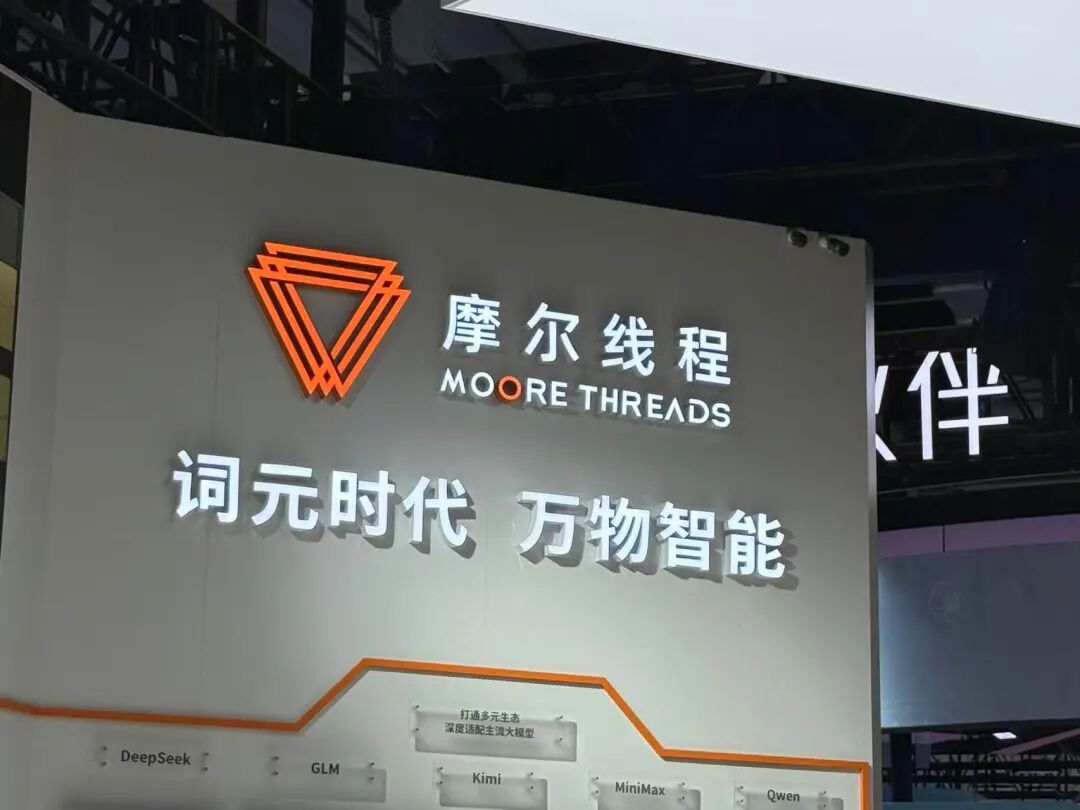
Photo by Time Finance
The "listing boom" has kicked off since then.
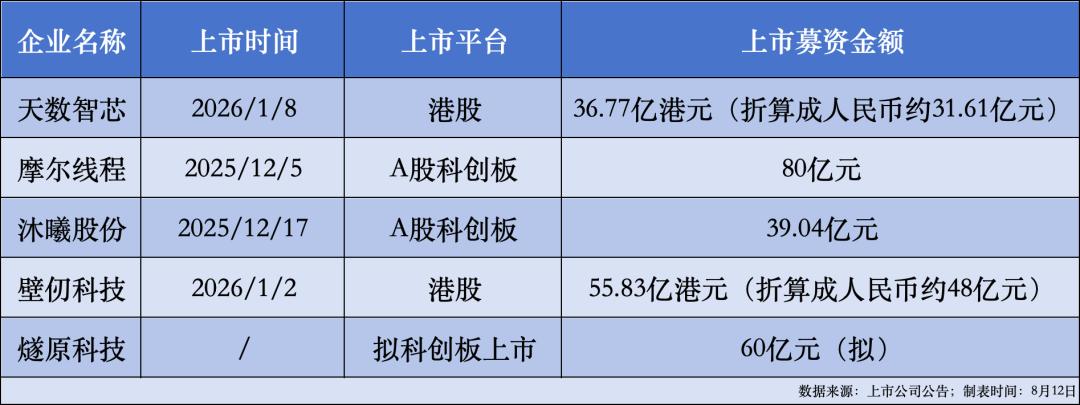
12 days later, Mthreads was successfully listed on the Sci-Tech Innovation Board, with a fundraising scale of 3.904 billion yuan. Following closely was Biren Technology, which chose the Hong Kong Stock Exchange and was listed on January 2, 2026, 16 days after Mthreads. Within the following week, on January 8, Iluvatar CoreX also stepped into the Hong Kong Stock Exchange.
It is rare to see in the capital market that four enterprises in the same track go public in less than 40 days. What's more, 14 days after Iluvatar CoreX was listed, Enflame Technology's Sci-Tech Innovation Board IPO was accepted by the Shanghai Stock Exchange, becoming the first accepted IPO project of A-shares in 2026.
In the view of Huang Lichong, President of Huison International Capital, the fact that several companies entered the public capital market at the same time in a very short period of time is no longer a financing event of a single company, but a collective capitalization of the entire track.
Huang Lichong told Time Finance that a strong positive feedback loop has emerged in the capital market for domestic GPUs: under the expectation of domestic substitution, GPU companies go public, listed companies obtain huge market value, the private equity market re-raises the valuation of companies in the same track, the next company takes the previous one as a comparable company, the IPO obtains high valuation again, and more capital flows into the GPU track.
Normally, the original valuation path of listed companies should be from technological progress to products, orders, profits, and cash flow. When these factors form a positive cycle, valuation is generated. But the current situation has changed, and the path is more inclined to the emotional response under the background of domestic substitution.
Huang Lichong admitted that he is somewhat worried about this, but he emphasized that capital clustering is not necessarily a bad thing in the early stage of industrial development. "To develop our own GPUs in China, a large amount of capital is objectively required. The problem is that after the capital cluster develops to a later stage, it can easily change from an 'industrial flywheel' to a 'financial reflexivity flywheel'."
Guo Tao, an angel investor and senior artificial intelligence expert, also said that capital is concentrated in leading targets such as Moore Threads and Mthreads, providing long-term R&D funds in a centralized manner, which can help enterprises break through the two core shortcomings of software ecology and advanced manufacturing process, and quickly narrow the gap with overseas giants. In addition, supporting enterprises in the upstream and downstream of the industrial chain can simultaneously obtain capital support, which is conducive to the improvement of the full chain supporting of local computing power.
3
To go global, enterprises cannot only accept the valuation system of Chinese investors
According to statistics from Time Finance, the IPO fundraising of the four listed enterprises has approached 20 billion yuan. Adding the HKD 7.072 billion placement (equivalent to about 6.1 billion yuan) completed by Iluvatar CoreX in July, their cumulative financing in the secondary market is about 26 billion yuan. If we include the planned 6 billion yuan fundraising of Enflame Technology which is still in the registration effectiveness stage, the planned financing scale of the five enterprises in the secondary market has exceeded 30 billion yuan.
Graphic by Time Finance
This is just the beginning.
In June this year, Mthreads launched its Hong Kong stock listing plan and started to build an "A+H" dual capital platform. Shortly after, Moore Threads joined the queue for Hong Kong listing. The industry has reached a consensus that the significance of listing is far more important than financing, and only by standing on the international financing window can enterprises better face the global market.
Guo Tao said that the core goal of the "A+H" layout is to build a global capital channel, rather than simply raising operating funds. The A-share market is dominated by domestic industrial capital and retail funds, which pays more attention to the performance delivery of domestic substitution, and it is difficult to cover global sovereign funds and overseas industrial investors. The Hong Kong stock market is naturally a hub to connect the international capital channel, which can provide convenient tools for overseas mergers and acquisitions, US dollar bond issuance, and cross-border equity incentives.
Since last year, leading enterprises in segmented tracks including CATL, Innolight, GigaDevice, Zhipu AI, and Minimax have successively launched or completed the "A+H" layout. The industry believes that this is a strategic choice for high-quality enterprises to optimize their capital structure and disperse market risks under the background of the complex and changeable global environment, and it is also an inevitable result of conforming to policy guidance and the development rhythm of the industry.
As early as April 2024, the China Securities Regulatory Commission (CSRC) released five measures for capital market cooperation with Hong Kong, and for the first time explicitly proposed to "support leading mainland industry enterprises to list in Hong Kong". Since then, the policies have been continuously upgraded, and the signal has become clearer. On August 3 this year, Wu Qing, Chairman of the CSRC, explicitly stated that "we will actively support qualified mainland enterprises to list in Hong Kong", and disclosed that since 2024, more than 270 mainland enterprises have completed the filing for Hong Kong listing, with a financing of over HKD 650 billion.
Huang Lichong's view is more practical. He told Time Finance that the GPU industry is an extremely "capital-intensive" industry where R&D cannot be stopped halfway. "Chips do not stop for three years to sell slowly after developing one generation of products. Before the fifth generation has fully recovered the investment, the sixth generation must have started tape-out, and the software stack, compiler, cluster, and ecology still need continuous investment."
Taking Moore Threads as an example, in the first half of 2026, the company's R&D investment was about 770 million yuan, equivalent to 44.3% of its revenue, and this figure exceeded 50% in the first quarter. From this perspective, establishing an offshore financing platform to achieve "capital durability" is the key concern of GPU enterprises.
In addition, the Hong Kong listing platform is more conducive to overseas mergers and acquisitions, strategic shareholding, employee incentives, and cooperation with international suppliers. "All these can use H shares as transaction currency, which is completely different from having several billion yuan more cash in the account." Huang Lichong added that building an "A+H" dual capital platform can also help domestic GPU enterprises establish an international valuation system and accumulate global market credit; enterprises can also seize the current rare capital window to lock in financing channels and valuation space in advance.
"If a Chinese GPU enterprise hopes to become a global company in the future, it cannot only accept the valuation system of Chinese investors forever."
4
There are bubbles, and they are not small, but they do not affect the industrial value
Another focus of market attention is whether the listed GPU enterprises have valuation bubbles?
Looking at the currently listed GPU enterprises, as of August 12, 2026, the total market value of Moore Threads is close to 269.1 billion yuan, the stock price has increased by 400.95% since its listing, and the highest price once reached 941.08 yuan during the period. As for Mthreads, the company's issuance price is 104.66 yuan, the stock price has risen by 583.44% since its listing, and the highest price reached 1033 yuan, once ranking among the thousand-yuan stock clubs.
The market's pursuit is in sharp contrast to the operating performance.
According to financial report data, in the first half of this year, Moore Threads achieved a revenue of 17.36 billion yuan, and the net profit attributable to owners was a loss of 12 million yuan. It should be noted that in the first quarter of 2026, the company's net profit attributable to owners was positive, corresponding to 29 million yuan. If calculated based on this, in the second quarter alone, Moore Threads' revenue increased by 35.23% compared with the first quarter (738 million yuan), but its net profit attributable to owners was a loss of 41 million yuan, with a month-on-month change of -241%.
On the other hand, by the end of June 2026, the net cash flow from operating activities of Moore Threads was -2.169 billion yuan, and this indicator was -2.956 billion yuan for the whole year of 2025. The continuous outflow of net operating cash flow means that the company has not yet achieved self-sustainability.
As for Mthreads, in the first quarter of this year, the company achieved a revenue of 562 million yuan, the net profit attributable to owners was a loss of 99 million yuan, and the net cash flow from operating activities was -550 million yuan. The situations of Iluvatar CoreX and Biren Technology are similar. Both of them were in a loss state last year, and their net operating cash flow was negative.
Admittedly, losses are the norm for hard technology enterprises in the investment stage, and capital bets on future expectations, but this does not mean that these indicators are unimportant. Wu Quan, chief expert of Huaxin Jintong (Beijing) Semiconductor Research Co., Ltd., told Time Finance that the chip industry seems to have a high gross profit margin, but in essence it is still an industry that highly relies on scale effects.
He said frankly that the break-even point of GPU enterprises roughly corresponds to the shipment scale of 200,000 to 300,000 chips. Assuming that the average price of AI training/inference chips used in data centers is about 50,000 yuan per piece, the corresponding revenue scale can be estimated. "That's why it is always said that domestic GPUs are still in the initial stage."