NVIDIA's "Horizontal + Vertical" Strategy and the Disappearance of the Smiling Curve
The familiar industrial distribution diagram "Smile Curve" looks like a person smiling. It is part of a theory proposed by the founder of a Taiwan, China-based computer manufacturer in the 1990s. Since the manufacturing and assembly sectors located right at the center of the diagram always generate low added value, the term has also been used to describe the predicament of a large number of Japanese manufacturing enterprises.
However, changes seem to be on the way. Hitachi Comprehensive Research Institute, a think tank under Hitachi, Ltd. based in Chiyoda Ward, Tokyo, states that based on the chart averaged over five years ending in 2025, the curve presents a slightly stiff expression with the middle part rising and the whole shape closing up.
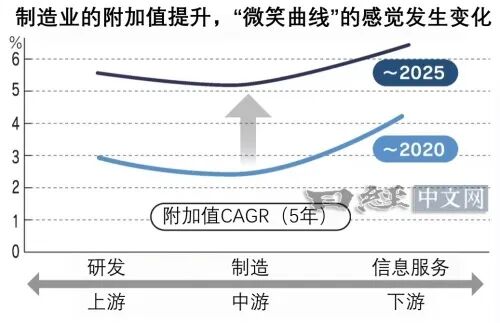
The survey covered around 700 listed enterprises worldwide with annual operating revenue exceeding 3 billion U.S. dollars (the top 20% of the total number). These enterprises are divided into three categories: upstream (R&D-focused), midstream (manufacturing) and downstream (information service) across industries, and the indicator of "CAGR (Compound Annual Growth Rate) of added value" is tracked.
Added value refers to the sum of profits, labor costs, depreciation expenses and other items, which is essentially the same as the calculation of Gross Domestic Product (GDP). In short, it measures the new value created in production activities, and can be used to compare the differences between R&D-oriented enterprises with no self-owned factories such as NVIDIA and Apple in the United States, and information service-oriented enterprises such as Google and Meta.
What is the reason for the change?
Yusaku Miyazaki, a senior researcher at Hitachi Comprehensive Research Institute, pointed out two trends. The first is "return to local". Affected by the COVID-19 epidemic that triggered the global semiconductor shortage and the China-U.S. confrontation, supply chain adjustment has been moving forward. It is reported that the trend of shifting to independent production or domestic production has increased, which drives the digital transformation of manufacturing front lines, improves production efficiency.
The second point is the transformation of business models. The manufacturing industry has begun to absorb high value-added business fields from the so-called upstream and downstream of the industry in the diagram, and combine intellectual property (IP) and services to build unprecedented profit models.
The latter may be more critical. Taking overseas cases as examples, TSMC, the semiconductor foundry enterprise, is a typical representative in recent years. The company has turned its own manufacturing technology (process) into IP, and built a platform to provide services for partners engaged in design work. This is an action to capture added value led by the manufacturing side.
Hon Hai Precision Industry, which manufactures products for Apple, is also exploring a "platform-based manufacturing" business model that provides customers with development tools for battery electric vehicles (BEVs) and other products to attract more clients.
Both of the two enterprises are regarded as part of the "horizontal division of labor", specializing in assembling products designed and sold by NVIDIA, Apple and other companies. In the case of TSMC, added value is skewed toward NVIDIA that designs AI chips, and its profitability is very prominent.
Let's take a look at the recently widely concerned "Physical AI" (such as robots, autonomous driving vehicles, etc.). NVIDIA has built a platform that provides all necessary tools for enterprises that want to develop the core "brain" part of AI, and gains profits smoothly through high value-added high-speed parallel computing services and the AI chip "GPU".
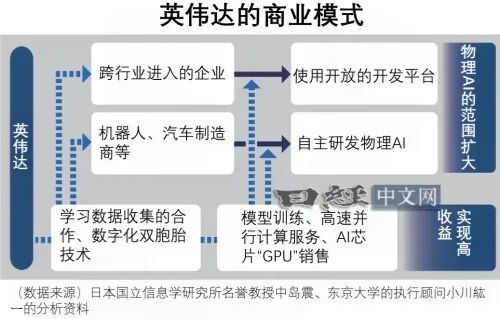
It can be said that TSMC and Hon Hai are trying to build a similar mechanism. Eventually, the relationship between NVIDIA and TSMC, as well as that between Apple and Hon Hai, is no longer a simple horizontal division of labor. A pattern where each party owns its own independent vertical integration system while cooperating with each other in the horizontal direction is gradually taking shape.
Looking back at industrial history, we can find that the era when vertically integrated enterprises held dominance and the era when horizontally divided enterprises reversed the situation appeared alternately. Since the 1980s, the Japanese automotive industry has accumulated strong competitiveness through vertical integration within the closed industrial association system called "Keiretsu", and finally reached the global peak.
In the era of personal computers and smartphones after the 1990s, the international horizontal division of labor represented by Apple and Hon Hai surpassed the Japanese electronics industry.
If we talk about what the next era will be like, it may no longer be an "either-or" era, but an "both-and" era. The core lies in having an ecosystem and business model that can guide added value to itself, and the classification method of horizontal or vertical may have been outdated long ago.
The book The Square and the Tower written by historian Niall Ferguson analyzes world history, especially the Renaissance, the French Revolution and the Industrial Revolution, from the perspective of "horizontal structures reshaping the world". In the Internet revolution since the end of the 20th century, the mechanism that the vertical industrial structure collides with horizontal factors to give birth to a new era has also emerged, which is very meaningful to observe.
What about Japanese enterprises? In the survey of Hitachi Comprehensive Research Institute, there are about 200 enterprises belonging to the midstream manufacturing sector, including around 70 in the United States, around 60 in China and around 20 in Japan. Japanese enterprises covered in the survey include Toyota, Sony Group, Hitachi and other companies.
The earnings release season for the April-June period has reached its peak. Led by Sony Group, the recovery and growth of the electronics industry that achieves high profitability through intellectual property and services is particularly prominent. All automotive enterprises are exploring multiple business models through next-generation technologies such as battery electric vehicles, but on the whole, signs of transformation from the traditional vertical integration model to a brand new profit model are still hard to observe.
Perhaps it is because the business reform that can absorb the added value of upstream and downstream sectors is progressing slowly. It is necessary to adjust the industrial structure to the direction where the Smile Curve disappears and the foundation of the manufacturing industry is enhanced. The long-time emphasis on "the significance of service-oriented operation" is exactly what it boils down to.
This article is from the WeChat Official Account "Nikkei Chinese Net" (ID: rijingzhongwenwang), written by Atsushi Nakayama, and is released by 36Kr with authorization.